📐 Perimeter & Circumference Arrangements
Master square/rectangular perimeter-based seating, perimeter distance calculations, corner vs middle positions, and mixed geometry problems
Perimeter & Circumference Arrangements
Perimeter-based seating arrangements extend the circumference concept from circles to squares and rectangles. Instead of a round table with a circumference, you have a square table with a perimeter, and distances between persons are measured along the edges.
These problems combine geometry, distance calculation, and seating logic into one question. They are tested at Mains level in SBI PO, IBPS PO, and RBI exams.
Key Differences: Circle vs Square
| Feature | Circular (Circumference) | Square (Perimeter) |
|---|---|---|
| Shape | Round table | Square table |
| Total distance | Circumference = 2 * pi * r | Perimeter = 4a (where a = side) |
| Distance measured | Along the curve | Along the edges (NOT diagonal) |
| Corners | No corners | 4 corners (special positions) |
| "Opposite" | Diametrically opposite | Opposite side of the square |
| Spacing | Can be equal or unequal | Can be equal or unequal |
Critical Rule: In square/rectangular perimeter problems, distances are ALWAYS measured along the edges (perimeter), NEVER as straight-line diagonals.
Pro Content Locked
Upgrade to Pro to access this lesson and all other premium content.
Charged once for one year · ₹1188 total
Save ₹100/month vs ₹2388/year launch price
- All Agriculture & Banking Courses
- AI Lesson Questions (100/day)
- AI Doubt Solver (50/day)
- Glows & Grows Feedback (30/day)
- AI Section Quiz (20/day)
- 22-Language Translation (100/day)
- Recall Questions (20/day)
- AI Quiz (15/day)
- AI Quiz Paper Analysis (100/day)
- AI Step-by-Step Explanations (100/day)
- Spaced Repetition Recall (FSRS)
- AI Tutor
- Immersive Text Questions
- Audio Lessons — Hindi & English
- Mock Tests & Previous Year Papers
- Summary & Mind Maps
- XP, Levels, Leaderboard & Badges
- Generate New Classrooms
- Voice AI Teacher (AgriDots Live)
- AI Revision Assistant
- Knowledge Gap Analysis
- Interactive Revision (LangGraph)
🔒 Secure one-time yearly payment via Razorpay · No hidden fees
Perimeter & Circumference Arrangements
Perimeter-based seating arrangements extend the circumference concept from circles to squares and rectangles. Instead of a round table with a circumference, you have a square table with a perimeter, and distances between persons are measured along the edges.
These problems combine geometry, distance calculation, and seating logic into one question. They are tested at Mains level in SBI PO, IBPS PO, and RBI exams.
Key Differences: Circle vs Square
| Feature | Circular (Circumference) | Square (Perimeter) |
|---|---|---|
| Shape | Round table | Square table |
| Total distance | Circumference = 2 * pi * r | Perimeter = 4a (where a = side) |
| Distance measured | Along the curve | Along the edges (NOT diagonal) |
| Corners | No corners | 4 corners (special positions) |
| "Opposite" | Diametrically opposite | Opposite side of the square |
| Spacing | Can be equal or unequal | Can be equal or unequal |
Critical Rule: In square/rectangular perimeter problems, distances are ALWAYS measured along the edges (perimeter), NEVER as straight-line diagonals.
Square Table Basics
Structure
A square table has:
- 4 corners (vertex positions)
- 4 sides (edge positions -- people can sit at the middle of each side)
- Perimeter = 4a where a is the side length
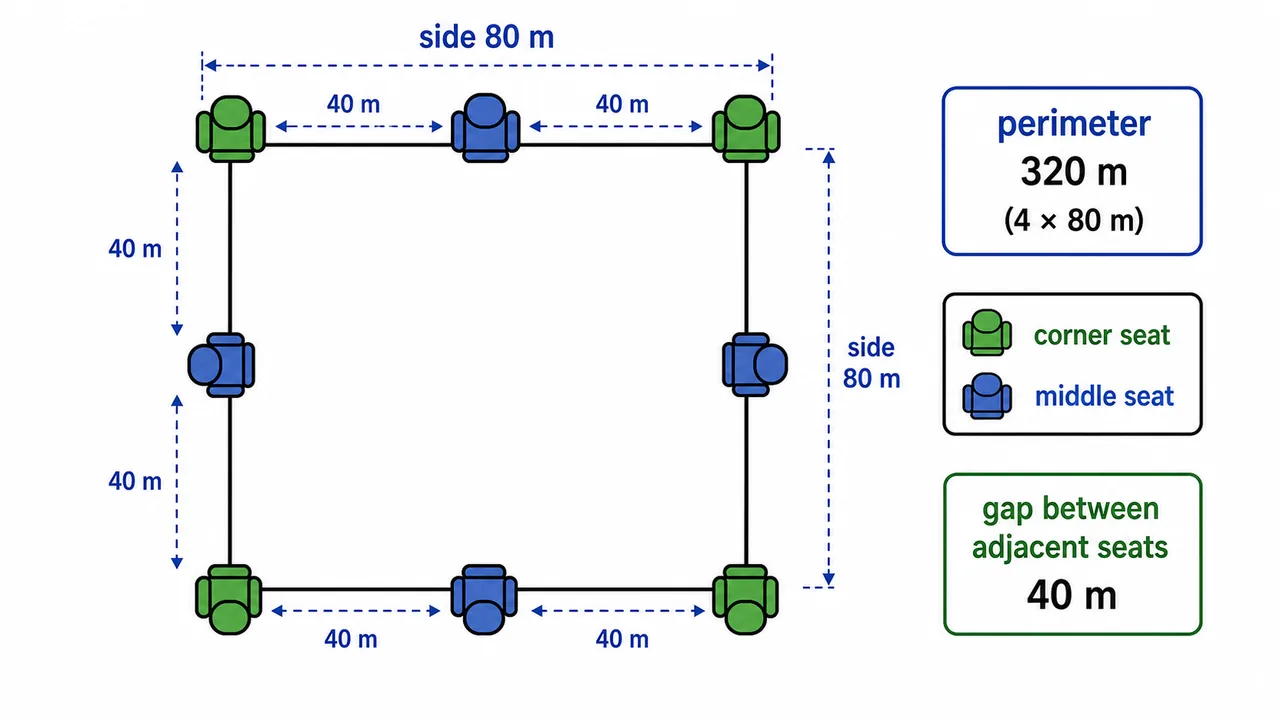
Typical Setup for 8 Persons
4 persons sit at corners + 4 persons sit at the middle of each side:
If perimeter = 320m and 8 persons are equally spaced:
- Side = 320/4 = 80m
- Gap between adjacent persons = 320/8 = 40m
- Each person is 40m from the next along the perimeter
Even vs Odd Number in Circles (Recap for Comparison)
Before diving into square problems, recall the circumference rules:
Even number of persons on a circle:
- "Opposite" exists (person directly across the diameter)
- Distance to opposite = Circumference / 2
Odd number of persons on a circle:
- "Opposite" does NOT exist
- No person is exactly halfway around
Solved Example 1: Square Table with Perimeter 320m
Question:
Eight scientists A, B, C, D, E, F, G, and H are sitting in a square table facing center, such that four of them are sitting at the corner of the square table and remaining four persons are sitting in the middle of the sides in the square table. All the persons are sitting along the perimeter of the square table at an equal distance between them. The perimeter of the square is 320m and the perimeter of the square is 4a, where a is the side of the square. Distances are considered only on the perimeter of the square table.
Clues:
- B sits 80m away from D who is not at any corner of the table.
- Three persons sit between D and A.
- E sits at corner of the table.
- F sits 40m to the right of E.
- H and C sit opposite to each other.
- F is not an immediate neighbor of C.
- D does not sit immediate left of G.
Step 1: Calculate distances
Perimeter = 320m, so side = 320/4 = 80m.
8 persons equally spaced: gap = 320/8 = 40m between each consecutive person.
Each adjacent pair is 40m apart along the perimeter.
Step 2: Use distance clues
Clue 1: B is 80m from D. Since each gap is 40m, 80m = 2 gaps. So B and D are 2 positions apart along the perimeter. Also, D is NOT at a corner -- D is at a middle position.
Clue 2: Three persons between D and A. So D and A are 4 positions apart (3 people between them).
Step 3: Place D (middle position)
Let us say D is at position 6 (middle of bottom side).
From clue 2: A is 4 positions from D. Position 6 + 4 = Position 2 (clockwise) OR Position 6 - 4 = Position 2 (anticlockwise). So A is at position 2 (middle of top side).
From clue 1: B is 2 positions from D. B is at position 4 or position 8. Both are middle positions. We will determine which one later.
Step 4: Place E at a corner (clue 3)
E is at a corner. Corners are positions 1, 3, 5, 7.
From clue 4: F sits 40m to the right of E. Since all face centre, "right" depends on which side E is on. 40m = 1 position to the right.
Step 5: Work through all possibilities
Place E at position 5 (bottom-right corner). F is 1 position to E's right.
For someone facing the centre at the bottom-right corner, their right goes along the right side upward. So F is at position 4 (middle of right side).
But from clue 1, B could be at position 4. If F is at position 4, then B must be at position 8.
So: B at position 8 (middle of left side).
Step 6: Place remaining persons
From clue 5: H and C are opposite. "Opposite" on a square with 8 equally-spaced persons means 4 positions apart (perimeter distance = 160m = half of 320m).
Remaining persons: C, G, H to place at positions 1, 3, 7.
Wait -- positions 1, 3, 7 are corners, and position 4 has F. Let us re-check.
Positions filled: D(6), A(2), B(8), E(5), F(4). Remaining: C, G, H at positions 1, 3, 7.
H and C opposite means 4 positions apart:
- Pos 1 and Pos 5 are opposite (but 5 is taken by E)
- Pos 3 and Pos 7 are opposite. So H and C are at positions 3 and 7 (in some order).
G goes to position 1.
From clue 6: F is not immediate neighbor of C. F is at position 4. Position 3 is adjacent to position 4. So C is NOT at position 3. Therefore C is at position 7 and H is at position 3.
From clue 7: D does not sit immediate left of G. G is at position 1. D is at position 6. Position 8 is immediate left of position 1 (anticlockwise). D is not at position 8 -- D is at position 6. Condition satisfied.
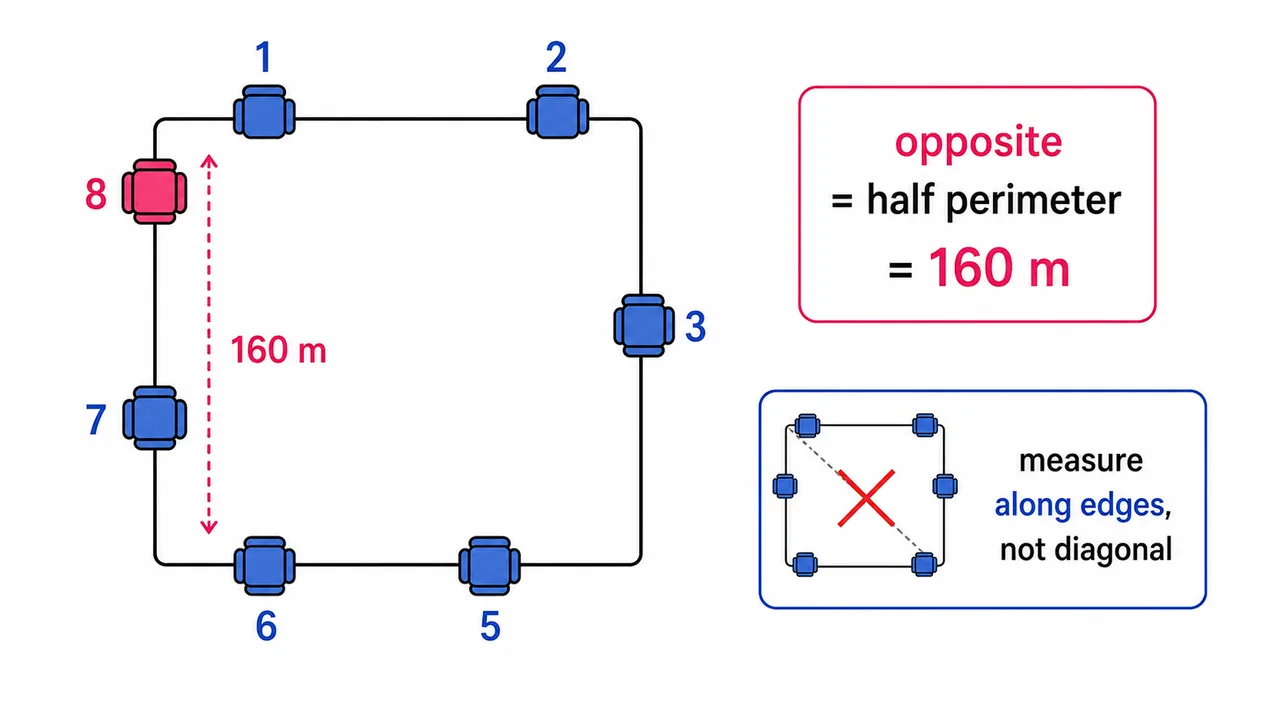
Final Arrangement (clockwise from position 1):
Verification:
- Clue 1: B(8) to D(6) = 2 positions = 80m. D is at middle (not corner). Verified.
- Clue 2: D(6) to A(2) = 4 positions apart, 3 persons between (at 3,4,5 or 7,8,1). Going 6->7->8->1->2: persons at 7,8,1 = C,B,G = 3 persons. Verified.
- Clue 3: E at position 5 (corner). Verified.
- Clue 4: F is 40m to right of E. E at corner facing centre, right side goes to position 4. F at position 4. Verified.
- Clue 5: H(3) and C(7) are opposite = 4 positions apart. Verified.
- Clue 6: F(4) neighbours are H(3) and E(5). C is at 7, not a neighbour of F. Verified.
- Clue 7: G(1) immediate left = position 8 = B (not D). Verified.
Solved Example 2: Circular Table, Circumference 540cm (Revisited with Perimeter Comparison)
This problem from the circumference PDF uses the same distance-based logic but on a circle.
Setup: 12 persons, circumference 540cm, gaps are consecutive multiples of 6.
The 12 gaps are: 12, 18, 24, 30, 36, 42, 48, 54, 60, 66, 72, 78 (all in cm).
Verify: 12+18+24+30+36+42+48+54+60+66+72+78 = 540cm.
Why this matters for comparison:
On a circle, the gaps go smoothly around -- there are no corners. On a square, you must track which gaps cross corners (where the perimeter turns 90 degrees). The distance is still measured along edges, but the geometry is different for questions about "who faces whom".
Key Differences in Square Perimeter Problems
Corner Positions Are Special
A person at a corner can see two sides of the square. Their "right" and "left" follow the perimeter, but they have a natural 90-degree turn at their position.
"Opposite" on a Square
Two persons are "opposite" on a square if they are separated by exactly half the perimeter. For 8 persons on a square with perimeter 320m:
Opposite distance = 320/2 = 160m = 4 positions apart
For different numbers of persons, "opposite" might not exist if the count is odd.
Distances Wrap Around Corners
If A is at one corner and B is at the middle of the adjacent side, the distance is measured along the edge, not diagonally. The diagonal distance is shorter, but it is NOT used.
Methodology for Perimeter Problems
- Calculate side length: Perimeter / 4 = side
- Calculate spacing: If equally spaced, gap = Perimeter / n
- Draw the square with all positions marked
- Identify corner vs middle positions -- some clues specify this
- Convert distance clues to position counts: Distance / gap = number of positions apart
- Place persons using positional clues (left, right, between)
- Check "opposite" conditions: Must be half-perimeter apart
- Verify ALL clues at the end
Common Traps to Watch For
Trap 1: Measuring distance as diagonal ALWAYS measure along the perimeter (edges), never as a straight line through the square.
Trap 2: Right/Left at corners At a corner, "right" follows the perimeter around the bend. It is easy to get confused about which direction is right when the table turns a corner. Always follow the facing direction.
Trap 3: "Opposite" meaning On a square with 8 persons, opposite = 4 positions apart along the perimeter. This is NOT the same as being "across the table" (which would be a diagonal).
Trap 4: Confusing perimeter and side If perimeter = 320m, the side = 80m. The question may give perimeter as "4a where a is the side." Make sure you use a = perimeter/4, not perimeter itself for side-related calculations.
Trap 5: Unequal spacing on square Some questions have unequal gaps (like circumference problems). In that case, you must track each specific gap along the perimeter, including around corners.
Comparing Circle and Square Problems
| Aspect | Circle Problem | Square Problem |
|---|---|---|
| Given | Circumference (e.g., 540cm) | Perimeter (e.g., 320m) |
| Shape | Smooth curve | 4 straight sides with corners |
| Special positions | None (all equivalent) | Corners vs middles |
| Opposite | Across diameter | Across half-perimeter |
| Distance | Along circumference | Along edges only |
| Right/Left | Consistent (CW/ACW) | Changes at corners |
| Typical persons | 8-13 | 8-12 |
Speed Tips
- For equal spacing on square: Gap = Perimeter / Total persons. Memorize: 320m / 8 = 40m.
- Half-perimeter rule: Opposite person = perimeter/2 distance. For 320m, opposite = 160m apart.
- Corner identification: If the question says "D is not at a corner", immediately eliminate corner positions for D.
- Draw the square FIRST with all 8 positions clearly marked as corners (C) and middles (M) before reading any clues.
- Number the positions 1-8 clockwise. Corners at 1, 3, 5, 7. Middles at 2, 4, 6, 8 (or vice versa).
Exam Strategy: Perimeter problems look intimidating because of the math, but the actual seating logic is identical to circular arrangements. Focus on converting distances to position-counts first, then solve like a normal circular arrangement.