⬟ Advanced Concentric & Multi-Shape Arrangements
Master advanced concentric arrangements - concentric hexagons, triangles, pentagons, squares within squares, multi-layer nested shapes, and parking lot problems
Advanced Concentric & Multi-Shape Arrangements
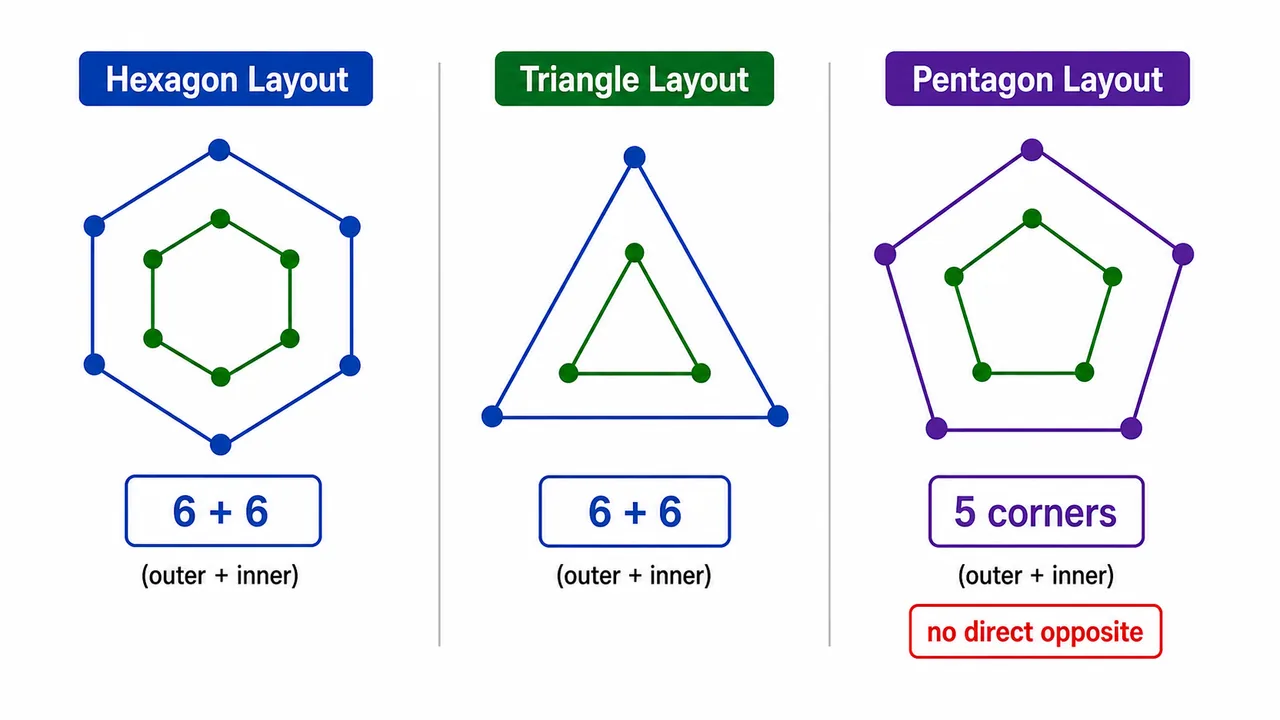
Advanced concentric arrangements go far beyond simple two-circle setups. At Mains level, questions involve hexagons inside hexagons, triangles inside triangles, pentagons inside circles, squares inside squares, and even 3+ nested layers of different shapes.
These are among the hardest reasoning questions in banking exams. They appear in SBI PO Mains, IBPS PO Mains, and RBI Grade B.
Types of Advanced Concentric Arrangements
Type 1: Concentric Squares (Square inside Square)
Two square tables -- inner and outer. People sit at corners and/or middles of each square. The outer square faces inward, the inner square faces outward.
Type 2: Concentric Triangles (Triangle inside Triangle)
Two triangular tables nested. Each triangle has 6 positions: 3 corners + 3 middles of sides.
Type 3: Concentric Hexagons
Two hexagons with 6 persons at each hexagon's corners. Outer faces inward, inner faces outward.
Type 4: Pentagon-Based Arrangements
A pentagon (5 sides, 5 corners) with a circle inscribed inside and a triangle inscribed inside the circle. This creates 3 nested layers.
Pro Content Locked
Upgrade to Pro to access this lesson and all other premium content.
Charged once for one year · ₹1188 total
Save ₹100/month vs ₹2388/year launch price
- All Agriculture & Banking Courses
- AI Lesson Questions (100/day)
- AI Doubt Solver (50/day)
- Glows & Grows Feedback (30/day)
- AI Section Quiz (20/day)
- 22-Language Translation (100/day)
- Recall Questions (20/day)
- AI Quiz (15/day)
- AI Quiz Paper Analysis (100/day)
- AI Step-by-Step Explanations (100/day)
- Spaced Repetition Recall (FSRS)
- AI Tutor
- Immersive Text Questions
- Audio Lessons — Hindi & English
- Mock Tests & Previous Year Papers
- Summary & Mind Maps
- XP, Levels, Leaderboard & Badges
- Generate New Classrooms
- Voice AI Teacher (AgriDots Live)
- AI Revision Assistant
- Knowledge Gap Analysis
- Interactive Revision (LangGraph)
🔒 Secure one-time yearly payment via Razorpay · No hidden fees
Advanced Concentric & Multi-Shape Arrangements
Advanced concentric arrangements go far beyond simple two-circle setups. At Mains level, questions involve hexagons inside hexagons, triangles inside triangles, pentagons inside circles, squares inside squares, and even 3+ nested layers of different shapes.
These are among the hardest reasoning questions in banking exams. They appear in SBI PO Mains, IBPS PO Mains, and RBI Grade B.
Types of Advanced Concentric Arrangements
Type 1: Concentric Squares (Square inside Square)
Two square tables -- inner and outer. People sit at corners and/or middles of each square. The outer square faces inward, the inner square faces outward.
Type 2: Concentric Triangles (Triangle inside Triangle)
Two triangular tables nested. Each triangle has 6 positions: 3 corners + 3 middles of sides.
Type 3: Concentric Hexagons
Two hexagons with 6 persons at each hexagon's corners. Outer faces inward, inner faces outward.
Type 4: Pentagon-Based Arrangements
A pentagon (5 sides, 5 corners) with a circle inscribed inside and a triangle inscribed inside the circle. This creates 3 nested layers.
Type 5: Multi-Pentagon (Parking Lot Problems)
Four concentric pentagons (P1, P2, P3, P4) where cars/objects are placed at the corners of the outermost and innermost pentagons.
Concentric Squares: 16-Person Problem
Standard Setup:
16 persons sit around two square tables, one inscribed inside the other. Each square has:
- 4 persons at corners
- 4 persons at middles of sides
Facing rules:
- Outer square: All face towards the centre
- Inner square: All face towards the centre (or as specified)
- OR: Outer faces inward, inner faces outward (embedded style)
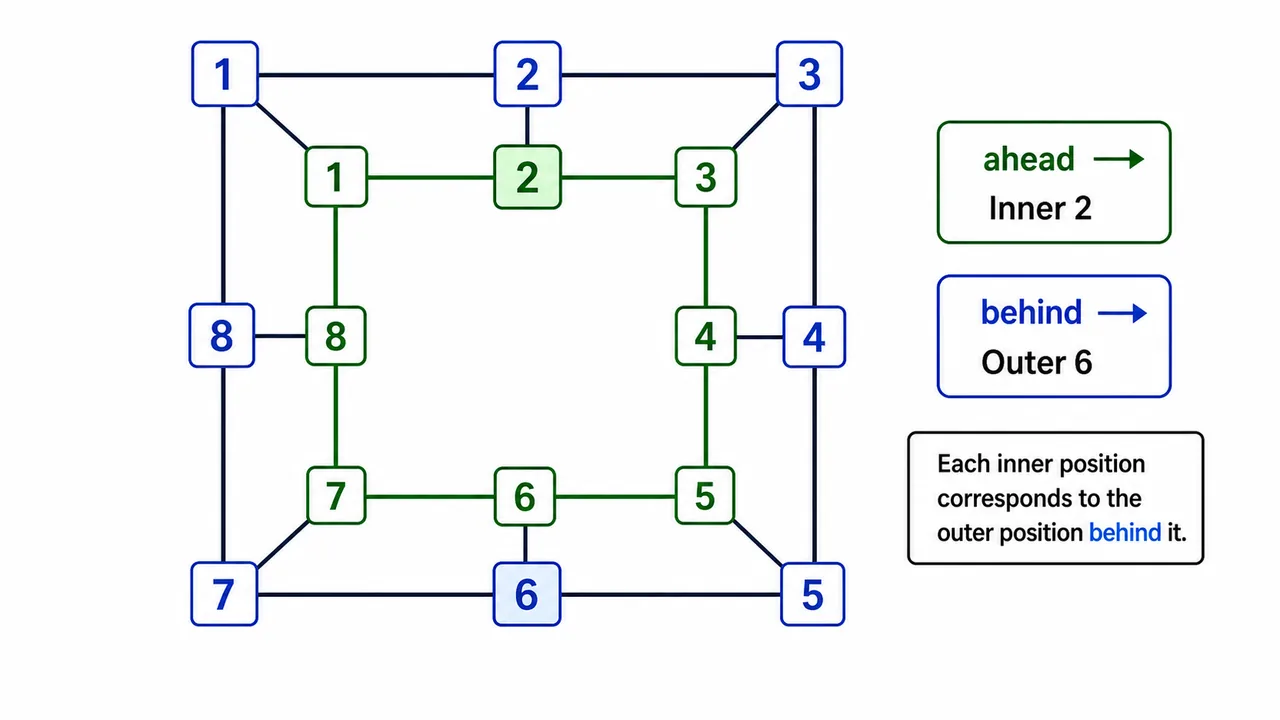
The "Ahead/Behind" Concept:
- Persons of outer square sit exactly behind the persons of inner square
- Persons of inner square sit exactly ahead of the persons of outer square
This means each outer person has a corresponding inner person directly in front of them.
Solved Example: 16 Persons on Two Concentric Squares
Question:
Sixteen persons are sitting around two square tables, one inscribed inside the other. All face towards the center. Four sit at the middle of sides, four at corners in each square. Eight persons A, B, C, D, E, F, G, H sit around the inner square table and like different colors: Blue, Red, Pink, Yellow, Orange, Green, Black, Purple. Eight persons P, Q, R, S, T, U, V, W sit around the outer square table and like different items: Pen, Pencil, Bag, Copy, Charger, Box, Bottle, Table. The persons of the outer square are sitting exactly behind the persons of the inner square, and the persons of the inner square are sitting exactly ahead of the persons of the outer square.
Key Conditions:
- D sits 3rd to right of the one who sits ahead of P.
- D likes yellow color.
- W is not an immediate neighbor of U who likes box.
- Q sits opposite to the one who sits behind one of the immediate neighbors of D in the outer square.
- Q likes pencil.
- A is not an immediate neighbor of C who likes Pink.
- A likes blue color.
- E sits neither ahead of P nor Q and likes orange color.
- V sits 2nd to the left of W, who sits at corner.
- E and G are immediate neighbors of H who likes purple.
- P likes pen.
- R sits immediate right of P and likes Bag.
- F sits immediate right of the person who sits ahead of Q.
- T and W like charger and table respectively.
- S sits behind of C and likes copy.
- U sits second to the right of S.
- F and G like green and black respectively.
Solution Approach:
Step 1: Draw both squares and mark 8 positions on each (corners C1-C4 and middles M1-M4).
Step 2: From clue 9, V is 2nd to left of W, and W is at a corner. Place W at a corner of the outer square.
Step 3: From clue 12, R is immediate right of P and likes Bag. From clue 11, P likes pen.
Step 4: From the "ahead/behind" pairing, each outer person is behind the corresponding inner person. Use clue 1 (D sits 3rd to right of the one ahead of P) to connect inner and outer positions.
Step 5: Continue resolving all clues systematically.
This type of problem is essentially two linked arrangements -- solve the inner square positions, outer square positions, and the pairings (ahead/behind) simultaneously.
Concentric Triangles: 12-Person Problem
Standard Setup:
12 persons sit around two triangular tables, one inside the other:
- Each triangle has 6 positions: 3 at corners + 3 at middle of sides
- Inner triangle: All persons face outward (away from centre)
- Outer triangle: All persons face inward (towards centre)
Corners vs Middle of Sides
In a triangular arrangement, 3 persons sit at corners and 3 persons sit at the middle of each side.
A person at a corner has two immediate neighbours -- one on each side meeting at that corner.
A person at the middle of a side has two immediate neighbours -- one on each side of them along the same edge.
"Opposite" in a Triangle
In a concentric triangle setup:
- "A sits opposite to B" means A is on one triangle and B is on the other, and they face each other.
- For persons on the same triangle, "opposite" typically means the person directly across (corner opposite to the midpoint of the opposite side).
Solved Example: 12 Persons on Two Concentric Triangles
Question:
Twelve persons are sitting around two triangular tables such as one is inside another one. Three of them are sitting at the corners of a table while three are sitting at the middle of the side. All persons sitting around the inner table are facing outward while those sitting around the outer table are facing inside.
Clues:
- The one who sits opposite to U sits second to the right of F.
- C sits immediate left of B.
- C does not sit opposite to Z.
- P is neither an immediate neighbor of A nor Z.
- R does not sit opposite to Z.
- D does not sit at the corner.
- Z sits second to the right of S.
- E is an immediate neighbor of the one who is sitting opposite to Z.
- S faces outside the centre.
- Only one person sits between E and A.
- Only two persons sit between U and T.
- U is neither an immediate neighbor of S nor Z and faces outside the center.
- E does not sit opposite to T.
Solution Approach:
Step 1: From clue 9, S faces outside the centre, so S is on the inner triangle.
Step 2: From clue 12, U faces outside the centre, so U is also on the inner triangle. U is not an immediate neighbor of S or Z.
Step 3: From clue 7, Z is 2nd to right of S. Since both are on the inner triangle (facing outward), right = clockwise. Place S and Z on the inner triangle with one position gap.
Step 4: From clue 6, D is not at a corner, so D sits at the middle of a side.
Step 5: Continue resolving systematically using facing pairs and positional clues.
Final Arrangement:
Pentagon-Based Arrangements (Parking Lot Problems)
This is one of the most advanced question types. The setup involves multiple concentric pentagons used as parking areas.
Setup
- 4 concentric pentagons: P1 (outermost), P2, P3, P4 (innermost)
- Each pentagon has 5 corners and 5 sides
- Objects (cars) are parked at the corners of P1 and P4 only
- P2 and P3 are vacant (no cars)
- All pentagons are regular (equal sides)
- Side lengths are multiples of 10
Key Concepts for Pentagon Problems
- Pentagon corners are numbered 1-5 anticlockwise
- Distance between consecutive parking areas = 200m (between P1-P2, P2-P3, P3-P4 boundaries)
- "Opposite" in a pentagon: There is NO perfect opposite (5 is odd). The furthest corner is 2 positions away.
- "2nd to the left/right" follows the pentagon's perimeter
Solved Example: Four Concentric Pentagons with 10 Cars
Question:
There are four pentagonal car parking areas and three pentagons are concentric with the large pentagon. The outermost is P1, inside P1 is P2, inside P2 is P3, and the innermost is P4. Ten cars -- Alto, Baleno, Scorpio, Ciaz, Swift, Thar, Celerio, WagonR, Santro, and Honda City -- are parked on the boundaries of P1 and P4. Five cars are parked at the corners of P1 pentagon and facing towards the center. The rest of the five cars are parked at the corners of P4 and facing away from the center. P2 and P3 pentagon car parking areas are vacant. The distance between the boundaries of any two consecutive parking areas is 200m. All four pentagons are regular and each of their sides is a multiple of 10.
Clues:
- Baleno is parked 2nd to the left of the car which is opposite to Celerio.
- Ciaz is parked on the P4 pentagon and is an immediate neighbour of Honda City.
- Swift is parked 400m away from P2.
- Wagon R is parked 3rd to the right of Swift.
- Honda City is parked opposite to the car which is the immediate right of Thar.
- The distance between Thar and Scorpio is 20m.
- Alto is parked opposite Wagon R.
- Celerio is parked 200m away from the P3 pentagon.
- Santro is parked 30m from the car which is parked opposite Honda City.
Solution Approach:
Step 1: Understand the distances.
- P1 to P2 boundary = 200m
- P2 to P3 boundary = 200m
- P3 to P4 boundary = 200m
- So P1 to P4 total = 600m
Step 2: From clue 3, Swift is 400m from P2. Since P1 is 200m from P2 and P4 is 600m from P2... but wait, P4 to P3 = 200m, P3 to P2 = 200m, so P4 to P2 = 400m. Therefore Swift is on P4 (innermost).
Step 3: From clue 8, Celerio is 200m from P3. P4 to P3 = 200m and P2 to P3 = 200m. Since P2 is vacant, Celerio is on P4 or we check: P1 to P3 = 400m (not 200m). So Celerio is on P4.
Wait -- if both Swift and Celerio are on P4, and P4 has 5 spots total, that uses 2 of 5.
From clue 2: Ciaz is on P4 and neighbour of Honda City. So Honda City is also likely on P4 (or P1 -- but "immediate neighbour" usually means same shape). If Honda City is on P4, that is 4 cars on P4 (Swift, Celerio, Ciaz, Honda City) with one more.
That means on P1 (outer): the remaining cars -- Alto, Baleno, Scorpio, Thar, and one more.
Step 4: From clue 6, distance between Thar and Scorpio = 20m. Since P1 has sides that are multiples of 10, and the cars are at corners with side-length distances between them, 20m suggests Thar and Scorpio are at adjacent corners of P1 with a very small pentagon side. Actually, P1 is the largest pentagon. Let us reconsider.
The 20m distance suggests they might be on P4 (smallest pentagon with short sides). But we already assigned cars to P4. Let us re-examine...
If both Thar and Scorpio are on P1 (with side length being some multiple of 10), then the distance between adjacent corners = side length = 10m? 20m? This depends on the pentagon's size.
Step 5: Continue resolving based on pentagon geometry and facing rules.
Key Pentagon Arrangement:
Note: The exact arrangement depends on resolving all clues. This is an illustrative layout.
Triple-Nested Shapes: Pentagon + Circle + Triangle
The most complex variant involves 3 layers of different shapes:
Example Setup:
8 persons (A-H) sit on the circle facing centre. Inside the circle, a triangle is inscribed. Inside, a pentagon is marked. After certain conditions (like coin tosses), persons move to triangle corners or pentagon corners.
Coin Toss Shifting Rules (from the PDF)
In the most advanced version, after placing persons in the initial arrangement, three coins are tossed and persons shift positions based on the outcome:
| Coin 1 | Coin 2 | Coin 3 | Who Moves | Where |
|---|---|---|---|---|
| Head | Head | Toss | Person with lowest odd toffees | Triangle corner 1, faces outside |
| Head | Toss | Toss | Person with 65-75 toffees | Pentagon corner 3, faces inside |
| Head | Toss (coin 2) | Head (coin 3) | Person with lowest even toffees | Triangle corner 2, faces inside |
| Head | Head | Head | Person with 55-60 toffees | Pentagon corner 5, faces outside |
| Toss | Head | Toss | Person with highest odd toffees | Pentagon corner 1, faces inside |
| Toss | Toss | Head | Person with highest even toffees | Stays, faces outside |
This adds an extra layer of data interpretation on top of the spatial reasoning.
Concentric Triangles with State/City Attributes
Question Format:
Nine persons sitting on 2 different triangular tables. Three sit at corners of the smaller (inner) triangle -- all face outside. Others sit at corners and middle of the larger (outer) triangle -- all face inside. The smaller table is embedded in the larger one. Each person belongs to a different state.
Key Concepts:
- Inner triangle: 3 corners, all face outward
- Outer triangle: 3 corners + 3 middles = 6 positions, all face inward
- "Faces" connects inner and outer persons
- Additional attribute (state) adds a secondary layer of information
Methodology for Multi-Shape Problems
- Identify all shapes and their nesting order (outermost to innermost)
- Count positions per shape: Pentagon = 5, Hexagon = 6, Triangle = 6 (3C + 3M), Square = 8 (4C + 4M)
- Determine facing directions for each layer
- Establish facing/opposite pairs between layers
- Resolve positional clues within each shape first
- Cross-reference between shapes using "faces" and "ahead/behind" clues
- Handle additional attributes (colors, items, states, quantities) as a separate dimension
Common Traps in Advanced Concentric Problems
Trap 1: Wrong shape geometry A pentagon has 5 corners. There is NO "opposite" corner in a pentagon (5 is odd). The farthest corner is 2 positions away. Do not assume "opposite" works like in a hexagon (6 corners, where opposite = 3 apart).
Trap 2: Confusing inner/outer facing In some questions, BOTH layers face the centre. In others, inner faces out and outer faces in. Read the setup carefully.
Trap 3: Middle vs corner positions In triangles and squares, persons can sit at corners OR middles of sides. The question will specify. "No one sits in the middle" means all sit at corners only.
Trap 4: Distance in concentric pentagons "Distance between boundaries of consecutive parking areas is 200m" means the gap between P1 and P2 (boundary to boundary) is 200m, NOT the distance between corners.
Trap 5: Dynamic shifting In coin-toss problems, the initial arrangement is only half the battle. You must also track who moves where based on the coin outcome. Some persons move, others stay. Re-verify all positions after the shift.
Speed Tips for Mains-Level Questions
- Invest time in the setup: Spend 2-3 minutes understanding the shapes, positions, and facing rules before reading any clues.
- Draw BIG diagrams: These problems are too complex for small sketches. Use full page width.
- Color-code layers: Use different colored pens for inner and outer shapes.
- Label everything: Mark corners (C), middles (M), facing directions, and pair connections.
- Solve one layer at a time: First fix all positions on one shape, then the other, then connect them.
- For coin-toss problems: First solve the base arrangement completely. Then handle the shifting as a separate step.
- For attribute problems: Make a separate table for attributes (color, item, state) alongside your spatial diagram.
- Pentagon numbering: Always number pentagon corners 1-5 anticlockwise as stated in the question.
- Time allocation: These questions typically have 5 sub-questions. Budget 10-12 minutes for the setup. Once the arrangement is correct, each sub-question takes only 15-30 seconds.
Exam Strategy: Advanced concentric problems are high-investment, high-reward questions. If you solve the arrangement correctly, you get 5 easy marks. If you make one mistake in the setup, you likely get all 5 wrong. Practice is the ONLY way to get fast and accurate at these.