🔣 Coded Seating Arrangements
Master coded seating arrangement puzzles where symbols replace position relationships - decode the key, then solve the arrangement
Coded Seating Arrangements
In coded seating arrangements, the position relationships between persons are expressed using symbols instead of plain English. You are given a decoding key at the start that maps each symbol to a specific seating relationship. All the conditions/statements are then written using these symbols.
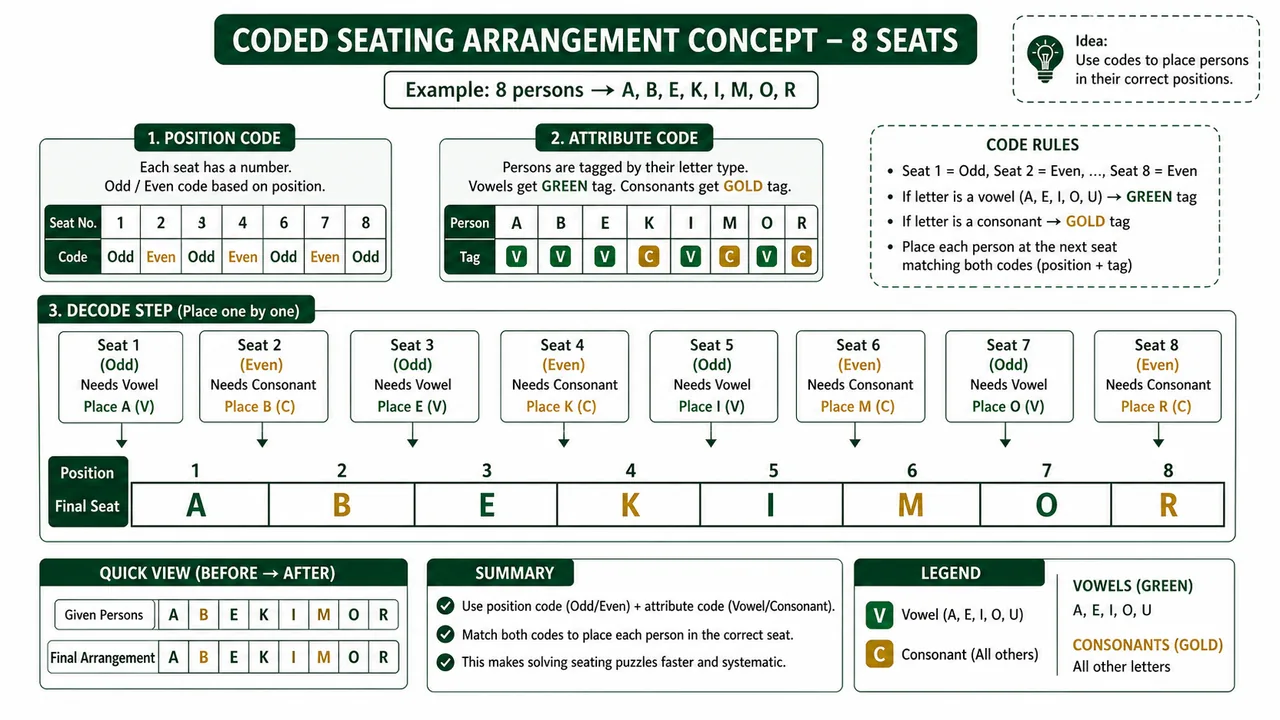
This is an advanced variation asked in IBPS PO Mains, SBI PO Mains, RBI Grade B, and similar exams. The core seating logic remains the same -- the added difficulty is the decoding layer.
What Makes Coded Seating Different
In a normal seating arrangement, you might read:
"A sits second to the left of B"
In a coded seating arrangement, the same information is written as:
"A @ B"
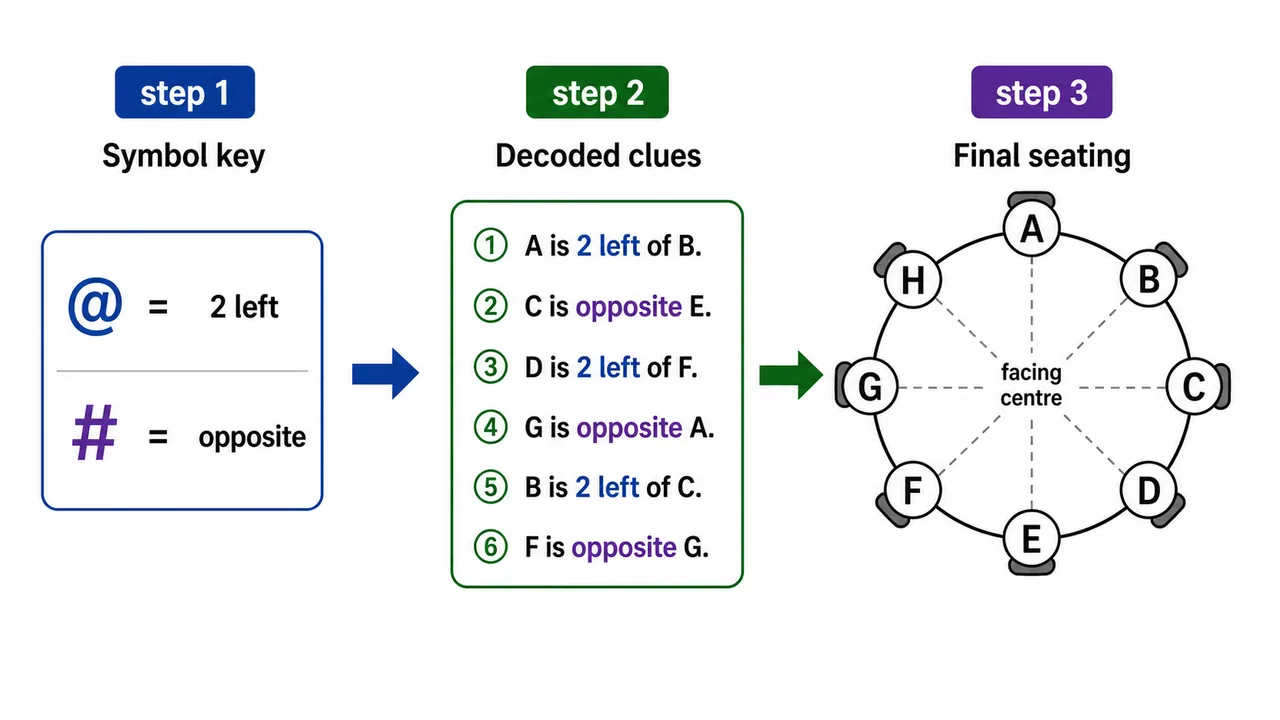
where @ has been defined to mean "sits second to the left of". You must translate every coded statement into plain English before solving.
Pro Content Locked
Upgrade to Pro to access this lesson and all other premium content.
Charged once for one year · ₹1188 total
Save ₹100/month vs ₹2388/year launch price
- All Agriculture & Banking Courses
- AI Lesson Questions (100/day)
- AI Doubt Solver (50/day)
- Glows & Grows Feedback (30/day)
- AI Section Quiz (20/day)
- 22-Language Translation (100/day)
- Recall Questions (20/day)
- AI Quiz (15/day)
- AI Quiz Paper Analysis (100/day)
- AI Step-by-Step Explanations (100/day)
- Spaced Repetition Recall (FSRS)
- AI Tutor
- Immersive Text Questions
- Audio Lessons — Hindi & English
- Mock Tests & Previous Year Papers
- Summary & Mind Maps
- XP, Levels, Leaderboard & Badges
- Generate New Classrooms
- Voice AI Teacher (AgriDots Live)
- AI Revision Assistant
- Knowledge Gap Analysis
- Interactive Revision (LangGraph)
🔒 Secure one-time yearly payment via Razorpay · No hidden fees
Coded Seating Arrangements
In coded seating arrangements, the position relationships between persons are expressed using symbols instead of plain English. You are given a decoding key at the start that maps each symbol to a specific seating relationship. All the conditions/statements are then written using these symbols.
This is an advanced variation asked in IBPS PO Mains, SBI PO Mains, RBI Grade B, and similar exams. The core seating logic remains the same -- the added difficulty is the decoding layer.
What Makes Coded Seating Different
In a normal seating arrangement, you might read:
"A sits second to the left of B"
In a coded seating arrangement, the same information is written as:
"A @ B"
where @ has been defined to mean "sits second to the left of". You must translate every coded statement into plain English before solving.
Key insight: Once you decode ALL the statements, the problem becomes a regular seating arrangement. The coding is just an extra step to slow you down and test attention to detail.
Common Symbol Patterns
Exams use different symbol sets each time. Here are the types of relationships that get coded:
| Relationship Type | Example Meaning |
|---|---|
| Immediate left/right | "A sits immediately to the left of B" |
| Second to left/right | "A sits second to the left of B" |
| Third to left/right | "A sits third to the left of B" |
| Opposite | "A sits opposite to B" |
| Immediate neighbour | "A is an immediate neighbour of B" |
| Not immediate neighbour | "A is NOT an immediate neighbour of B" |
The symbols used can be @, #, $, %, &, *, or any special character. Never assume a symbol means the same thing across different questions -- always read the key.
Step-by-Step Strategy
Step 1: Read and memorize the decoding key
Before touching any statement, read the entire symbol key carefully. Write it on rough paper.
Step 2: Decode ALL statements first
Convert every coded statement into plain English. Write them all out. Do NOT try to decode and solve simultaneously.
Step 3: Solve as a normal seating arrangement
Once decoded, apply standard circular/linear seating techniques.
Step 4: Verify using the code
When answering questions, you may need to re-encode your answer into symbols. Double-check against the key.
Solved Example 1: All Facing Centre (8 persons)
Question: Eight persons A, B, C, D, E, F, G and H are sitting around a circular table facing towards the centre.
Symbol Key:
| Symbol | Meaning |
|---|---|
| P @ Q | P sits second to the left of Q |
| P # Q | P and Q sit opposite to each other |
| P $ Q | P is an immediate neighbour of Q |
| P % Q | P sits third to the left of Q |
| P & Q | P sits third to the right of Q |
| P * Q | P is NOT an immediate neighbour of Q |
Given Statements: H & E $ G, B # E, C @ G, D # F, E * C * F
Solution Walkthrough
Step 1 -- Decode each statement:
- H & E means H sits third to the right of E
- E $ G means E is an immediate neighbour of G
- B # E means B sits opposite to E
- C @ G means C sits second to the left of G
- D # F means D sits opposite to F
- E * C means E is NOT an immediate neighbour of C
- C * F means C is NOT an immediate neighbour of F
Step 2 -- Start placing persons:
Start with the clue that gives the most definite position. H & E (H is 3rd to the right of E) is definite.
Fix E at a position. H is 3 places to the right (clockwise).
Now E $ G -- E and G are immediate neighbours. Place G next to E.
B # E -- B is opposite E (4 seats away in 8-person circle).
C @ G -- C is 2nd to the left of G. Count 2 places anticlockwise from G.
D # F -- D and F are opposite each other.
Step 3 -- Build the complete arrangement:
Working through all the decoded clues:
Final arrangement (clockwise from top): B, H, A, G, E, F, D, C
Step 4 -- Verify the negative conditions:
- E * C -- E and C are NOT neighbours. In the arrangement, E's neighbours are G and F. Confirmed.
- C * F -- C and F are NOT neighbours. C's neighbours are B and D. Confirmed.
Answering Questions in Code
Q1: Which one of the following is correct?
- a) H % D -- H sits third to left of D. Check: counting 3 anticlockwise from D gives C, not H. Wrong.
- b) A $ D -- A is immediate neighbour of D. Check: A's neighbours are H and G. Wrong.
- c) D # B -- D sits opposite B. Check: opposite of B is E, not D. Wrong.
- d) G $ F -- G is immediate neighbour of F. Check: G's neighbours are A and E. Wrong.
- e) None of these -- Correct answer.
Solved Example 2: Mixed Facing (Inside/Outside)
Question: Eight persons A, B, C, D, E, F, G and H are sitting around a circular table. Only four face inside. H faces Outside. E faces Inside.
Symbol Key:
| Symbol | Meaning |
|---|---|
| P @ Q | P sits second to the left of Q |
| P # Q | P sits second to the right of Q |
| P $ Q | P is opposite to Q |
| P % Q | P sits third to the left of Q |
| P & Q | P sits third to the right of Q |
| P * Q | P is NOT an immediate neighbour of Q |
Given Statements: E @ H & D * E, G % A $ H, D @ F, F % E * B
Solution Walkthrough
Step 1 -- Decode:
Break the compound statements into individual clues:
- E @ H means E sits 2nd to the left of H
- H & D means H sits 3rd to the right of D
- D * E means D is NOT immediate neighbour of E
- G % A means G sits 3rd to the left of A
- A $ H means A is opposite to H
- D @ F means D sits 2nd to the left of F
- F % E means F sits 3rd to the left of E
- E * B means E is NOT immediate neighbour of B
Step 2 -- Place persons (remember mixed facing changes left/right):
With mixed facing, left/right depends on which direction the person faces:
- Facing inside: Left = clockwise, Right = anticlockwise
- Facing outside: Left = anticlockwise, Right = clockwise
We know H faces outside and E faces inside. Start building from the definite clues.
Step 3 -- Final arrangement (clockwise):
Verify: 4 face inside (A, B, C, E) and 4 face outside (D, F, G, H). H faces outside and E faces inside as given.
Solved Example 3: Facing Inside/Outside with Different Key
Question: Eight persons A, B, C, D, E, F, G, H sit in a circle, facing either inside or outside.
Symbol Key:
| Symbol | Meaning |
|---|---|
| A @ B | A sits immediate left of B |
| A # B | A sits opposite of B |
| A $ B | A sits third to the left of B |
| A % B | A sits second to the right of B |
| A * B | A is NOT an immediate neighbour of B |
Given Statements: D % G, H @ E, A * C, F # B, E $ C
Solution Walkthrough
Step 1 -- Decode:
- D % G means D sits 2nd to the right of G
- H @ E means H sits immediate left of E
- A * C means A is NOT immediate neighbour of C
- F # B means F sits opposite B
- E $ C means E sits 3rd to the left of C
Step 2 -- Build arrangement:
Start with H @ E (definite adjacent pair). Then use E $ C to place C. Continue with D % G and F # B.
Remember: when some face inside and some outside, "left" and "right" flip for outward-facing persons.
Question asked: Who sits opposite A?
After completing the arrangement, identify who is directly across from A. Answer: CND (Cannot be Determined) or whichever specific person is found opposite.
Solved Example 4: Another Variation
Question: Eight persons M, N, O, P, Q, R, S, T sit around a circular table, some facing inside, some outside.
Symbol Key:
| Symbol | Meaning |
|---|---|
| X @ Y | X sits immediate right of Y |
| X # Y | X is opposite of Y |
| X $ Y | X is second to the left of Y |
| X % Y | X is third to the right of Y |
| X * Y | X is NOT an immediate neighbour of Y |
Given Statements: M $ P, R @ T, Q # S, O % N, M * O
Solution Walkthrough
Step 1 -- Decode:
- M $ P means M sits 2nd to the left of P
- R @ T means R sits immediate right of T
- Q # S means Q sits opposite S
- O % N means O sits 3rd to the right of N
- M * O means M is NOT immediate neighbour of O
Step 2 -- Solve systematically:
Start with R @ T (definite adjacent position). Use Q # S and O % N for more placements. Apply M $ P and verify M * O.
Question asked: Who sits to the immediate left of Q?
After solving the complete arrangement: Answer: CND (or the specific person found).
Handling Compound Coded Statements
A common exam trick is chaining multiple codes in one statement:
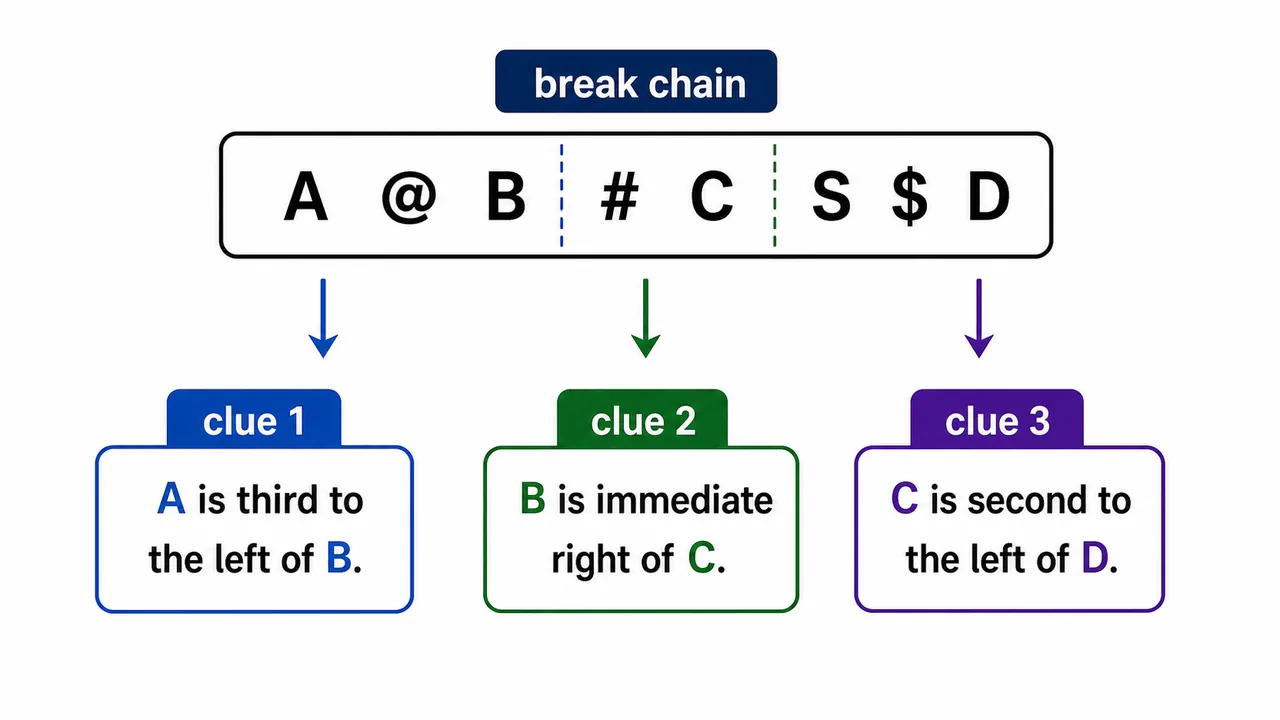
E @ H & D * E
This is actually THREE separate clues:
- E @ H -- E sits 2nd to left of H
- H & D -- H sits 3rd to right of D
- D * E -- D is not immediate neighbour of E
Always break compound statements into individual pairs before solving.
Speed Tips for Exam Day
-
Write the key on rough paper immediately -- Do not keep flipping back to the question. Copy the key with large, clear symbols.
-
Decode ALL statements before placing anyone -- This prevents errors from partially decoded conditions.
-
Circle the negative conditions (* = NOT neighbour) -- These are for verification, not placement. Handle them last.
-
Start with opposite (#) and adjacent (@) clues -- These give the most definite positions.
-
For mixed facing, draw arrows -- Use inward/outward arrows on your diagram to track facing direction. This prevents left/right confusion.
-
Compound statements are free clues -- A statement like A @ B # C $ D gives you THREE relationships, not one. Exploit this.
Common Traps to Watch For
Trap 1: Same symbol, different meaning across questions
@ might mean "2nd to left" in one question and "immediate right" in the next. Always read the key fresh.
Trap 2: Confusing left and right in mixed facing
When people face outside, their left and right are reversed relative to the clockwise/anticlockwise direction. This is the most common source of errors.
Trap 3: Not breaking compound statements
H & E G</mark> contains TWO clues: <mark class="agridots-imp">H & E</mark> AND <mark class="agridots-imp">E G. Students who miss the second clue cannot solve the puzzle.
Trap 4: Answering in code vs. plain English
Some questions ask "Which of the following coded statements is true?" You must re-encode your final arrangement back into symbols. Others ask in plain English. Read carefully.
Trap 5: Assuming facing direction
In "all facing centre" problems, everyone faces inward. But if the question says "some face inside, some outside" or specifies facing for certain persons, you must track this explicitly.
Quick Reference: Reading Direction in Circular Arrangements
All Facing Centre (Inside):
- Left of a person = Clockwise from that person
- Right of a person = Anticlockwise from that person
Facing Outside:
- Left of a person = Anticlockwise from that person
- Right of a person = Clockwise from that person
Memory trick: Stand at a person's position, face the direction they face. Your physical left hand points to their "left" side.
Practice Approach
- Start with all facing centre coded problems (simplest -- no facing direction ambiguity)
- Move to mixed facing coded problems
- Finally attempt coded + variable (coded with additional variables like colour or profession)
For each practice problem:
- Time yourself on decoding (should take under 1 minute)
- Time yourself on solving (target: 3-4 minutes for the full arrangement)
- Always verify negative conditions at the end