🃏 Conditional & Dynamic Seating Arrangements
Master conditional seating arrangements where persons change positions based on card draws, coin tosses, or rule-based triggers
Conditional & Dynamic Seating Arrangements
Conditional seating arrangements are two-phase problems. In Phase 1, you solve a standard seating arrangement. In Phase 2, persons change their positions based on a set of conditions (card draws, coin tosses, dice rolls, etc.). Questions are then asked about the final arrangement after rearrangement.
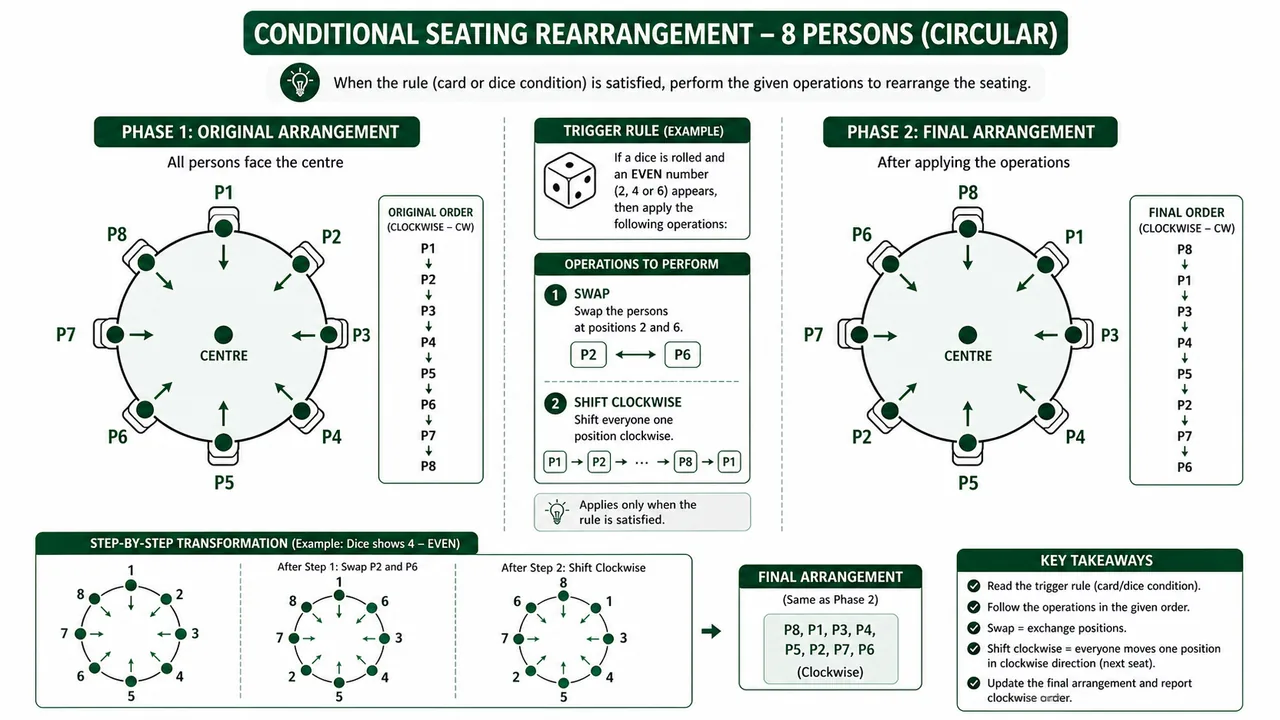
This is a Mains-level topic frequently asked in IBPS PO Mains, SBI PO Mains, and RBI Grade B exams. It combines circular/linear seating with conditional logic and sometimes additional variables.
Structure of a Conditional Problem
Every conditional arrangement has three parts:
Part 1 -- Initial Arrangement Standard seating clues (circular, linear, or multi-shape). Solve this completely first.
Part 2 -- Movement Rules (Conditions) A set of rules that define how persons move based on some trigger. For example:
Pro Content Locked
Upgrade to Pro to access this lesson and all other premium content.
Charged once for one year · ₹1188 total
Save ₹100/month vs ₹2388/year launch price
- All Agriculture & Banking Courses
- AI Lesson Questions (100/day)
- AI Doubt Solver (50/day)
- Glows & Grows Feedback (30/day)
- AI Section Quiz (20/day)
- 22-Language Translation (100/day)
- Recall Questions (20/day)
- AI Quiz (15/day)
- AI Quiz Paper Analysis (100/day)
- AI Step-by-Step Explanations (100/day)
- Spaced Repetition Recall (FSRS)
- AI Tutor
- Immersive Text Questions
- Audio Lessons — Hindi & English
- Mock Tests & Previous Year Papers
- Summary & Mind Maps
- XP, Levels, Leaderboard & Badges
- Generate New Classrooms
- Voice AI Teacher (AgriDots Live)
- AI Revision Assistant
- Knowledge Gap Analysis
- Interactive Revision (LangGraph)
🔒 Secure one-time yearly payment via Razorpay · No hidden fees
Conditional & Dynamic Seating Arrangements
Conditional seating arrangements are two-phase problems. In Phase 1, you solve a standard seating arrangement. In Phase 2, persons change their positions based on a set of conditions (card draws, coin tosses, dice rolls, etc.). Questions are then asked about the final arrangement after rearrangement.
This is a Mains-level topic frequently asked in IBPS PO Mains, SBI PO Mains, and RBI Grade B exams. It combines circular/linear seating with conditional logic and sometimes additional variables.
Structure of a Conditional Problem
Every conditional arrangement has three parts:
Part 1 -- Initial Arrangement Standard seating clues (circular, linear, or multi-shape). Solve this completely first.
Part 2 -- Movement Rules (Conditions) A set of rules that define how persons move based on some trigger. For example:
- "If Heart card is drawn, move to outer circle"
- "If coin shows Heads, shift 2 positions left"
Part 3 -- Trigger Events The actual events that happen (e.g., "A draws Jack of Heart, B draws King of Club..."). Apply the rules to determine each person's new position.
Types of Triggers
Card-Based Triggers
The most common type. Each person draws a card from a shuffled deck. The suit of the card (Heart, Spade, Club, Diamond) determines the movement rule.
| Card Suit | Typical Movement Rule |
|---|---|
| Heart | Move to outer circle at same position, face centre |
| Spade | Move to outer circle, face centre, shift 2 positions left |
| Club | Move to a corner of a square/polygon shape |
| Diamond | Stay in same circle but reverse facing direction |
Important: The rules change with every question. NEVER assume the rules from a previous question apply.
Coin-Based Triggers
Three coins are tossed. The combination of Heads (H) and Tails (T) determines which person moves and where.
| Coin Combination | Example Condition |
|---|---|
| H, H, T | Person with lowest odd toffees moves to corner 1 of triangle |
| H, T, T | Person with 65-75 toffees moves to corner 3 of pentagon |
| H, H, H | Person with 55-60 toffees moves to corner 5 of pentagon |
| T, T, H | Person with highest even toffees stays, faces outside |
Other Triggers
Some problems use dice, lottery numbers, or custom event-based triggers. The principle remains the same -- solve initial arrangement, then apply movement rules.
Multi-Shape Layouts
Conditional problems often involve multiple geometric shapes:
Circle + Square Layout
- Inner circle: Initial arrangement (all facing centre)
- Outer circle: Persons who draw Heart/Spade move here
- Square corners: Persons who draw Club move here (numbered 1-4 anticlockwise)
Circle + Triangle + Pentagon Layout
More complex problems inscribe a triangle and pentagon inside the circle:
Persons move to triangle corners or pentagon corners based on conditions.
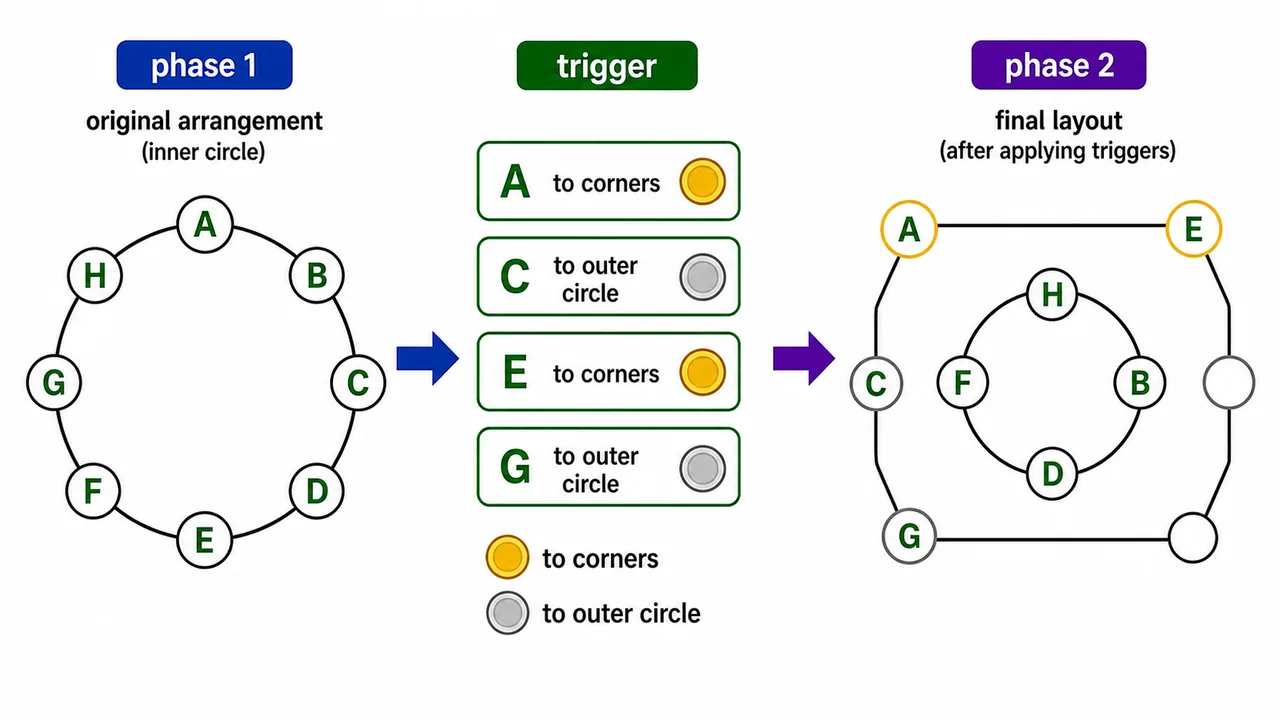
Solved Example 1: Card Draw with Inner/Outer Circle
Question: Eight friends A, B, C, D, E, F, G and H are sitting in the innermost circle. All of them are facing towards the centre.
Initial Clues:
- Only two people sit between C and H
- Three people sit between H and E
- A sits second to the left of E
- Three people sit between A and F
- B sits to the immediate left of F
- D sits second to the right of G
Phase 1 -- Solve Initial Arrangement
Step 1: Fix C at top. "Only two between C and H" gives two possibilities for H.
Step 2: "Three people between H and E" -- place E.
Step 3: "A sits 2nd to left of E" -- place A.
Step 4: "Three people between A and F" -- place F.
Step 5: "B sits immediate left of F" -- place B.
Step 6: "D sits 2nd to right of G" -- place D and G in remaining spots.
Initial arrangement (clockwise from top):
All 8 persons are in the inner circle, all facing centre.
Phase 2 -- Movement Rules (Conditions)
Conditions given:
- Heart -- Person moves to outer circle (same position), facing centre
- Spade -- Person moves to outer circle, facing centre, and moves 2 positions to the left
- Club -- Person moves to a corner of the Square (1st Club drawer goes to corner 1, 2nd to corner 2, etc.), facing away from centre
- Diamond -- Person stays in same circle but now faces away from centre
Phase 3 -- Apply Triggers
Card draws (clockwise from C):
| Person | Card Drawn | Suit | Action |
|---|---|---|---|
| C | Queen of Spade | Spade | Outer circle + shift 2 left |
| D | 3 of Diamond | Diamond | Stay in inner circle, face out |
| A | Jack of Heart | Heart | Move to outer circle, same position |
| E | Ace of Heart | Heart | Move to outer circle, same position |
| B | King of Club | Club | Move to square corner 1 |
| F | 7 of Club | Club | Move to square corner 2 |
| G | 4 of Heart | Heart | Move to outer circle, same position |
| H | 8 of Diamond | Diamond | Stay in inner circle, face out |
Note: Cards are drawn in clockwise order starting from C.
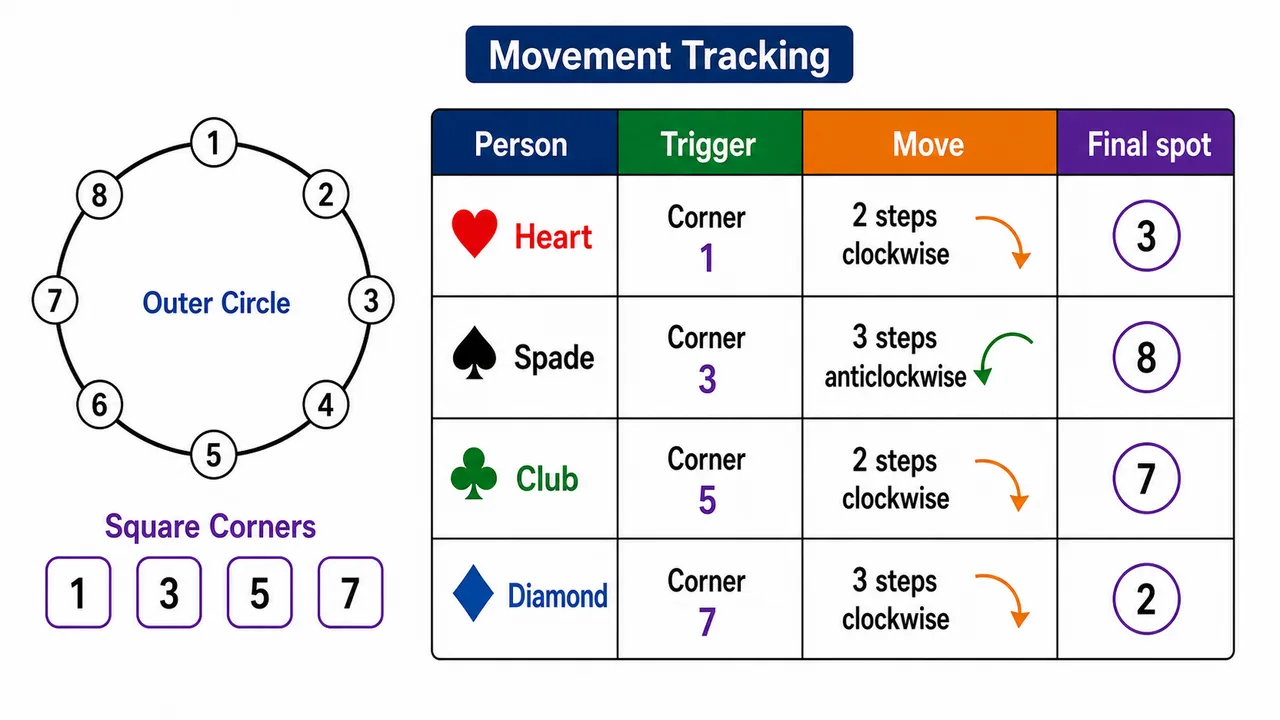
Applying Each Movement
A (Heart): Moves to outer circle at same position. Faces centre.
E (Heart): Moves to outer circle at same position. Faces centre.
G (Heart): Moves to outer circle at same position. Faces centre.
C (Spade): Moves to outer circle at C's original position, then shifts 2 positions to the left (anticlockwise). So C moves from the original position to 2 seats anticlockwise in the outer circle. Faces centre.
D (Diamond): Stays at same position in inner circle. Now faces outward (away from centre).
H (Diamond): Stays at same position in inner circle. Now faces outward (away from centre).
B (Club): Moves to corner 1 of the square. Faces away from centre.
F (Club): Moves to corner 2 of the square. Faces away from centre.
Final Arrangement After Rearrangement
Solved Example 2: Coin Toss with Circle + Triangle + Pentagon
Question: A pentagon having 5 equal sides in which a circle is inscribed. Eight persons A, B, C, D, E, F, G and H are sitting in a circular table facing centre. Inside the circle, a triangle is inscribed. Each person has a certain number of toffees.
Initial setup (after solving the circular arrangement and toffee values):
| Person | Toffees | Position |
|---|---|---|
| A | 68 | Top |
| B | 63 | 2nd clockwise |
| C | 48 | 3rd clockwise |
| G | 56 | 4th clockwise |
| H | 31 | 5th clockwise |
| D | 122 | 6th clockwise |
| F | 29 | 7th clockwise |
| E | 87 | 8th clockwise |
Note: Triangle corners numbered 1, 2, 3 anticlockwise. Pentagon corners numbered 1, 2, 3, 4, 5 anticlockwise.
Coin Toss Conditions
| # | Coin 1 | Coin 2 | Coin 3 | Who Moves | Where | Facing |
|---|---|---|---|---|---|---|
| 1 | Head | Head | Toss | Lowest odd toffees | Triangle corner 1 | Outside centre |
| 2 | Head | Toss | Toss | 65 < toffees < 75 | Pentagon corner 3 | Inside centre |
| 3 | Head | Toss (C2) | Head (C3 is Toss) | Lowest even toffees | Triangle corner 2 | Inside centre |
| 4 | Head | Head | Head | 55 < toffees < 60 | Pentagon corner 5 | Outside centre |
| 5 | Toss | Head (C2) | Toss (C1,C3) | Highest odd toffees | Pentagon corner 1 | Inside centre |
| 6 | Toss | Toss | Head | Highest even toffees | Same position | Outside centre |
| 7 | -- | -- | -- | All others | Same position | Same direction |
Applying the Conditions
Condition 1 (H, H, T): Lowest odd toffees = F (29, odd). F moves to triangle corner 1, faces outside.
Condition 2 (H, T, T): Person with 65-75 toffees = A (68). A moves to pentagon corner 3, faces inside.
Condition 3 (H, T for C1&C3, T for C2): Lowest even toffees = C (48, even). C moves to triangle corner 2, faces inside.
Condition 4 (H, H, H): Person with 55-60 toffees = G (56). G moves to pentagon corner 5, faces outside.
Condition 5 (T, H, T): Highest odd toffees = E (87, odd). E moves to pentagon corner 1, faces inside.
Condition 6 (T, T, H): Highest even toffees = D (122, even). D stays at same position, faces outside.
Condition 7: B (63) and H (31) remain at same position and facing.
Solving Strategy for Conditional Problems
Step 1: Solve the Initial Arrangement Completely
Do NOT skip ahead to the conditions. The initial arrangement must be 100% solved before applying any movement.
Time target: 3-4 minutes for the initial arrangement.
Step 2: Create a Movement Tracking Table
| Person | Initial Position | Card/Trigger | New Location | New Facing |
|---|---|---|---|---|
| A | Pos 1 | Heart | Outer, Pos 1 | Centre |
| B | Pos 2 | Club | Square, Corner 1 | Away |
| ... | ... | ... | ... | ... |
Step 3: Apply Rules One Person at a Time
Process each person's trigger systematically. Do not try to do multiple persons simultaneously.
Step 4: Draw the Final Arrangement
Redraw the entire layout with all persons in their new positions. This is critical for answering "who sits next to whom" questions.
Multi-Row Conditional Problems
Some conditional problems use parallel lines instead of circles:
Example setup: Four parallel lines (Line 1: RA = 39m, Line 2: SB = 25m, Line 3: TC = 27m, Line 4: UD = 49m).
Persons stand on lines with specific distances between them (multiples of 7m on one line, multiples of 9m on another). Conditions then move persons between lines.
Key concept: Distance between persons = multiples of a given number from one end.
For Line 1 (RA, 39m, multiples of 7):
- Person 1 at R (0m), Person 2 at 7m, Person 3 at 14m, Person 4 at 21m, Person 5 at 28m, Person 6 at 35m
For Line 4 (UD, 49m, multiples of 9):
- Person 1 at U (0m), Person 2 at 9m, Person 3 at 18m, Person 4 at 27m, Person 5 at 36m, Person 6 at 45m
Speed Tips for Exam Day
-
Draw the initial arrangement in pen, the final arrangement in pencil -- This prevents confusion between the two phases.
-
Number the positions clockwise (1-8) -- When a condition says "shift 2 positions left", you can quickly calculate the new position number.
-
Process Club/Square conditions in ORDER of drawing -- The first person to draw Club goes to corner 1, the second to corner 2, etc. The draw order matters.
-
Diamond = simplest rule -- Usually "stay in place, flip facing". Handle these first.
-
Heart = move but same position -- Second simplest. Handle after Diamond.
-
Spade = move + shift -- Most complex. Handle last.
-
Track facing direction explicitly -- Use arrows: an inward arrow for "faces centre", an outward arrow for "faces away from centre".
Common Traps to Watch For
Trap 1: Wrong draw order
Cards are drawn in a specific order (clockwise from a specific person). If you process them out of order, the Club corner assignments will be wrong.
Trap 2: Confusing "same position" with "same circle"
- Heart: move to outer circle at the same angular position
- Diamond: stay in same circle but flip direction
These are different. Heart physically moves to a different circle.
Trap 3: Left/right after facing change
After a person moves and their facing direction changes, their "left" and "right" also change. Questions about the final arrangement must use the NEW facing direction.
Trap 4: Forgetting "all others remain"
The last condition usually says "All other persons remain at the same position facing the same direction." Do not accidentally move someone who should stay put.
Trap 5: Counting positions in the wrong direction
"Shift 2 positions left" means 2 positions in the LEFT direction of that person (which depends on their facing). In a standard all-facing-centre circle, left = clockwise.
Types of Questions Asked
After the rearrangement, expect questions like:
-
"Who sits to the immediate left of A after rearrangement?" -- Check A's new position and facing, identify the person at the adjacent position.
-
"How many persons are in the outer circle?" -- Count persons who drew Heart or Spade.
-
"Who sits at corner 3 of the square?" -- Check which Club-drawer was third in the draw order.
-
"Who faces away from the centre after rearrangement?" -- Check Diamond-drawers (flipped) and Club-drawers (facing away) and Spade-drawers if their rule includes facing info.
-
"What is the position of F relative to G after rearrangement?" -- Both may have moved. Check their new positions and facing directions.