👪 Seating Arrangement with Blood Relations
Master seating arrangements combined with blood relations - build the family tree first, then solve the circular arrangement
Seating Arrangement with Blood Relations
This is one of the most frequently asked topics in Mains-level banking exams. It combines two reasoning topics into one:
- Blood Relations -- Decode who is father, mother, son, daughter, brother, sister, husband, wife
- Circular Seating Arrangement -- Place persons around a table
The twist is that seating clues reference relationships instead of (or in addition to) names. For example: "D's father sits second to the right of F" -- you must first know who D's father is before you can place anyone.
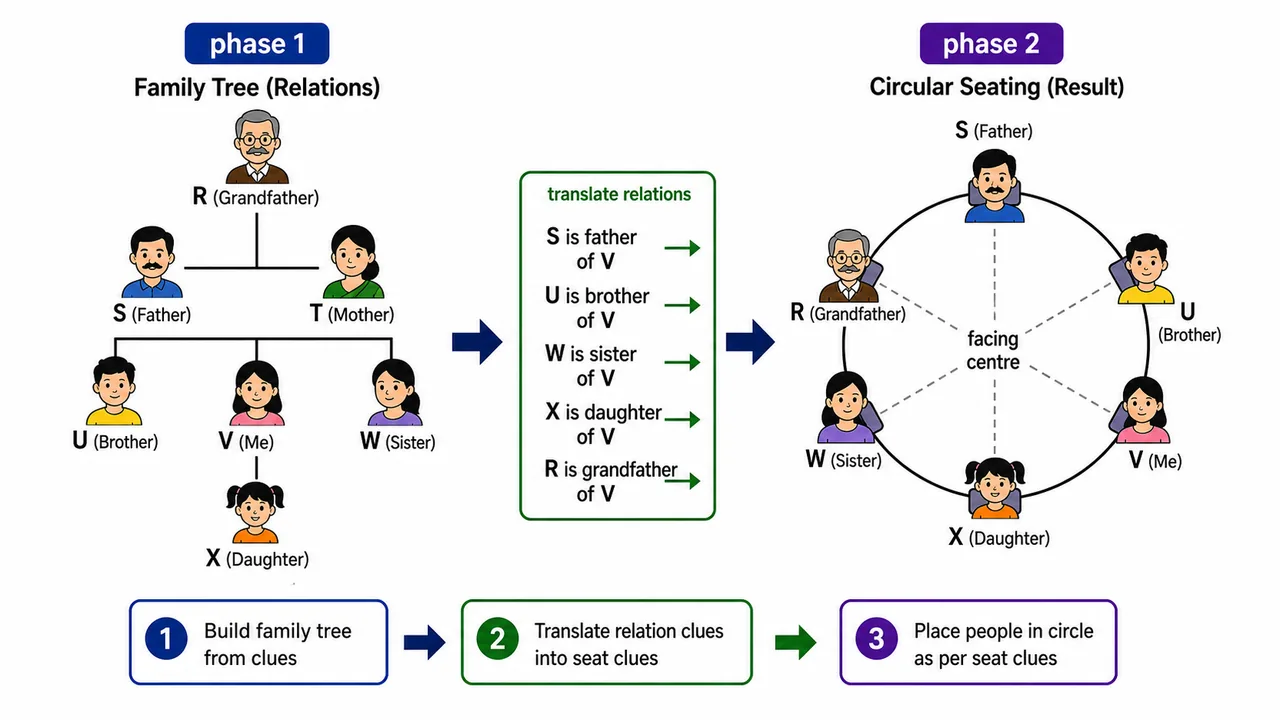
The Two-Phase Approach
Phase 1: Build the Family Tree
Before touching the seating arrangement, identify ALL relationships. Draw a proper family chart.
Phase 2: Solve the Seating Arrangement
Use the family chart to translate relationship-based clues into name-based clues, then solve normally.
Golden Rule: Never try to solve both simultaneously. Separate the relationship logic from the seating logic.
Family Chart Notation
Use this standard notation for building family trees:
Pro Content Locked
Upgrade to Pro to access this lesson and all other premium content.
Charged once for one year · ₹1188 total
Save ₹100/month vs ₹2388/year launch price
- All Agriculture & Banking Courses
- AI Lesson Questions (100/day)
- AI Doubt Solver (50/day)
- Glows & Grows Feedback (30/day)
- AI Section Quiz (20/day)
- 22-Language Translation (100/day)
- Recall Questions (20/day)
- AI Quiz (15/day)
- AI Quiz Paper Analysis (100/day)
- AI Step-by-Step Explanations (100/day)
- Spaced Repetition Recall (FSRS)
- AI Tutor
- Immersive Text Questions
- Audio Lessons — Hindi & English
- Mock Tests & Previous Year Papers
- Summary & Mind Maps
- XP, Levels, Leaderboard & Badges
- Generate New Classrooms
- Voice AI Teacher (AgriDots Live)
- AI Revision Assistant
- Knowledge Gap Analysis
- Interactive Revision (LangGraph)
🔒 Secure one-time yearly payment via Razorpay · No hidden fees
Seating Arrangement with Blood Relations
This is one of the most frequently asked topics in Mains-level banking exams. It combines two reasoning topics into one:
- Blood Relations -- Decode who is father, mother, son, daughter, brother, sister, husband, wife
- Circular Seating Arrangement -- Place persons around a table
The twist is that seating clues reference relationships instead of (or in addition to) names. For example: "D's father sits second to the right of F" -- you must first know who D's father is before you can place anyone.
The Two-Phase Approach
Phase 1: Build the Family Tree
Before touching the seating arrangement, identify ALL relationships. Draw a proper family chart.
Phase 2: Solve the Seating Arrangement
Use the family chart to translate relationship-based clues into name-based clues, then solve normally.
Golden Rule: Never try to solve both simultaneously. Separate the relationship logic from the seating logic.
Family Chart Notation
Use this standard notation for building family trees:
Example family chart:
Gender Indicators in Questions
Questions provide gender through:
- Direct statement: "T is a male"
- Relationship terms: "father/husband/brother/son" = male; "mother/wife/sister/daughter" = female
- Pronouns: "he sits..." = male; "she sits..." = female (not always given)
Key Relationship Terms for Exams
| Term | Meaning | Gender |
|---|---|---|
| Father | Male parent | Male |
| Mother | Female parent | Female |
| Son | Male child | Male |
| Daughter | Female child | Female |
| Brother | Male sibling | Male |
| Sister | Female sibling | Female |
| Husband | Male spouse | Male |
| Wife | Female spouse | Female |
| Father-in-law | Spouse's father | Male |
| Mother-in-law | Spouse's mother | Female |
| Son-in-law | Daughter's husband | Male |
| Daughter-in-law | Son's wife | Female |
| Brother-in-law | Spouse's brother or Sister's husband | Male |
| Sister-in-law | Spouse's sister or Brother's wife | Female |
| Grandfather | Parent's father | Male |
| Grandmother | Parent's mother | Female |
| Grandson | Child's son | Male |
| Granddaughter | Child's daughter | Female |
| Uncle | Father's/Mother's brother | Male |
| Aunt | Father's/Mother's sister | Female |
| Nephew | Sibling's son | Male |
| Niece | Sibling's daughter | Female |
Step-by-Step Methodology
Step 1: Extract ALL Relationship Clues
Read the entire passage. Highlight or list every relationship mentioned:
- "D's son"
- "D's husband"
- "D's father"
- "D's brother"
- "D's daughter"
- "D's sister"
- "D's mother"
Step 2: Identify the Central Person
Often, one person is related to everyone else (like "D" in many problems). Start building the family tree around this person.
Step 3: Build the Family Chart
Start with definite relationships (e.g., "K is the husband of V" -- this is definite).
Then add conditional relationships (e.g., "D's son" -- we do not yet know who D's son is, but we know D has a son).
Step 4: Assign Names to Relationships
As you get more clues from the seating arrangement, assign specific names to relationships. For example, if "R sits on the immediate right of D's son" and you know from the seating that only Q can be in that position, then you can work backward.
Step 5: Translate and Solve Seating
Replace every relationship-based clue with the actual name and solve as a standard seating arrangement.
Solved Example 1: 8 Persons with Blood Relations
Question: C, D, E, F, P, Q, R and S are sitting around a circular table facing the centre with equal distance between each other. Each one of them is also related to D in some way or the other.
Clues:
- Only one person sits between P and D's son
- R sits on the immediate right of D's son
- Only three people sit between D's husband and R
- Only one person sits between D's husband and C
- F sits to the immediate right of Q
- D's father sits second to the right of F
- Only three people sit between D's father and D's brother
- D's daughter sits second to the right of S
- D's sister sits third to the right of D's mother
- P sits third to the right of E
- D sits on the immediate left of E
Phase 1 -- Build Family Chart
From the clues, D has: husband, father, mother, brother, sister, son, daughter.
This means D is female (she has a husband).
The family tree around D:
That gives us: D's Father, D's Mother, D's Husband, D's Brother, D's Sister, D's Son, D's Daughter = 7 relations + D herself = 8 persons.
The 8 persons are: C, D, E, F, P, Q, R, S. So each of C, E, F, P, Q, R, S corresponds to one of: D's Father, D's Mother, D's Husband, D's Brother, D's Sister, D's Son, D's Daughter.
Phase 2 -- Solve Seating
From clue 11: D sits immediate left of E. Place them adjacent.
From clue 10: P sits 3rd to the right of E.
From clue 2: R sits immediate right of D's son. From clue 1: Only one person between P and D's son.
Since P is placed, count one seat from P to find possible positions for D's son. R must be immediately right of D's son.
From clue 3: Three people between D's husband and R. From clue 4: One person between D's husband and C. From clue 5: F sits immediate right of Q. From clue 6: D's father sits 2nd to right of F. From clue 7: Three people between D's father and D's brother. From clue 8: D's daughter sits 2nd to right of S. From clue 9: D's sister sits 3rd to right of D's mother.
Working through these systematically with the family chart:
Final arrangement (clockwise):
Note: The exact name-to-relation mapping depends on solving all constraints simultaneously. The key is that the family chart constrains which persons can fill which roles.
Solved Example 2: 8 Family Members with Relations
Question: Eight family members A, B, Z, F, H, I, D, C are seating around a circle and facing at the centre.
Clues:
- Only one person sits between H and Z
- Z is the mother of C
- Z is not an immediate neighbor of I
- B sits second to the left of H's husband
- No female is an immediate neighbour of B
- D's daughter sits second to the right of F
- F is the sister of Z
- F is not an immediate neighbour of H's husband
- Only one person sits between A and F
- A is the father of Z
- H's brother D sits to the immediate left of H's mother
- Only one person sits between H's mother and I
- D's daughter is not B
Phase 1 -- Build Family Chart
From clue 10: A is the father of Z. So A is male, A is a generation above Z. From clue 7: F is the sister of Z. So F is female, same generation as Z. From clue 2: Z is the mother of C. So Z is female, C is Z's child.
So far:
From clue 11: H's brother is D. So D is male. H has a brother D. From clue 4: H has a husband. So H is female. From clue 11: D sits immediate left of H's mother.
H and D are siblings. H's mother = D's mother. Since A is father of Z and F, H's mother could be A's wife.
From clue 13: D's daughter is not B.
Building the complete chart:
H and D are siblings (from another family or same family -- solve based on context).
If H is married into this family: H's husband could be C (Z's son), making H a daughter-in-law.
The exact mapping requires solving all clues together with the seating.
Phase 2 -- Solve Seating
From clue 1: One person between H and Z. From clue 4: B sits 2nd to left of H's husband. From clue 9: One person between A and F. From clue 11: D sits immediate left of H's mother. From clue 12: One person between H's mother and I.
After solving all constraints:
Final arrangement (clockwise):
With relationships assigned to positions.
How to Reduce Possible Cases
The biggest challenge is the number of possible cases. Here is how to minimize them:
Technique 1: Start with Definite Relations
Clues like "A is the father of Z" or "K is the husband of V" give you definite information. Extract these first.
Technique 2: Use Gender Constraints
If "no female is an immediate neighbour of B" and you know who is male/female from the family chart, this eliminates many seating positions.
Technique 3: Count Family Members
A question with 8 persons and a family tree that needs Father, Mother, Son, Daughter, Brother, Sister, Husband, Wife = exactly 8 roles. Each person fills exactly one role.
Technique 4: Generation Counting
- Generation 1: Grandparents
- Generation 2: Parents (children of Gen 1)
- Generation 3: Children (grandchildren of Gen 1)
If the problem mentions "father" and "son" of the same person, that person is in Generation 2.
Solved Example 3: Approach Flowchart
Follow this systematic approach for every seating + relation problem:
Common Relationship Clues in Seating Context
"X sits to the immediate right of Y's husband"
- First find who Y's husband is (from family chart)
- Then place X to the immediate right of that person
"Only three people sit between D's father and D's brother"
- Both D's father and D's brother are specific persons
- Find them from the chart, then apply the seating constraint
"D's daughter sits second to the right of S"
- D's daughter is a specific person (find from chart)
- Place her 2 seats clockwise from S
"No female is an immediate neighbour of B"
- B's two adjacent persons must both be male
- Use gender info from the family chart
Speed Tips for Exam Day
-
Draw the family chart FIRST -- Spend 1-2 minutes on this before any seating work. It saves time later.
-
Use + and - symbols for gender -- Mark every person as + (male) or - (female) as soon as you determine their gender.
-
Number of family members = Number of persons -- If there are 8 persons and you have identified 8 distinct family roles, every person maps to exactly one role. Use this to eliminate options.
-
Handle "whose" and "who is" carefully -- "X, who is the mother of Y" means X = Y's mother. Do not misread this as Y being the mother.
-
Married couples are always one male + one female -- If the question says "married couple", one must be male and the other female. This constrains gender assignments.
Common Traps to Watch For
Trap 1: Assuming gender without evidence
Names like "P", "Q", "R" do not indicate gender. Only relationship terms or explicit statements reveal gender.
Trap 2: Confusing "father-in-law" with "father"
- Father = biological father
- Father-in-law = spouse's father
These are different people. "D's father-in-law" is the father of D's spouse, NOT D's own father.
Trap 3: Multiple possible family trees
Sometimes the family chart has 2 possible structures. You must try both and see which one is consistent with the seating clues. Usually one will lead to a contradiction.
Trap 4: "Only child" constraint
If "E is the only child of his parents", then E has no siblings. This is a strong constraint that eliminates many family tree possibilities.
Trap 5: Circular references
"D's son's wife's father" = D's daughter-in-law's father. Trace step by step: D's son married someone, that person's father is who we want.
Practice Approach
- Start with 6-person problems (smaller family, fewer variables)
- Move to 8-person (standard exam level)
- Then 10-person with mixed facing (Mains level)
For each practice problem:
- Draw the family chart completely before touching seating
- Time yourself: family chart should take 1-2 minutes
- Seating arrangement should take 3-4 minutes
- Total: under 6 minutes for the complete solution