🏆 Exam Practice & Speed Strategies
Comprehensive exam-level mixed practice with all syllogism types, speed strategies for solving under time pressure, rough paper organization, and common exam traps to avoid
Exam Practice & Speed Strategies
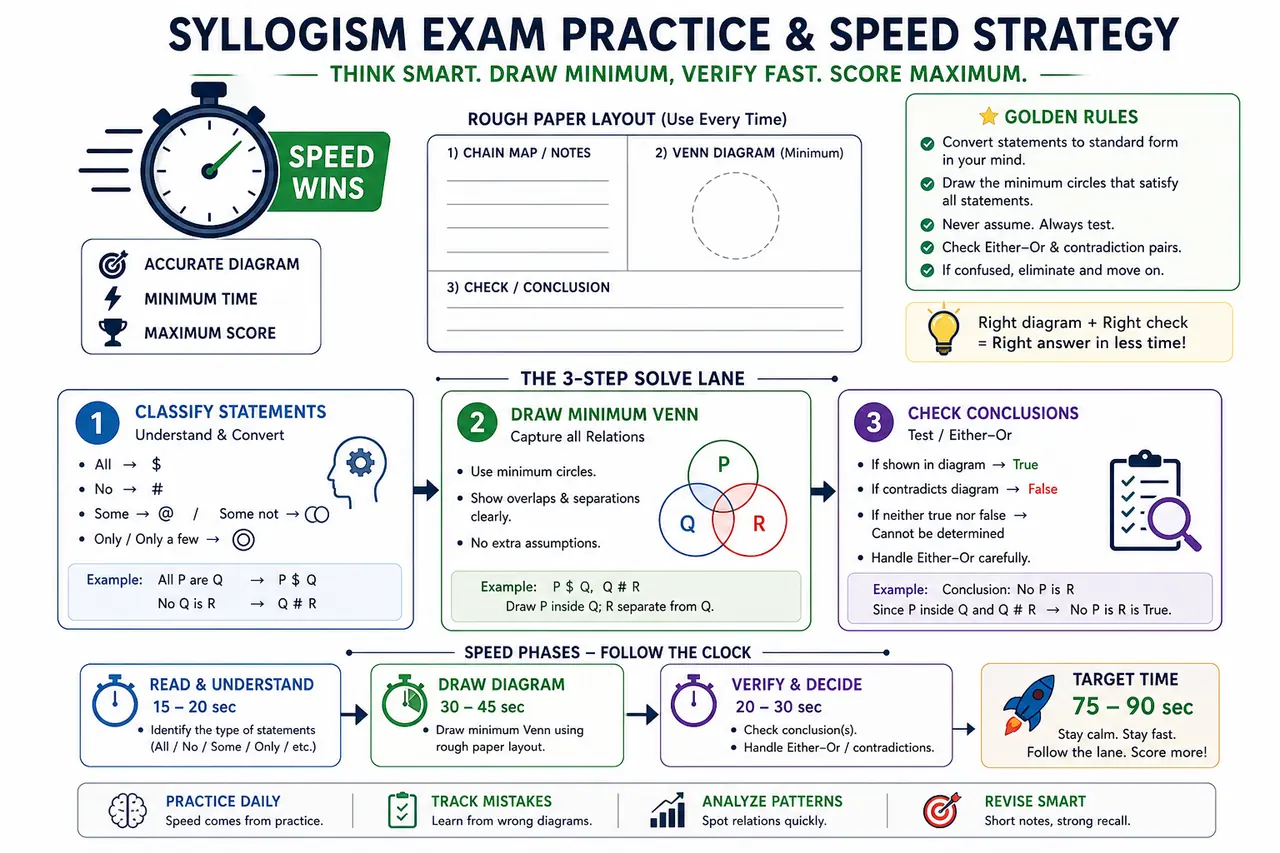
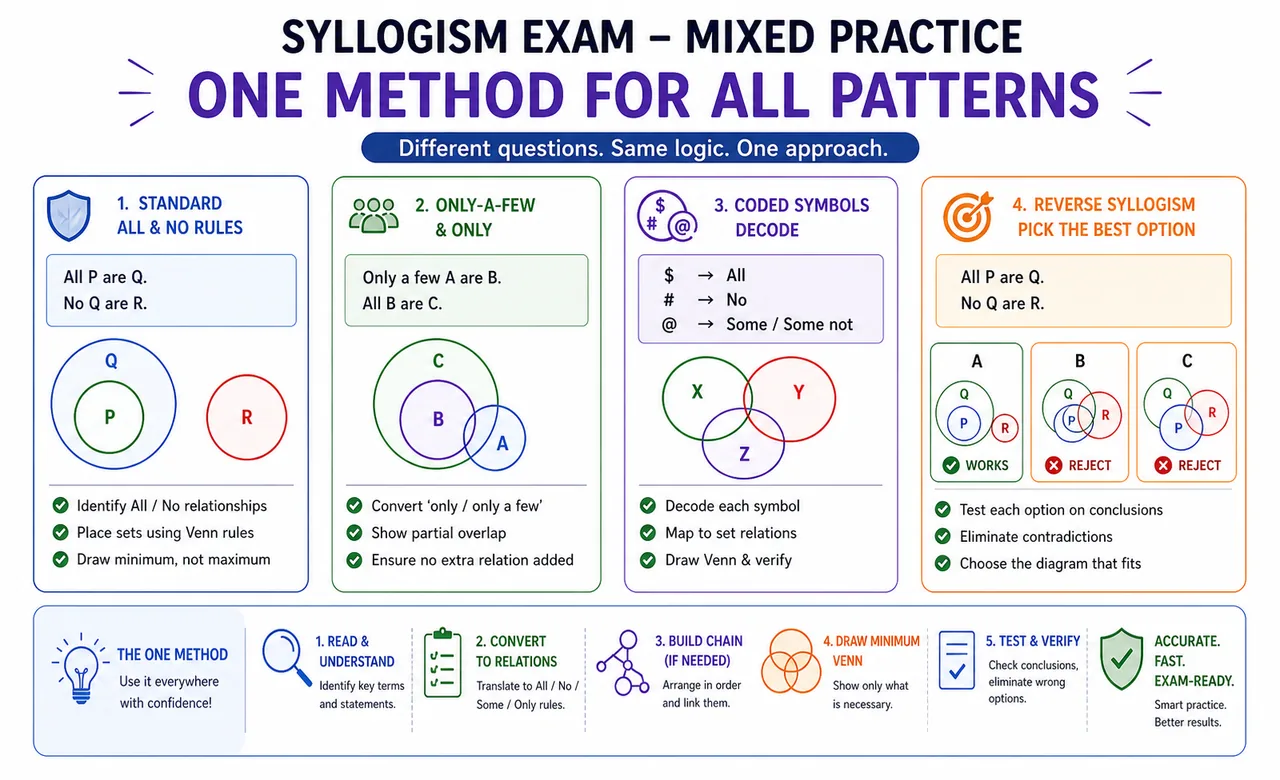
This lesson brings together ALL syllogism concepts with exam-level practice and time management strategies for banking Mains exams.
Time Management
Exam timing for syllogism:
| Phase | Time | What To Do |
|---|---|---|
| Read statements | 15-20 sec | Identify types (All/No/Some/Only/Only a few) |
| Convert & Draw | 30-45 sec | Convert "Only"/"Only a few", draw Venn diagram |
| Check conclusions | 15-20 sec each | Check against diagram |
| Total per set (5 Qs) | 3-4 min | Under 1 min per question |
In Prelims: 3 questions, simple statements → Target 2 minutes total In Mains: 5 questions, complex statements → Target 4 minutes total
The 15-Second Statement Classification
As soon as you read the statements, classify each one:
| See This | Write This |
|---|---|
| All / Every / Each / 100% | → (draw inner circle) |
| No / None / 0% | → (draw separate circles) |
| Some / A few / Several / 30-90% | → (draw overlapping circles) |
| Only X are Y | → All Y are X (flip!) |
| Only a few X are Y | → S: X∩Y + S: X∉Y |
| None but X are Y | → All Y are X (same as Only) |
Write the converted form next to each statement. This prevents re-reading during solving.
Pro Content Locked
Upgrade to Pro to access this lesson and all other premium content.
Pay once for one year · Effective ₹99/mo
- All Agriculture & Banking Courses
- AI Lesson Questions (100/day)
- AI Doubt Solver (50/day)
- Glows & Grows Feedback (30/day)
- AI Section Quiz (20/day)
- 22-Language Translation (100/day)
- Recall Questions (20/day)
- AI Quiz (15/day)
- AI Quiz Paper Analysis (100/day)
- AI Step-by-Step Explanations (100/day)
- Spaced Repetition Recall (FSRS)
- AI Tutor
- Immersive Text Questions
- Audio Lessons — Hindi & English
- Mock Tests & Previous Year Papers
- Summary & Mind Maps
- XP, Levels, Leaderboard & Badges
- Generate New Classrooms
- Voice AI Teacher (AgriDots Live)
- AI Revision Assistant
- Knowledge Gap Analysis
- Interactive Revision (LangGraph)
🔒 Secure one-time yearly payment via Razorpay · No hidden fees
Exam Practice & Speed Strategies
This lesson brings together ALL syllogism concepts with exam-level practice and time management strategies for banking Mains exams.
Time Management
Exam timing for syllogism:
| Phase | Time | What To Do |
|---|---|---|
| Read statements | 15-20 sec | Identify types (All/No/Some/Only/Only a few) |
| Convert & Draw | 30-45 sec | Convert "Only"/"Only a few", draw Venn diagram |
| Check conclusions | 15-20 sec each | Check against diagram |
| Total per set (5 Qs) | 3-4 min | Under 1 min per question |
In Prelims: 3 questions, simple statements → Target 2 minutes total In Mains: 5 questions, complex statements → Target 4 minutes total
The 15-Second Statement Classification
As soon as you read the statements, classify each one:
| See This | Write This |
|---|---|
| All / Every / Each / 100% | → (draw inner circle) |
| No / None / 0% | → (draw separate circles) |
| Some / A few / Several / 30-90% | → (draw overlapping circles) |
| Only X are Y | → All Y are X (flip!) |
| Only a few X are Y | → S: X∩Y + S: X∉Y |
| None but X are Y | → All Y are X (same as Only) |
Write the converted form next to each statement. This prevents re-reading during solving.
Rough Paper Template
Use this layout every time:
━━━━━━━━━━━━━━━━━━━━━━━━━━━━━━━━
STATEMENTS (converted):
1. All W are X             [W⊂X]
2. Only few X are Y        [S:X∩Y, S:X∉Y]
3. No Y is Z               [Y∩Z=∅]
4. Some Z are V             [Z∩V]
━━━━━━━━━━━━━━━━━━━━━━━━━━━━━━━━
DIAGRAM:
   [Draw here — one diagram for all]
━━━━━━━━━━━━━━━━━━━━━━━━━━━━━━━━
DEFINITE CONCLUSIONS:
✓ Some W are X
✓ Some W are Y (chain)
✓ Some X are not Y
✓ No X is Z (chain? check)
━━━━━━━━━━━━━━━━━━━━━━━━━━━━━━━━
CHECK:
I. ___  → ✓ / ✗ / ?
II. ___ → ✓ / ✗ / ?
Either-Or? → check pairs
━━━━━━━━━━━━━━━━━━━━━━━━━━━━━━━━
Practice Set 1: Standard (Prelims Level)
Statements:
- All islands are archipelagos
- No archipelago is a reef
- Some reefs are lagoons
Conclusions:
I. No island is a reef
II. Some lagoons are reefs
III. Some archipelagos are islands
IV. All lagoons are reefs
Solution:
- Islands inside Archipelagos. Archipelagos separate from Reefs. Reefs overlap Lagoons.
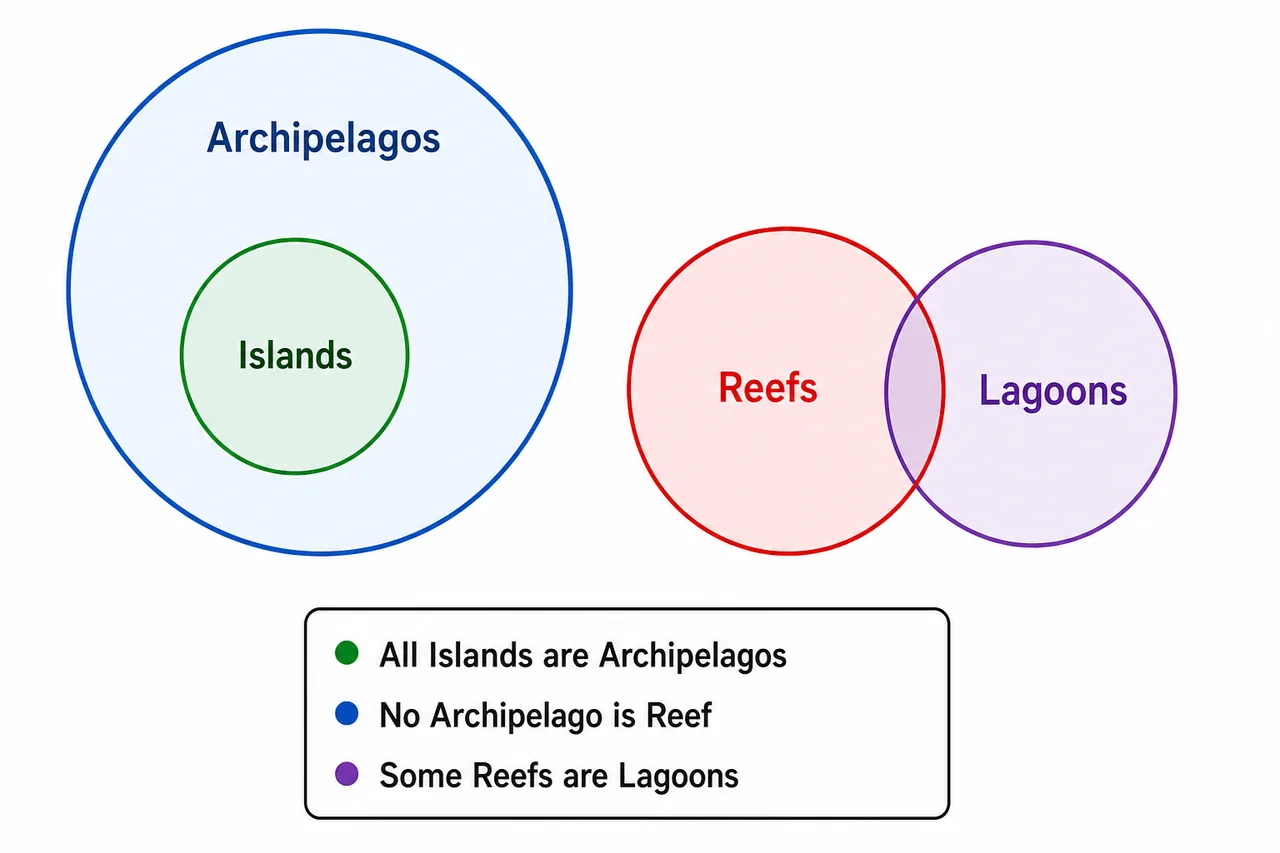
I. No island is a reef → Islands inside Archipelagos, Reefs separate from Archipelagos → ✓ Follow
II. Some lagoons are reefs → ✓ Follow (given: Some reefs are lagoons → reverse)
III. Some archipelagos are islands → ✓ Follow (Islands inside Archipelagos → Some Archipelagos are Islands)
IV. All lagoons are reefs → Doubtful. Does not follow.
Answer: I, II, and III follow
Practice Set 2: "Only a Few" (Mains Level)
Statements:
- Only a few loans are deposits (Some loans are deposits + Some loans are not deposits)
- All deposits are assets
- No asset is a liability
- Some liabilities are equities
Conclusions:
I. Some loans are assets
II. Some loans are not assets
III. No deposit is a liability
IV. Some equities are not assets
V. Either II or "All loans are assets" follows
Solution:
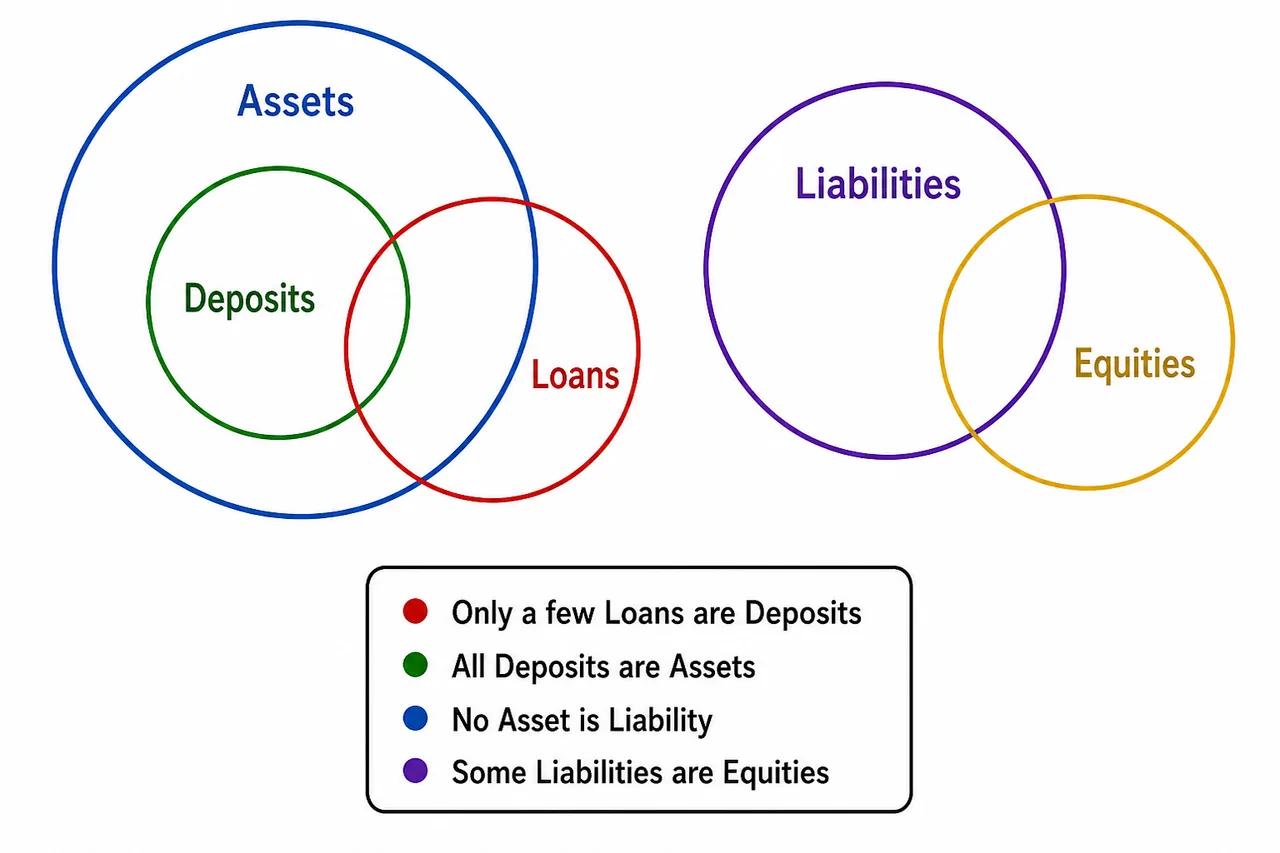
I. Some loans are assets → Some loans are deposits + All deposits are assets → Some loans are assets → ✓ Follow
II. Some loans are not assets → The "not deposits" part of loans could be inside or outside assets → Doubtful
III. No deposit is a liability → Deposits inside Assets, Liabilities separate from Assets → Deposits separate from Liabilities → ✓ Follow
IV. Some equities are not assets → Liabilities separate from Assets. Equities overlap Liabilities. The liability-equity overlap is outside assets → ✓ Follow
V. Conclusion II is doubtful. "All loans are assets" is also doubtful. They form a complementary pair (All ↔ Some Not) → ✓ Either-Or applies
Answer: I, III, IV follow. V (Either-Or) also applies for II.
Practice Set 3: Coded Syllogism (Mains Level)
Code:
| Symbol | Meaning |
|---|---|
| A $ B | All A are B |
| A # B | No A is B |
| A @ B | Some A are B |
| A % B | Some A are not B |
| A & B | Only a few A are B |
Statements:
- F & G (Only a few F are G → Some F are G + Some F are not G)
- G $ H (All G are H)
- H # J (No H is J)
- J @ K (Some J are K)
Conclusions:
I. F @ H (Some F are H)
II. G # J (No G is J)
III. F $ H (All F are H)
IV. J % H (Some J are not H)
Decode and solve:
- Some F are G + All G are H → Some F are H → I ✓ Follow
- G inside H, H separate from J → G separate from J → "No G is J" → II ✓ Follow
- All F are H → Doubtful (only "some" F are connected to H through G) → III Does not follow
- Some J are not H → J and H are completely separate (No H is J) → ALL J are not H → "Some J are not H" ✓ → IV ✓ Follow
Answer: I, II, IV follow
Practice Set 4: Reverse Syllogism (Mains Level)
Conclusions:
I. Some coaches are athletes
II. No athlete is a trainer
Which set of statements produces both conclusions?
- (a) All coaches are athletes. No trainer is an athlete.
- (b) Some coaches are athletes. All trainers are athletes.
- (c) Only a few coaches are athletes. No athlete is a trainer.
- (d) All athletes are coaches. Some trainers are athletes.
Eliminate:
- Conclusion II: "No athlete is a trainer"
- Option (b): "All trainers are athletes" contradicts "No athlete is a trainer"? If all trainers are athletes, then some athletes are trainers → "No athlete is a trainer" is false → ELIMINATE
- Option (d): "Some trainers are athletes" → some athletes are trainers → "No athlete is a trainer" is false → ELIMINATE
Remaining: (a) and (c)
- Option (a): "All coaches are athletes" → "Some coaches are athletes" ✓. "No trainer is an athlete" = "No athlete is a trainer" ✓. Both follow.
- Option (c): "Only a few coaches are athletes" → "Some coaches are athletes" ✓. "No athlete is a trainer" ✓. Both follow.
If only one answer is expected, option (a) gives the strongest statements. But both are technically valid.
Practice Set 5: New Pattern — Missing Statement
Given:
- All W are X
-
- Some Y are Z
Target conclusion: Some W are Z
Options:
- (a) No X is Y
- (b) All X are Y
- (c) Some W are Y
- (d) All Y are W
Solution:
- Need "Some W are Z"
- We have: All W are X, [missing], Some Y are Z
- We need a chain: W → X → ? → Y → Z (with "Some" at Y→Z)
If (b) "All X are Y": W inside X, X inside Y → W inside Y. Some Y are Z → W is inside Y, but Y-Z overlap might not include W → "Some W are Z" not guaranteed.
Actually: W inside X, X inside Y → W inside Y. Some Y are Z → the W part of Y might or might not overlap with Z. → Doubtful.
Hmm, let me reconsider. We need "Some W are Z":
If (c) "Some W are Y": Some W overlap Y. Some Y are Z. → Two "Some" links → uncertain.
If (d) "All Y are W": All Y inside W. Some Y are Z → the Y-Z overlap exists → those Y members that are Z are also inside W → "Some W are Z" ✓
Answer: (d) All Y are W
Chain: All W are X [not needed], All Y are W, Some Y are Z → the Y-Z overlap is inside W → Some W are Z ✓
The 5 Golden Rules for Exam Day
Rule 1: Convert first, think later
- Write "Only X are Y" → "All Y are X" immediately. Don't try to reason with "Only" in your head.
Rule 2: One diagram, not multiple
- Draw ALL statements on ONE Venn diagram. Multiple diagrams lead to errors.
Rule 3: Chain shortcuts
All + All = All ✓
All + No  = No ✓
Some + All = Some ✓
Everything else = Uncertain
Rule 4: Check Either-Or last
- If individual conclusions don't follow, check for complementary pairs:
- All ↔ Some Not (same direction)
- Some ↔ No (same elements)
Rule 5: Possibility ≠ Follow
- "X is a possibility" → True if X is doubtful or definite
- "X follows" → True ONLY if X is definite
Common Exam Traps — Complete List
| Trap | How to Avoid |
|---|---|
| "All X are Y" → "All Y are X" | NEVER reverse "All". Write "≠ reverse" on rough paper |
| "Some X are not Y" → "Some Y are not X" | NEVER reverse "Some Not". It's one-directional |
| "Only X are Y" treated as "All X are Y" | ALWAYS convert: "Only X are Y" → "All Y are X" |
| "Only a few" treated as "Only" | Completely different! "Only a few" = Some + Some Not |
| "A few" treated as "Only a few" | "A few" = "Some" only. No "Some Not" component |
| Either-Or when one conclusion is definite | Either-Or only when BOTH are doubtful |
| "Not possible" vs "Does not follow" | "Not possible" = definitely false. "Does not follow" = could be doubtful OR false |
| Percentage conversion: 90% treated as "All" | 90% = Some. Only 100% = All |
| Reverse syllogism: not checking all conclusions | ALL given conclusions must follow from the chosen statements |
| Coded: carrying over symbols from previous question | Re-read the code table for each new question set |
Difficulty Progression for Self-Study
| Week | Focus | Practice Sets |
|---|---|---|
| Week 1 | All, No, Some basics | 10 sets (3 statements, 2-3 conclusions) |
| Week 1 | Possibility concept | 10 sets |
| Week 2 | Some Not + "Only a few" | 10 sets |
| Week 2 | "Only" / "None but" | 10 sets |
| Week 3 | Either-Or | 10 sets |
| Week 3 | Multi-statement (4-6) | 10 sets |
| Week 4 | Coded Syllogism | 5 sets |
| Week 4 | Reverse Syllogism | 5 sets |
| Week 4 | New Pattern (all types) | 10 sets |
After 4 weeks: You should solve any syllogism set in under 4 minutes, with 95%+ accuracy.
Quick Revision Checklist
Before the exam, review these concepts:
- All = inner circle. No = separate. Some = overlap. Some Not = partial outside.
- "Only X are Y" = All Y are X (direction flip)
- "Only a few X are Y" = Some X are Y + Some X are not Y
- "A few" = Some only (no "Some Not")
- Chain: All+All=All, All+No=No, Some+All=Some
- Chain breaks: Some+Some, Some+No, No+All → uncertain
- Complementary pairs: All↔SomeNot, Some↔No
- Either-Or: BOTH must be doubtful
- Possibility: anything that doesn't contradict is possible
- Percentages: 0%=No, 100%=All, rest=Some
- Coded: ALWAYS decode first, then solve normally
- Reverse: Elimination first, then verify
- "Some not" is NOT reversible
- "Some" IS reversible. "No" IS reversible.
Summary Cheat Sheet
| Concept / Topic | Key Details / Explanation |
|---|---|
| Exam timing — Prelims | 3 questions, simple statements → Target 2 minutes total (~40 sec per question). |
| Exam timing — Mains | 5 questions, complex statements → Target 4 minutes total (~1 min per question). |
| Phase breakdown | Read statements: 15-20s | Convert & Draw: 30-45s | Check each conclusion: 15-20s each |
| 15-second classification | All/Every/Each/100% → inner circle. No/None/0% → separate. Some/A few/30-90% → overlap. Only X are Y → write "All Y are X" (flip!). Only a few X are Y → S:X∩Y + S:X∉Y. None but X are Y → "All Y are X". |
| 5 Golden Rules | 1) Convert first, think later. 2) One diagram, not multiple. 3) Use chain shortcuts. 4) Check Either-Or last. 5) Possibility ≠ Follow. |
| Chain shortcuts (memorize) | All+All=All ✓ | All+No=No ✓ | Some+All=Some ✓ | Everything else = Uncertain. |
| Either-Or check (do last) | After individual conclusions fail, check: All↔SomeNot (same direction) or Some↔No (same elements). BOTH must be doubtful. |
| Possibility ≠ Follow | "X is a possibility" → true if X is doubtful OR definite. "X follows" → true ONLY if X is definite. |
| Trap: "All X are Y" → "All Y are X" | NEVER reverse "All". Write "≠ reverse" on rough paper at exam start. |
| Trap: "Some X are not Y" reversed | "Some not" is one-directional. Never reverse it. "Some not X→Y" ≠ "Some not Y→X". |
| Trap: "Only" vs "Only a few" vs "A few" | "Only X are Y" = All Y are X (direction flip, definite). "Only a few" = Some + Some Not (two statements). "A few" = Some only (one statement). |
| Trap: Either-Or when one is definite | Either-Or applies ONLY when BOTH conclusions are individually doubtful. If one is definite, it's not Either-Or. |
| Trap: "Not possible" vs "Does not follow" | "Not possible" = definitely false in ALL diagrams. "Does not follow" = could be doubtful OR false. These are different. |
| Trap: Percentage conversion | 90% = Some (NOT All). Only 100% = All. Only 0% = No. |
| Trap: Reverse syllogism | Check ALL given conclusions against the chosen statement set. One missed conclusion = wrong answer. |
| Trap: Coded — symbol carry-over | Re-read the code table for EACH new question set. Symbols change between sets. |
| Trap: Cross-direction Either-Or | "All X are Y" ↔ "Some Y are not X" — cross direction, NOT complementary. Answer = Neither follows. |
| Self-study progression | Week 1: All/No/Some basics + Possibility. Week 2: Some Not + Only a few + Only. Week 3: Either-Or + Multi-statement (4-6). Week 4: Coded + Reverse + New Patterns. |
| Target accuracy | After 4 weeks: any syllogism set under 4 minutes, 95%+ accuracy. |