🚀 New Pattern & Advanced Problems
Master column-matching, statement combination, contradiction detection, missing statement problems, and other advanced syllogism patterns from SBI PO Mains and RBI Grade B
New Pattern & Advanced Problems
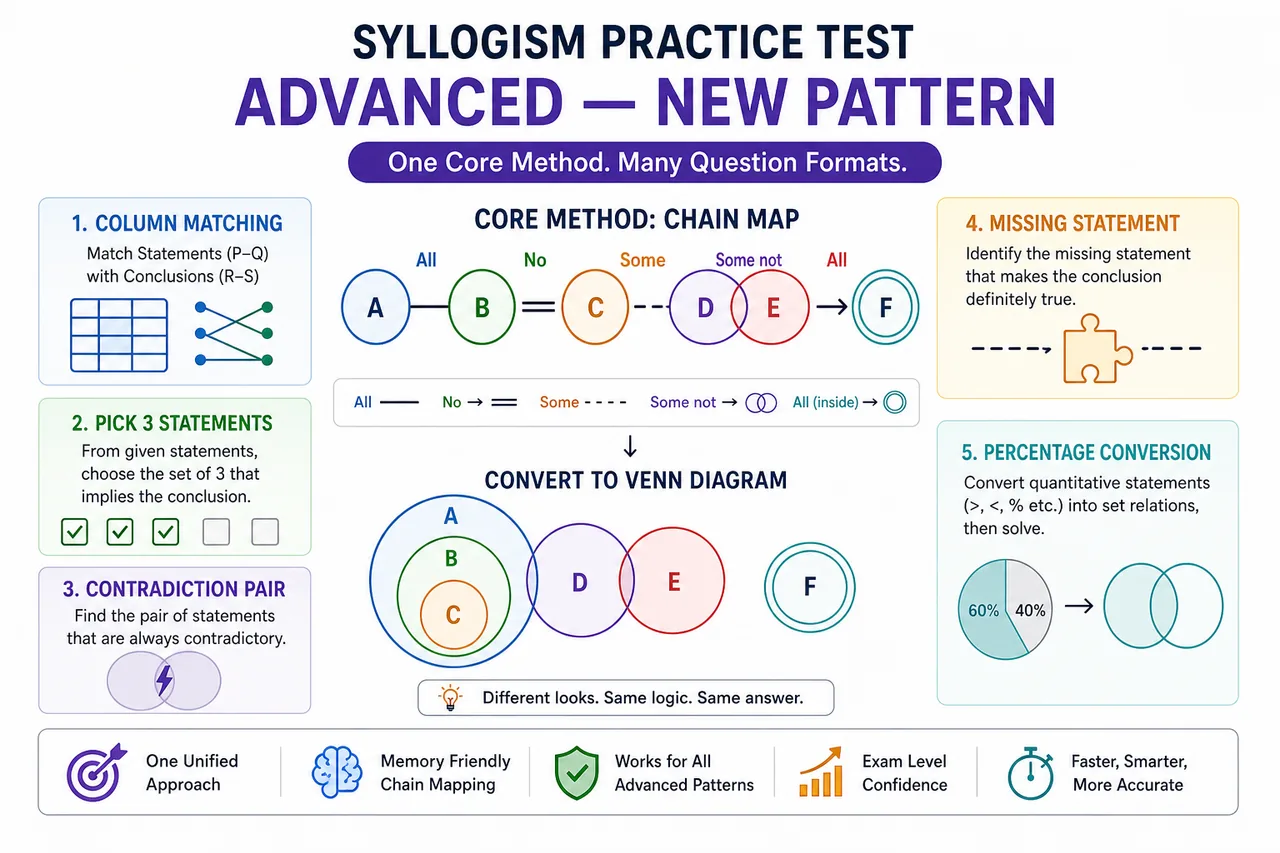
Advanced syllogism questions go beyond the traditional "statements → conclusions" format. SBI PO Mains and RBI Grade B feature new pattern questions that test deeper logical reasoning. This lesson walks through every modern format you will encounter.
Type 1: Column Matching
Format: Two columns are provided. Column I contains statements, Column II contains conclusions. Your task is to determine which statement(s) lead to which conclusion(s).
Example:
Column I (Statements): (W) All clouds are rain (X) No rain is a storm (Y) Some storms are thunder (Z) All thunder are lightning
Column II (Conclusions): (p) No cloud is a storm (q) Some lightning are storms (r) Some thunder are lightning (s) No cloud is thunder
Pro Content Locked
Upgrade to Pro to access this lesson and all other premium content.
Pay once for one year · Effective ₹99/mo
- All Agriculture & Banking Courses
- AI Lesson Questions (100/day)
- AI Doubt Solver (50/day)
- Glows & Grows Feedback (30/day)
- AI Section Quiz (20/day)
- 22-Language Translation (100/day)
- Recall Questions (20/day)
- AI Quiz (15/day)
- AI Quiz Paper Analysis (100/day)
- AI Step-by-Step Explanations (100/day)
- Spaced Repetition Recall (FSRS)
- AI Tutor
- Immersive Text Questions
- Audio Lessons — Hindi & English
- Mock Tests & Previous Year Papers
- Summary & Mind Maps
- XP, Levels, Leaderboard & Badges
- Generate New Classrooms
- Voice AI Teacher (AgriDots Live)
- AI Revision Assistant
- Knowledge Gap Analysis
- Interactive Revision (LangGraph)
🔒 Secure one-time yearly payment via Razorpay · No hidden fees
New Pattern & Advanced Problems
Advanced syllogism questions go beyond the traditional "statements → conclusions" format. SBI PO Mains and RBI Grade B feature new pattern questions that test deeper logical reasoning. This lesson walks through every modern format you will encounter.
Type 1: Column Matching
Format: Two columns are provided. Column I contains statements, Column II contains conclusions. Your task is to determine which statement(s) lead to which conclusion(s).
Example:
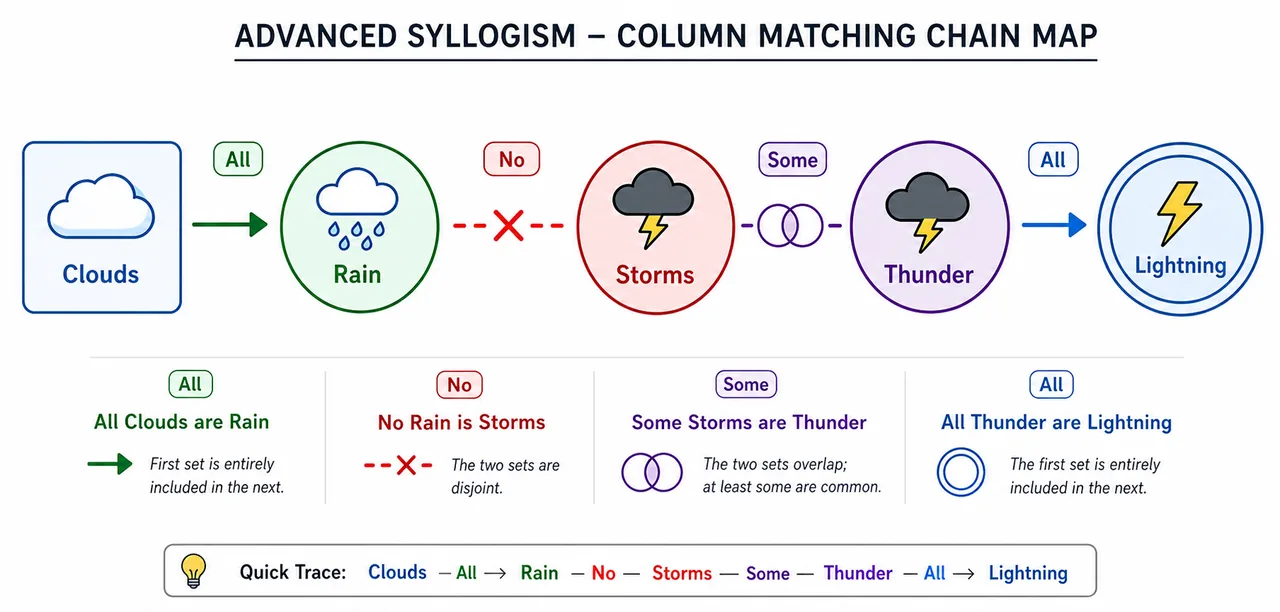
Column I (Statements): (W) All clouds are rain (X) No rain is a storm (Y) Some storms are thunder (Z) All thunder are lightning
Column II (Conclusions): (p) No cloud is a storm (q) Some lightning are storms (r) Some thunder are lightning (s) No cloud is thunder
Q: Conclusion (p) follows from which combination of statements?
Solve:
Q: Conclusion (r) "Some thunder are lightning" follows from?
- We need a relationship between thunder and lightning
- Statement (Z): All thunder are lightning → thunder inside lightning → Some thunder are lightning ✓
- Answer: (Z) alone
Solving Column Matching Efficiently
-
For each conclusion, identify which two elements are involved
-
Find statements that contain those elements or connect to them through intermediaries
-
Verify the chain from statements to conclusion
Speed trick: Build a relationship map:
clouds ──All──> rain ──No──> storms ──Some──> thunder ──All──> lightning
Then trace the path between the elements in each conclusion.
Type 2: Pick 3 Statements from 6
Format: Six statements are given. You must pick exactly 3 that together make a given conclusion true.
Example:
Statements: (W) All J are K (X) No K is L (Y) Some L are M (Z) All M are N (V) Some J are L (U) No N is J
Q: Which 3 statements make "Some N are not J" definitely true?
Solution:
Try (Y) + (Z) + (U):
- Some L are M → some overlap
- All M are N → M inside N → the L-M overlap is inside N
- No N is J → N separate from J
Wait — if No N is J, then ALL N are not J, which means "Some N are not J" is definitely true ✓
But does this use the right 3? (Y) Some L are M isn't needed if (Z) + (U) already give "No N is J" → "Some N are not J" ✓
Actually, we need N to have members first. (Z) All M are N tells us N is non-empty (if M exists). But we need to confirm M exists... (Y) gives us L-M overlap, confirming M exists.
Hmm, actually for "Some N are not J", we need N to exist and some N to be outside J. From "No N is J" → ALL N are outside J → "Some N are not J" follows as long as N is non-empty.
Simplest: (X) + (Z) + (U) or just (Z) + (U) + any statement confirming N exists.
The key is finding the minimum set of 3 that creates the chain.
Type 3: Contradiction Detection
Format: Given a set of statements, identify which pair of conclusions cannot both be true simultaneously.
Example:
Statements:
- All G are H
- Some H are J
- No J is K
Conclusions: (I) Some G are J (II) No G is J (III) Some H are K (IV) No H is K
Q: Which pair of conclusions cannot be true together?
Analysis:
- (I) "Some G are J" and (II) "No G is J" → These are direct contradictions (Some overlap ↔ No overlap). Cannot both be true.
- (III) "Some H are K" and (IV) "No H is K" → Same contradiction pattern. Cannot both be true.
Answer: (I, II) and (III, IV) are contradictory pairs
Contradiction rules:
| Pair | Contradicts? |
|---|---|
| All X are Y ↔ Some X are not Y | Yes |
| Some X are Y ↔ No X is Y | Yes |
| All X are Y ↔ No X is Y | Yes (these are "contraries" — both can be false, but both cannot be true) |
| Some X are Y ↔ Some X are not Y | No (both can be true simultaneously) |
Type 4: Missing Statement Problems
Format: Given some statements and a target conclusion, find which additional statement would make the conclusion true.
Example:
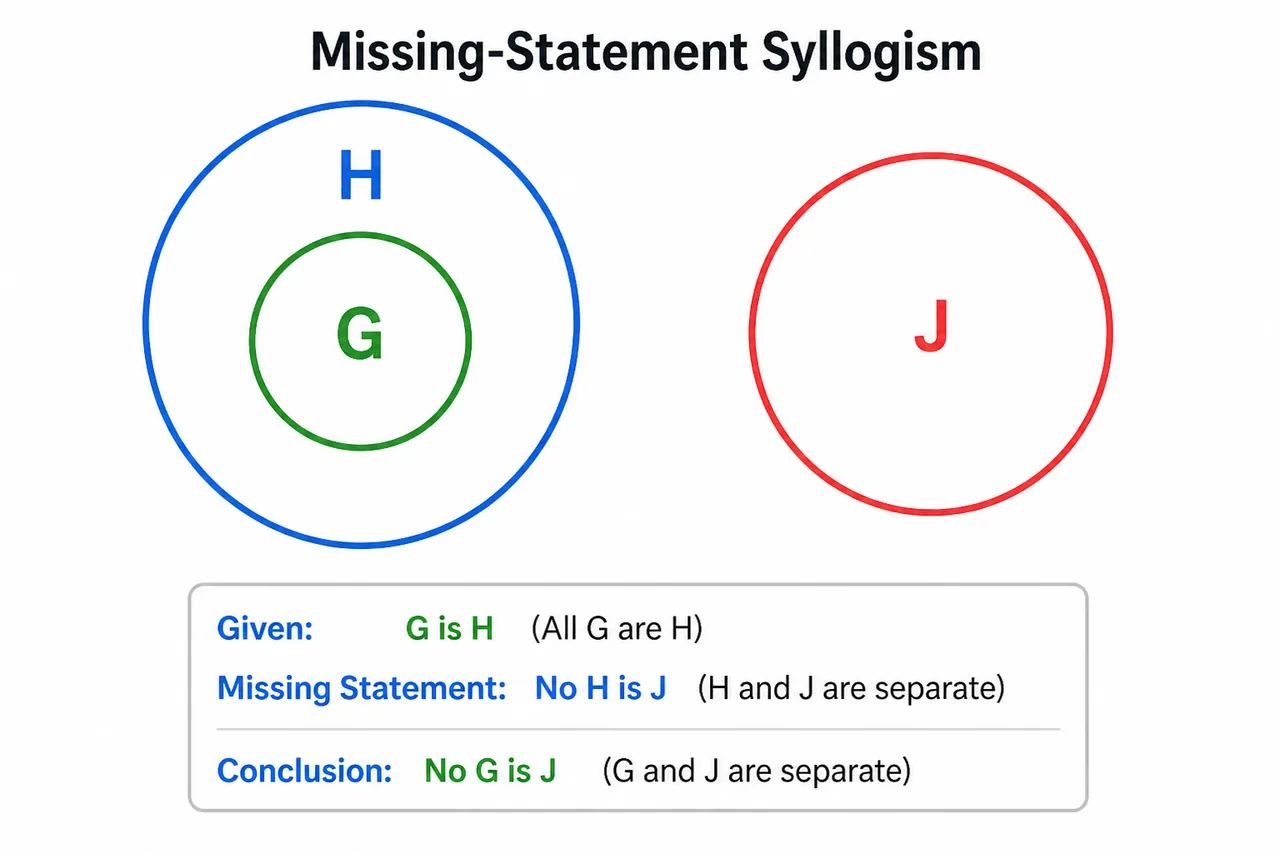
Given statements:
- All G are H
- _________ (missing)
Target conclusion: No G is J
Options: (a) All J are G (b) No H is J (c) Some H are J (d) All J are H
Solution:
- We need "No G is J"
- We know "All G are H" (G inside H)
- If "No H is J" (H separate from J) → G inside H, H separate from J → G separate from J → "No G is J" ✓
Answer: (b) No H is J
Approach:
- What relationship do we need? (G separate from J)
- What do we already know? (G inside H)
- What would create the needed relationship? (H separate from J would separate G from J)
Type 5: Logically Related Statement Combinations
Format: Multiple statement groups are given. Determine which group produces valid conclusions.
Example:
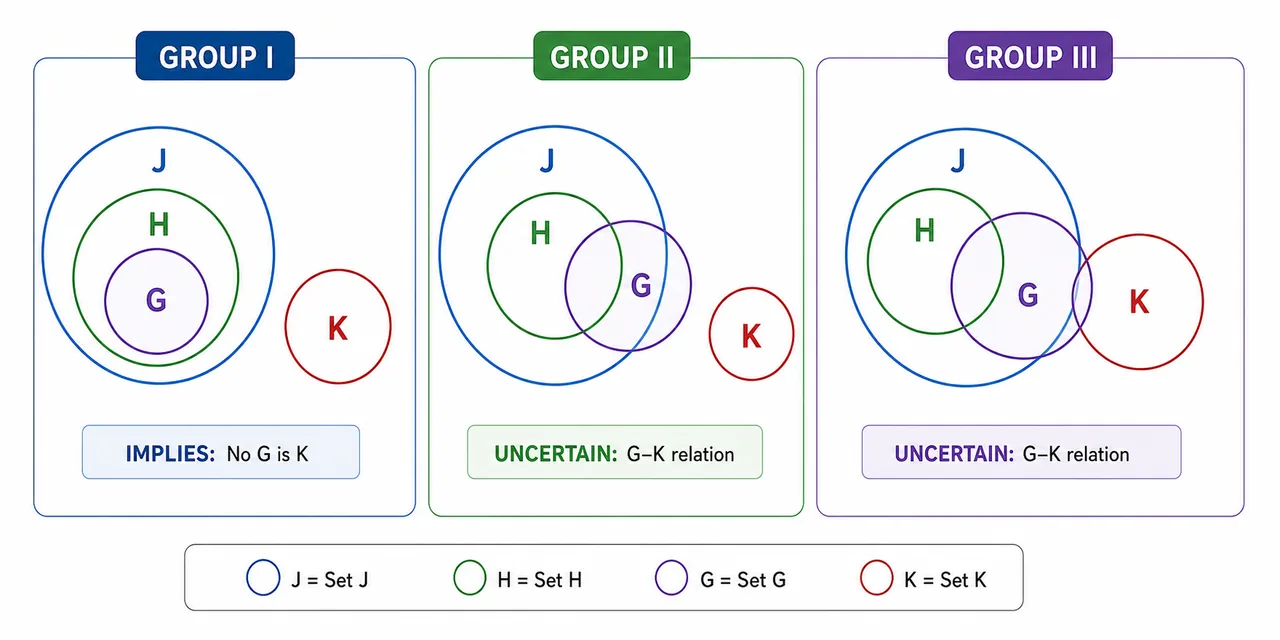
Group I: All G are H. All H are J. No J is K. Group II: Some G are H. All H are J. Some J are K. Group III: No G is H. All H are J. All J are K.
Q: From which group(s) can we conclude "No G is K"?
Group I: G inside H, H inside J, K separate from J → G inside J → G separate from K → "No G is K" ✓
Group II: Some G are H, All H inside J, Some J overlap K → G-K relationship uncertain → "No G is K" not definite ✗
Group III: G separate from H, H inside J, J inside K → G separate from H, but G could overlap with J or K → "No G is K" not definite ✗
Answer: Only Group I
Type 6: Percentage-Based Advanced
Modern exams use percentages to create complex scenarios:
Statements:
- 90% of G are H (= Some G are H)
- 30% of H are J (= Some H are J)
- 0% of J are K (= No J is K)
- 40% of K are L (= Some K are L)
- 75% of L are G (= Some L are G)
- 100% of G are M (= All G are M)
For syllogism purposes, convert all percentages:
- 0% = No
- 100% = All
- 1%-99% = Some
Then solve normally.
But some questions ask about the PERCENTAGE explicitly:
Q: "Can we say 100% of G are J?"
- We know "Some G are H" and "Some H are J"
- Two "Some" links → No definite conclusion about all G being J
- Answer: Cannot be determined
Q: "Is it possible that 0% of G are K?"
- We need to check if "No G is K" is possible
- G → H (Some), H → J (Some), J → K (No)
- The chain has "Some" breaks, so G-K relationship is uncertain
- "No G is K" is possible ✓
Solving Strategy for New Patterns
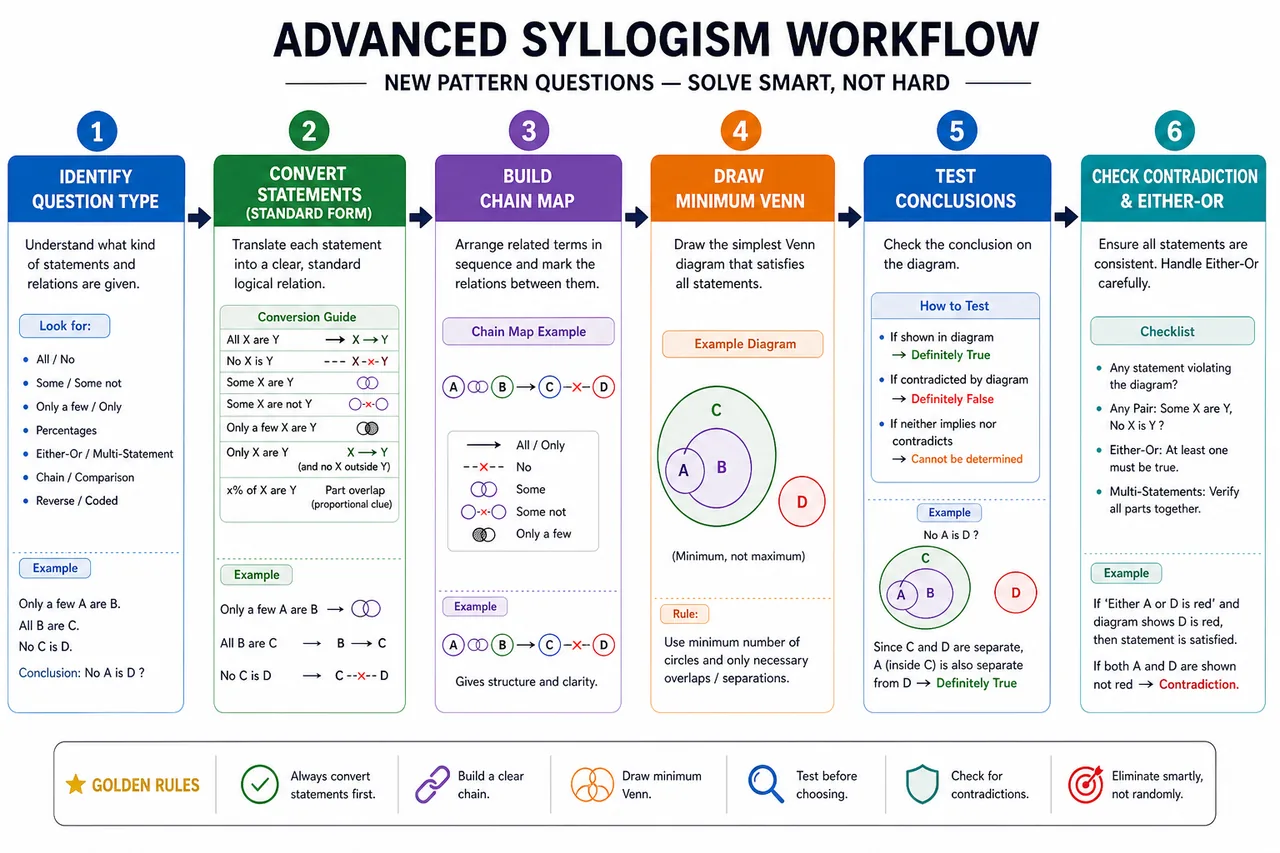
Step 1: Identify the question type (Column match / Pick 3 / Contradiction / Missing / Percentage)
Step 2: Convert all statements to standard form (especially percentages and "Only a few" / "Only")
Step 3: Build the relationship chain on rough paper:
G ──All──> H ──No──> J ──Some──> K ──All──> L
Step 4: For the specific question:
- Column match → trace path between conclusion elements
- Pick 3 → find minimum connecting chain
- Contradiction → find opposing pairs
- Missing → identify the gap in the chain
- Percentage → convert and solve normally
Practice Problems
Problem 1: Column Matching
Statements: (W) All flutes are drums (X) No drum is a guitar (Y) Some guitars are violins (Z) All violins are instruments
Conclusions: (p) No flute is a guitar (q) Some instruments are guitars (r) Some violins are instruments
Match:
- (p) needs flute-guitar relationship → (W) + (X): flutes→drums, drums✗guitars → flutes✗guitars ✓
- (q) needs instrument-guitar relationship → (Y) + (Z): Some guitars are violins + All violins are instruments → Some guitars are instruments → Some instruments are guitars ✓
- (r) needs violin-instrument relationship → (Z) alone: All violins are instruments → Some violins are instruments ✓
Problem 2: Missing Statement
Given: _____ . All H are J. Conclusion needed: Some G are J.
Options: (a) No G is H (b) Some G are H (c) All J are G (d) No G is J
Solution:
- Need "Some G are J"
- We have "All H are J" (H inside J)
- If "Some G are H" → Some G overlap with H → that overlap is inside J → "Some G are J" ✓
Answer: (b)
Problem 3: Contradiction
Statements: All J are K. Some K are L. No L is M.
Which pair CANNOT both be true? (a) "Some J are L" and "No J is L" (b) "Some K are M" and "Some K are not M" (c) "All L are K" and "Some L are not K"
Solution:
(a) "Some J are L" ↔ "No J is L" → Contradictory (Some ↔ No) ✓
(b) "Some K are M" ↔ "Some K are not M" → Both CAN be true simultaneously ✗
(c) "All L are K" ↔ "Some L are not K" → Contradictory (All ↔ Some not) ✓
Answer: (a) and (c)
Type 7: "At Least" and "At Most" Keyword Patterns
Modern exams (SBI PO Mains 2023-25, IBPS PO) have introduced "at least" and "at most" phrasing. These are NOT the same as "Some" or "All".
Keyword Conversion Table:
| Exam Keyword | Logical Meaning | Standard Form |
|---|---|---|
| At least some X are Y | Some X are Y (minimum overlap) | Some X are Y |
| At least all X are Y | All X are Y (minimum = all) | All X are Y |
| At most some X are Y | Some or None (maximum = some) | NOT "All X are Y" |
| At most all X are Y | All or Some or None (no constraint) | No useful info |
| At least no X is Y | No X is Y (minimum separation) | No X is Y |
Key Insight: "At least" sets a minimum — the reality could be stronger. "At most" sets a maximum — the reality could be weaker.
"At Least" Examples:
Q: "At least some G are H" — what follows?
- This means: minimum overlap = Some. Could be All G are H.
- "Some G are H" → ✓ Follow (guaranteed minimum)
- "All G are H" → ? Doubtful (possible, not guaranteed)
- "No G is H" → ✗ Not possible
Q: "At least all G are H" — what follows?
- This means: minimum = All G are H. G is definitely inside H.
- Same as "All G are H" — use normal "All" rules.
"At Most" Examples:
Q: Statement says "At most some G are H" — what follows?
- This means: maximum overlap = Some. It's NOT the case that All G are H.
- "Some G are not H" → ✓ Follow (since not all G are H, some must be outside)
- "All G are H" → ✗ Not possible (violates the "at most" limit)
- "Some G are H" → ? Doubtful (there might be zero overlap — "at most some" allows "None")
- "No G is H" → ? Doubtful (possible — zero is ≤ some)
This is tricky! "At most some" means the overlap is anywhere from 0% to partial — it could be zero!
Practice Problem:
Statements:
- At least some rivers are lakes
- All lakes are reservoirs
- At most some reservoirs are dams
Conclusions:
- Some rivers are reservoirs → ?
- All rivers are reservoirs → ?
- All reservoirs are dams → ?
- Some lakes are not dams → ?
Solution:
-
"At least some rivers are lakes" = "Some rivers are lakes" (minimum). Some rivers are lakes + All lakes are reservoirs → Some rivers are reservoirs → ✓ Follow
-
"All rivers are reservoirs" → Doubtful (we only know "some rivers are lakes", not all) → Does not follow
-
"All reservoirs are dams" → "At most some" means NOT all → ✗ Definitely False
-
"Some lakes are not dams" → Lakes inside reservoirs. "At most some reservoirs are dams" means some reservoirs might not be dams. But we can't guarantee the lake portion is in the non-dam part. → Doubtful, does not follow (but IS a possibility)
Common Mistakes
- Column matching: Not checking the full chain. Two statements might seem sufficient but miss an intermediate link.
- Pick 3: Selecting statements that don't connect. All 3 must form a continuous chain.
- Contradiction: Confusing "contraries" (both can be false) with "contradictories" (one must be true). For syllogism: All↔Some not and Some↔No are true contradictories.
- Missing statement: Not considering the direction. "All G are H" and "All H are G" are different!
- Percentage traps: Treating 90% as "All" instead of "Some". Any percentage 1-99% = Some.
Summary Cheat Sheet
| Concept / Topic | Key Details / Explanation |
|---|---|
| Type 1: Column Matching | Column I = statements, Column II = conclusions. Identify which statements form the chain needed for each conclusion. Build a relationship map (A──All──>B──No──>C) and trace paths. |
| Column matching strategy | For each conclusion, identify the two elements involved → find statements containing those elements or intermediaries → verify the chain. |
| Type 2: Pick 3 from 6 | Given 6 statements, pick exactly 3 that together make a target conclusion true. Find the minimum connecting chain. All 3 must be continuous. |
| Pick 3 key insight | For "Some N are not J": if "No N is J" is achievable through 3 statements, then "Some N are not J" follows automatically (all not → some not). Confirm N is non-empty via the third statement. |
| Type 3: Contradiction Detection | Find which pair of conclusions cannot both be true. Use contradiction rules: All ↔ Some Not (contradictory), Some ↔ No (contradictory), All ↔ No (contrary — both can be false, but cannot both be true). |
| Contrary vs Contradictory | Contradictory: exactly one must be true (All↔SomeNot, Some↔No). Contrary: both can be false but not both true (All↔No). |
| "Some X are Y" + "Some X are not Y" | These are NOT contradictory — both CAN be true simultaneously (partial overlap satisfies both). |
| Type 4: Missing Statement | Given some statements + target conclusion, find which additional statement completes the chain. Work backwards: what gap needs to be filled to connect the elements? |
| Missing statement approach | 1) What relationship is needed? 2) What is already known? 3) What would bridge the gap? — Usually a statement connecting the middle element to the target. |
| Type 5: Logically Related Groups | Multiple statement groups given; determine which group produces the target conclusion. Apply chain analysis to each group separately. |
| Type 6: Percentage-Based | Convert all percentages: 0% = No, 100% = All, 1-99% = Some. Then solve normally. "Can 100% of G be J?" = Can "All G are J" follow? Apply chain rules. |
| "At least some X are Y" | = Some X are Y (minimum). Some X are Y → ✓. All X are Y → Doubtful. No X is Y → impossible. |
| "At least all X are Y" | = All X are Y (minimum = all). Same as standard "All" rules. |
| "At most some X are Y" | = NOT All X are Y. Maximum is partial overlap. Some X are not Y → ✓ (definite). All X are Y → impossible. Some X are Y → Doubtful (could be zero). No X is Y → Doubtful (zero is ≤ some). |
| "At most" is tricky | "At most some" allows ZERO overlap. So "Some X are Y" is only possible, not definite. "No X is Y" is also possible. |
| General strategy for new patterns | 1) Identify question type. 2) Convert all statements. 3) Build relationship chain on rough paper. 4) Trace/fill/find/verify based on type. |