🔃 Reverse Syllogism
Master reverse syllogism where conclusions are given and you must find the correct set of statements. Learn the two-way verification method, direct relationship approach, and common term analysis
Reverse Syllogism
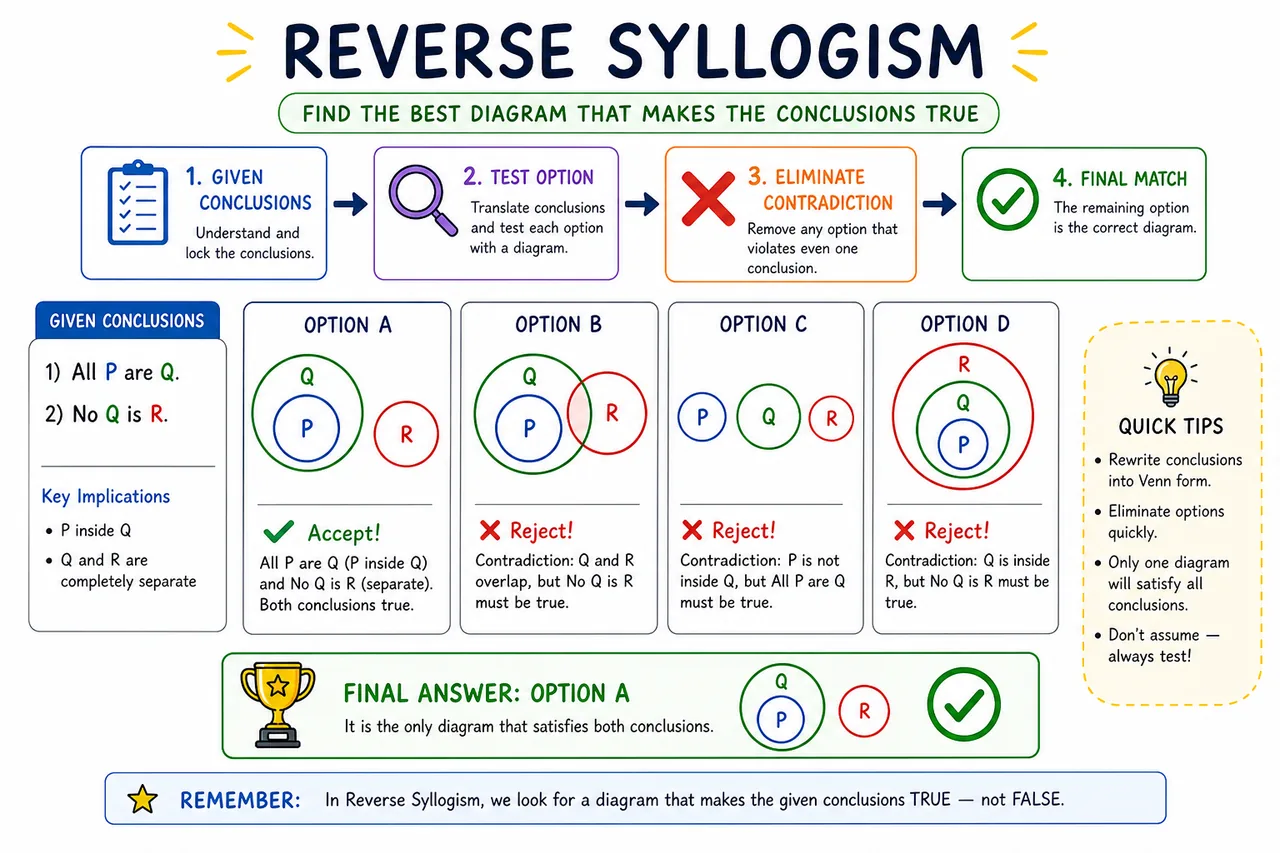
In reverse syllogism, the question format is flipped: You are given conclusions and must find which set of statements makes those conclusions true. This is a Mains-level topic appearing in SBI PO, IBPS PO, and RBI Grade B.
How Reverse Syllogism Works
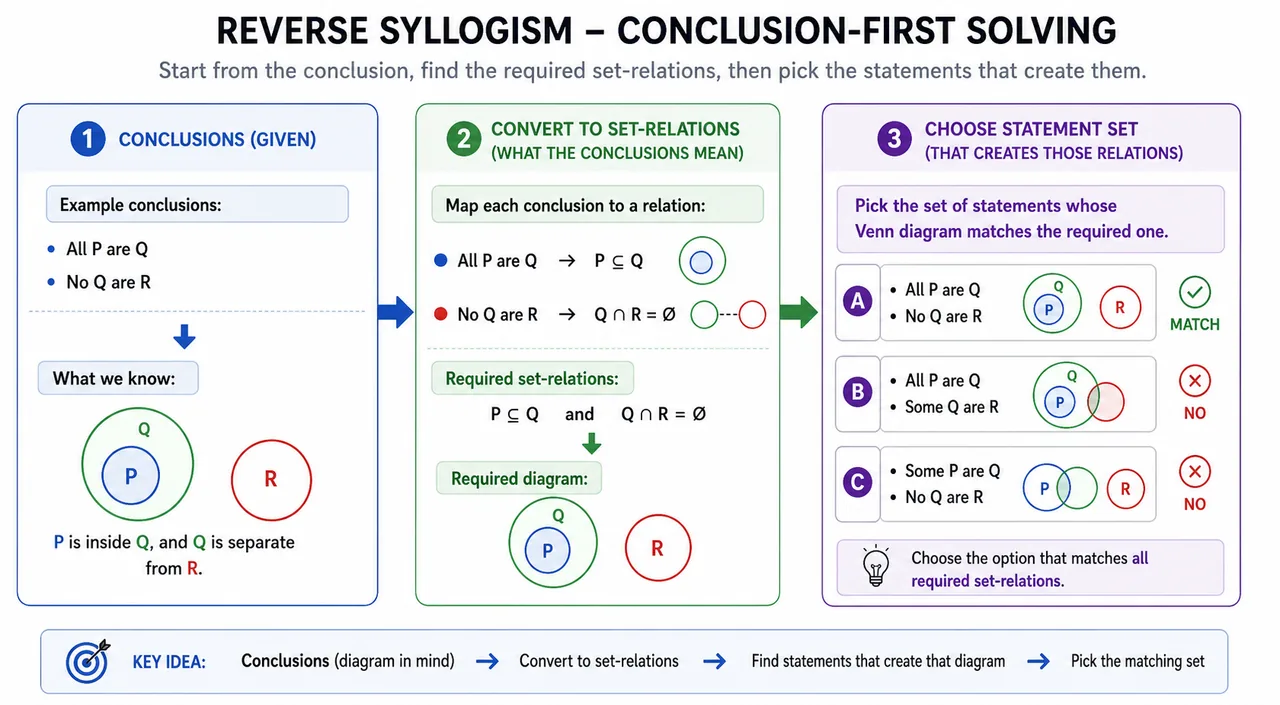
Normal Syllogism: Given: Statements → Find: Which conclusions follow
Reverse Syllogism: Given: Conclusions → Find: Which set of statements produces those conclusions
Typical format:
Conclusions: I. Some J are K II. No L is M
Which of the following statement sets makes both conclusions true?
- All J are K. Some L are M.
- Some K are J. All M are L.
- All K are J. No M is L.
- Some J are L. No K is M.
The Three Approaches
Approach 1: Two-Way Verification (Most Reliable)
Step 1: Take each option's statements
Pro Content Locked
Upgrade to Pro to access this lesson and all other premium content.
Pay once for one year · Effective ₹99/mo
- All Agriculture & Banking Courses
- AI Lesson Questions (100/day)
- AI Doubt Solver (50/day)
- Glows & Grows Feedback (30/day)
- AI Section Quiz (20/day)
- 22-Language Translation (100/day)
- Recall Questions (20/day)
- AI Quiz (15/day)
- AI Quiz Paper Analysis (100/day)
- AI Step-by-Step Explanations (100/day)
- Spaced Repetition Recall (FSRS)
- AI Tutor
- Immersive Text Questions
- Audio Lessons — Hindi & English
- Mock Tests & Previous Year Papers
- Summary & Mind Maps
- XP, Levels, Leaderboard & Badges
- Generate New Classrooms
- Voice AI Teacher (AgriDots Live)
- AI Revision Assistant
- Knowledge Gap Analysis
- Interactive Revision (LangGraph)
🔒 Secure one-time yearly payment via Razorpay · No hidden fees
Reverse Syllogism
In reverse syllogism, the question format is flipped: You are given conclusions and must find which set of statements makes those conclusions true. This is a Mains-level topic appearing in SBI PO, IBPS PO, and RBI Grade B.
How Reverse Syllogism Works
Normal Syllogism: Given: Statements → Find: Which conclusions follow
Reverse Syllogism: Given: Conclusions → Find: Which set of statements produces those conclusions
Typical format:
Conclusions: I. Some J are K II. No L is M
Which of the following statement sets makes both conclusions true?
- All J are K. Some L are M.
- Some K are J. All M are L.
- All K are J. No M is L.
- Some J are L. No K is M.
The Three Approaches
Approach 1: Two-Way Verification (Most Reliable)
Step 1: Take each option's statements
Step 2: Draw the Venn diagram
Step 3: Check if ALL given conclusions follow
Step 4: If yes → that's the answer. If no → try next option.
This is the safest method but can be slow for 4-5 options.
Approach 2: Direct Relationship (Fastest)
Step 1: Look at the conclusions — what relationships are needed?
Step 2: Scan options for statements that DIRECTLY establish those relationships
Step 3: Eliminate options that contradict the conclusions
Example: Conclusions: "Some J are K" and "No L is J"
Scan options:
- Any option with "All J are K" → makes "Some J are K" true ✓
- Any option with "Some J are K" → directly gives the conclusion ✓
- Any option with "No J is L" → makes "No L is J" true ✓
- Any option with "All J are L" → contradicts "No L is J" ✗ ELIMINATE
Approach 3: Common Term Analysis
Step 1: Check if conclusions share a common element
Step 2: If the statements must connect two conclusions through a common element, identify which option provides that link
Solved Example 1
Conclusions:
I. Some cars are trucks
II. Some trucks are not bikes
Options:
- All cars are trucks. No truck is a bike.
- Some trucks are cars. All bikes are trucks.
- All trucks are cars. Some bikes are not trucks.
- No car is a truck. All bikes are trucks.
Solution using Direct Relationship:
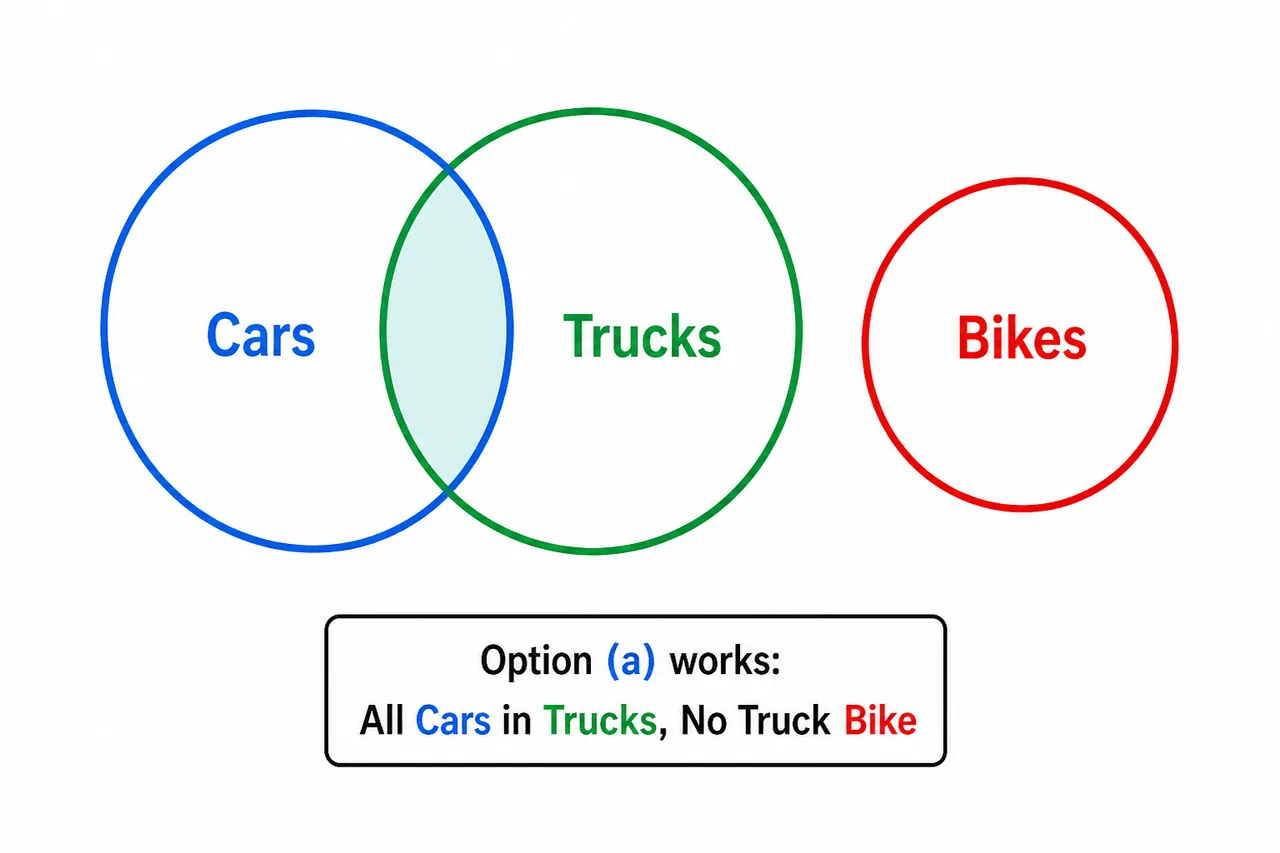
Conclusion I needs: "Some cars are trucks" — overlap between cars and trucks
- Option (d): "No car is a truck" → Directly contradicts Conclusion I → ELIMINATE
Conclusion II needs: "Some trucks are not bikes" — part of trucks outside bikes
- Option (a): "No truck is a bike" → ALL trucks are outside bikes → "Some trucks are not bikes" ✓
- Option (a): "All cars are trucks" → "Some cars are trucks" ✓ (All → Some)
Answer: (a)
Verify option (a):
Statements: All cars are trucks. No truck is a bike.
- "Some cars are trucks" → ✓ (from All cars are trucks)
- "Some trucks are not bikes" → ✓ (from No truck is a bike → All trucks are not bikes → Some trucks are not bikes)
Both conclusions follow. ✓
Solved Example 2
Conclusions:
I. All houses are towers
II. Some bridges are houses
Options:
- All houses are towers. All bridges are houses.
- Some houses are towers. Some houses are bridges.
- All houses are towers. Some bridges are houses.
- All towers are houses. All houses are bridges.
Solution:
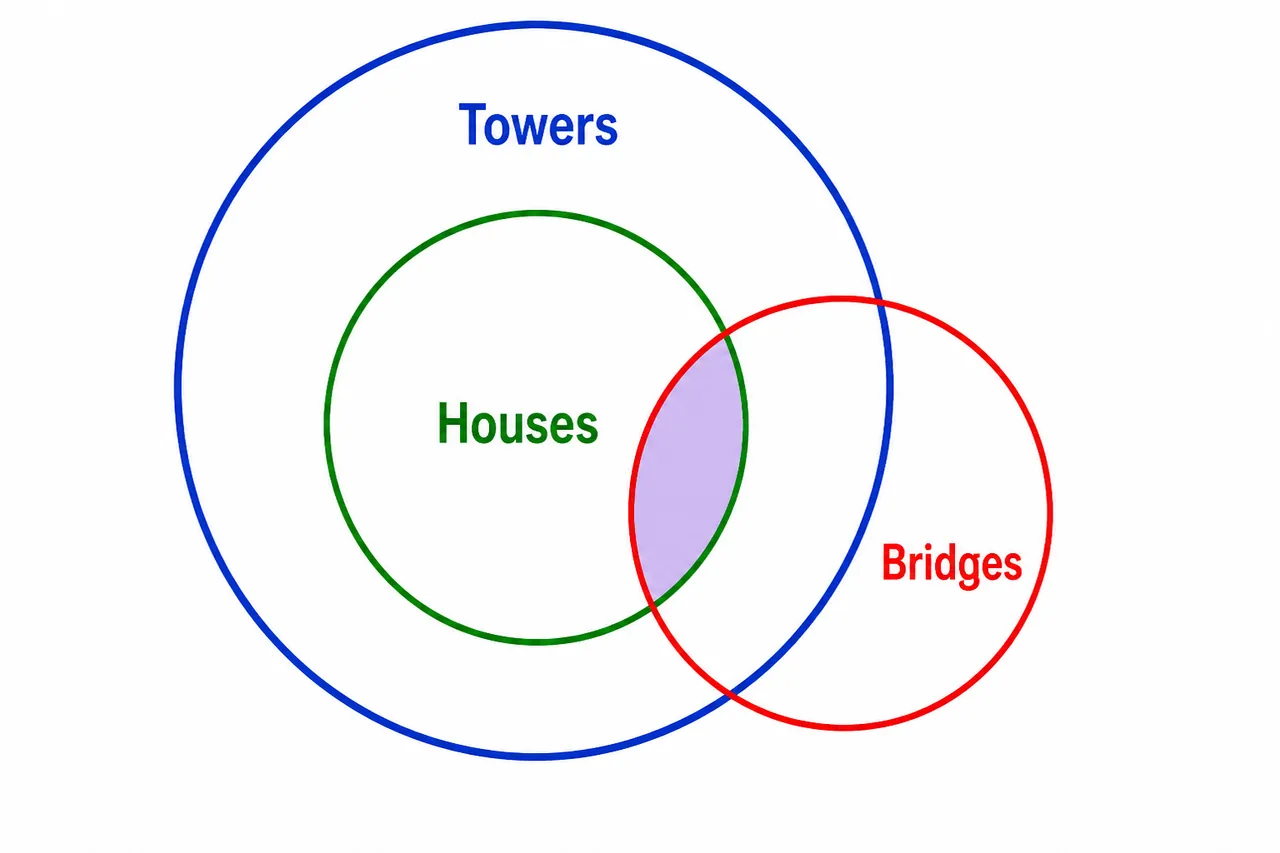
Conclusion I needs "All houses are towers" — definite "All" statement.
- Option (b): "Some houses are towers" → "Some" doesn't give "All" → Can it still work through chain? "Some houses are bridges"... no chain to get "All houses are towers" → ELIMINATE
- Option (d): "All towers are houses" → This gives "All towers are houses", NOT "All houses are towers" → Let's check if "All houses are bridges" helps. No. → ELIMINATE
Remaining: (a) and (c).
- Option (a): "All houses are towers" → Conclusion I ✓. "All bridges are houses" → "Some bridges are houses" ✓. Both follow.
- Option (c): "All houses are towers" → Conclusion I ✓. "Some bridges are houses" → Conclusion II ✓. Both follow.
Both (a) and (c) work.
If both work, check if the question asks for the BEST or ONLY option. Usually one option is the answer. In this case, both are valid, but option (c) is the more direct match (it contains the exact conclusions as statements).
Exam tip: When multiple options seem valid, pick the one that most directly matches the conclusions.
Solved Example 3: With "Only a Few"
Conclusions:
I. Some gold items are silver
II. Some gold items are not silver
Options:
- All gold items are silver.
- No gold item is silver.
- Only a few gold items are silver.
- Some silver items are gold.
Solution:
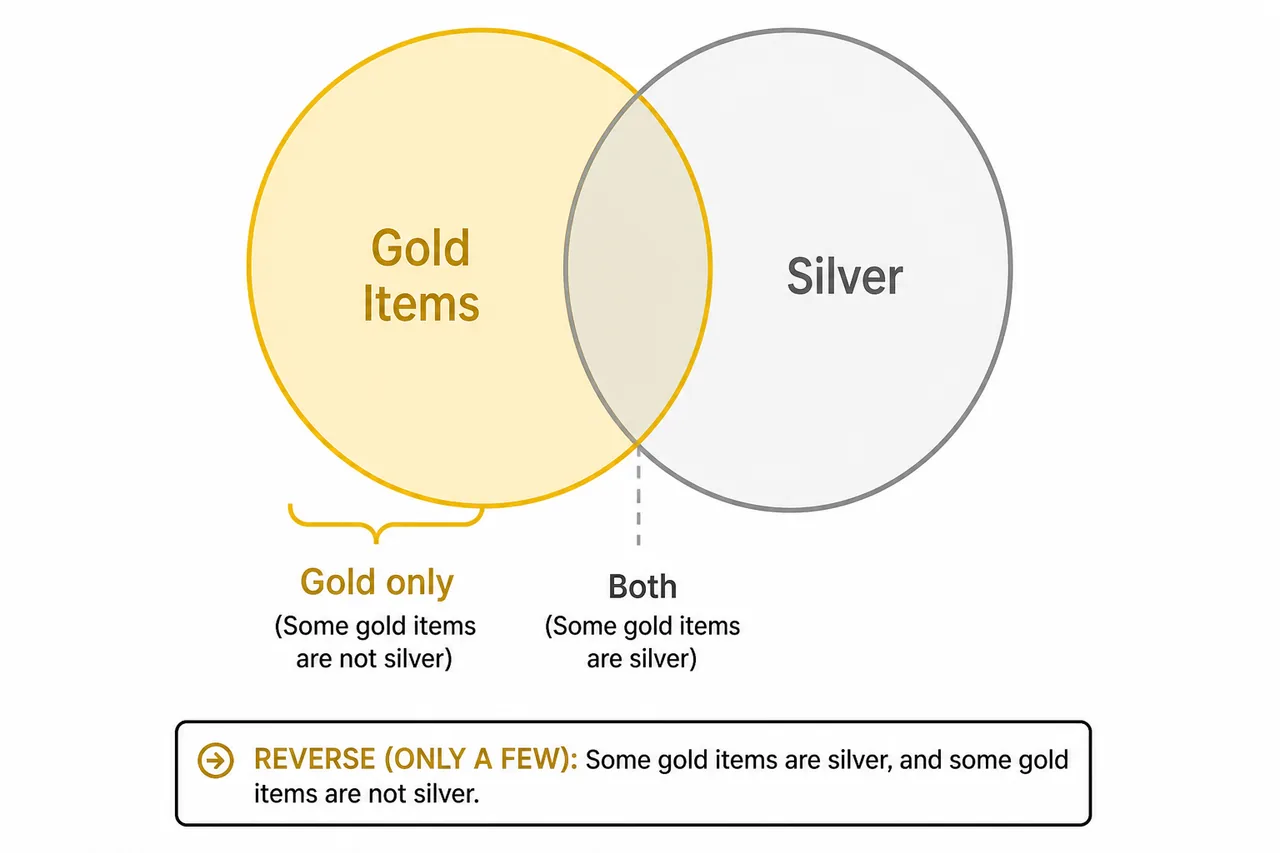
Both conclusions together mean: Some gold is IN silver AND some gold is OUTSIDE silver.
-
Option (a): "All gold items are silver" → "Some gold items are not silver" is IMPOSSIBLE → ELIMINATE
-
Option (b): "No gold item is silver" → "Some gold items are silver" is IMPOSSIBLE → ELIMINATE
-
Option (c): "Only a few gold items are silver" = Some gold items are silver + Some gold items are not silver → Both conclusions ✓
-
Option (d): "Some silver items are gold" → "Some gold items are silver" ✓, but "Some gold items are not silver" is Doubtful → Does not guarantee Conclusion II
Answer: (c)
Reverse Syllogism with Coded Statements
Some exams combine coded and reverse syllogism:
Conclusions:
I. E # F (No E is F)
II. Some G are E
Code:
- $ = All
- # = No
- @ = Some
- % = Some not
Options (coded):
- E $ G, G # F
- G @ E, E # F
- F $ E, G @ F
- E # F, G $ E
Decode options first:
- All E are G, No G is F → "No E is F" (through chain: E inside G, G separate from F → E separate from F) ✓. "Some G are E" (from All E are G → Some G are E) ✓.
- Some G are E, No E is F → Conclusion I: "No E is F" ✓ (given). Conclusion II: "Some G are E" ✓ (given). Both ✓.
Both (a) and (b) work. Pick the most direct match or check if there's a distinguishing factor.
Actually, re-examine option (a): "All E are G" → "Some G are E" ✓. "No G is F" → E inside G, G separate from F → "No E is F" ✓. Both follow.
Option (b): "Some G are E" ✓. "No E is F" ✓. Both follow directly.
In exams, typically only one option works. Re-read the code carefully to ensure correct decoding.
Elimination Strategy (Fastest Method)
For reverse syllogism, elimination is faster than verification:
- If a conclusion says "All X are Y": Eliminate any option that has "No X is Y" or "Some X are not Y" for those elements.
- If a conclusion says "No X is Y": Eliminate any option that has "All X are Y" or "Some X are Y" for those elements.
- If a conclusion says "Some X are Y": Eliminate any option that has "No X is Y" for those elements.
- If a conclusion says "Some X are not Y": Eliminate any option that has "All X are Y" for those elements.
After elimination, verify the remaining option(s).
Practice Problems
Problem 1: Conclusions: I. No P is Q II. Some R are P
Options: (a) All P are Q. Some Q are R. (b) No Q is P. All P are R. (c) No P is Q. Some R are Q. (d) Some P are not Q. All R are P.
Eliminate:
- Conclusion I: "No P is Q" → Option (a) has "All P are Q" → contradicts → ELIMINATE
- Conclusion I: "No P is Q" → Option (d) has "Some P are not Q" which is weaker, doesn't give "No" → check
Remaining: (b), (c), (d)
Option (b): "No Q is P" = "No P is Q" ✓. "All P are R" → "Some R are P" ✓. Answer: (b)
Problem 2: Conclusions: I. All players are coaches II. Some coaches are not referees
Options: (a) All players are coaches. No coach is a referee. (b) All coaches are players. Some referees are coaches. (c) All players are coaches. Some coaches are referees. (d) All players are coaches. Only a few coaches are referees.
Analysis:
- All options except (b) have "All players are coaches" → Conclusion I ✓
- Option (b): "All coaches are players" ≠ "All players are coaches" → Can we derive it? No additional info. → ELIMINATE
Check Conclusion II for remaining:
- Option (a): "No coach is a referee" → "Some coaches are not referees" ✓ (if none are, then some aren't)
- Option (c): "Some coaches are referees" → "Some coaches are not referees" is Doubtful → doesn't guarantee Conclusion II
- Option (d): "Only a few coaches are referees" → Some coaches are referees + Some coaches are not referees → Conclusion II ✓
Both (a) and (d) work. If the exam has only one answer, verify more carefully.
Option (a): "No coach is a referee" is stronger than needed. It gives "Some coaches are not referees" ✓. Option (d): "Only a few coaches are referees" directly gives "Some coaches are not referees" ✓.
Both are valid — pick based on exact exam wording.
Speed Tips
-
Start with elimination, not verification. It's faster to cross out wrong options.
-
Check the strongest conclusion first. "All" and "No" conclusions are easier to match.
-
Look for direct matches. If a conclusion says "No P is Q", look for options containing "No P is Q" or "No Q is P".
-
Reverse is just forward, backwards. Your Venn diagram skills apply equally.
-
For coded reverse: Decode ALL options first, then eliminate.
Common Mistakes
- Not checking ALL conclusions: An option must satisfy EVERY conclusion, not just one
- Direction errors: "All J are K" in statements gives "Some K are J", not "All K are J". Don't confuse when matching conclusions.
- Forgetting chain reasoning: Some conclusions follow from chains, not direct statements
- Coded + Reverse double confusion: Decode first (remove coding), then solve the reverse problem
Summary Cheat Sheet
| Concept / Topic | Key Details / Explanation |
|---|---|
| What is Reverse Syllogism? | Given = conclusions. Task = find which set of statements produces those conclusions. Normal syllogism is flipped. Appears in SBI PO, IBPS PO, RBI Grade B Mains. |
| Approach 1: Two-Way Verification | Take each option → draw Venn diagram → check if ALL conclusions follow. Most reliable but slower. |
| Approach 2: Direct Relationship (fastest) | Look at what each conclusion needs → scan options for statements that directly establish those relationships → eliminate contradictions. |
| Approach 3: Common Term Analysis | If conclusions share a common element, find the option that links them through that element. |
| Elimination strategy | Fastest method: eliminate before verifying. If conclusion says "No X is Y" → eliminate any option with "All X are Y" or "Some X are Y". If conclusion says "Some X are Y" → eliminate options with "No X is Y". |
| Elimination rules | "All X are Y" needed → eliminate "No/Some-not X are Y". "No X is Y" needed → eliminate "All/Some X are Y". "Some X are Y" needed → eliminate "No X is Y". "Some X are not Y" needed → eliminate "All X are Y". |
| ALL conclusions must be satisfied | The chosen statement set must make EVERY given conclusion true. Not just one. |
| "Only a few" as answer | If both "Some X are Y" AND "Some X are not Y" are needed as conclusions → "Only a few X are Y" directly satisfies both. |
| Direction errors in verification | "All J are K" gives "Some K are J" (not "All K are J"). Match carefully when conclusions need specific directions. |
| Chain reasoning in reverse | Some conclusions follow through chains, not direct statements. E.g., "All cars are trucks + No truck is a bike" → "Some trucks are not bikes" ✓ via chain. |
| Multiple valid options | When two options both satisfy all conclusions, pick the one that most directly matches the conclusions (fewer inferential steps). |
| Coded + Reverse problems | Decode ALL options first (convert to English), then eliminate. Don't try to reason in coded form. |
| "Some X are not Y" from "No X is Y" | If an option says "No X is Y" → that satisfies "Some X are not Y" as a conclusion (ALL not → some not). |
| Exam shortcut | Start by checking the strongest conclusion first (All or No). These are easiest to match and eliminate options quickly. |