🔐 Coded Syllogism
Master coded syllogism where statements use symbols instead of words like All/No/Some. Learn multiple coding systems, decoding strategies, and solve coded problems at exam speed
Coded Syllogism
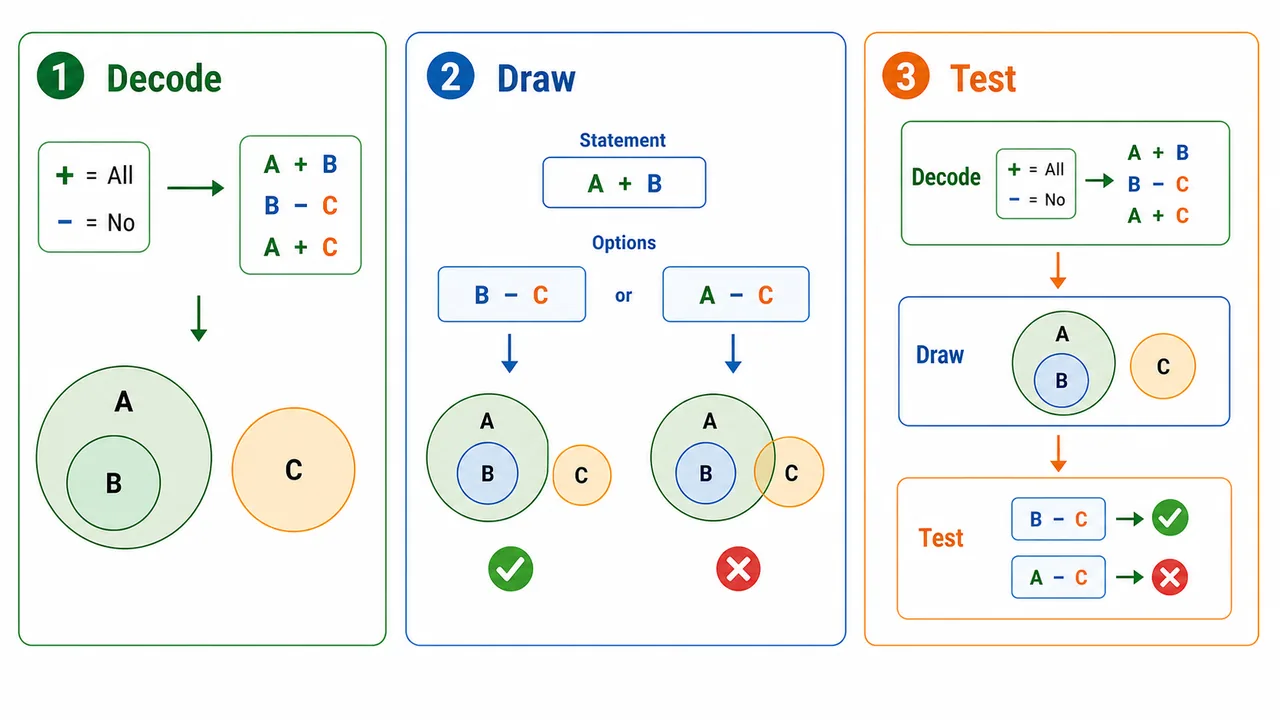
Coded Syllogism is a Mains-level topic frequently tested in SBI PO Mains, IBPS PO Mains, and RBI Grade B. Rather than stating "All J are K" in plain English, the exam encodes relationship types using symbols. Your job is to decode first, then solve.
What is Coded Syllogism?
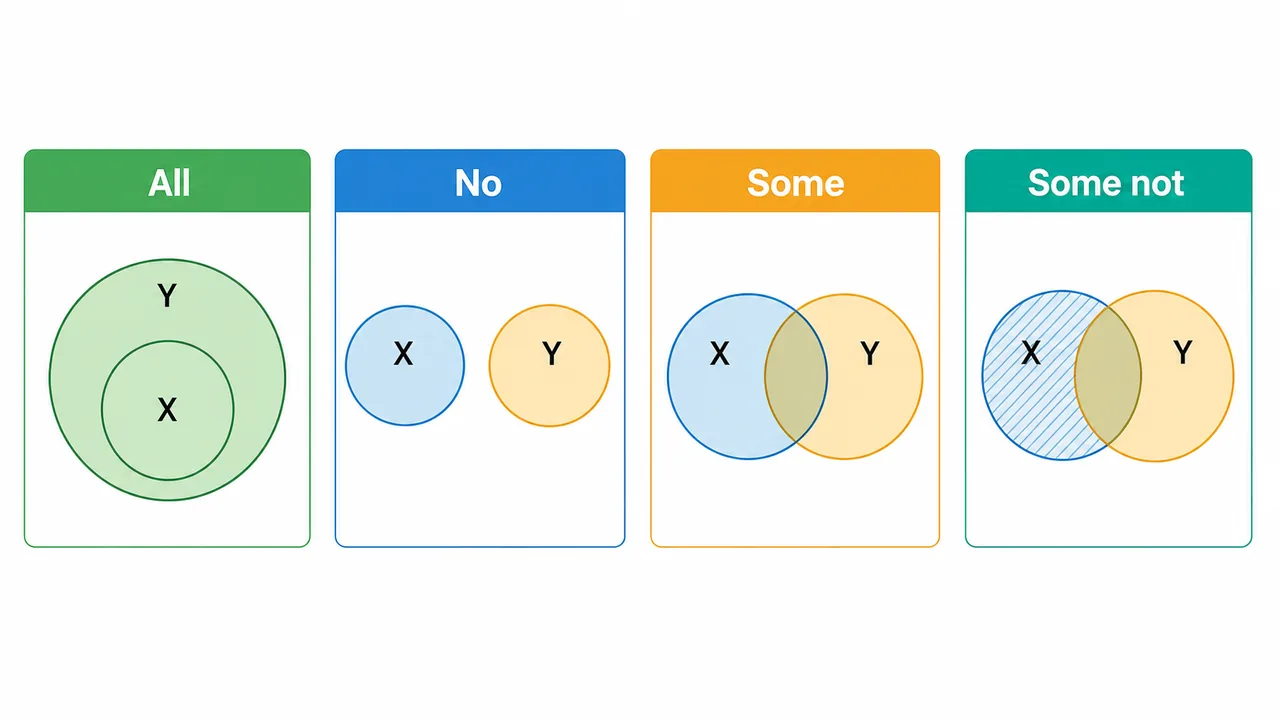
In coded syllogism, symbols stand in for each relationship type:
Example Coding System 1:
| Symbol | Meaning |
|---|---|
| P $ Q | All P are Q |
| P # Q | No P is Q |
| P & Q | Some Q are not P |
| P % Q | Only a few P are Q |
| P @ Q | Some Q are P |
Example Coding System 2:
Pro Content Locked
Upgrade to Pro to access this lesson and all other premium content.
Pay once for one year · Effective ₹99/mo
- All Agriculture & Banking Courses
- AI Lesson Questions (100/day)
- AI Doubt Solver (50/day)
- Glows & Grows Feedback (30/day)
- AI Section Quiz (20/day)
- 22-Language Translation (100/day)
- Recall Questions (20/day)
- AI Quiz (15/day)
- AI Quiz Paper Analysis (100/day)
- AI Step-by-Step Explanations (100/day)
- Spaced Repetition Recall (FSRS)
- AI Tutor
- Immersive Text Questions
- Audio Lessons — Hindi & English
- Mock Tests & Previous Year Papers
- Summary & Mind Maps
- XP, Levels, Leaderboard & Badges
- Generate New Classrooms
- Voice AI Teacher (AgriDots Live)
- AI Revision Assistant
- Knowledge Gap Analysis
- Interactive Revision (LangGraph)
🔒 Secure one-time yearly payment via Razorpay · No hidden fees
Coded Syllogism
Coded Syllogism is a Mains-level topic frequently tested in SBI PO Mains, IBPS PO Mains, and RBI Grade B. Rather than stating "All J are K" in plain English, the exam encodes relationship types using symbols. Your job is to decode first, then solve.
What is Coded Syllogism?
In coded syllogism, symbols stand in for each relationship type:
Example Coding System 1:
| Symbol | Meaning |
|---|---|
| P $ Q | All P are Q |
| P # Q | No P is Q |
| P & Q | Some Q are not P |
| P % Q | Only a few P are Q |
| P @ Q | Some Q are P |
Example Coding System 2:
| Symbol | Meaning |
|---|---|
| A * B | All A are B |
| A © B | No A is B |
| A $ B | Some A are B |
| A # B | Some A are not B |
| A @ B | All B are A |
The coding system varies across exams! Always study the code table thoroughly before attempting any question.
Step-by-Step Solving Method
Step 1: Read the code table — Write down each symbol's meaning clearly on rough paper
Step 2: Decode each statement — Convert symbols back to English
Step 3: Solve normally — Use Venn diagrams as usual
Step 4: Decode conclusions — Check which coded conclusions follow
Solved Example 1
Code:
| Symbol | Meaning |
|---|---|
| P $ Q | All P are Q |
| P # Q | No P is Q |
| P @ Q | Some P are Q |
| P % Q | Some P are not Q |
| P & Q | Only a few P are Q |
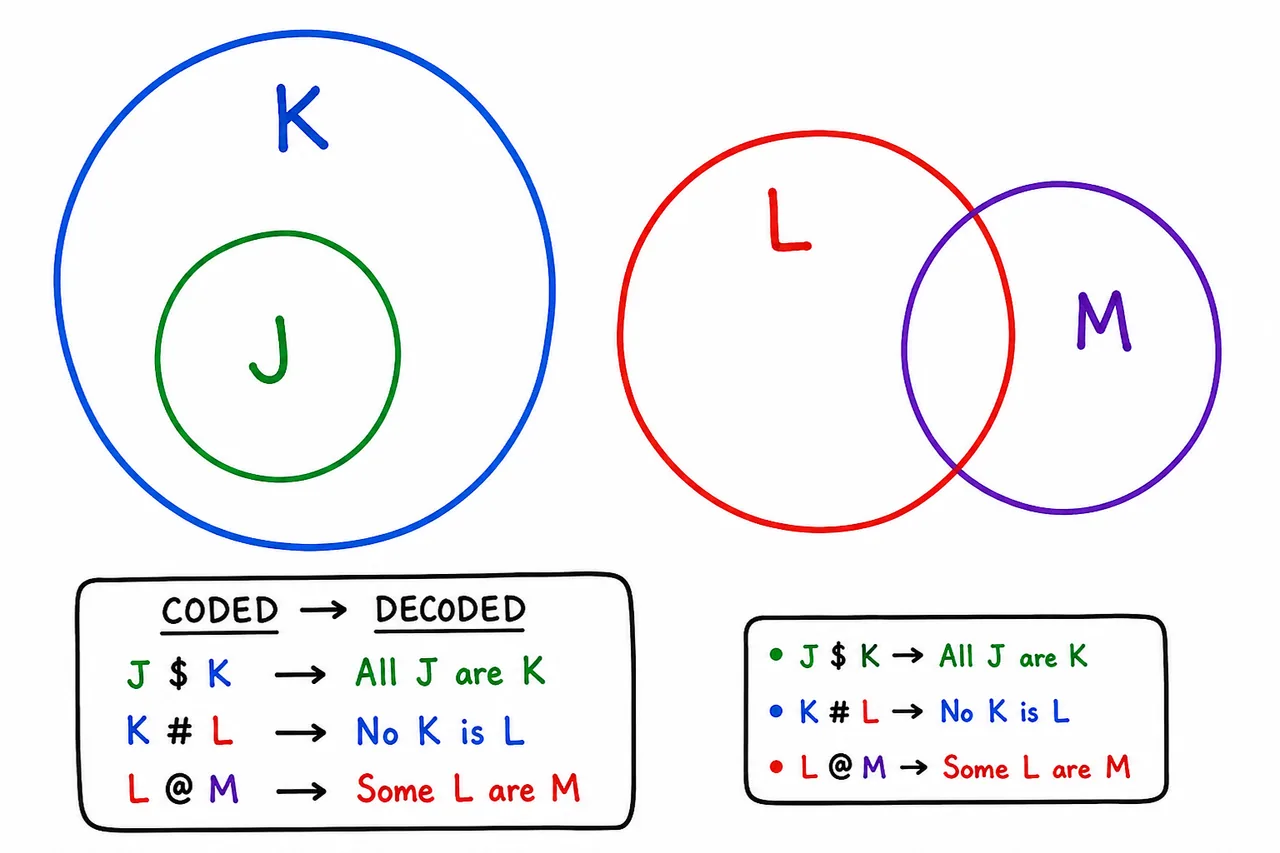
Statements:
- J $ K (All J are K)
- K # L (No K is L)
- L @ M (Some L are M)
Decode and draw:
- All J are K → J inside K
- No K is L → K and L separate
- Some L are M → L and M partially overlap
Conclusions to check:
I. J # L (No J is L)
- J is inside K, L is separate from K → J is separate from L → ✓ Follow
II. L % K (Some L are not K)
- L and K are completely separate → ALL L are not K → "Some L are not K" ✓ Follow
III. M @ K (Some M are K)
- M overlaps with L, K is separate from L. But M could extend to overlap with K. → Doubtful. Does not follow.
IV. J % M (Some J are not M)
- J is separate from L. M overlaps with L but could also extend elsewhere. J-M relationship uncertain. → Doubtful. Does not follow.
Answer: I and II follow
Solved Example 2: With "Only a Few"
Code:
| Symbol | Meaning |
|---|---|
| P $ Q | All P are Q |
| P # Q | No P is Q |
| P @ Q | Some P are Q |
| P & Q | Only a few P are Q |
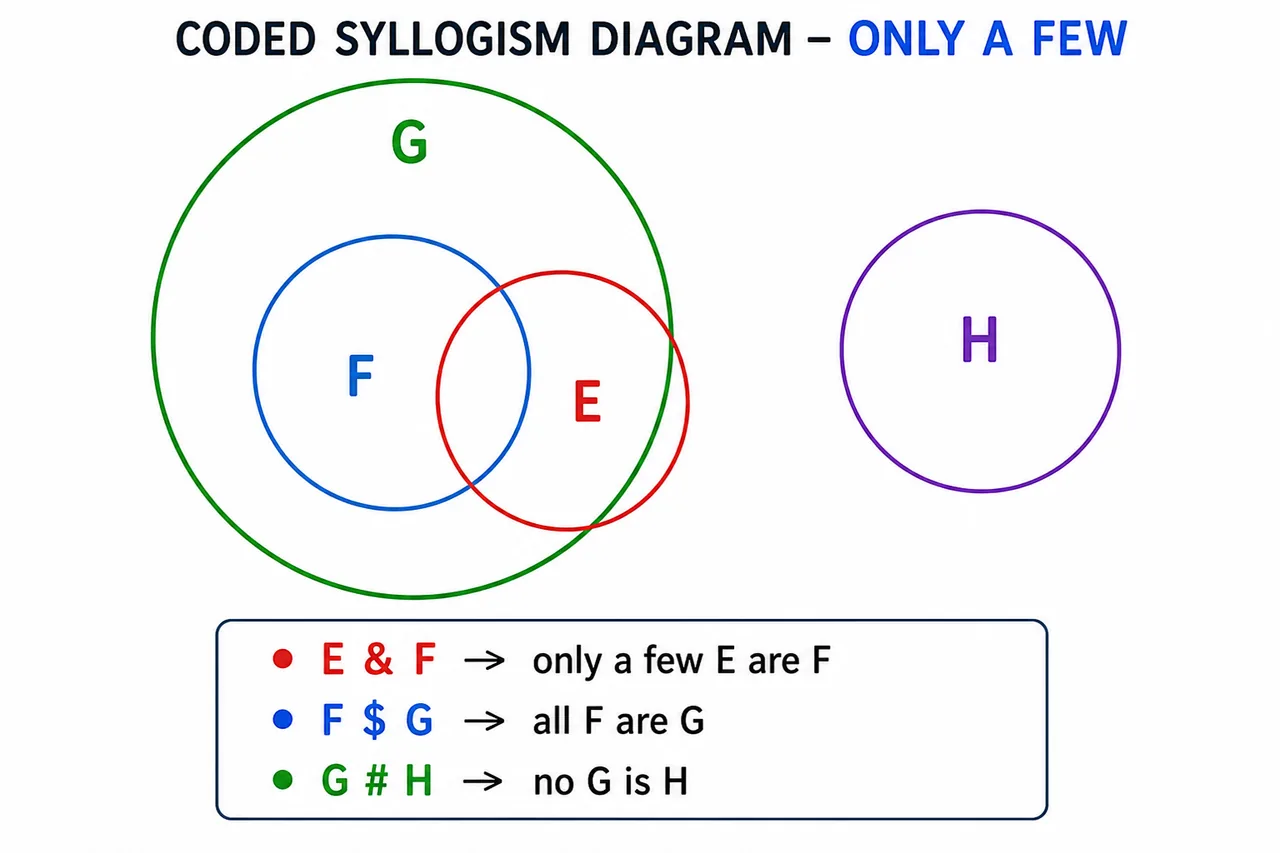
Statements:
- E & F (Only a few E are F → Some E are F + Some E are not F)
- F $ G (All F are G)
- G # H (No G is H)
Decoded:
- Some E are F, Some E are not F
- All F are G
- No G is H
Draw:
Conclusions:
-
E @ G (Some E are G) → Some E are F + All F are G → Some E are G → ✓ Follow
-
F # H (No F is H) → F inside G, G separate from H → F separate from H → ✓ Follow
-
E $ G (All E are G) → Doubtful (only "some" E are connected to G through F) → ✗ Does not follow
-
E # H (No E is H) → Doubtful (the part of E outside F could overlap with H) → ✗ Does not follow
Coded Syllogism with "+" for Possibility
Some exams introduce a special symbol for possibility:
| Without + | With + |
|---|---|
| A $ B = All A are B | A $+ B = All A are B is a possibility |
| A # B = No A is B | A #+ B = No A is B is a possibility |
The "+" suffix means "possibility case" — check if the conclusion CAN be true, not if it MUST be true.
Reverse Coded — Watch the Direction!
Some exams flip the direction within the code:
Normal coding:
| Symbol | Meaning |
|---|---|
| A $ B | All A are B |
Reverse coding:
| Symbol | Meaning |
|---|---|
| A $ B | All B are A |
Always re-read the code table. If the meaning says "All Q are P" for "P $ Q", the direction is reversed from what you might expect.
"Logically Follows" vs "Does Not Follow" vs "Definitely False"
Coded syllogism questions come in three variants:
Variant 1: "Which conclusion logically follows?" → Find the conclusion that is definitely true.
Variant 2: "Which conclusion does NOT follow?" → Find the conclusion that is doubtful or definitely false.
Variant 3: "Which is definitely false?" → Find the conclusion that is impossible in all diagrams.
Be very careful about which variant is being asked!
Multiple Coding Systems in One Exam
Some exams present two different coding systems in the same paper:
System A (for Questions 1-5):
| $ | # | @ | % | & |
|---|---|---|---|---|
| All | No | Some | Some not | Only a few |
System B (for Questions 6-10):
| $ | # | @ | % | & |
|---|---|---|---|---|
| No | All | Some not | Some | Only |
Each system must be decoded separately. Don't carry over meanings from one system to another.
Solved Example 3: Full Coded Problem
Code:
| Symbol | Meaning |
|---|---|
| P $ Q | All P are Q |
| P # Q | No P is Q |
| P @ Q | Some Q are P |
| P % Q | Only a few P are Q |
| P & Q | Some Q are not P |
Statements:
- J $ K (All J are K)
- K @ L (Some L are K)
- L % M (Only a few L are M → Some L are M + Some L are not M)
Conclusions:
I. J @ L (Some L are J)
- All J are K, Some L are K. The L-K overlap might or might not include J. → Doubtful. Does not follow.
II. K & M (Some M are not K)
- Some L are M (from "only a few"), but M's relationship with K is uncertain. → Doubtful. Does not follow.
III. L & J (Some J are not L)
- All J are K, Some L are K. We don't know if all J are L or some J are not L. → Doubtful. Does not follow.
IV. J # M (No J is M)
- J inside K. M partially overlaps L. L partially overlaps K. Chain: J→K←L→M has a "Some" break. J-M relationship unknown. → Doubtful. Does not follow.
Check for Either-Or among the conclusions...
Speed Tips for Coded Syllogism
- Write the decode table on rough paper immediately. Don't try to remember it.
- Decode ALL statements first before drawing. Write them in English next to the coded form:
J $ K → All J are K K # L → No K is L - Draw the diagram from the decoded statements. Forget the symbols at this point.
- Decode conclusions one by one and check against the diagram.
- Watch for "Only a few" in codes — it gives two sub-conclusions. Decompose it immediately:
P % Q → Some P are Q + Some P are not Q - Time target: 30 seconds for decoding + normal solving time.
Practice Problems
Problem 1: Code: $ = All, # = No, @ = Some, % = Some not, & = Only
Statements: W $ X, X # Y, Y @ Z
Conclusions: I. W # Y II. X % Z III. Y @ W
Decode:
- All W are X
- No X is Y
- Some Y are Z
Solve:
I. No W is Y → W inside X, Y separate from X → W separate from Y → ✓ Follow
II. Some X are not Z → X separate from Y. X-Z relationship unknown → ✗ Doubtful
III. Some Y are W → Y separate from X which contains W. Y-W could still overlap if Y extends beyond X → ✗ Doubtful
Answer: Only I follows
Problem 2: Code: $ = All, # = No, @ = Some, & = Only a few
Statements: J & K, K $ L, L # M
Conclusions: I. J @ L II. K # M III. J & L (conclusion asks: "Only a few J are L")
Decode:
- Only a few J are K → Some J are K + Some J are not K
- All K are L
- No L is M
I. Some J are L → Some J are K + All K are L → Some J are L → ✓ Follow
II. No K is M → K inside L, M separate from L → K separate from M → ✓ Follow
III. Only a few J are L → This means "Some J are L + Some J are not L". We know "Some J are L" (definite). "Some J are not L"? The part of J outside K might or might not be inside L. Doubtful.
Answer: I and II follow
Common Mistakes
- Not reading the code table carefully — Each exam can have different symbol meanings
- Carrying over previous coding — Symbol meanings change between question sets
- Forgetting to decode conclusions — Students decode statements but check conclusions in coded form
- Direction confusion in reverse coding — If "P $ Q" means "All Q are P", draw Q inside P, not P inside Q
- Missing "Only a few" decomposition — Always split into two sub-statements
Summary Cheat Sheet
| Concept / Topic | Key Details / Explanation |
|---|---|
| What is Coded Syllogism? | Symbols replace "All/No/Some/Some not/Only a few". Your job: decode → draw → solve. Appears in SBI PO Mains, IBPS PO Mains, RBI Grade B. |
| Step-by-step method | 1) Write decode table on rough paper. 2) Decode each statement to English. 3) Draw Venn diagram from decoded statements. 4) Decode conclusions and check against diagram. |
| Common symbol meanings (vary per exam) | Often: $ = All, # = No, @ = Some, % = Some not / Only a few, & = Only a few / Only. Always re-read the code table — never assume. |
| Code table changes between question sets | Symbol meanings can be completely different for Q1-5 vs Q6-10 in the same paper. Never carry over meanings. |
| Reverse coding trap | If "P $ Q" means "All Q are P", draw Q inside P — not P inside Q. Always check the direction in the code definition. |
| "+" suffix for possibility | A $+ B means "All A are B is a possibility" — check if it CAN be true, not if it MUST be true. |
| "Only a few" in codes | When a symbol means "Only a few P are Q", immediately decompose: Some P are Q + Some P are not Q. Write both on rough paper. |
| Variant types | Variant 1: "Which follows?" → find definite. Variant 2: "Which does NOT follow?" → find doubtful/false. Variant 3: "Which is definitely false?" → find impossible. Read the question type carefully. |
| Decode conclusions separately | Students often decode statements but then check conclusions in coded form. Always decode conclusions too before checking. |
| Time target | 30 seconds for decoding + normal solving time. Write decode table immediately when the question set begins. |
| "Some L are not K" from "No K is L" | "No K is L" = K and L completely separate = ALL L are not K → "Some L are not K" ✓ Follow. |
| Uncertain chain in coded problems | After decoding, apply standard chain rules. E.g., J $ K + K @ L (Some L are K) + L & M (Only a few) → J-M chain has a "Some" break → J-M uncertain. |
| Multiple coding systems | Some exams provide System A (for Q1-5) and System B (for Q6-10) with different symbol meanings. Decode each set separately. |
| Exam trap: same symbol, different meaning | The same symbol (e.g., @) can mean "Some P are Q" in one set and "Some Q are P" in another. Direction matters. |