🧩 Multi-Statement Complex Problems
Tackle 4-6 statement problems with mixed statement types, chain diagrams, percentage-based statements, and problems combining "Only a few", "Only", and "No" in a single set
Multi-Statement Complex Problems
Banking Mains exams typically present 4-6 statements with multiple conclusions. This lesson teaches you the systematic approach to handle complex multi-statement problems without getting confused.
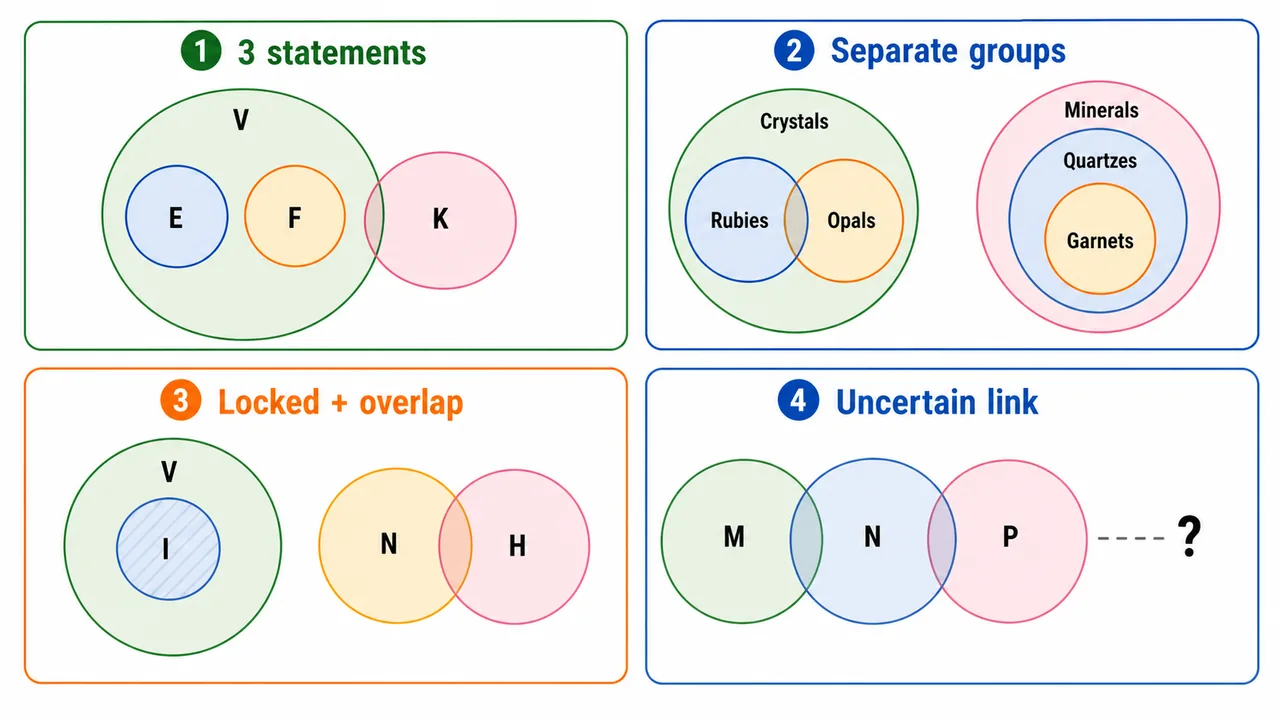
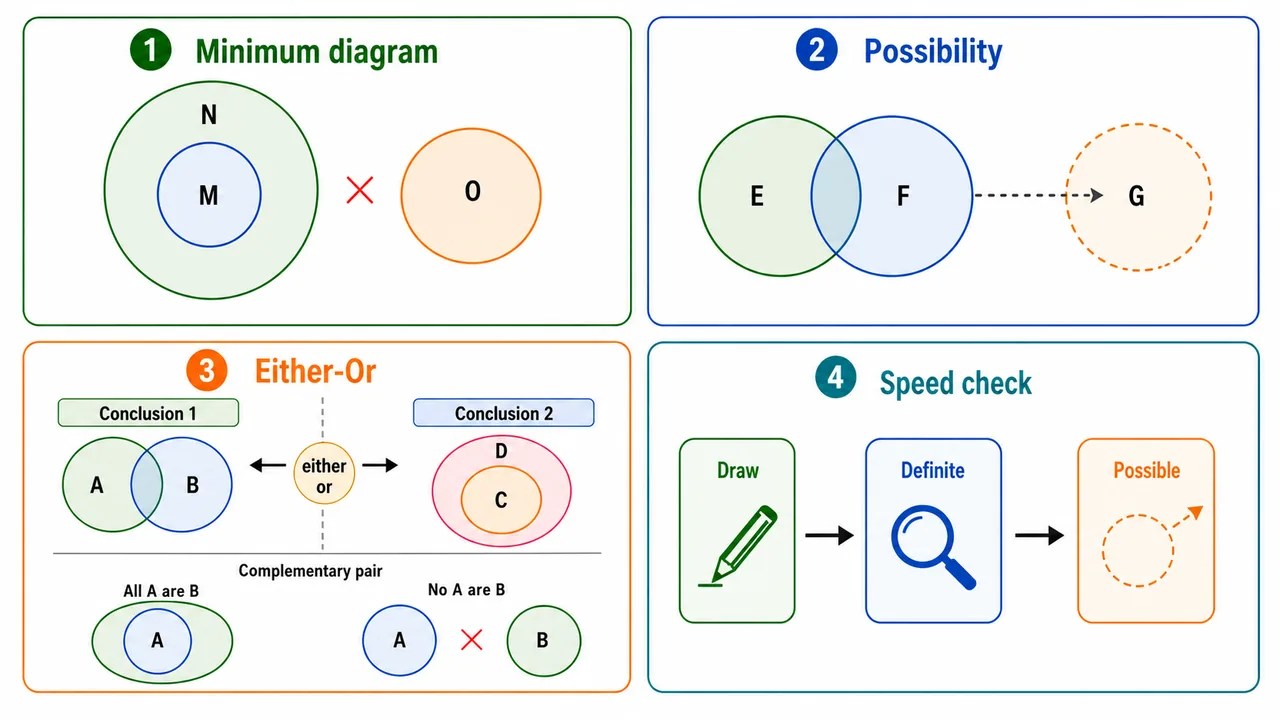
The Systematic Approach
Step 1: Read ALL statements first (don't start drawing after the first one)
Step 2: Identify relationships:
- Which elements appear in multiple statements? (connecting elements)
- What type is each statement? (All/No/Some/Only/Only a few)
Step 3: Draw the Venn diagram in order:
- Start with "All" and "No" statements (they give definite shapes)
- Add "Some" statements (partial overlaps)
- Add "Only" and "Only a few" statements (converted to their meanings)
Step 4: Check each conclusion against the diagram
Practice Set 1: 4 Statements
Statements:
Pro Content Locked
Upgrade to Pro to access this lesson and all other premium content.
Pay once for one year · Effective ₹99/mo
- All Agriculture & Banking Courses
- AI Lesson Questions (100/day)
- AI Doubt Solver (50/day)
- Glows & Grows Feedback (30/day)
- AI Section Quiz (20/day)
- 22-Language Translation (100/day)
- Recall Questions (20/day)
- AI Quiz (15/day)
- AI Quiz Paper Analysis (100/day)
- AI Step-by-Step Explanations (100/day)
- Spaced Repetition Recall (FSRS)
- AI Tutor
- Immersive Text Questions
- Audio Lessons — Hindi & English
- Mock Tests & Previous Year Papers
- Summary & Mind Maps
- XP, Levels, Leaderboard & Badges
- Generate New Classrooms
- Voice AI Teacher (AgriDots Live)
- AI Revision Assistant
- Knowledge Gap Analysis
- Interactive Revision (LangGraph)
🔒 Secure one-time yearly payment via Razorpay · No hidden fees
Multi-Statement Complex Problems
Banking Mains exams typically present 4-6 statements with multiple conclusions. This lesson teaches you the systematic approach to handle complex multi-statement problems without getting confused.
The Systematic Approach
Step 1: Read ALL statements first (don't start drawing after the first one)
Step 2: Identify relationships:
- Which elements appear in multiple statements? (connecting elements)
- What type is each statement? (All/No/Some/Only/Only a few)
Step 3: Draw the Venn diagram in order:
- Start with "All" and "No" statements (they give definite shapes)
- Add "Some" statements (partial overlaps)
- Add "Only" and "Only a few" statements (converted to their meanings)
Step 4: Check each conclusion against the diagram
Practice Set 1: 4 Statements
Statements:
- No E is F
- All E are V
- All F are V
- Some V are K
Step 1: Identify connections:
- E appears in statements 1, 2
- F appears in statements 1, 3
- V appears in statements 2, 3, 4
- K appears in statement 4
Step 2: Draw:
- E and F are separate (No E is F)
- E is inside V (All E are V)
- F is inside V (All F are V)
- V overlaps with K (Some V are K)
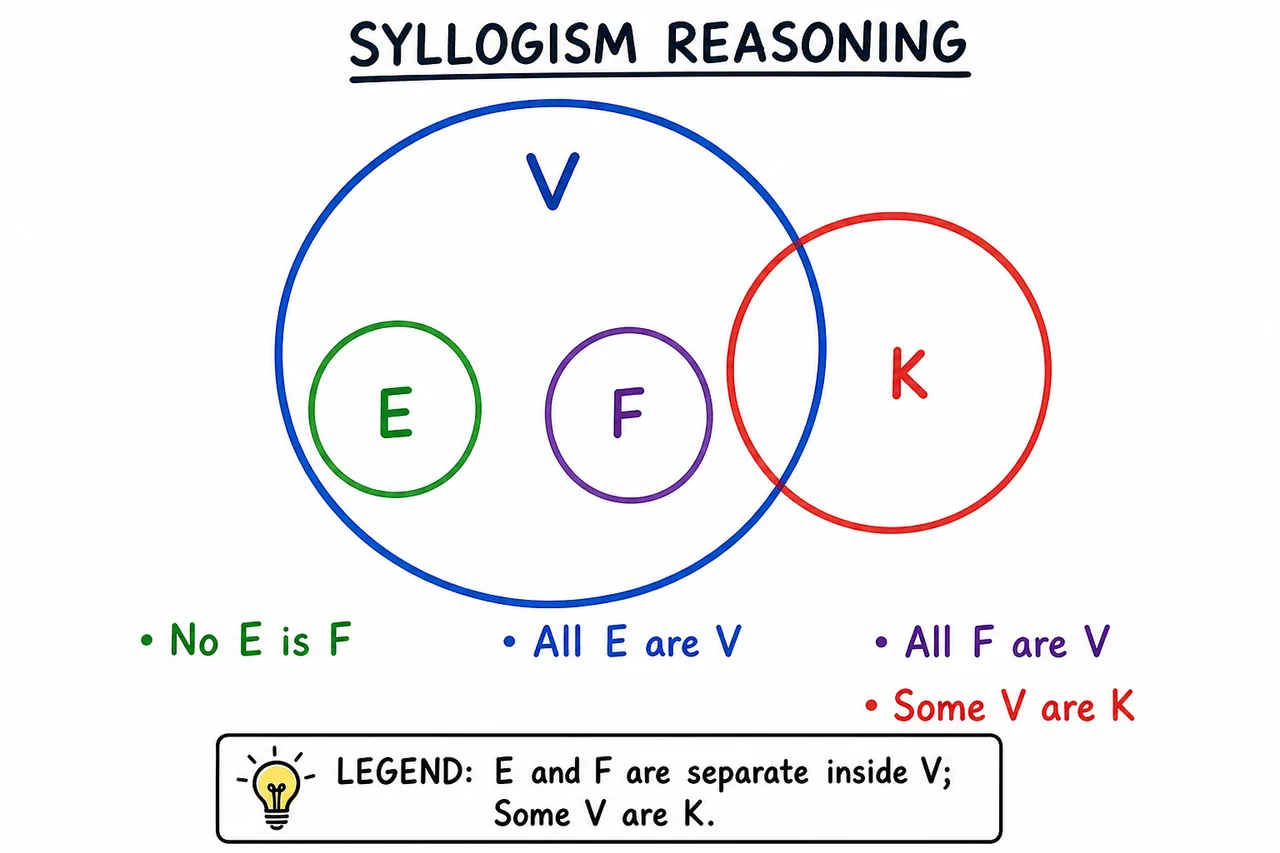
E and F are both inside V but separate from each other. K overlaps with V but its overlap area could be with E, F, or the part of V outside both.
Conclusions:
- Some E are K → Doubtful (K's overlap with V might not include E). Does not follow.
- Some V are not F → ✓ Follow (E is inside V and separate from F → the E-part of V is not F)
- No E is K → Doubtful. Does not follow.
- Some K are V → ✓ Follow (given: Some V are K → Some K are V)
Practice Set 2: 5 Statements with "Only a Few"
Statements:
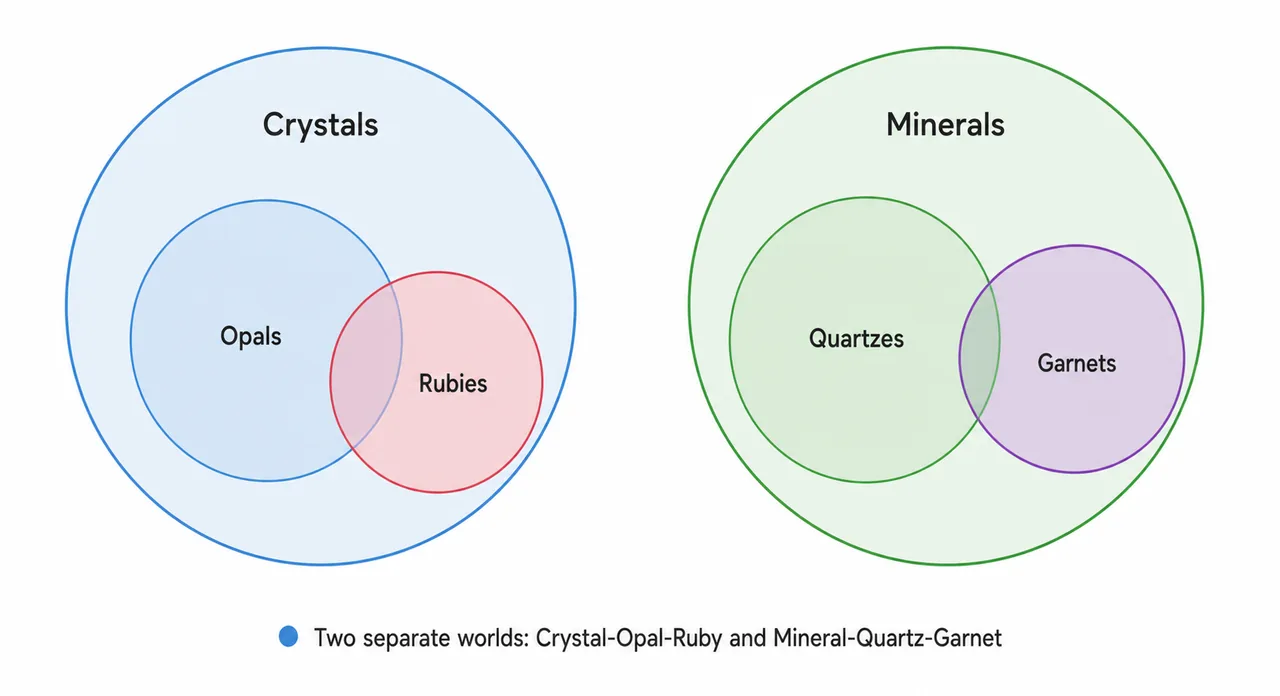
- Only a few rubies are opals (= Some rubies are opals + Some rubies are not opals)
- All opals are crystals
- No crystal is a garnet
- Some garnets are quartzes
- All quartzes are minerals
Draw step by step:
Conclusions:
- Some rubies are crystals → ✓ Follow (Some rubies are opals + All opals are crystals → Some rubies are crystals)
- Some rubies are not opals → ✓ Follow (from "Only a few rubies are opals")
- No opal is a garnet → ✓ Follow (Opals inside Crystals, Garnets separate from Crystals)
- Some minerals are not crystals → Doubtful. We know some Minerals contain Quartzes which contain Garnets-overlap. Garnets are separate from Crystals. So the Quartz-Garnet part of Minerals is separate from Crystals. But do those Quartzes contain elements that are NOT in Crystals? Quartzes overlap with Garnets (Some garnets are quartzes). Those quartzes that are garnets are NOT crystals (garnets separate from crystals). So Some minerals are not crystals (through the quartz-garnet chain). ✓ Follow!
Practice Set 3: Percentage-Based Statements
Modern exams use percentage-based statements:
Statements:
- 100% of M are N (= All M are N)
- 0% of N are K (= No N is K)
- 30% of K are H (= Some K are H)
- 75% of H are J (= Some H are J)
Conversion rule:
| Percentage | Statement Type |
|---|---|
| 100% | All |
| 0% | No |
| 1% - 99% | Some |
After conversion, draw normally:
- All M are N
- No N is K
- Some K are H
- Some H are J
Practice Set 4: Mixed "Only" and "Only a Few"
Statements:
- Only visions are insights (= All insights are visions)
- No insight is a notion
- Only a few notions are hunches (= Some notions are hunches + Some notions are not hunches)
Draw:
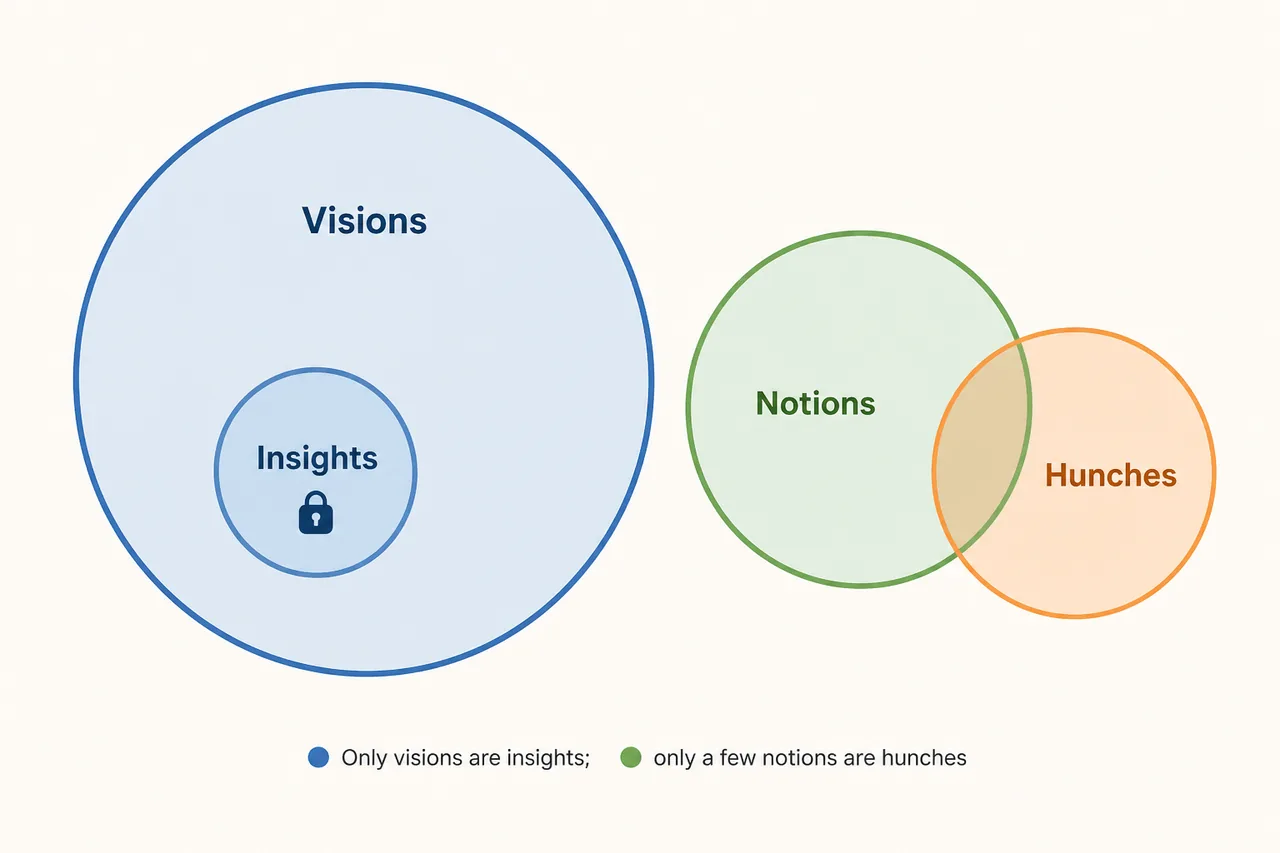
Insights inside Visions. Insights separate from Notions. Notions partially overlap with Hunches.
Conclusions:
- No insight is a hunch → Doubtful. Insights are separate from Notions, but Hunches extend beyond Notions. The Hunch part outside Notions could overlap with Insights. Does not follow.
- Some visions are not notions → Doubtful? Actually, Insights are inside Visions and separate from Notions. So those Vision members that are Insights are NOT Notions → Some visions are not notions ✓ Follow.
- All hunches are notions → Doubtful (Hunches partially overlap with Notions from "only a few"). Does not follow.
Practice Set 5: 6 Statements
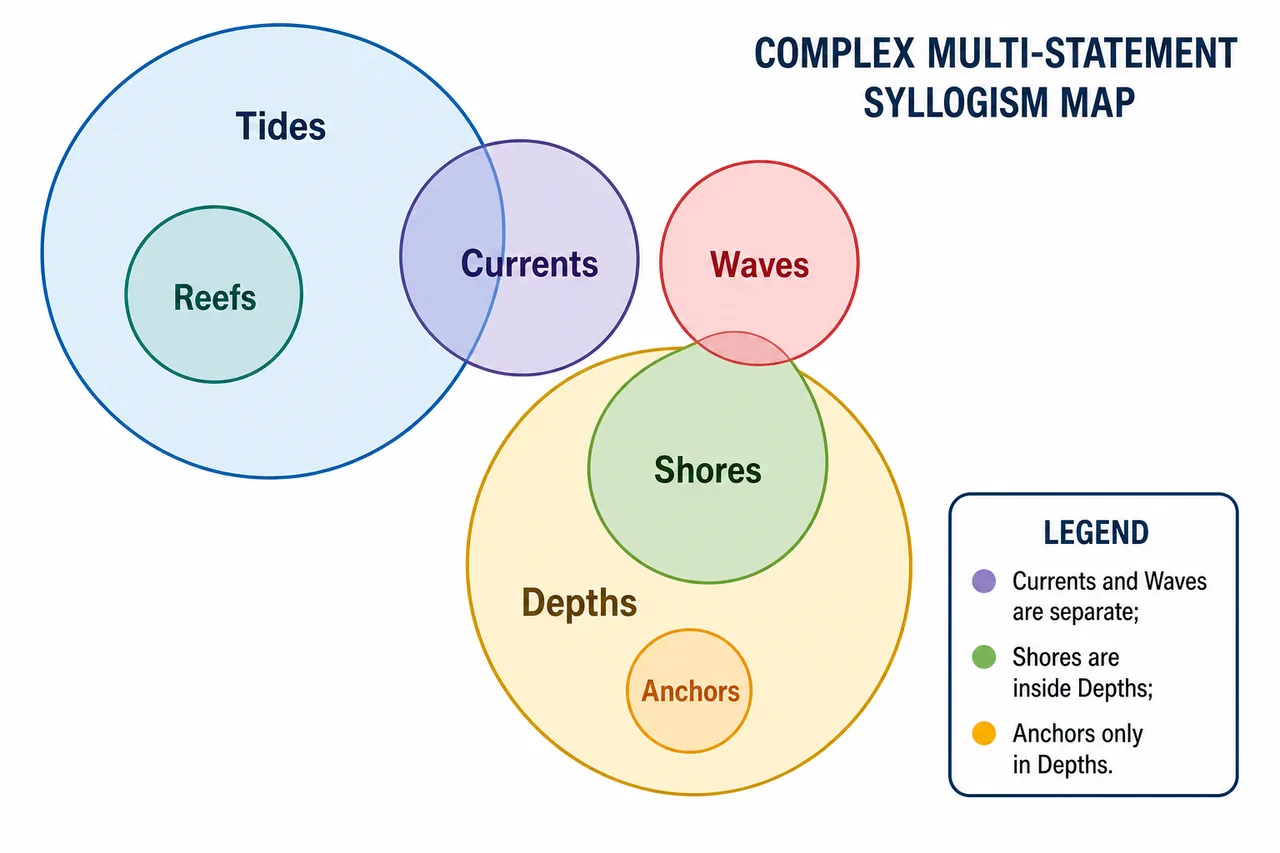
Statements:
- All reefs are tides
- Only a few tides are currents (= Some tides are currents + Some tides are not currents)
- No current is a wave
- Some waves are shores
- All shores are depths
- Only depths are anchors (= All anchors are depths)
Key relationships to establish:
- Reefs inside Tides
- Tides partially overlap Currents
- Currents separate from Waves
- Waves overlap Shores
- Shores inside Depths
- Anchors inside Depths
Diagram sketch:
Conclusions:
- Some reefs are currents → Doubtful. Reefs are inside Tides, Tides partially overlap Currents. The overlap might or might not include Reefs. Does not follow.
- Some tides are not currents → ✓ Follow (from "only a few tides are currents")
- Some depths are waves → ✓ Follow (Waves overlap Shores, Shores inside Depths → Some Waves are Depths → Some Depths are Waves)
- No current is a shore → Doubtful. Currents separate from Waves. But Shores could extend beyond Waves to overlap with Currents. Does not follow.
- Some anchors are shores → Doubtful. Both Anchors and Shores are inside Depths but their mutual relationship is unknown. Does not follow.
Rough Paper Strategy for Multi-Statement Problems
ROUGH PAPER LAYOUT:
═══════════════════════════════════
STATEMENTS:                     CONVERSIONS:
1. Only a few A are B           → S: A∩B, S: A∉B
2. All B are C                  → B ⊂ C
3. No C is D                    → C ∩ D = ∅
4. Some D are E                 → D∩E
═══════════════════════════════════

DIAGRAM:
[Draw Venn diagram here]

═══════════════════════════════════
DEFINITE CONCLUSIONS:
- Some A are B ✓
- Some A are not B ✓
- Some A are C ✓ (chain)
- No B is D ✓
═══════════════════════════════════
CHECK CONCLUSIONS:
I.  [...]  → ✓/✗/?
II. [...]  → ✓/✗/?
Write down definite conclusions as you draw. This saves re-checking.
Chain Analysis Shortcuts
| Chain Pattern | Result |
|---|---|
| All + All | All (definite) |
| All + No | No (definite) |
| All + Some | Some (definite) |
| Some + All | Some (definite) |
| No + All | Uncertain |
| Some + Some | Uncertain |
| Some + No | Uncertain |
| No + Some | Uncertain |
| Some Not + anything | Usually uncertain |
Remember: The chain gives a definite result only when:
- The first link is "All" or "Some" pointing INTO the middle element
- AND the second link is "All" or "No" pointing OUT of the middle element
Common Mistakes in Multi-Statement Problems
- Not converting "Only" and "Only a few" first: Always convert before drawing
- Forgetting indirect relationships: If A→B→C→D, check A-D relationship too
- Assuming unknown relationships are "No": If two elements aren't connected by any chain, their relationship is UNKNOWN (not "No")
- Drawing too many separate diagrams: Try to fit everything in ONE diagram
- Not marking definite conclusions immediately: Write them as you draw, not after checking conclusions
- Percentage conversion errors: 0% = No, 100% = All, anything between = Some
Summary Cheat Sheet
| Concept / Topic | Key Details / Explanation |
|---|---|
| Systematic approach (4 steps) | 1) Read ALL statements first. 2) Identify connecting elements and statement types. 3) Draw in order: All/No first, then Some, then Only/Only-a-few. 4) Check each conclusion. |
| Drawing order | Start with "All" and "No" (definite shapes), then add "Some" overlaps, then convert and add "Only"/"Only a few". |
| Conversion before drawing | Always convert "Only X are Y" → "All Y are X" and "Only a few X are Y" → "Some X are Y + Some X are not Y" BEFORE drawing. |
| Percentage conversion | 0% = No, 100% = All, 1%–99% = Some. Never treat 90% as "All". |
| Chain analysis shortcuts | All+All=All ✓ | All+No=No ✓ | All+Some=Some ✓ | Some+All=Some ✓ | All others (No+All, Some+Some, Some+No, No+Some, SomeNot+anything) = Uncertain |
| When chain gives definite result | Only when first link is "All" or "Some" pointing INTO the middle element AND second link is "All" or "No" pointing OUT. |
| One diagram for all statements | Draw ALL statements on ONE Venn diagram. Multiple diagrams cause errors. |
| Mark definite conclusions immediately | As you draw, write ✓ next to definite conclusions on rough paper. Don't wait until checking phase. |
| Unknown element relationships | If two elements have no chain connecting them, their relationship is UNKNOWN — not "No". Never assume separation. |
| "Only a few" in multi-statement | Immediately decompose: Some ∩ exists + Some ∉ exists. Mark "All" and "No" as impossible for those elements. |
| Rough paper layout | Statements (converted) → Diagram → Definite conclusions → Check each conclusion. Use this template every time. |
| Indirect relationships | If A→B→C→D, always check A-D relationship through the chain. Students often miss indirect links. |
| 4-6 statement strategy | Build a relationship map on rough paper (e.g., A──All──> B ──No──> C ──Some──> D). Trace paths between conclusion elements. |
| "Some V are not F" derivation trick | If E is inside V and E is separate from F → the E-part of V is not F → "Some V are not F" ✓ |
| "Some minerals are not crystals" pattern | If element A is inside B, B overlaps C, C is separate from D — then the B-C overlap (which is inside A's container) is not D → "Some A's container are not D". |