⚖️ Either-Or & Complementary Pairs
Master the Either-Or concept in syllogism — when two conclusions cannot both be false, one must be true. Learn the complementary pair table and solve either-or questions in seconds
Either-Or & Complementary Pairs
Either-Or is one of the most exam-important concepts. Many banking Mains questions have "Either conclusion I or conclusion II follows" as an answer option. Understanding complementary pairs lets you solve these instantly.
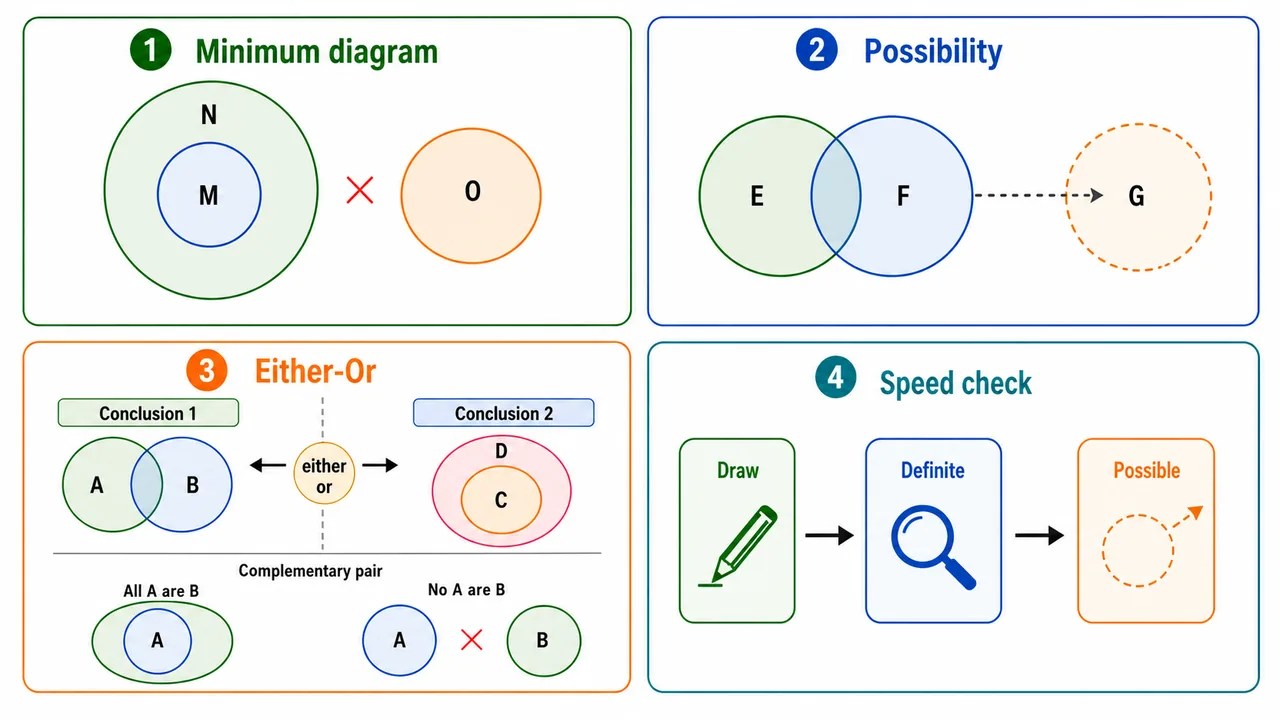
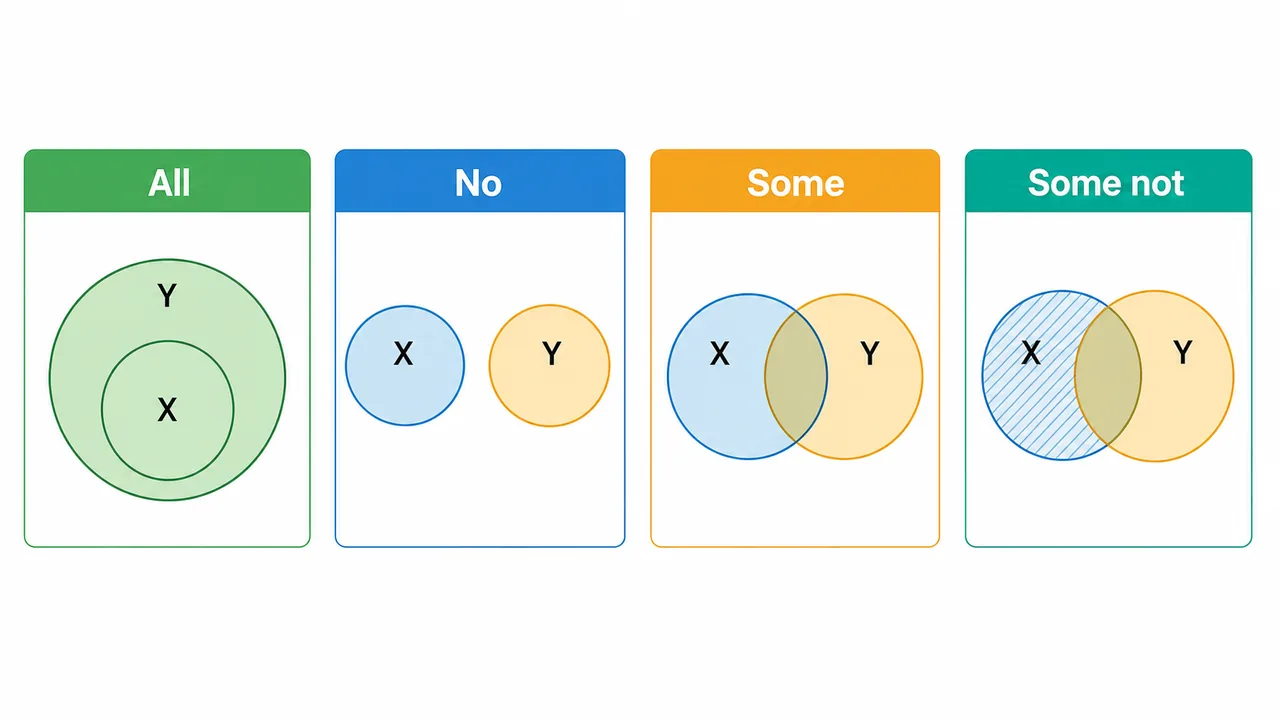
What is Either-Or?
When the answer options include:
- (a) Only conclusion I follows
- (b) Only conclusion II follows
- (c) Both conclusions follow
- (d) Neither conclusion follows
- (e) Either conclusion I or conclusion II follows
Option (e) means: Exactly one of the two conclusions MUST be true, but we cannot determine which one. They are complementary — one is true and the other is false, always.
The 3 Conditions for Either-Or
Two conclusions are complementary (Either-Or applies) only when ALL three conditions are met:
Pro Content Locked
Upgrade to Pro to access this lesson and all other premium content.
Pay once for one year · Effective ₹99/mo
- All Agriculture & Banking Courses
- AI Lesson Questions (100/day)
- AI Doubt Solver (50/day)
- Glows & Grows Feedback (30/day)
- AI Section Quiz (20/day)
- 22-Language Translation (100/day)
- Recall Questions (20/day)
- AI Quiz (15/day)
- AI Quiz Paper Analysis (100/day)
- AI Step-by-Step Explanations (100/day)
- Spaced Repetition Recall (FSRS)
- AI Tutor
- Immersive Text Questions
- Audio Lessons — Hindi & English
- Mock Tests & Previous Year Papers
- Summary & Mind Maps
- XP, Levels, Leaderboard & Badges
- Generate New Classrooms
- Voice AI Teacher (AgriDots Live)
- AI Revision Assistant
- Knowledge Gap Analysis
- Interactive Revision (LangGraph)
🔒 Secure one-time yearly payment via Razorpay · No hidden fees
Either-Or & Complementary Pairs
Either-Or is one of the most exam-important concepts. Many banking Mains questions have "Either conclusion I or conclusion II follows" as an answer option. Understanding complementary pairs lets you solve these instantly.
What is Either-Or?
When the answer options include:
- (a) Only conclusion I follows
- (b) Only conclusion II follows
- (c) Both conclusions follow
- (d) Neither conclusion follows
- (e) Either conclusion I or conclusion II follows
Option (e) means: Exactly one of the two conclusions MUST be true, but we cannot determine which one. They are complementary — one is true and the other is false, always.
The 3 Conditions for Either-Or
Two conclusions are complementary (Either-Or applies) only when ALL three conditions are met:
- Both conclusions are individually doubtful — neither follows on its own
- They cannot both be true at the same time
- They cannot both be false at the same time (at least one must be true)
If even one condition fails, Either-Or does NOT apply.
The 2 Complementary Pair Patterns
There are only 2 genuine complementary pair patterns you need to memorize:
| # | Conclusion I | Conclusion II | Why Complementary |
|---|---|---|---|
| 1 | All X are Y | Some X are not Y | Either every X is inside Y, or at least one X is outside Y. No third option exists. |
| 2 | Some X are Y | No X is Y | Either overlap exists between X and Y, or it doesn't. No third option exists. |
Critical Rule: Both conclusions must be about the same two elements in the same direction. "All X are Y" pairs with "Some X are not Y" — NOT with "Some Y are not X".
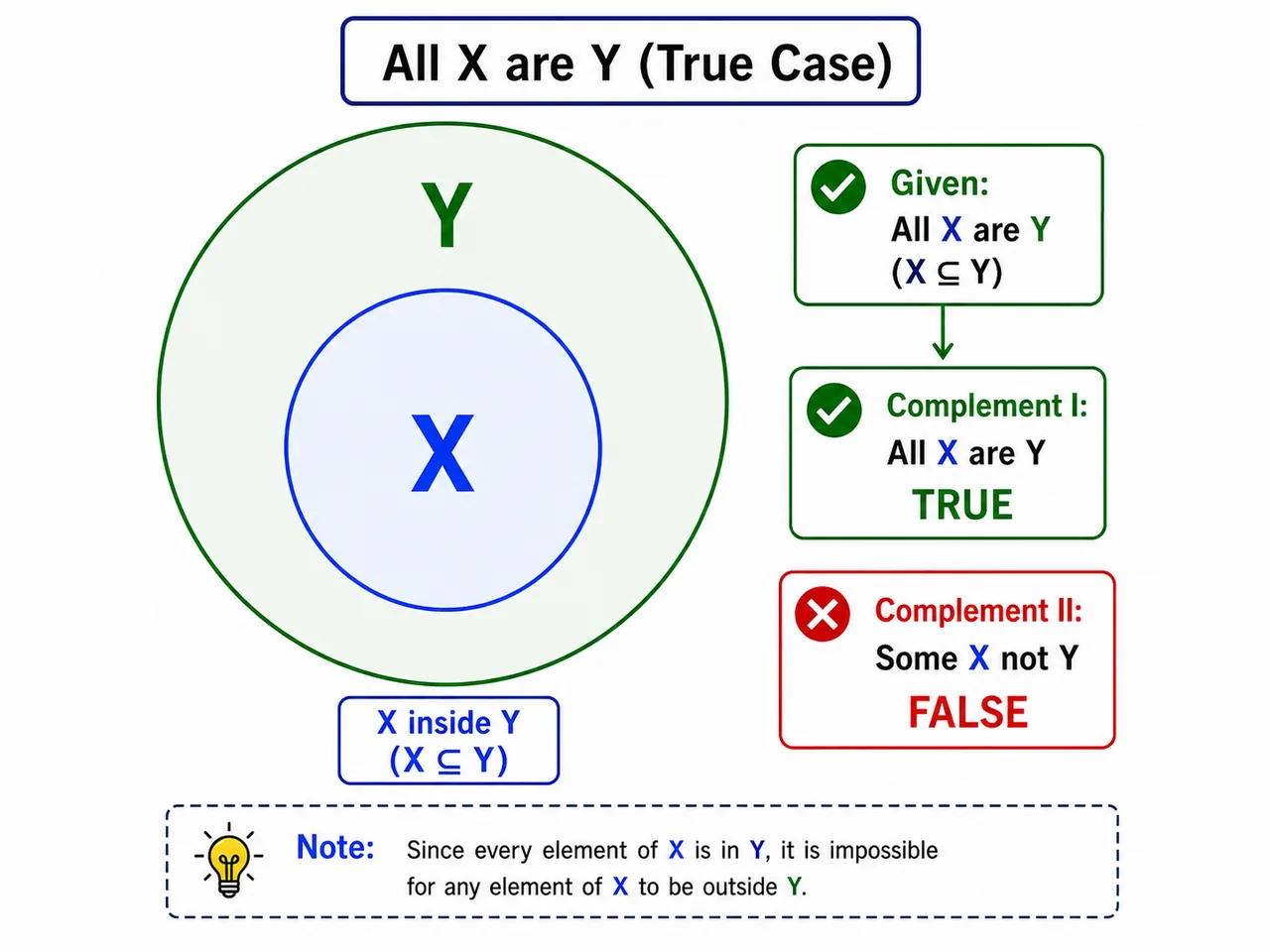
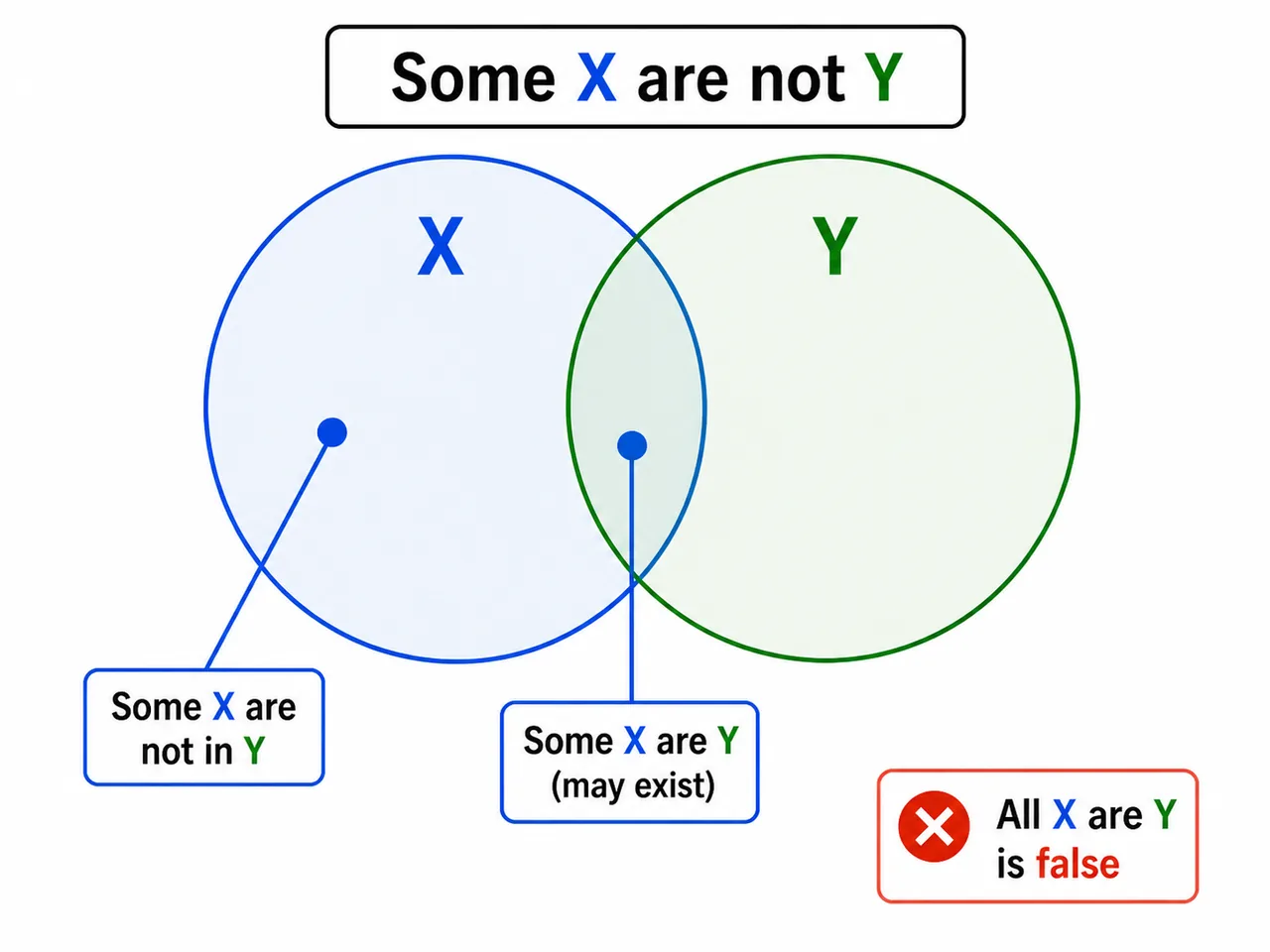
Pattern 1: All X are Y ↔ Some X are not Y
These are direct logical opposites about X's relationship with Y:
- "All X are Y" = Every single X is inside Y (100%)
- "Some X are not Y" = At least one X is outside Y (not 100%)
There is no middle ground. Either 100% of X is in Y, or less than 100% is. One statement must be true and the other must be false.
Example: Statement: Some E are F.
Conclusions: I. All E are F II. Some E are not F
Analysis:
- From "Some E are F", we know overlap exists, but we don't know the full extent
- Conclusion I: "All E are F" → Doubtful (possible but not certain)
- Conclusion II: "Some E are not F" → Doubtful (possible but not certain)
- Both are doubtful ✓
- They form Pattern 1 (All E→F ↔ Some E not→F) ✓
- Answer: Either I or II follows
Pattern 2: Some X are Y ↔ No X is Y
These are direct logical opposites about whether overlap exists:
- "Some X are Y" = At least one element is in both X and Y (overlap exists)
- "No X is Y" = Zero elements are in both X and Y (no overlap)
There is no middle ground. Either overlap exists or it doesn't.
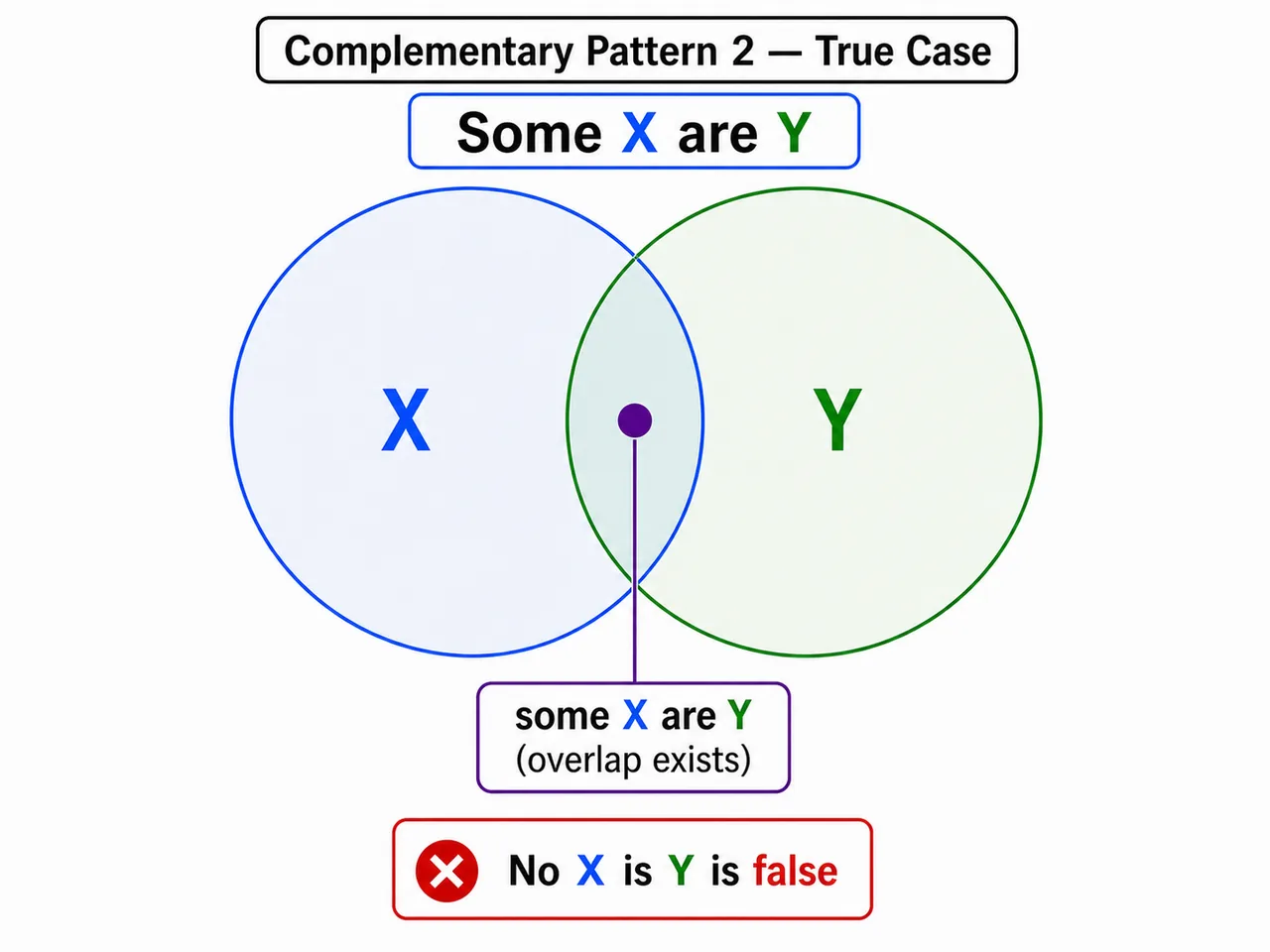
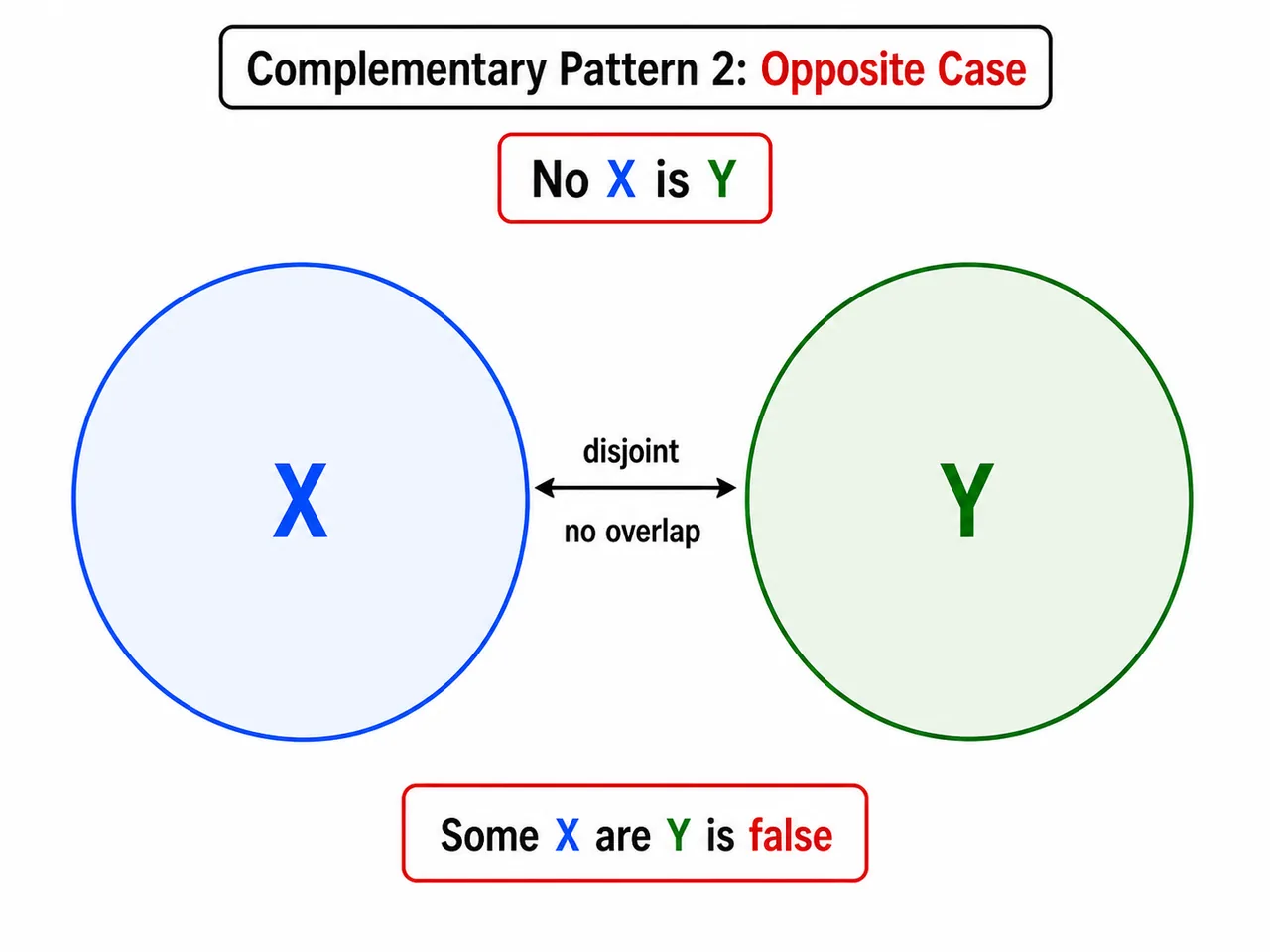
What if the exam writes it in crossed form? Suppose the conclusions are "Some X are Y" and "No Y is X". Don't panic — "No Y is X" means exactly the same thing as "No X is Y" (the "No" statement is reversible). So even though it looks crossed, it's actually the same Pattern 2. Similarly, "Some Y are X" and "No X is Y" is also Pattern 2, because "Some Y are X" = "Some X are Y". Both "Some" and "No" are reversible, so direction never matters for this pattern.
Example: Statements: All E are F. (No mention of G)
Conclusions: I. Some E are G II. No E is G
Analysis:
- E and G have no stated relationship — their connection is completely unknown
- Conclusion I: "Some E are G" → Doubtful
- Conclusion II: "No E is G" → Doubtful
- Both are doubtful ✓
- They form Pattern 2 (Some E→G ↔ No E→G) ✓
- Answer: Either I or II follows
The Either-Or Decision Flowchart
Follow this step-by-step process for every question:
Step 1: Check Conclusion I independently. Does it Follow / Doubtful / Definitely False?
Step 2: Check Conclusion II independently. Does it Follow / Doubtful / Definitely False?
Step 3: Apply this decision table:
| Conclusion I | Conclusion II | Answer |
|---|---|---|
| Follows | Follows | Both follow |
| Follows | Does not follow | Only I follows |
| Does not follow | Follows | Only II follows |
| Doubtful | Doubtful + Complementary pair | Either I or II |
| Doubtful | Doubtful + NOT complementary | Neither follows |
| Definitely False | Doubtful | Neither follows |
| Definitely False | Definitely False | Neither follows |
Key insight: Either-Or is the answer ONLY when BOTH conclusions are doubtful AND they form one of the 2 complementary patterns. If even one conclusion is definite (true or false), Either-Or cannot be the answer.
When Either-Or Does NOT Apply
Case 1: One conclusion already follows If one is definitely true, that one follows individually — no need for Either-Or.
Case 2: Both follow If both are true, the answer is "Both follow", not Either-Or.
Case 3: Both are doubtful but NOT complementary Two doubtful conclusions that don't match Pattern 1 or Pattern 2 → "Neither follows".
Case 4: One is definitely false A definitely false conclusion can never be part of an Either-Or pair. Answer is either "Only the other follows" or "Neither follows".
Case 5: "Some X are not Y" is already definite If a given statement like "Only a few X are Y" already makes "Some X are not Y" definite, then the pair "All X are Y" ↔ "Some X are not Y" breaks — because "Some X are not Y" already follows, and "All X are Y" is definitely false.
⚠️ Common Trap: Cross-Direction Pairs
A very common exam trap involves cross-direction pairs. Students often mistake these for complementary pairs, but they are NOT.
The trap: "All X are Y" ↔ "Some Y are not X"
Notice the direction flip — the first is X→Y, the second is Y→X. These are different elements' perspectives and they can both be true simultaneously:
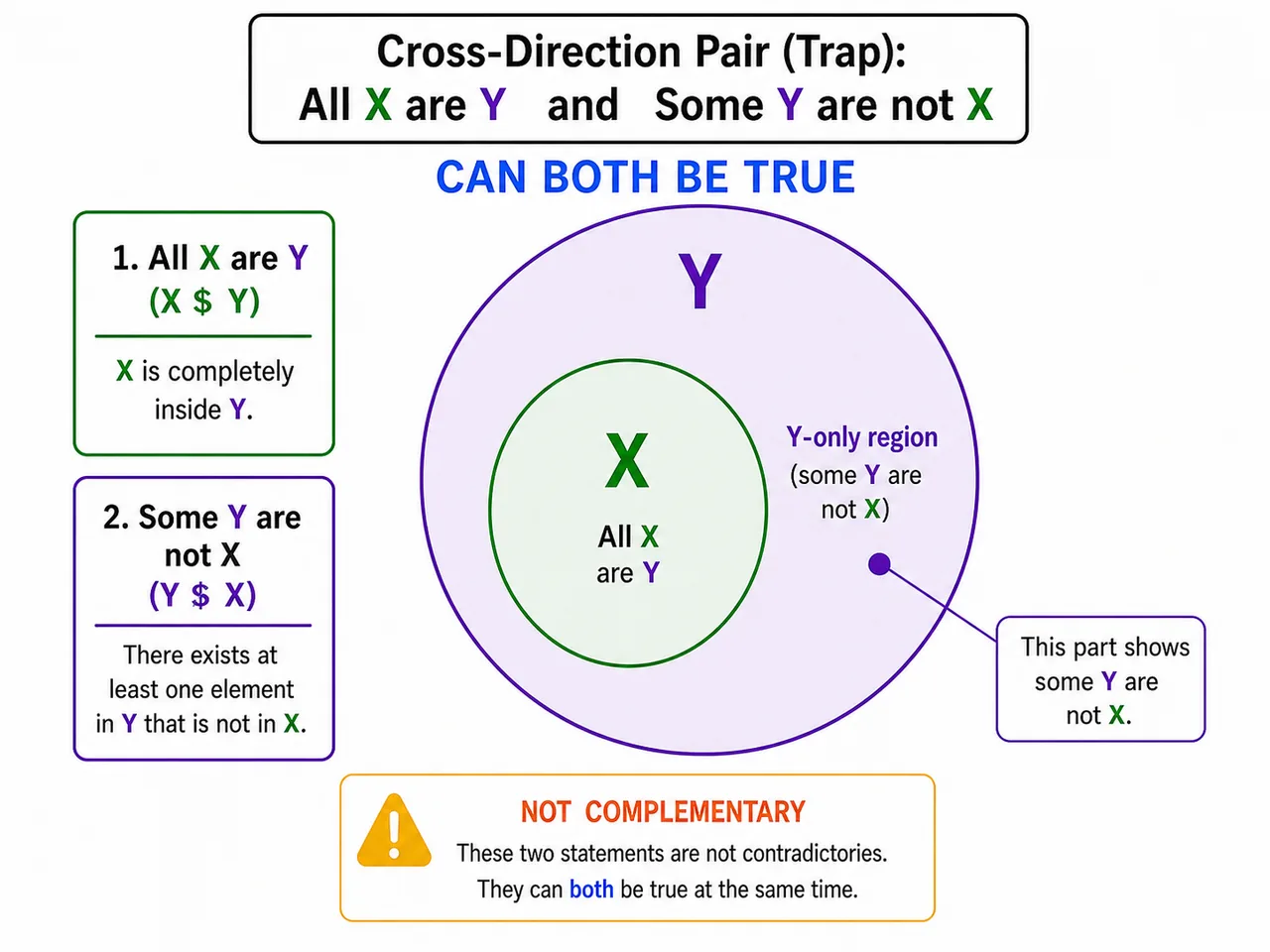
In this diagram:
- "All X are Y" → ✓ True (X is completely inside Y)
- "Some Y are not X" → ✓ True (the part of Y outside X exists)
Both are true at the same time! This violates the complementary pair rule that "they cannot both be true." Therefore, cross-direction pairs are NOT complementary and Either-Or does NOT apply to them.
How to identify the trap:
| Pair | Directions | Complementary? |
|---|---|---|
| All X are Y ↔ Some X are not Y | Same (X→Y) | ✓ YES |
| All X are Y ↔ Some Y are not X | Crossed (X→Y vs Y→X) | ✗ NO |
| Some X are Y ↔ No X is Y | Same (X→Y) | ✓ YES |
| Some X are Y ↔ No Y is X | Crossed — but both reversible | ✓ YES (special case) |
Why does "Some/No" cross work but "All/Some Not" cross doesn't? Because "Some X are Y" = "Some Y are X" and "No X is Y" = "No Y is X" — both statements are reversible, so crossing makes no difference. But "All X are Y" ≠ "All Y are X" and "Some X are not Y" ≠ "Some Y are not X" — these are NOT reversible, so cross-direction changes the meaning entirely.
Example of the trap: Statements: Some E are F.
Conclusions: I. All E are F II. Some F are not E
Wrong thinking: "All E are F" and "Some F are not E" look like opposites → Either-Or? NO!
Correct thinking:
- These are cross-direction (E→F vs F→E)
- Both CAN be true: if all E are inside F and F is bigger, then "All E are F" is true AND "Some F are not E" is true
- NOT a complementary pair
- Check each independently: I → Doubtful, II → Doubtful, but not complementary
- Answer: Neither follows
Worked Examples
Example 1: Statements:
- All E are F
- Some F are G
Conclusions: I. All G are E II. Some G are not E
Analysis:
- From the statements, the relationship between E and G is uncertain (the "Some" in statement 2 breaks the chain)
- Conclusion I: "All G are E" → Doubtful
- Conclusion II: "Some G are not E" → Doubtful
- Complementary? "All G are E" ↔ "Some G are not E" → Same direction (G→E) → YES, Pattern 1
- Answer: Either I or II follows
Example 2: Statements:
- Some M are N
- All N are K
Conclusions: I. All M are K II. Some M are not K
Analysis:
- "Some M are N" + "All N are K" → "Some M are K" (definite)
- But we don't know the full M–K relationship
- Conclusion I: "All M are K" → Doubtful
- Conclusion II: "Some M are not K" → Doubtful
- Complementary? "All M are K" ↔ "Some M are not K" → Same direction (M→K) → YES, Pattern 1
- Answer: Either I or II follows
Example 3: Statements:
- All E are F
- No F is G
Conclusions: I. Some E are G II. No E is G
Analysis:
- "All E are F" + "No F is G" → "No E is G" (definite — E inside F, G separate from F)
- Conclusion II follows definitely
- Conclusion I is definitely false
- Answer: Only II follows (NOT either-or, because II is definite)
Example 4: Statements:
- No M is N
- All N are K
Conclusions: I. Some K are not M II. All K are M
Analysis:
- "All N are K" → Some K are N → those K (that are N) are not M (since No M is N) → "Some K are not M" → ✓ Definite!
- Conclusion I follows
- Answer: Only I follows (not either-or)
Example 5 (Cross-direction trap): Statements:
- Some E are F
- All F are G
Conclusions: I. All E are G II. Some G are not E
Analysis:
- "Some E are F" + "All F are G" → "Some E are G" (definite)
- Conclusion I: "All E are G" → Doubtful
- Conclusion II: "Some G are not E" → Doubtful
- Complementary? "All E are G" ↔ "Some G are not E" → CROSS direction (E→G vs G→E)
- NOT a complementary pair — both can be true if E is inside G and G is bigger
- Answer: Neither follows
Either-Or with Unknown Relationships
The most common scenario for Either-Or is when two elements have no stated relationship at all. If elements P and Q are never mentioned together in any statement and have no chain connecting them:
- "Some P are Q" → Doubtful (might overlap)
- "No P is Q" → Doubtful (might not overlap)
- These form Pattern 2 → Either-Or
Similarly:
- "All P are Q" → Doubtful
- "Some P are not Q" → Doubtful
- These form Pattern 1 → Either-Or
Exam shortcut: When you see two conclusions about elements with NO connecting chain, immediately check if they form a complementary pair. If yes, you've found your Either-Or answer in seconds.
Quick Reference Card
Write this on your rough paper at the start of the exam:
EITHER-OR (both must be DOUBTFUL):

Pattern 1:  All X→Y  ↔  Some X not→Y    ✓
Pattern 2:  Some X→Y ↔  No X→Y          ✓

TRAP (NOT either-or):
All X→Y  ↔  Some Y not→X               ✗ (cross — can both be true)

REMEMBER:
- Some/No are reversible → cross = same → works
- All/Some-Not are NOT reversible → cross ≠ same → TRAP
Practice Problems
Problem 1: Statements: Only a few E are F. All F are G.
Conclusions: I. All E are G II. Some E are not G
- "Only a few E are F" → Some E are F + Some E are not F
- Some E are F + All F are G → Some E are G (definite)
- All E are G → Doubtful
- Some E are not G → Doubtful
- Complementary pair? All E→G ↔ Some E not→G → YES, Pattern 1
- Answer: Either I or II
Problem 2: Statements: All E are F. Some G are F.
Conclusions: I. All G are E II. Some G are not E
- E inside F, G overlaps with F — but E-G relationship is uncertain
- All G are E → Doubtful
- Some G are not E → Doubtful
- Same direction (G→E) → Pattern 1 → YES
- Answer: Either I or II
Problem 3: Statements: Some E are F. No F is G.
Conclusions: I. Some E are G II. No E is G
- E overlaps with F, G separate from F — but E could extend to overlap G independently
- Some E are G → Doubtful
- No E is G → Doubtful
- Pattern 2 (Some E→G ↔ No E→G) → YES
- Answer: Either I or II
Problem 4 (Trap): Statements: Some E are F.
Conclusions: I. All F are E II. Some E are not F
- All F are E → Doubtful
- Some E are not F → Doubtful
- Complementary? "All F are E" ↔ "Some E are not F" → Different directions! (F→E vs E→F)
- Neither Pattern 1 nor Pattern 2
- Answer: Neither follows
Common Mistakes
-
Applying either-or when one conclusion is definite: Either-or only works when BOTH conclusions are individually doubtful. If one follows or is definitely false, it's not either-or.
-
Falling for cross-direction traps: "All X are Y" and "Some Y are not X" look like opposites but are NOT complementary. Always verify both conclusions talk about the same direction.
-
Forgetting to verify the pair pattern: Not every pair of doubtful conclusions is complementary. They must match Pattern 1 or Pattern 2.
-
Confusing "possible" with "either-or": Just because both conclusions are "possible" doesn't mean either-or applies. They must be logical opposites that exhaust all possibilities.
-
Ignoring "Only a few" / "Only" effects: If a given statement already makes one half of a pair definite (e.g., "Only a few X are Y" makes "Some X are not Y" definite), then either-or breaks because the pair is no longer two doubtful conclusions.
Summary Cheat Sheet
| Concept / Topic | Key Details / Explanation |
|---|---|
| What is Either-Or? | Exactly one of two conclusions MUST be true, but we cannot say which. Used as answer option: "Either I or II follows." |
| 3 Conditions for Either-Or | 1) Both conclusions are individually doubtful. 2) Cannot both be true simultaneously. 3) Cannot both be false simultaneously. ALL three must hold. |
| Pattern 1 (complementary pair) | All X are Y ↔ Some X are not Y (same direction, X→Y). Either 100% of X is in Y, or less — no middle ground. |
| Pattern 2 (complementary pair) | Some X are Y ↔ No X is Y (same direction). Either overlap exists or it doesn't — no middle ground. |
| CRITICAL: Same direction required | Both conclusions must be about the same two elements in the same direction for Pattern 1. |
| Cross-direction trap (Pattern 1) | "All X are Y" ↔ "Some Y are not X" — CROSS direction. BOTH can be true simultaneously (if Y > X). NOT a complementary pair. Answer: Neither follows. |
| Cross-direction for Pattern 2 | "Some X are Y" ↔ "No Y is X" — "Some" and "No" are reversible, so cross = same. This IS Pattern 2. ✓ |
| Why Some/No cross works but All/SomeNot cross doesn't | Some X=Y = Some Y=X (reversible). No X=Y = No Y=X (reversible). But All X≠Y are X (not reversible) and Some X not Y ≠ Some Y not X (not reversible). |
| Decision table | Both follow → Both. One follows → that one. Both doubtful + complementary → Either-Or. Both doubtful + NOT complementary → Neither. One definite false → Neither (or only the other). |
| Either-Or fails when one conclusion is definite | If one conclusion already follows or is definitely false, Either-Or does NOT apply. |
| Unknown relationship → Either-Or | If two elements have NO connecting chain at all: "Some P are Q" ↔ "No P is Q" → Pattern 2 → Either-Or instantly. |
| "Only a few" breaks Either-Or | If "Only a few X are Y" is given, "Some X are not Y" is already definite → the pair All X=Y ↔ Some X not=Y breaks. |
| Exam shortcut for unknown pairs | No chain between P and Q → check conclusions about P-Q. If Pattern 1 or 2 → Either-Or in seconds. |
| Quick reference card | Pattern 1: All X→Y ↔ Some X not→Y ✓ | Pattern 2: Some X→Y ↔ No X→Y ✓ | TRAP: All X→Y ↔ Some Y not→X ✗ (cross, can both be true) |