🎪 Only & None But Concept
Master the "Only X are Y" statement (which means All Y are X — reversed direction), the "None but" equivalent, and understand why Y cannot relate with others when "Only" is used
Only & None But Concept
"Only" is one of the most tricky keywords in syllogism. It reverses the direction of "All" and creates a constraint that restricts one group's relationships. This appears frequently in SBI PO Mains and RBI Grade B.
What Does "Only E are F" Mean?
"Only E are F" = "All F are E" (reversed direction!)
It means: F is completely inside E. Nothing outside E can be F.
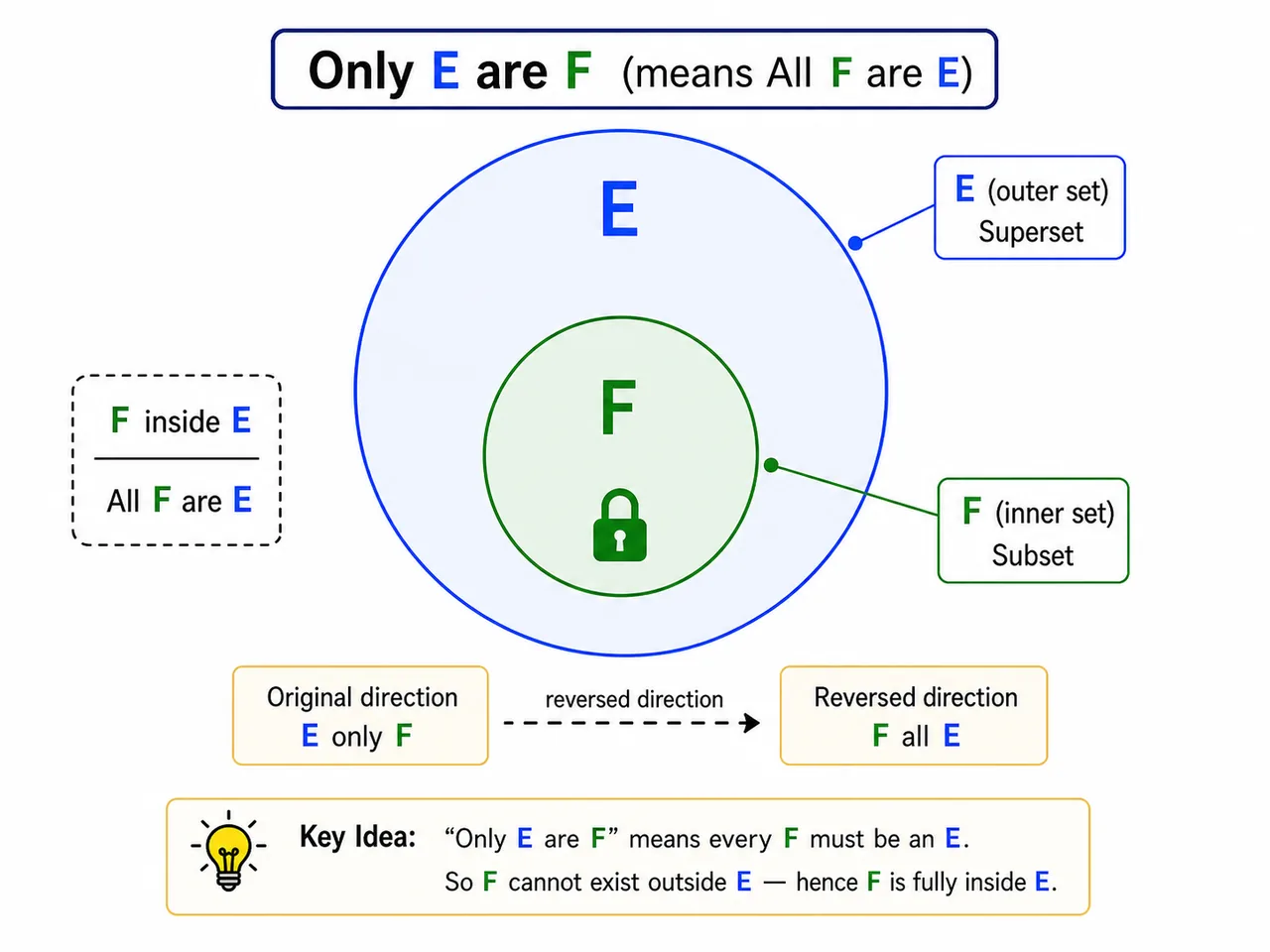
The shaded/hatched circle (F) indicates it is FIXED — F cannot move outside E in any possibility case. This is the key visual for "Only" statements.
Pro Content Locked
Upgrade to Pro to access this lesson and all other premium content.
Pay once for one year · Effective ₹99/mo
- All Agriculture & Banking Courses
- AI Lesson Questions (100/day)
- AI Doubt Solver (50/day)
- Glows & Grows Feedback (30/day)
- AI Section Quiz (20/day)
- 22-Language Translation (100/day)
- Recall Questions (20/day)
- AI Quiz (15/day)
- AI Quiz Paper Analysis (100/day)
- AI Step-by-Step Explanations (100/day)
- Spaced Repetition Recall (FSRS)
- AI Tutor
- Immersive Text Questions
- Audio Lessons — Hindi & English
- Mock Tests & Previous Year Papers
- Summary & Mind Maps
- XP, Levels, Leaderboard & Badges
- Generate New Classrooms
- Voice AI Teacher (AgriDots Live)
- AI Revision Assistant
- Knowledge Gap Analysis
- Interactive Revision (LangGraph)
🔒 Secure one-time yearly payment via Razorpay · No hidden fees
Only & None But Concept
"Only" is one of the most tricky keywords in syllogism. It reverses the direction of "All" and creates a constraint that restricts one group's relationships. This appears frequently in SBI PO Mains and RBI Grade B.
What Does "Only E are F" Mean?
"Only E are F" = "All F are E" (reversed direction!)
It means: F is completely inside E. Nothing outside E can be F.
The shaded/hatched circle (F) indicates it is FIXED — F cannot move outside E in any possibility case. This is the key visual for "Only" statements.
Think of it this way:
- "All rivers are waterways" → Rivers inside Waterways
- "Only waterways are rivers" → Rivers inside Waterways (same meaning!)
The "Only" keyword flips the direction. And F is permanently locked inside E — no possibility diagram can place F outside E.
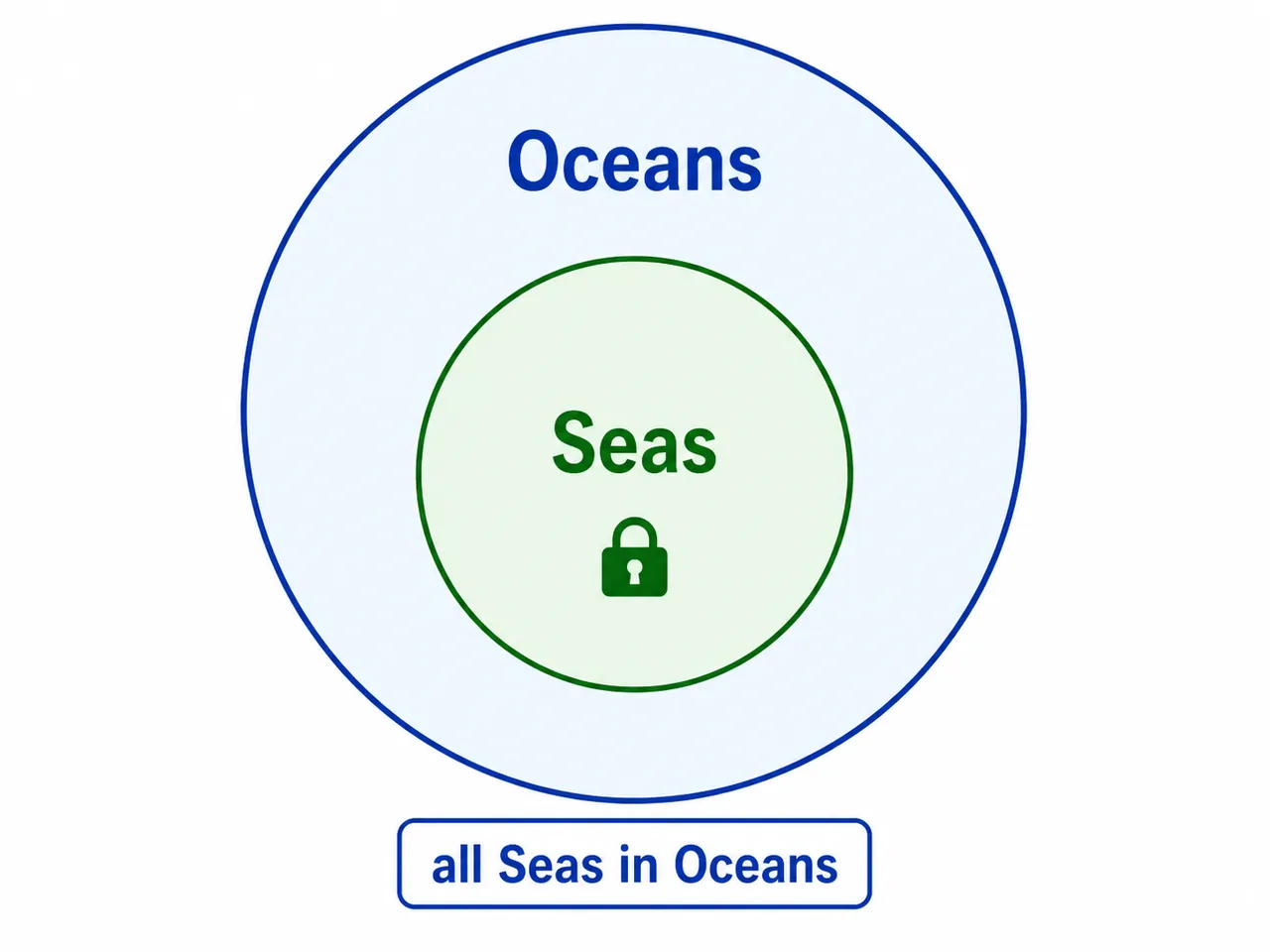
"None But" = "Only"
"None but E are F" = "Only E are F" = "All F are E"
"None but" means "nothing except E can be F" → F must be inside E.
Example:
- "None but oceans are seas" = "Only oceans are seas" = "All seas are oceans"
Why the Direction Matters
"All E are F" vs "Only E are F":
| Statement | Meaning | E and F |
|---|---|---|
| All E are F | E is inside F | E ⊆ F |
| Only E are F | F is inside E | F ⊆ E |
These are opposite directions!
Common trap: Statement: "Only mountains are peaks" Wrong interpretation: All mountains are peaks ✗ Correct interpretation: All peaks are mountains ✓
Complete Conclusion Table for "Only E are F"
Since "Only E are F" = "All F are E":
| Conclusion | Status |
|---|---|
| All F are E | ✓ Follow (this IS the meaning) |
| Some E are F | ✓ Follow (F is inside E → overlap exists) |
| Some F are E | ✓ Follow (F inside E → all F are E → some F are E) |
| All E are F | ? Doubtful / Possible (E could be bigger than F) |
| No E is F | ✗ Not possible (F is inside E, overlap exists) |
| Some E are not F | ? Doubtful / Possible (E could extend beyond F) |
| No F is E | ✗ Not possible |
| Some F are not E | ✗ Not possible (ALL F are inside E) |
The "F Cannot Relate" Rule
When "Only E are F" is given, F is locked inside E and cannot form definite relationships with elements connected to E from outside.
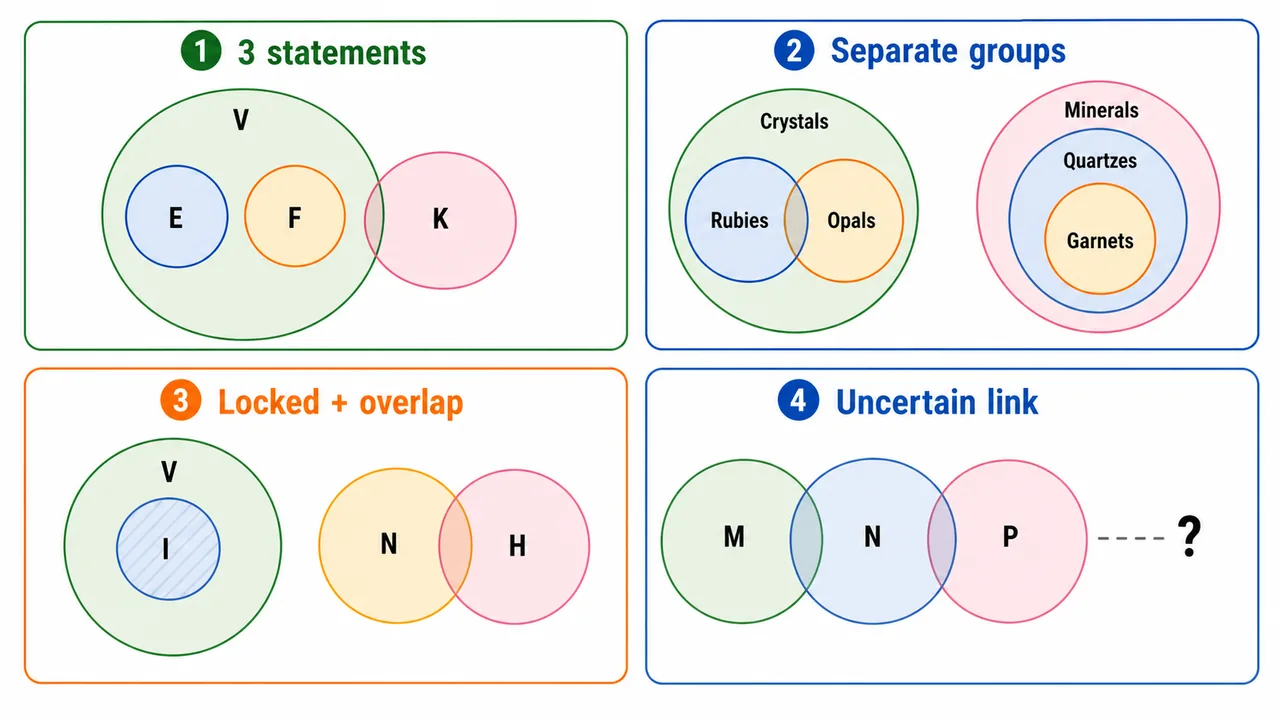
Example: Statements:
- Only D are F (= All F are D)
- All D are G
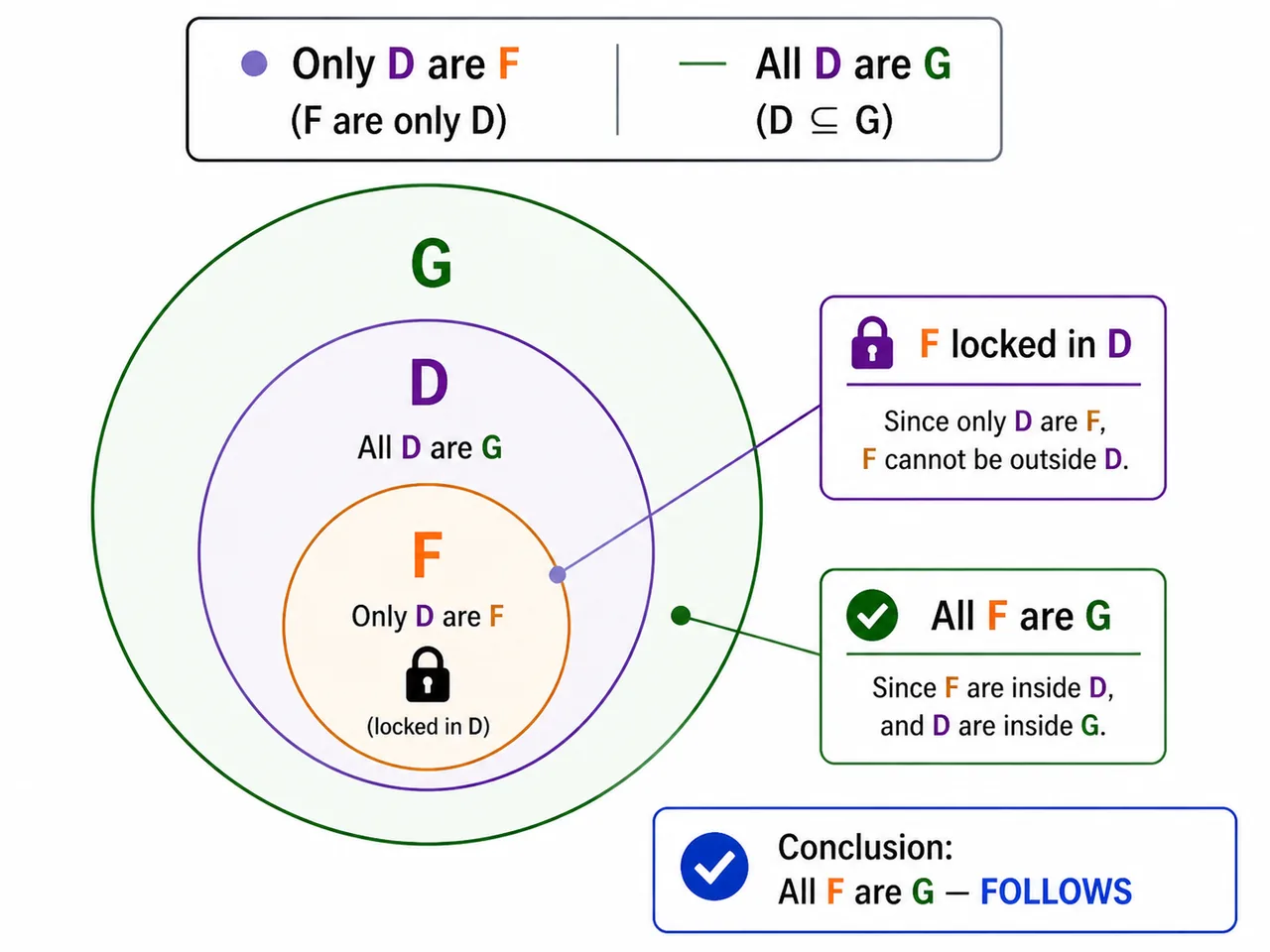
F is inside D, D is inside G → F is inside G.
- All F are G → ✓ Follow
- Some G are F → ✓ Follow
But what if we add "No G is H"?
- No F is H → ✓ Follow (F inside G, H separate from G)
- F's relationship with H is determined through G
The rule is: F (the "F" in "Only E are F") can only connect to other elements THROUGH E. It cannot independently connect to elements that aren't already connected to E.
"Only" + "No" Combination
Statements:
- Only J are K (= All K are J)
- No J is L
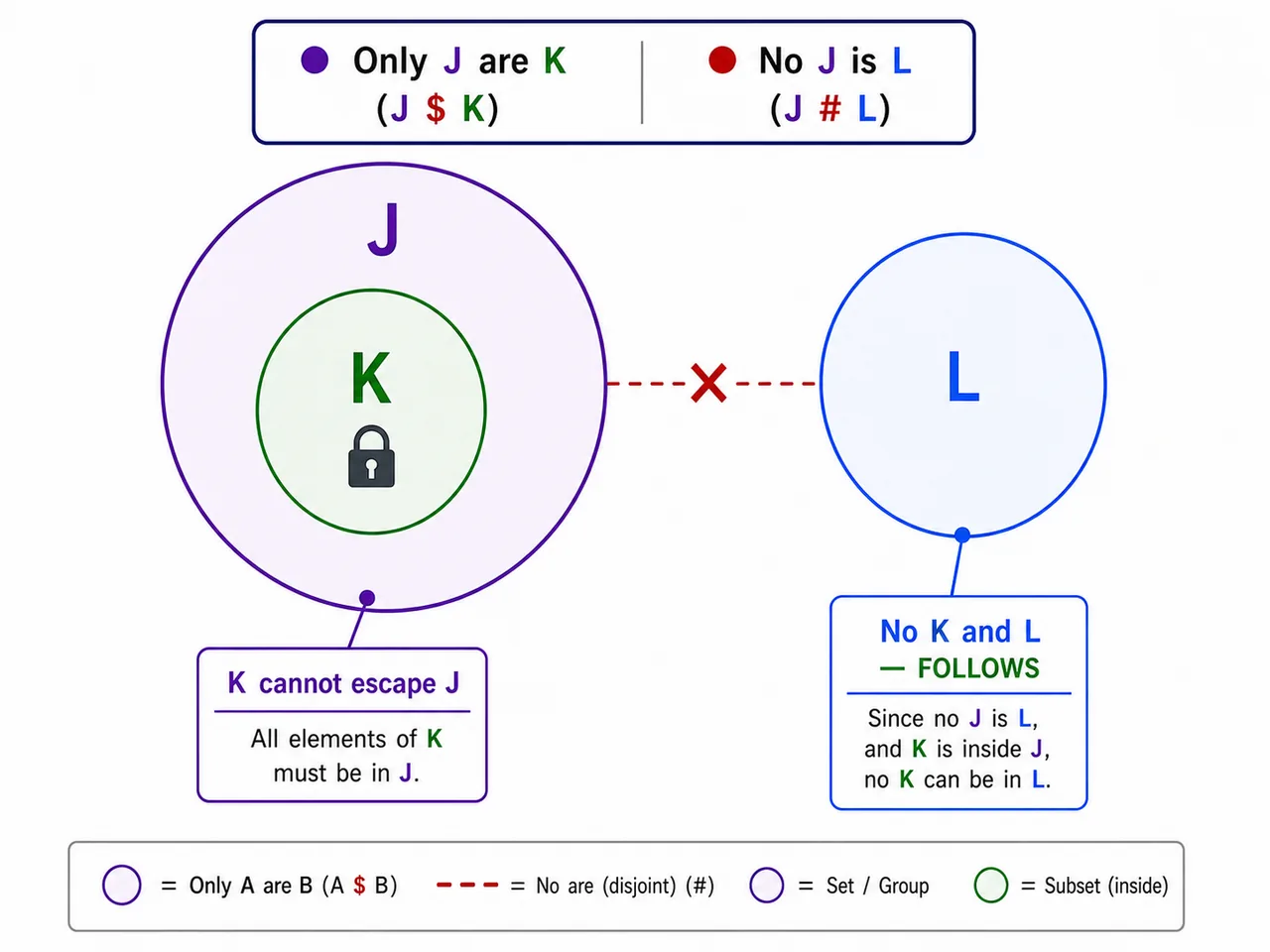
Conclusions:
- No K is L → ✓ Follow (K inside J, L separate from J)
- No L is K → ✓ Follow
- Some J are not L → ✓ Follow (J exists and is separate from L)
- Some K are not L → ✓ Follow (all K are inside J which is separate from L)
"Only" + "Some" Combination
Statements:
- Only E are F (= All F are E)
- Some E are W
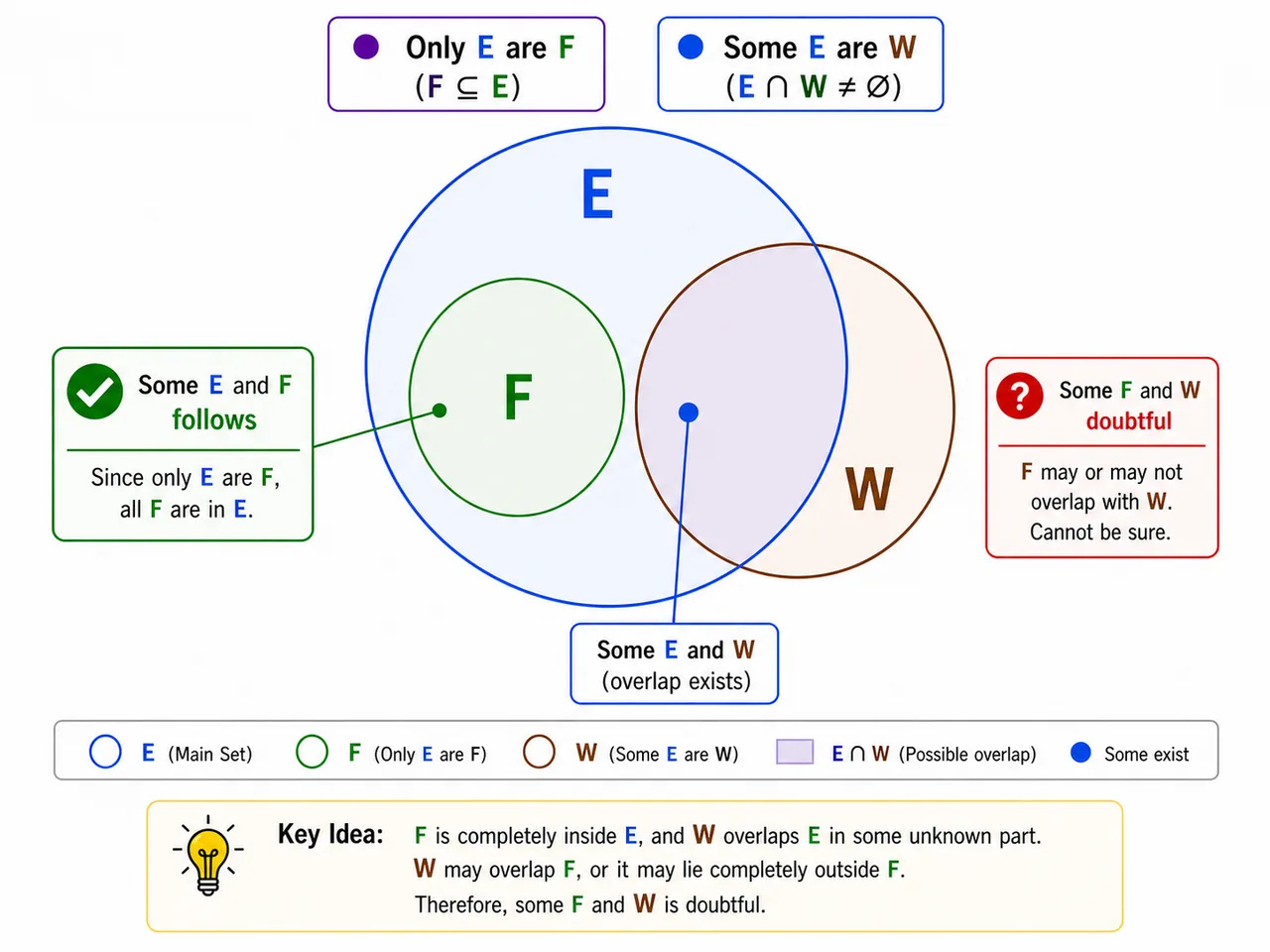
Conclusions:
- Some F are W → ? Doubtful (the E-W overlap might not include F). Does not follow.
- Some E are F → ✓ Follow (from "Only E are F")
- All W are E → ? Doubtful
The F-W relationship is uncertain because F is locked inside E, and the W overlap with E might not include the F part.
"None But" Practice
Statements:
- None but forests are jungles (= All jungles are forests)
- No jungle is a desert
- Some deserts are plateaus
- All plateaus are landforms
Draw:
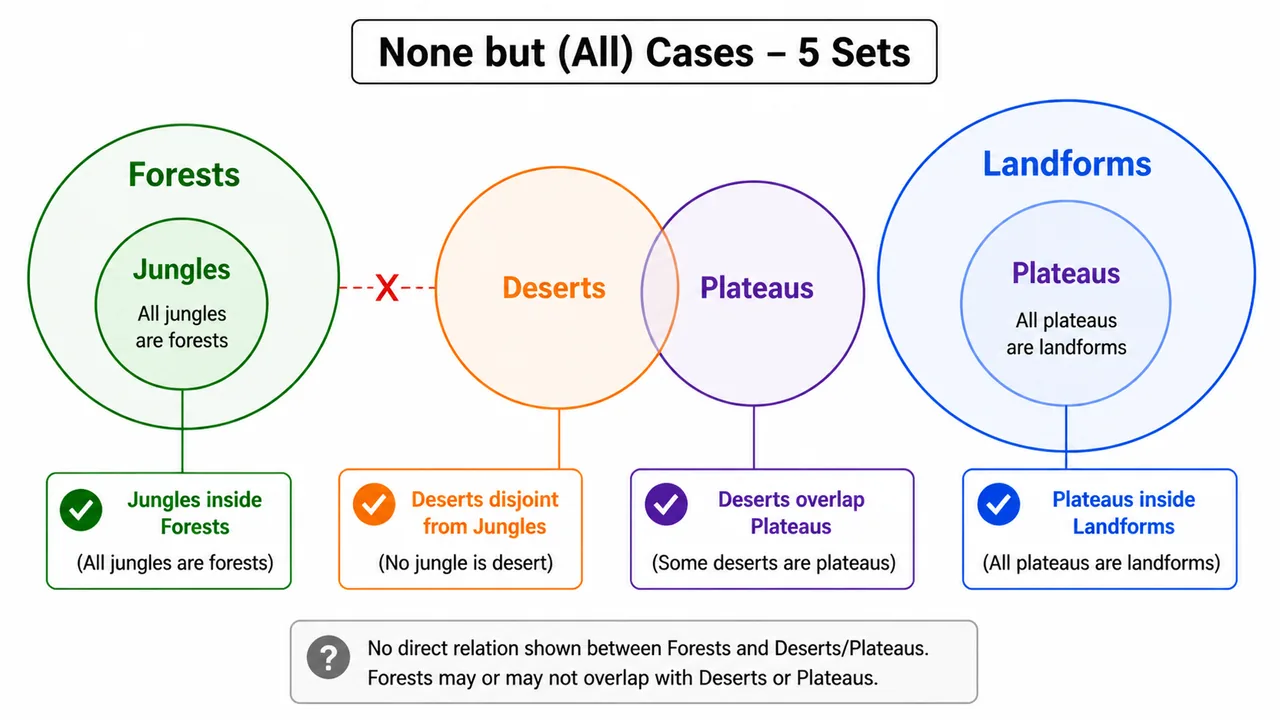
Wait — Deserts and Jungles are separate (No jungle is a desert). But we need to figure out Forests' relationship with Deserts/Plateaus/Landforms.
Actually, we only know:
- Jungles inside Forests
- Jungles separate from Deserts
- Deserts overlap with Plateaus
- Plateaus inside Landforms
Forests' relationship with Deserts/Plateaus/Landforms is uncertain (Forests could overlap or not).
Conclusions:
- Some forests are jungles → ✓ Follow
- No jungle is a plateau → ? Doubtful (Jungles are separate from Deserts, Deserts overlap with Plateaus, but Jungle-Plateau relationship is uncertain)
- Some landforms are deserts → ✓ Follow (Deserts overlap with Plateaus, Plateaus inside Landforms → Some Deserts are Landforms → Some Landforms are Deserts ✓)
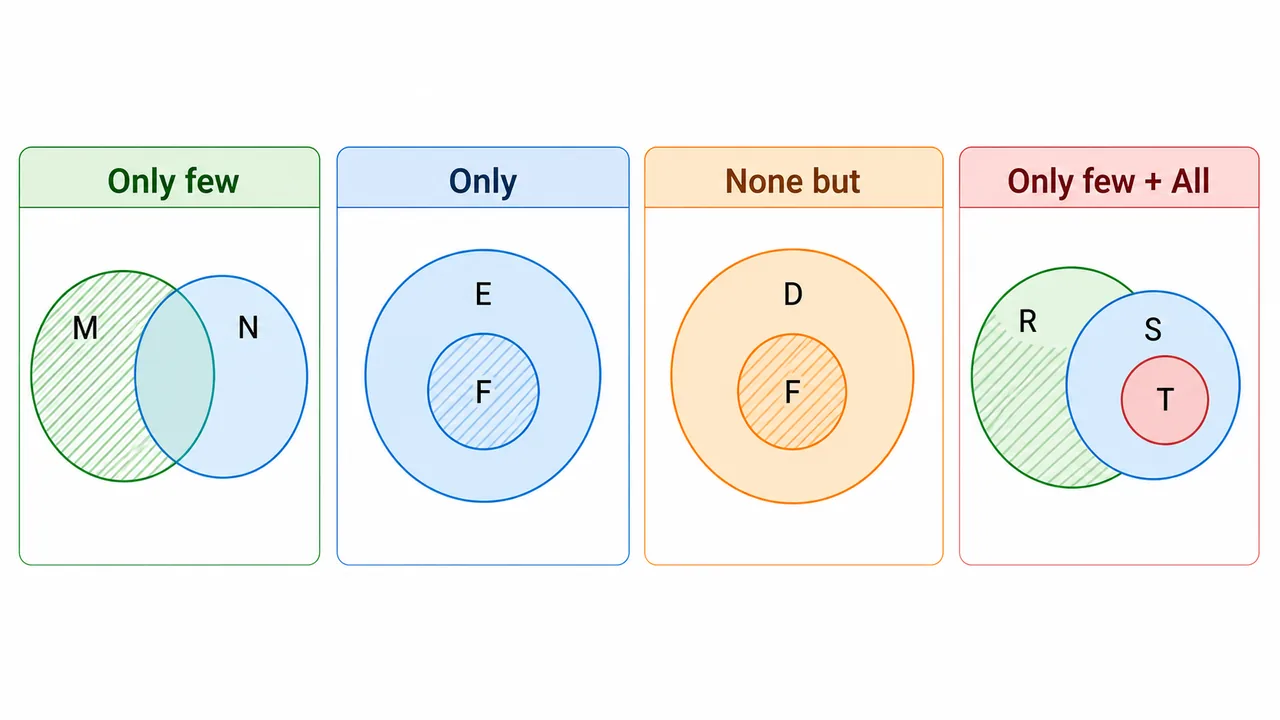
Comparison: "Only" vs "Only a Few" vs "A Few" vs "All"
These four keywords look similar but have completely different logical meanings. Confusing them is the #1 reason students lose marks.
| Statement | Logical Meaning | What it gives you | Venn Diagram |
|---|---|---|---|
| All E are F | E ⊆ F (E inside F) | Some E are F ✓, Some F are E ✓ | E circle inside F circle |
| Only E are F | F ⊆ E (F inside E) — reversed! | All F are E ✓, Some E are F ✓ | F circle inside E circle |
| A few E are F | Same as "Some E are F" | Some E are F ✓, Some F are E ✓ | Partial overlap |
| Only a few E are F | Some E are F + Some E are not F (BOTH guaranteed) | Some E are F ✓, Some E are not F ✓, Some F are E ✓ | Partial overlap + guaranteed non-overlap |
Detailed Breakdown: "A Few" vs "Only a Few"
This distinction is a favourite exam trap in SBI PO and IBPS.
"A Few E are F" = "Some E are F"
- Guarantees: overlap exists (at least one E is F)
- Does NOT guarantee: that some E are NOT F (all E could be F)
- Equivalent to: "Some", "Several", "Many"
"Only a Few E are F" = "Some E are F" + "Some E are not F"
- Guarantees: overlap exists AND non-overlap exists
- The word "Only" restricts it — not all E are F, but not zero either
- Gives TWO definite conclusions instead of one
Complete conclusion tables:
Given: A Few E are F (= Some E are F)
| Conclusion | Status |
|---|---|
| Some E are F | ✓ Follow |
| Some F are E | ✓ Follow |
| Some E are not F | ? Doubtful (possible, not definite) |
| All E are F | ? Doubtful (possible) |
| No E is F | ✗ Not possible |
Given: Only a Few E are F (= Some E are F + Some E are not F)
| Conclusion | Status |
|---|---|
| Some E are F | ✓ Follow |
| Some F are E | ✓ Follow |
| Some E are not F | ✓ Follow (guaranteed!) |
| All E are F | ✗ Not possible (because some E are NOT F) |
| No E is F | ✗ Not possible (because some E ARE F) |
The critical difference: "Only a few" gives you "Some E are not F" as DEFINITE, while plain "A few" / "Some" keeps it doubtful.
Exam Trap Example
Statement: Only a few rivers are lakes.
Q1: Does "Some rivers are not lakes" follow? → ✓ YES — "Only a few" guarantees non-overlap.
Q2: Does "All rivers are lakes" follow? → ✗ NO — "Only a few" means NOT all. This is definitely false, not even a possibility.
Q3: Is "All lakes are rivers" a possibility? → ✓ YES — We only know about rivers→lakes. Lakes could all be inside rivers.
Now compare with: "A few rivers are lakes"
Q1: Does "Some rivers are not lakes" follow? → ✗ NO — "A few" = "Some", doesn't guarantee non-overlap.
Q2: Is "All rivers are lakes" a possibility? → ✓ YES — "A few" doesn't prevent this (unlike "Only a few").
Practice Problems
Problem 1: Statements:
- Only summits are ridges (= All ridges are summits)
- Some ridges are cliffs
- No cliff is a valley
Conclusions:
- Some summits are cliffs → ? "Some ridges are cliffs" and "All ridges are summits" → The ridges that are cliffs are also summits → Some summits are cliffs ✓ Follow
- No ridge is a valley → ? Ridges overlap with cliffs, cliffs separate from valleys. But ridges could also directly overlap with valleys. Doubtful. Does not follow.
- Some summits are not valleys → ? Doubtful. Does not follow.
Problem 2: Statements:
- Only trails are routes (= All routes are trails)
- No route is a highway
- All highways are passages
Conclusions:
- No trail is a highway → Doubtful (Routes are inside Trails, Highways are separate from Routes, but Trails could extend to overlap with Highways). Does not follow.
- Some passages are not routes → ✓ Follow? Highways are inside Passages, Highways separate from Routes → those Passages that are Highways are not Routes → Some Passages are not Routes ✓ Follow
- No route is a passage → Doubtful. Routes and Passages could overlap (Routes are separate from Highways but Passages extends beyond Highways). Does not follow.
Speed Tips
- "Only E are F" → immediately write "All F are E" on rough paper. Convert it and forget the word "Only".
- "None but" = "Only" — same conversion: "None but E are F" → "All F are E"
- Direction check: After converting, point an arrow from F to E. F is the inner circle.
- F is restricted: In "Only E are F", F cannot escape E. All of F's relationships must go through E.
Common Mistakes
- Wrong direction: "Only E are F" → students draw E inside F. WRONG. It's F inside E.
- Confusing with "Only a few": "Only" and "Only a few" are completely different. "Only" = All (reversed). "Only a few" = Some + Some not.
- Forgetting the conversion: Don't try to reason with the word "Only" directly. Always convert to "All F are E" first.
- Over-concluding: "Only E are F" does NOT mean "All E are F". E can extend beyond F.
Summary Cheat Sheet
| Concept / Topic | Key Details / Explanation |
|---|---|
| "Only E are F" meaning | = "All F are E" — direction is REVERSED. F is completely inside E. |
| "None but E are F" meaning | = "Only E are F" = "All F are E". Identical logical content. |
| Direction rule | "Only E are F": draw F inside E (not E inside F). The word "Only" flips the direction. |
| Exam conversion rule | Always convert immediately: "Only X are Y" → write "All Y are X" on rough paper. Then forget the word "Only". |
| "Only E are F" — definite conclusions | All F are E ✓, Some E are F ✓, Some F are E ✓ |
| "Only E are F" — possible (not definite) | All E are F (?), Some E are not F (?) |
| "Only E are F" — impossible | No E is F ✗, No F is E ✗, Some F are not E ✗ (ALL F are inside E) |
| "F is locked inside E" rule | F cannot escape E in any possibility diagram. All of F's relationships with other elements must go THROUGH E. |
| "Only" + "All" chain | Only D are F (= All F are D) + All D are G → F inside D inside G → All F are G ✓, Some G are F ✓ |
| "Only" + "No" chain | Only J are K (= All K are J) + No J is L → K inside J, L separate from J → No K is L ✓, No L is K ✓, Some K are not L ✓ |
| "Only" + "Some" chain | Only E are F (= All F are E) + Some E are W → F-W relationship uncertain (W overlap with E might not include the F part). |
| Keyword comparison table | All E are F: E ⊆ F | Only E are F: F ⊆ E (reversed!) | A few E are F: partial overlap | Only a few E are F: partial overlap + guaranteed non-overlap |
| "All E are F" vs "Only E are F" | "All E are F" → E inside F. "Only E are F" → F inside E. Opposite directions — most common trap. |
| Wrong direction trap | Statement "Only mountains are peaks" → students draw mountains inside peaks. WRONG. Correct: peaks inside mountains (All peaks are mountains). |
| "None but" exam examples | "None but oceans are seas" = All seas are oceans. Seas is the inner (locked) circle. |
| "Only a few" ≠ "Only" | "Only" = All reversed (definite). "Only a few" = Some + Some Not (two statements). Never confuse them. |