🔍 Only a Few Concept
Master the "Only a few X are Y" statement which combines "Some" and "Some not" simultaneously, and learn the critical difference between "a few" and "only a few"
Only a Few Concept
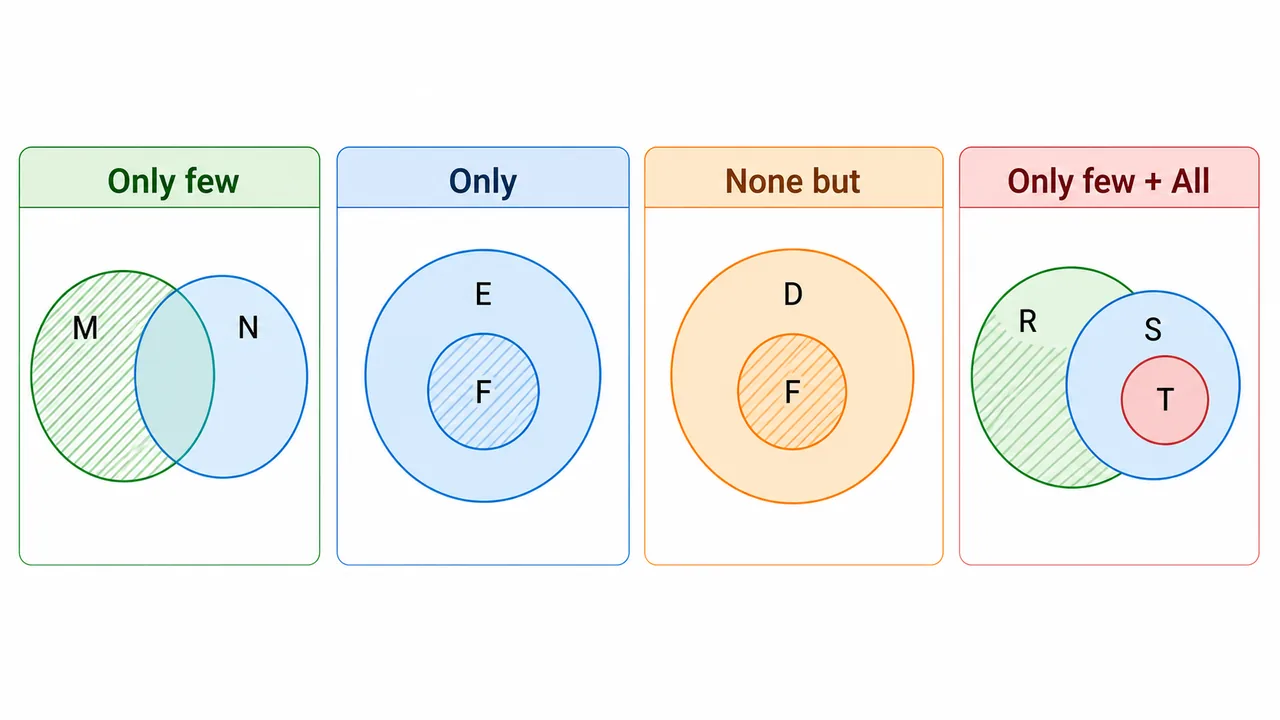
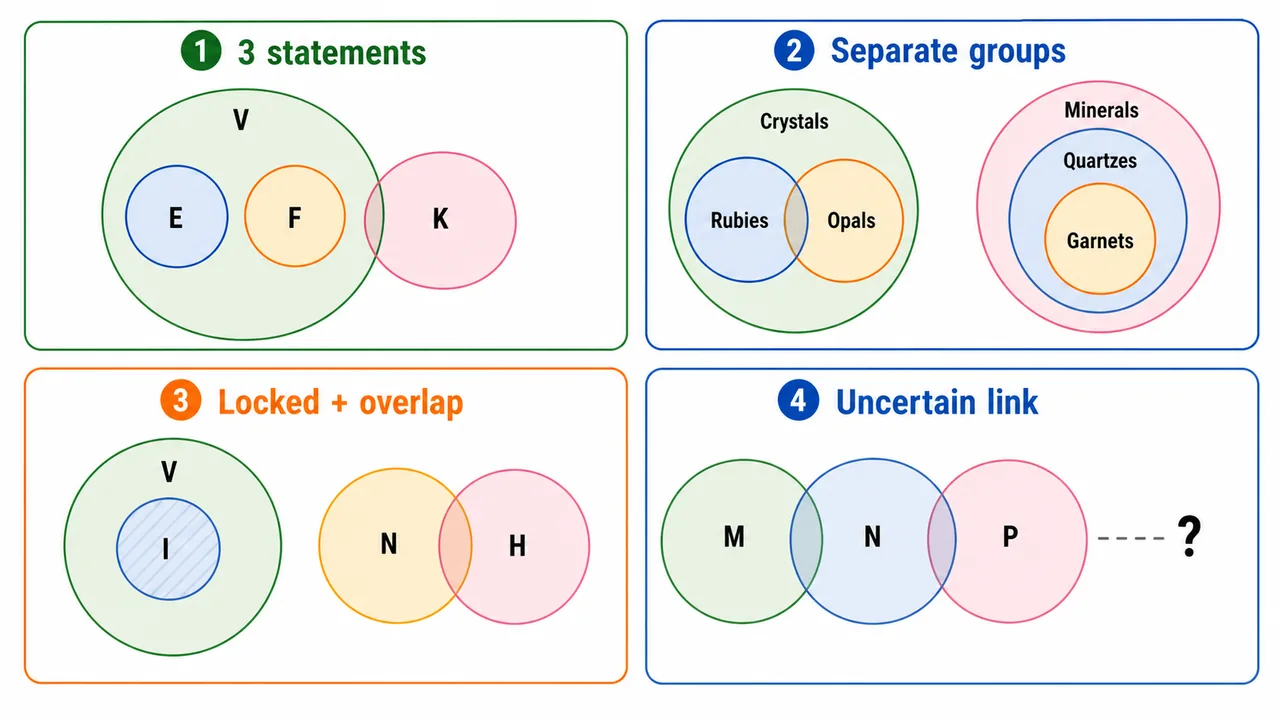
"Only a few" is a modern exam favourite that appears in SBI PO, IBPS PO Mains, and RBI Grade B. It combines two statements into one and creates many conclusion possibilities.
What Does "Only a Few M are N" Mean?
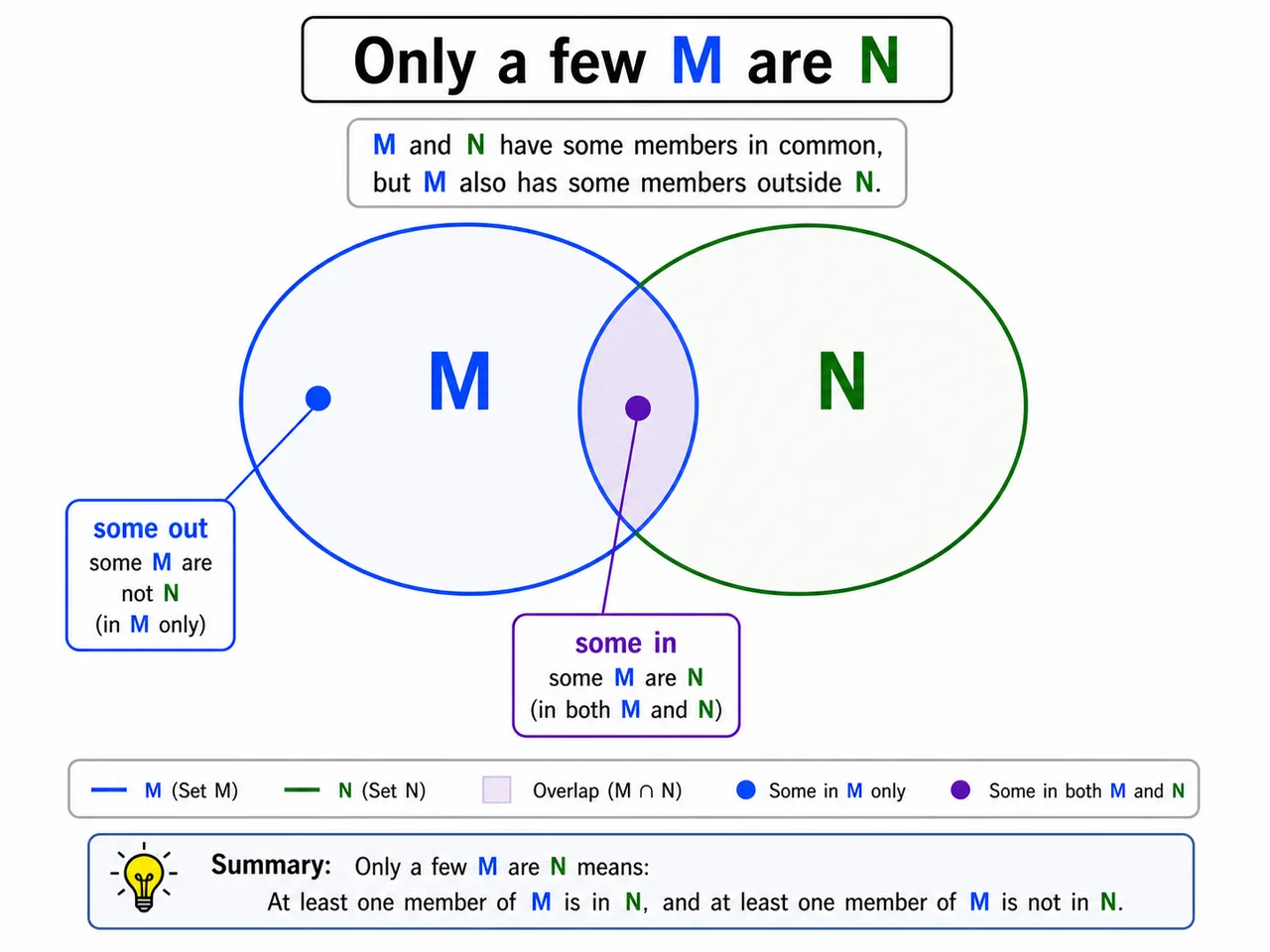
"Only a few M are N" = "Some M are N" + "Some M are not N"
It means:
- Some M are inside N (overlap exists)
- Some M are outside N (non-overlap exists)
- NOT all M are N
- NOT no M is N
"A Few" vs "Only a Few" — Critical Difference
| Statement | Means | Includes |
|---|---|---|
| A few M are N | Some M are N | "Some" ONLY |
| Only a few M are N | Some M are N + Some M are not N | "Some" + "Some Not" |
"A few" = "Some" — it only tells us overlap exists. It does NOT tell us that some M are outside N.
Pro Content Locked
Upgrade to Pro to access this lesson and all other premium content.
Pay once for one year · Effective ₹99/mo
- All Agriculture & Banking Courses
- AI Lesson Questions (100/day)
- AI Doubt Solver (50/day)
- Glows & Grows Feedback (30/day)
- AI Section Quiz (20/day)
- 22-Language Translation (100/day)
- Recall Questions (20/day)
- AI Quiz (15/day)
- AI Quiz Paper Analysis (100/day)
- AI Step-by-Step Explanations (100/day)
- Spaced Repetition Recall (FSRS)
- AI Tutor
- Immersive Text Questions
- Audio Lessons — Hindi & English
- Mock Tests & Previous Year Papers
- Summary & Mind Maps
- XP, Levels, Leaderboard & Badges
- Generate New Classrooms
- Voice AI Teacher (AgriDots Live)
- AI Revision Assistant
- Knowledge Gap Analysis
- Interactive Revision (LangGraph)
🔒 Secure one-time yearly payment via Razorpay · No hidden fees
Only a Few Concept
"Only a few" is a modern exam favourite that appears in SBI PO, IBPS PO Mains, and RBI Grade B. It combines two statements into one and creates many conclusion possibilities.
What Does "Only a Few M are N" Mean?
"Only a few M are N" = "Some M are N" + "Some M are not N"
It means:
- Some M are inside N (overlap exists)
- Some M are outside N (non-overlap exists)
- NOT all M are N
- NOT no M is N
"A Few" vs "Only a Few" — Critical Difference
| Statement | Means | Includes |
|---|---|---|
| A few M are N | Some M are N | "Some" ONLY |
| Only a few M are N | Some M are N + Some M are not N | "Some" + "Some Not" |
"A few" = "Some" — it only tells us overlap exists. It does NOT tell us that some M are outside N.
"Only a few" = "Some" + "Some Not" — it tells us BOTH overlap AND non-overlap exist.
Why this matters:
Given "A few M are N":
- "All M are N" → Possible (because "a few" doesn't rule out "all")
- "Some M are not N" → Possible but not definite
Given "Only a few M are N":
- "All M are N" → NOT possible (because "some M are not N" is definite)
- "Some M are not N" → ✓ Definite follow
Complete Conclusion Table for "Only a Few M are N"
| Conclusion | Status |
|---|---|
| Some M are N | ✓ Follow |
| Some N are M | ✓ Follow |
| Some M are not N | ✓ Follow |
| All M are N | ✗ Not possible (contradicts "Some M are not N") |
| No M is N | ✗ Not possible (contradicts "Some M are N") |
| All N are M | ? Doubtful / Possible |
| Some N are not M | ? Doubtful / Possible |
"Only a Few Not" Concept
"Only a few M are not N" = "Some M are not N" + "Some M are N"
Wait — this looks the same as "Only a few M are N"! But there's a subtle difference in emphasis:
- "Only a few M are N" → Few are inside N, most are outside
- "Only a few M are not N" → Few are outside N, most are inside
For syllogism purposes, the logical content is the same: Both give "Some M are N" + "Some M are not N"
But in some exam contexts, "only a few not" emphasizes that the majority IS in N.
"Only a Few" + "No" Combination
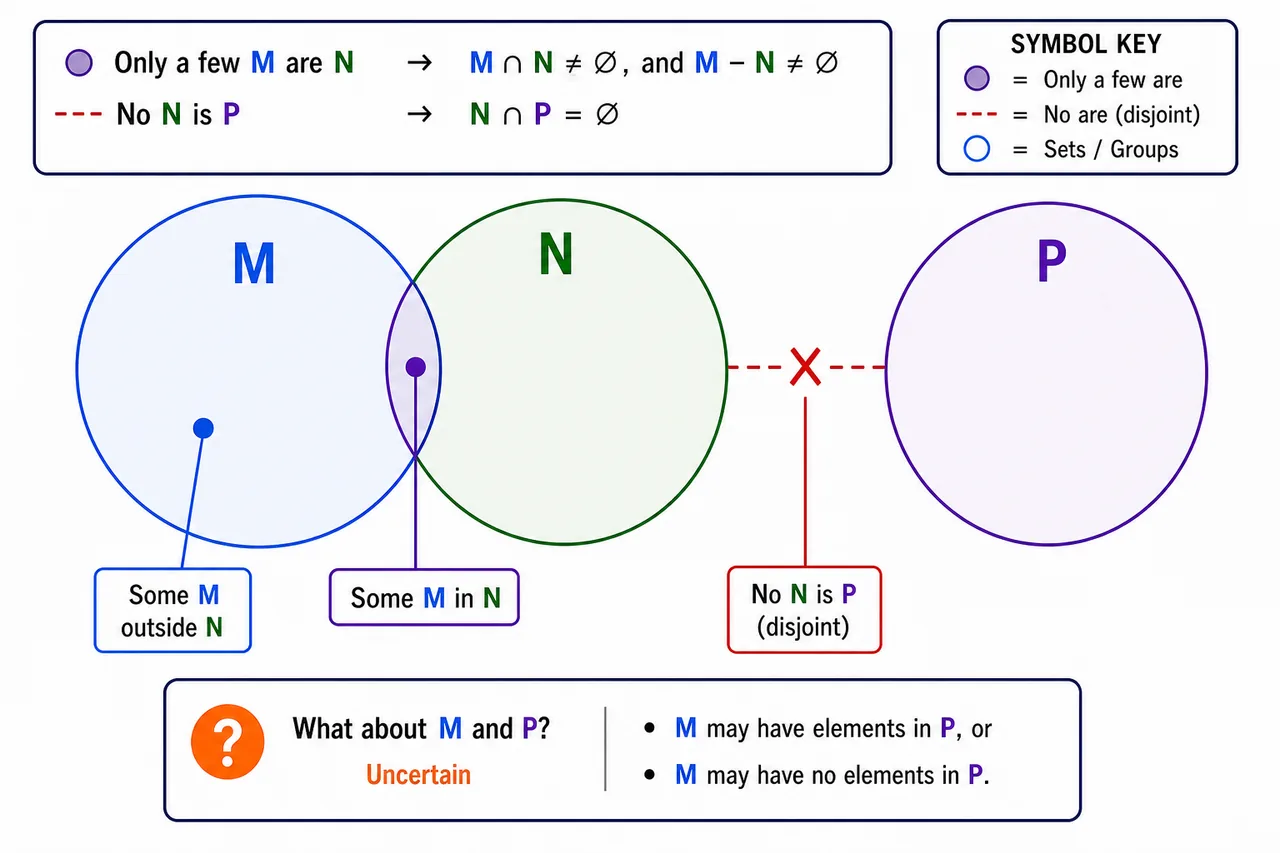
Statements:
- Only a few M are N
- No N is P
What we know:
- Some M are N (from "only a few")
- Some M are not N (from "only a few")
- N and P are completely separate
Conclusions:
- Some M are N → ✓ Follow
- Some M are not N → ✓ Follow
- No N is P → ✓ Follow (given)
- Some M are not P → ? Doubtful (the "not N" part of M might or might not overlap with P)
- No M is P → ? Doubtful
- Some M are P → ? Doubtful
Key insight: The "not N" part of M has an uncertain relationship with P. We only know the "N" part of M is separate from P.
"Only a Few" + "All" Combination
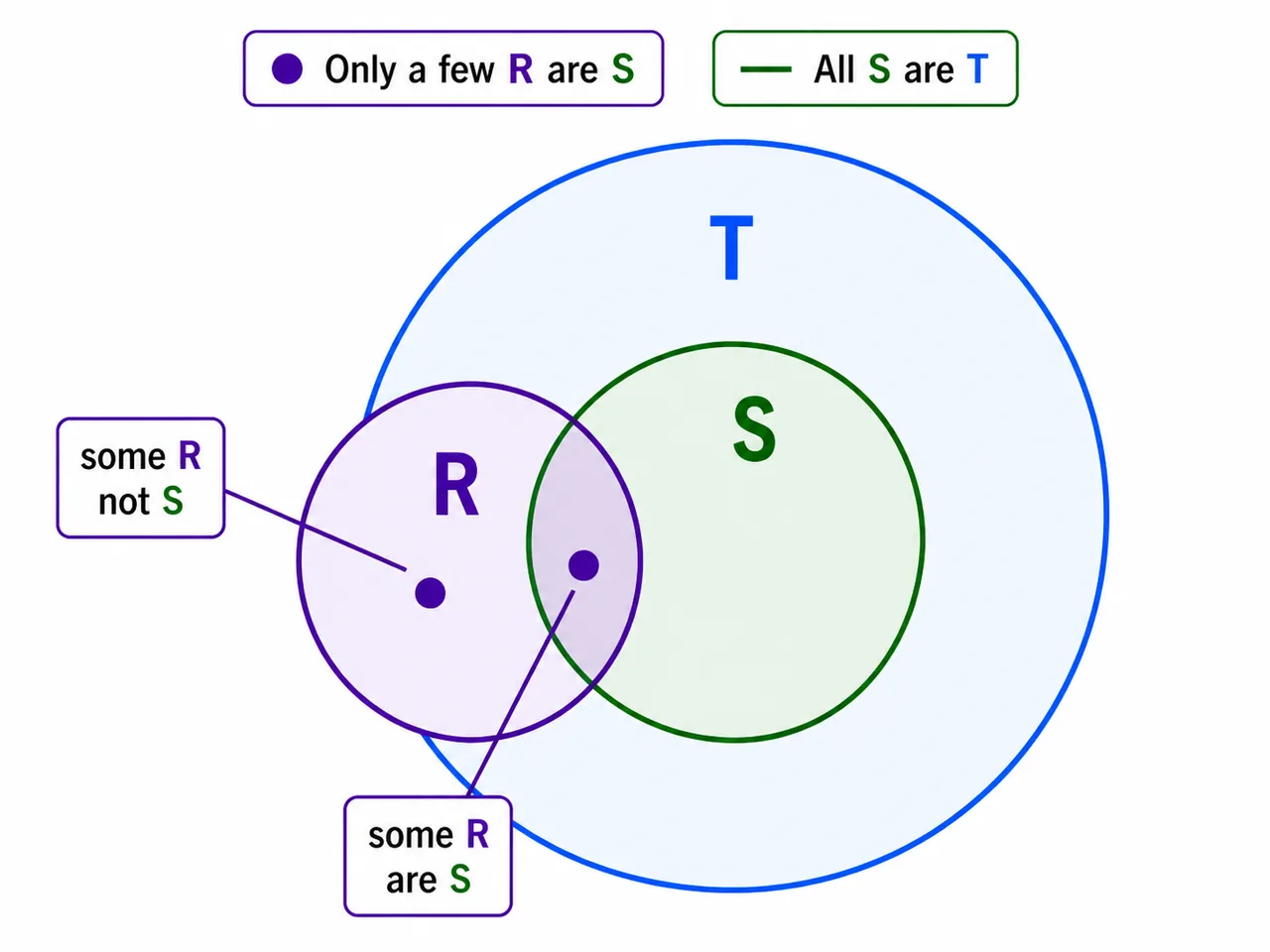
Statements:
- Only a few R are S
- All S are T
What follows:
- Some R are S → ✓ Follow (from "only a few")
- Some R are not S → ✓ Follow (from "only a few")
- Some R are T → ✓ Follow (the R-S overlap is inside T)
- All R are T → ? Doubtful (the "not S" part of R might be inside or outside T)
- Some R are not T → ? Doubtful
"Only a Few" in Both Directions
Statements:
- Only a few M are N
- Only a few N are P
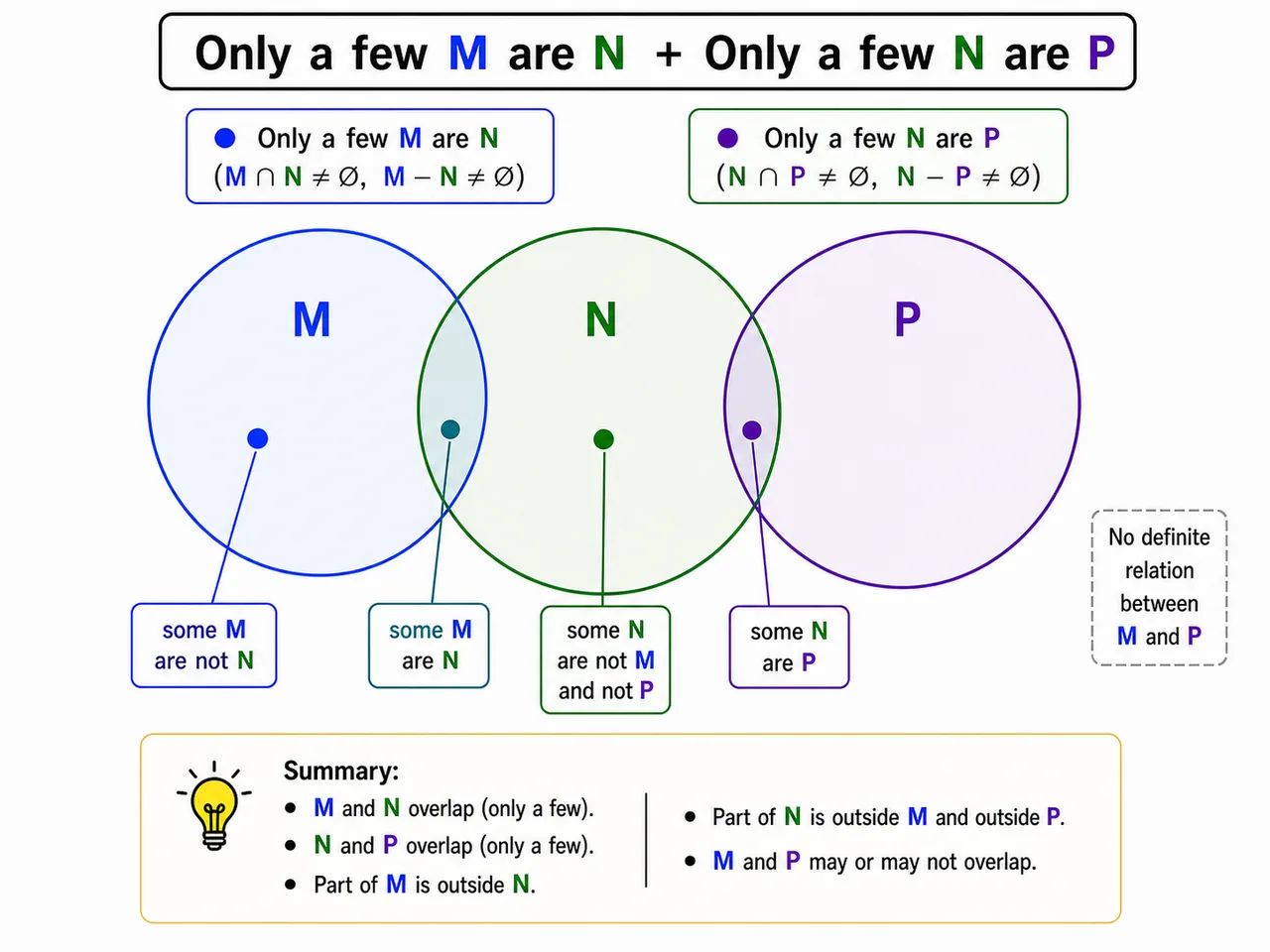
Both have "some" and "some not" components. The relationship between M and P is completely uncertain.
Practice Problems
Problem 1: Statements:
- Only a few laptops are tablets
- All tablets are devices
- No device is a phone
Conclusions:
- Some laptops are devices → ✓ Follow (Some laptops are tablets + All tablets are devices)
- Some laptops are not tablets → ✓ Follow (from "only a few")
- No laptop is a phone → ? Does not follow (the "not tablet" part of laptops might overlap with phones? No — wait, phones are separate from devices, and tablets are inside devices. But laptops could extend beyond devices to overlap with phones.)
- All devices are laptops → ? Does not follow
Actually for conclusion 3: "No device is a phone" means devices and phones are separate. The laptops-that-are-tablets are inside devices, so those laptops are not phones. But the laptops-that-are-NOT-tablets could be anywhere (inside or outside devices). If some laptops are outside devices, those laptops COULD overlap with phones. So "No laptop is a phone" → Does not follow (Doubtful).
Problem 2: Statements:
- No G is H
- All G are K
- All H are K
- Some K are V
- Some V are J
- All J are L
Draw step by step:
- G and H separate
- G inside K, H inside K (both inside K but separate from each other)
- K overlaps with V
- V overlaps with J
- J inside L
Conclusions:
- Some K are L → ? The chain K→V→J→L has two "Some" links. K-V is "Some", V-J is "Some". So K to J is uncertain. But wait: Some V are J and All J are L → Some V are L. Then Some K are V and Some V are L → K to L is uncertain. Does not follow.
Actually let me reconsider: "Some K are V" + "Some V are J" → uncertain. But "Some V are J" + "All J are L" → "Some V are L" (definite). Then "Some K are V" + "Some V are L" → still uncertain for K to L. Does not follow.
- No G is H → ✓ Follow (given directly)
- Some K are not H → ✓ Follow (G is inside K and separate from H, so the G-part of K is not H)
Exam Shortcut: Spotting "Only a Few"
When you see "Only a few M are N" in the statements:
- Immediately write two things on rough paper:
- Some M are N ✓
- Some M are not N ✓
- Mark "All M are N" as IMPOSSIBLE
- Mark "No M is N" as IMPOSSIBLE
- Proceed with the two "Some" statements as if they were given separately
This decomposition makes all subsequent chain reasoning much easier.
Common Mistakes
- Confusing "a few" with "only a few": "A few" = Some only. "Only a few" = Some + Some not. This distinction is tested frequently.
- Forgetting to extract both parts: "Only a few" gives you TWO conclusions to work with. Students often forget the "Some not" part.
- Reversing "Some not": Even from "Only a few M are N", you get "Some M are not N" — this is NOT reversible to "Some N are not M".
- "Only a few" ≠ "Only": These are completely different concepts. "Only" is covered in the next lesson.
Summary Cheat Sheet
| Concept / Topic | Key Details / Explanation |
|---|---|
| "Only a few M are N" meaning | = "Some M are N" + "Some M are not N" simultaneously. Both overlap AND non-overlap are confirmed. |
| "A few M are N" meaning | = "Some M are N" only. Does NOT confirm that some M are outside N. |
| Critical difference: "a few" vs "only a few" | "A few" = Some (one conclusion). "Only a few" = Some + Some Not (two conclusions). Frequently tested trap. |
| "Only a few M are N" — definite conclusions | Some M are N ✓, Some N are M ✓, Some M are not N ✓ |
| "Only a few M are N" — impossible conclusions | All M are N ✗ (contradicts "some not"), No M is N ✗ (contradicts "some") |
| "Only a few M are N" — doubtful | All N are M (?), Some N are not M (?) |
| "A few M are N" — definite conclusions | Some M are N ✓, Some N are M ✓ |
| "A few M are N" — possible (not definite) | Some M are not N (?), All M are N (?) |
| "A few M are N" — impossible | No M is N ✗ |
| Exam shortcut for "Only a few" | Immediately write on rough paper: (1) Some M are N ✓, (2) Some M are not N ✓, (3) Mark "All M are N" as IMPOSSIBLE, (4) Mark "No M is N" as IMPOSSIBLE. Then use these two as separate statements. |
| "Only a few" + "All" chain | Only a few R are S + All S are T → Some R are T ✓ (the R-S overlap goes through T). All R are T → Doubtful (the "not S" part of R may be outside T). |
| "Only a few" + "No" chain | Only a few M are N + No N is P → The "not N" part of M has uncertain relation with P. Some M are not P → Doubtful. |
| "Only a few not" concept | = "Some M are not N" + "Some M are N" — logically same content as "Only a few M are N". |
| "Some not" from "Only a few" is NOT reversible | "Only a few M are N" gives "Some M are not N" — this does NOT reverse to "Some N are not M". |
| "Only a few" ≠ "Only" | "Only" = All (reversed direction). "Only a few" = Some + Some Not. Completely different. |