⚡ Some Not & Conclusion Matrix
Master "Some X are not Y" statements, understand the complete definite-vs-possible conclusion matrix for all four statement types, and learn to handle "Some-Some Not" combinations
Some Not & Conclusion Matrix
"Some X are not Y" is the most confusing statement for beginners. This lesson clarifies exactly what it means, what you can and cannot conclude, and how it interacts with other statements.
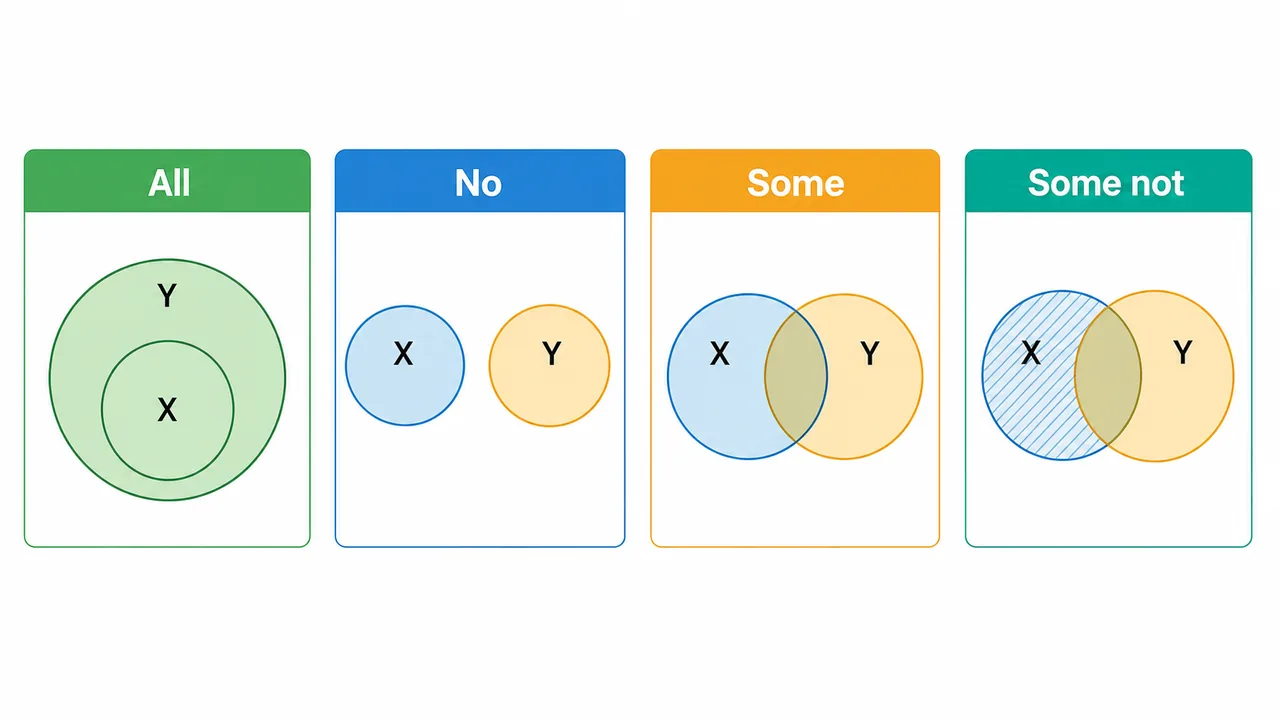
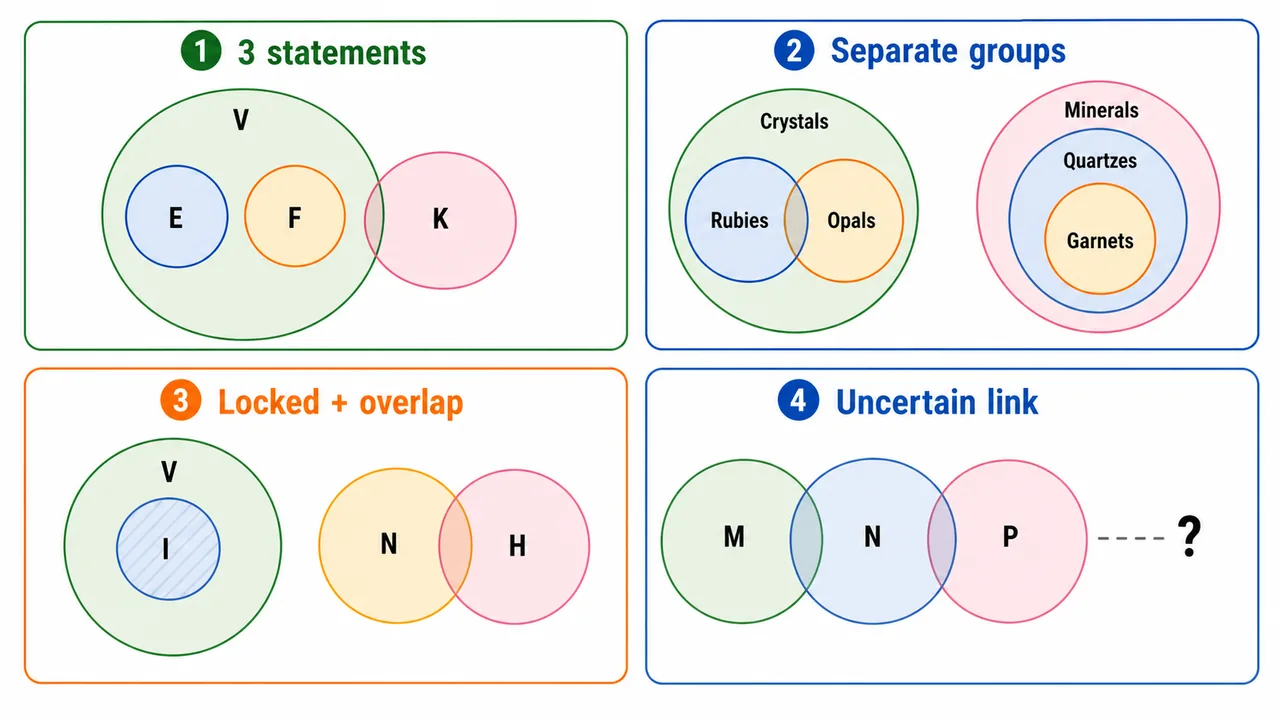
What Does "Some X are not Y" Mean?
"Some X are not Y" means at least one member of X is outside Y. Part of X does not overlap with Y.
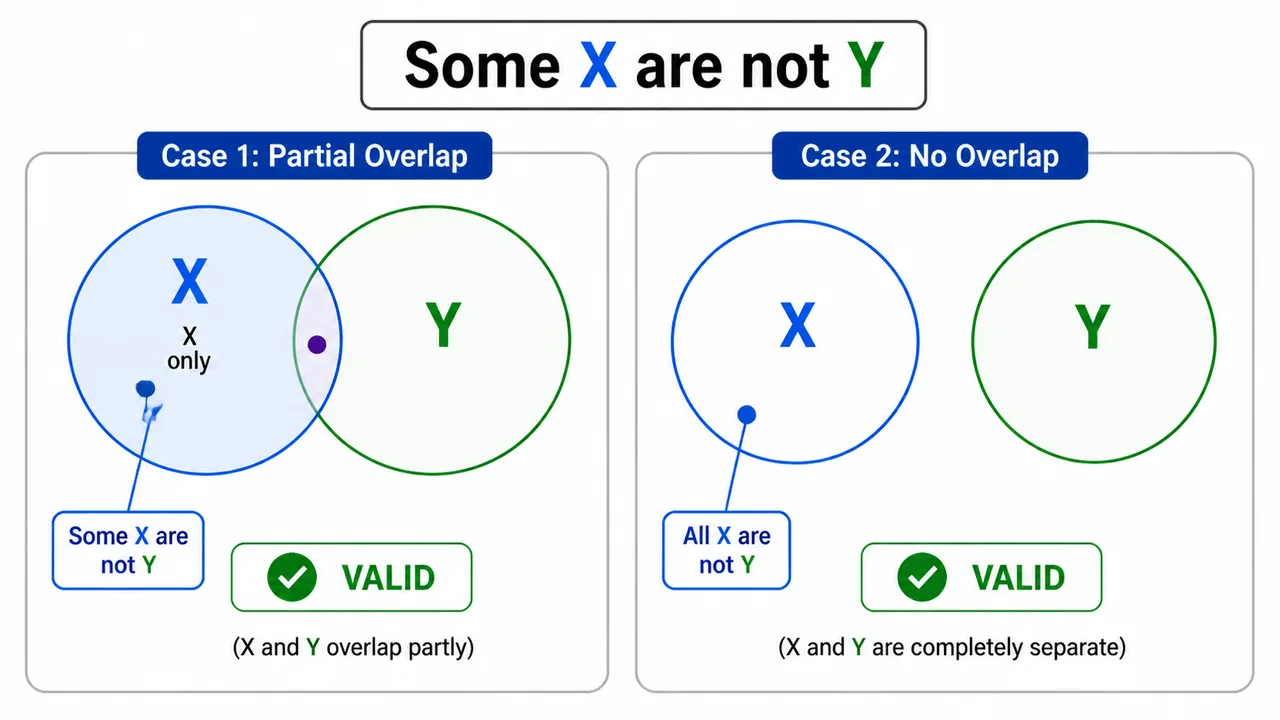
The shaded "outside" part of X is NOT in Y. But some of X might still be in Y.
Pro Content Locked
Upgrade to Pro to access this lesson and all other premium content.
Pay once for one year · Effective ₹99/mo
- All Agriculture & Banking Courses
- AI Lesson Questions (100/day)
- AI Doubt Solver (50/day)
- Glows & Grows Feedback (30/day)
- AI Section Quiz (20/day)
- 22-Language Translation (100/day)
- Recall Questions (20/day)
- AI Quiz (15/day)
- AI Quiz Paper Analysis (100/day)
- AI Step-by-Step Explanations (100/day)
- Spaced Repetition Recall (FSRS)
- AI Tutor
- Immersive Text Questions
- Audio Lessons — Hindi & English
- Mock Tests & Previous Year Papers
- Summary & Mind Maps
- XP, Levels, Leaderboard & Badges
- Generate New Classrooms
- Voice AI Teacher (AgriDots Live)
- AI Revision Assistant
- Knowledge Gap Analysis
- Interactive Revision (LangGraph)
🔒 Secure one-time yearly payment via Razorpay · No hidden fees
Some Not & Conclusion Matrix
"Some X are not Y" is the most confusing statement for beginners. This lesson clarifies exactly what it means, what you can and cannot conclude, and how it interacts with other statements.
What Does "Some X are not Y" Mean?
"Some X are not Y" means at least one member of X is outside Y. Part of X does not overlap with Y.
The shaded "outside" part of X is NOT in Y. But some of X might still be in Y.
Valid diagrams for "Some X are not Y":
Key insight: "Some X are not Y" does NOT tell us whether ANY X is inside Y. It only guarantees some X is outside Y.
Complete "Some Not" Conclusion Table
Given: Some X are not Y
| Conclusion | Definite? | Possible? |
|---|---|---|
| Some Y are not X | ✗ Not definite | ✓ Possible |
| Some X are Y | ✗ Not definite | ✓ Possible |
| All X are Y | ✗ Not definite | ✗ Not possible |
| No X is Y | ✗ Not definite | ✓ Possible |
| All Y are X | ✗ Not definite | ✓ Possible |
| No Y is X | ✗ Not definite | ✓ Possible |
"Some X are not Y" gives NO definite conclusions at all — not even the reverse!
The only thing NOT possible is "All X are Y" — because we know some X is outside Y, so "All X are Y" contradicts the statement.
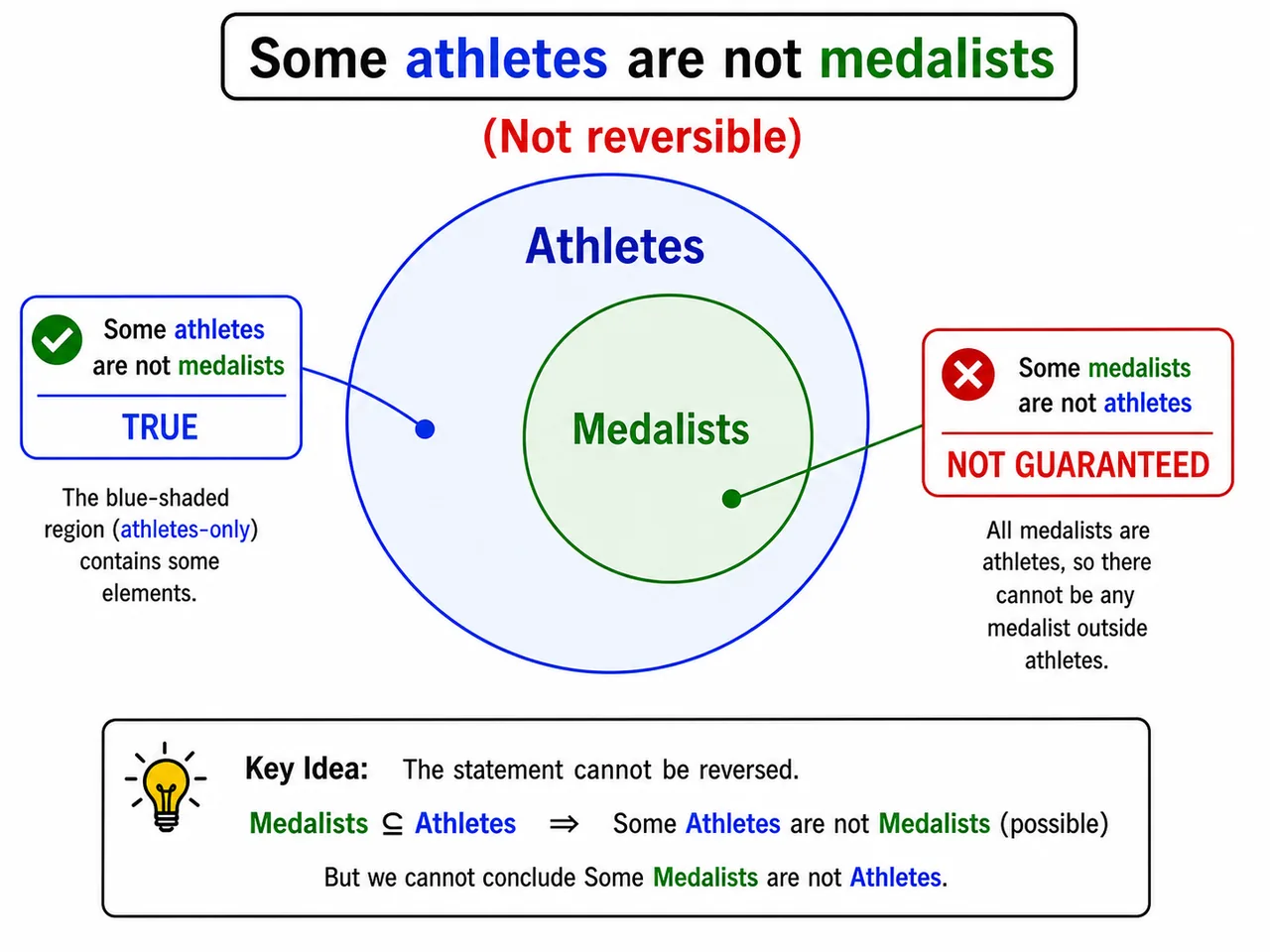
"Some Not" is NOT Reversible
This is the biggest trap in syllogism:
"Some X are not Y" does NOT mean "Some Y are not X"
Example: "Some athletes are not medalists."
This means some athletes exist outside the "medalists" group. But it's possible that ALL medalists are athletes. In that case, "Some medalists are not athletes" would be false.
Here: "Some athletes are not medalists" ✓ (the non-medalist athletes) But: "Some medalists are not athletes" ✗ (ALL medalists are athletes)
"All X are Y" and "Some X are not Y" — Contradiction
These two statements are direct contradictions:
- "All X are Y" → Every X is inside Y
- "Some X are not Y" → At least one X is outside Y
They can NEVER be true simultaneously.
This is crucial for Either-Or questions (covered in Lesson 7).
If "All X are Y" does NOT follow → "Some X are not Y" is a possibility If "Some X are not Y" does NOT follow → "All X are Y" is a possibility
"Some-Some Not" Combination
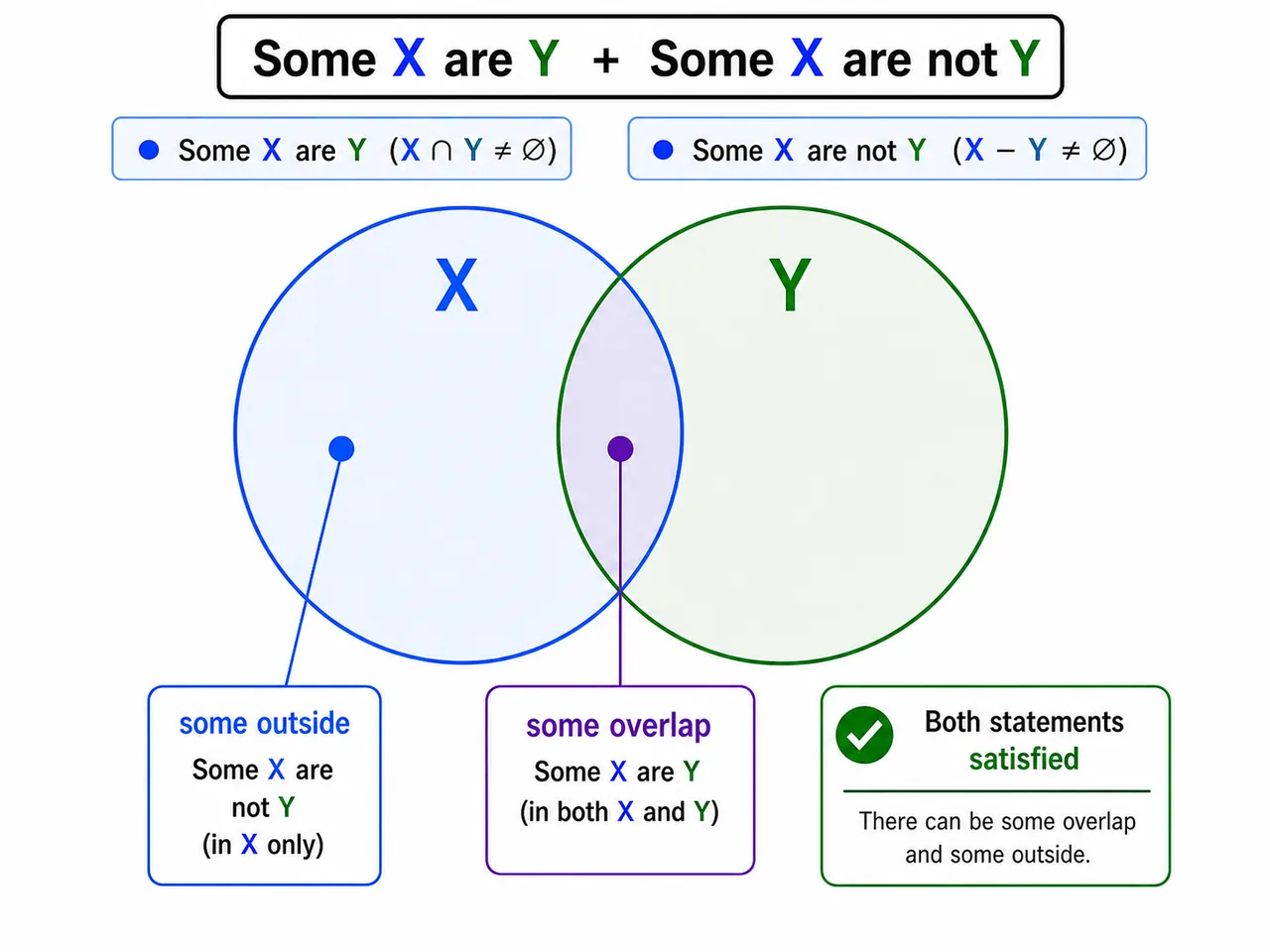
Statements: Some X are Y + Some X are not Y
This is one of the most common exam patterns. It means:
- Some X is inside Y (overlap exists)
- Some X is outside Y (non-overlap exists)
What follows:
| Conclusion | Answer |
|---|---|
| Some X are Y | ✓ Follow (given) |
| Some Y are X | ✓ Follow (reverse of "Some") |
| All X are Y | ✗ Not possible (contradicts "Some X are not Y") |
| No X is Y | ✗ Not possible (contradicts "Some X are Y") |
| Some X are not Y | ✓ Follow (given) |
| All Y are X | ? Doubtful |
"All X are Y" — What About "Some X are not Y"?
Given: All X are Y
Can we conclude "Some X are not Y"? → ✗ Definitely False
Because if ALL X are inside Y, then NO X is outside Y. So "Some X are not Y" is impossible.
But can we conclude "Some Y are not X"? → Doubtful (Possible but not definite)
Because Y could be bigger than X, in which case some Y exists outside X. But Y could also equal X.
The Complete 4×4 Conclusion Matrix
This is the master reference table. Memorize it or keep it on rough paper during exams.
Given one statement, what can you definitely conclude?
| Given ↓ / Conclude → | All X are Y | No X is Y | Some X are Y | Some X are not Y |
|---|---|---|---|---|
| All X are Y | — | ✗ Def. False | ✓ Follow | ✗ Def. False |
| No X is Y | ✗ Def. False | — | ✗ Def. False | ✓ Follow |
| Some X are Y | ? Doubtful | ✗ Def. False | — | ? Doubtful |
| Some X are not Y | ✗ Def. False | ? Doubtful | ? Doubtful | — |
Given one statement, what is POSSIBLE?
| Given ↓ / Possible? → | All X are Y | No X is Y | Some X are Y | Some X are not Y |
|---|---|---|---|---|
| All X are Y | — | ✗ No | ✓ Yes | ✗ No |
| No X is Y | ✗ No | — | ✗ No | ✓ Yes |
| Some X are Y | ✓ Yes | ✗ No | — | ✓ Yes |
| Some X are not Y | ✗ No | ✓ Yes | ✓ Yes | — |
Multi-Statement Practice
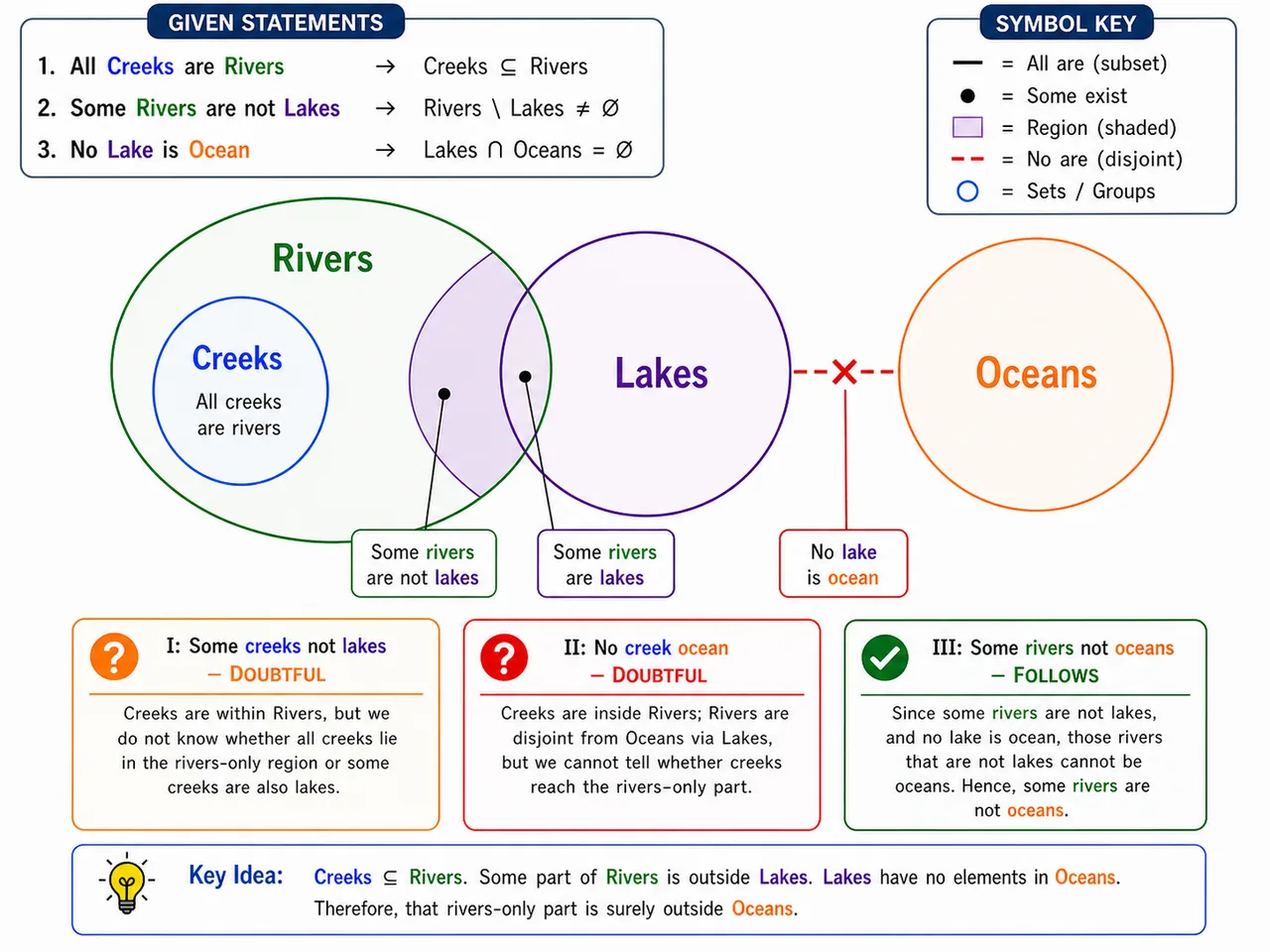
Problem 1: Statements:
- All creeks are rivers
- Some rivers are not lakes
- No lake is an ocean
Draw:
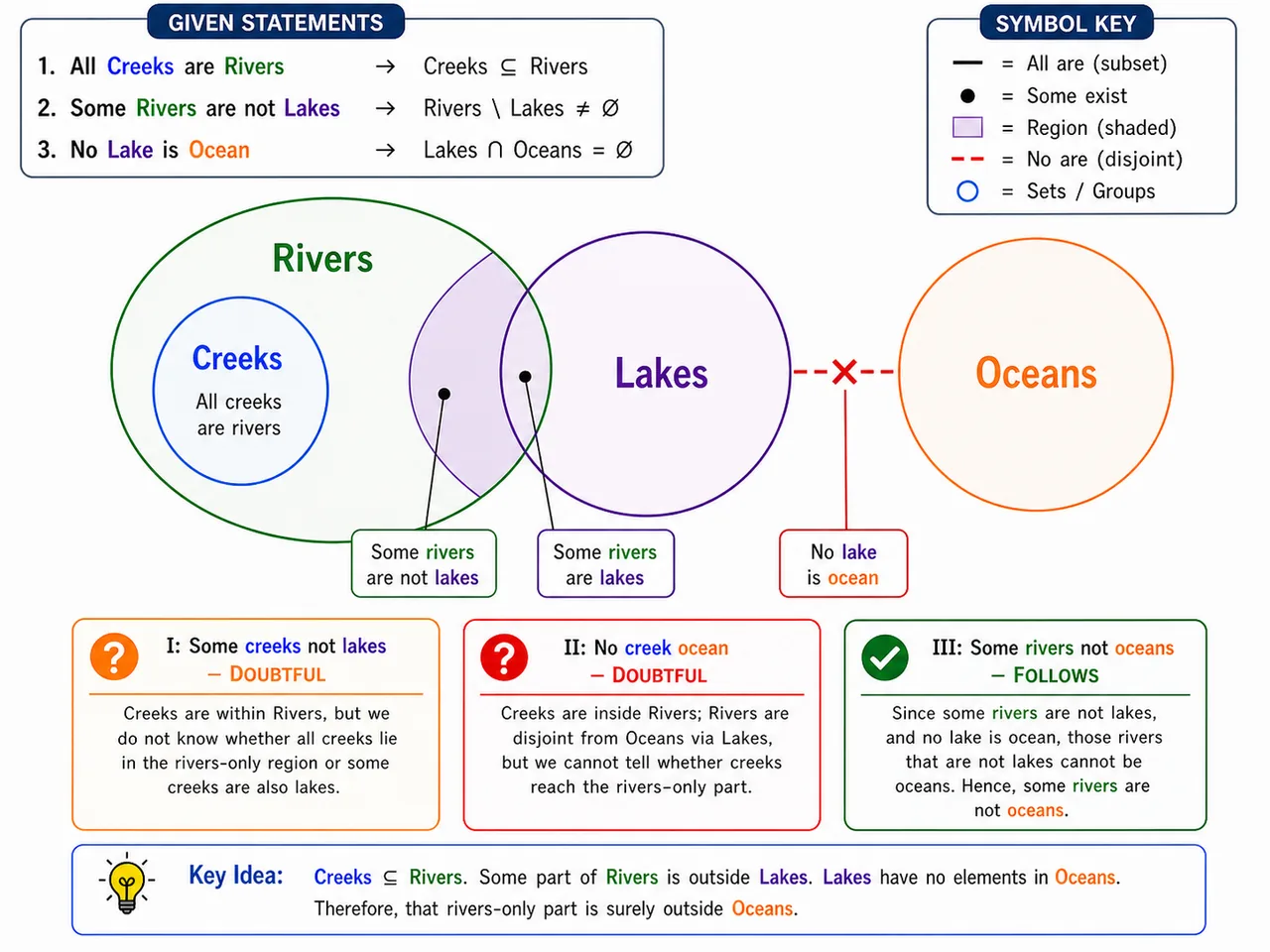
Conclusions:
- Some creeks are not lakes → ? Doubtful. Creeks are inside Rivers, some Rivers are not Lakes, but Creeks might all be in the Lake part. Does not follow.
- No creek is an ocean → ? Doubtful. We don't know if Creeks overlap with Oceans. Does not follow.
- Some rivers are not oceans → ? Let's check: No lake is an ocean + Some rivers are lakes. The lake part of rivers is separate from oceans. So some rivers (the lake part) are not oceans. ✓ Follow.
Problem 2: Statements:
- Some H are J
- All J are V
- Some V are W
Conclusions:
- Some H are V → ✓ Follow (Some H are J + All J are V → Some H are V)
- Some J are W → ? Doubtful (All J are V, Some V are W — but the W-V overlap might not include J). Does not follow.
- All W are H → ? Doubtful. Does not follow.
- Some V are H → ✓ Follow (reverse of conclusion 1)
Practice: Possibility Type
Statements:
- Some H are J
- All J are V
- No V is W
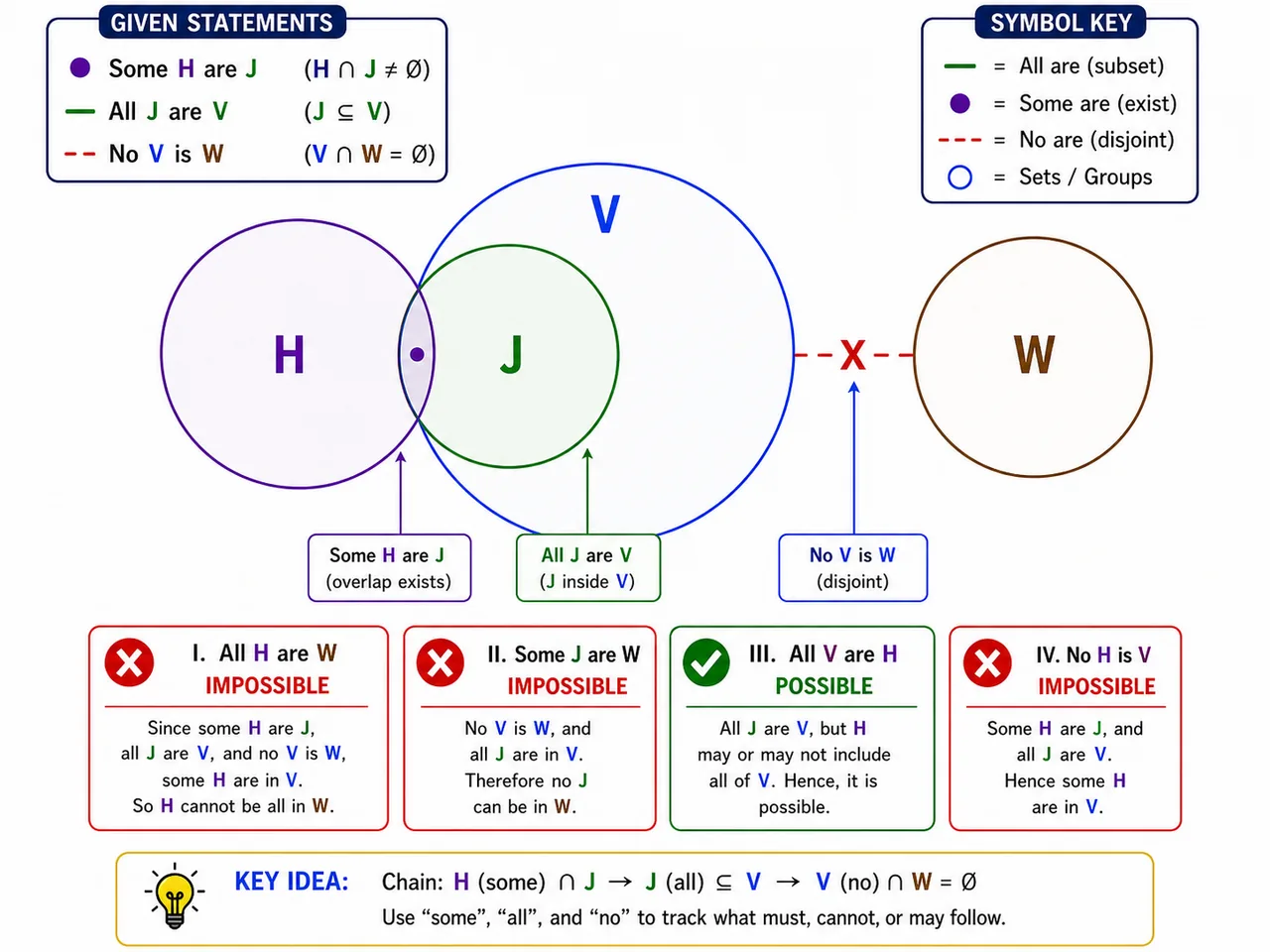
Q: Which of the following is a possibility? (a) All H are W (b) Some J are W (c) All V are H (d) No H is V
Solution:
- Some H are J, All J are V → Some H are V (definite)
- No V is W → J is inside V, W separate from V → No J is W (definite)
(a) All H are W → Part of H is in V (which is separate from W), so that part of H is NOT in W. But the rest of H could be in W? Actually, "Some H are V" and "No V is W" means some H is definitely NOT in W. So "All H are W" is NOT possible.
(b) Some J are W → J is inside V, W separate from V → J separate from W → NOT possible
(c) All V are H → "Some H are V" is definite, and if V is small enough, V could be inside H → IS a possibility ✓
(d) No H is V → We already know "Some H are V" is definite → "No H is V" contradicts → NOT possible
Answer: (c)
Speed Tips
- "Some not" = weakest statement. It gives you almost nothing definite.
- "Some not" is NOT reversible. Never reverse it. Mark this on your rough paper.
- Contradictions to memorize: All ↔ Some Not (contradictory pair), Some ↔ No (contradictory pair)
- The matrix is your weapon. For possibility questions, just check the matrix.
- Don't overthink "Some not" chains — they almost never give definite conclusions with other elements.
Common Mistakes
- Reversing "Some not": "Some X are not Y" does NOT give "Some Y are not X"
- Confusing "Some not" with "No": "Some X are not Y" still allows some X to be in Y. "No X is Y" allows NO overlap.
- Forgetting contradictions: "All" and "Some not" are contradictory. If one is given, the other is impossible.
- Possibility error: "Some X are not Y" makes "No X is Y" possible (they could be completely separate). Don't mark it as impossible.
Summary Cheat Sheet
| Concept / Topic | Key Details / Explanation |
|---|---|
| "Some X are not Y" meaning | At least one member of X is outside Y. Part of X does not overlap with Y. |
| Valid diagrams for "Some X are not Y" | Partial overlap (some X in Y, some outside) OR completely separate (no overlap). Both are valid. |
| "Some X are not Y" — definite conclusions | None at all. This is the weakest statement. |
| "Some X are not Y" — only impossible conclusion | All X are Y ✗ (because some X is confirmed to be outside Y). |
| "Some X are not Y" is NOT reversible | Does NOT give "Some Y are not X". Classic exam trap — medalists inside athletes example. |
| Contradiction pair | All X are Y ↔ Some X are not Y are direct contradictions. Can NEVER both be true. |
| "All X are Y" → "Some X are not Y"? | Definitely False — if all X are inside Y, none can be outside. |
| "All X are Y" → "Some Y are not X"? | Doubtful (possible) — Y could be bigger than X. |
| "Some X are Y" + "Some X are not Y" together | Overlap AND non-overlap confirmed. All X are Y → impossible ✗. No X is Y → impossible ✗. |
| 4×4 Definite Conclusion Matrix | All→All: — ; All→No: ✗; All→Some: ✓; All→SomeNot: ✗ | No→All: ✗; No→No: —; No→Some: ✗; No→SomeNot: ✓ | Some→All: ?; Some→No: ✗; Some→Some: —; Some→SomeNot: ? | SomeNot→All: ✗; SomeNot→No: ?; SomeNot→Some: ?; SomeNot→SomeNot: — |
| Possibility Matrix key | All: possible for Some only. No: possible for SomeNot only. Some: possible for All, SomeNot. SomeNot: possible for No, Some. |
| Contradictory pairs to memorize | All ↔ Some Not (contradictory); Some ↔ No (contradictory). If one is given, the other is impossible. |
| "Some Not" in chains | Almost never gives definite conclusions with other elements. Treat as a chain-breaker. |
| Speed tip for possibility Qs | Use the 4×4 matrix. Check which conclusions are "possible" for the given statement type. If it contradicts → definitely false. |