🔄 Some & Possibility Concept
Master "Some X are Y" statements, understand what can and cannot be concluded, and learn the critical distinction between definite conclusions and possibility conclusions
Some & Possibility Concept
"Some" is the trickiest statement type because it allows multiple valid Venn diagrams. Understanding what "Some" means — and what it does NOT mean — is essential for accuracy.
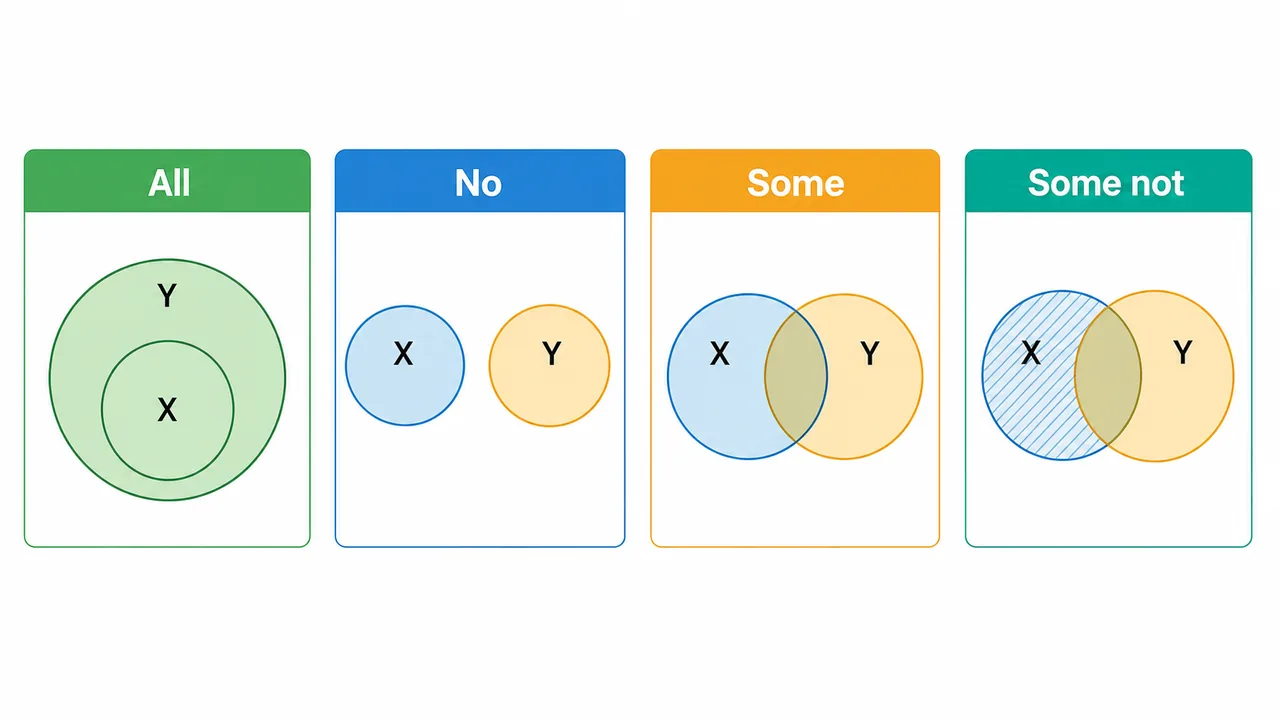
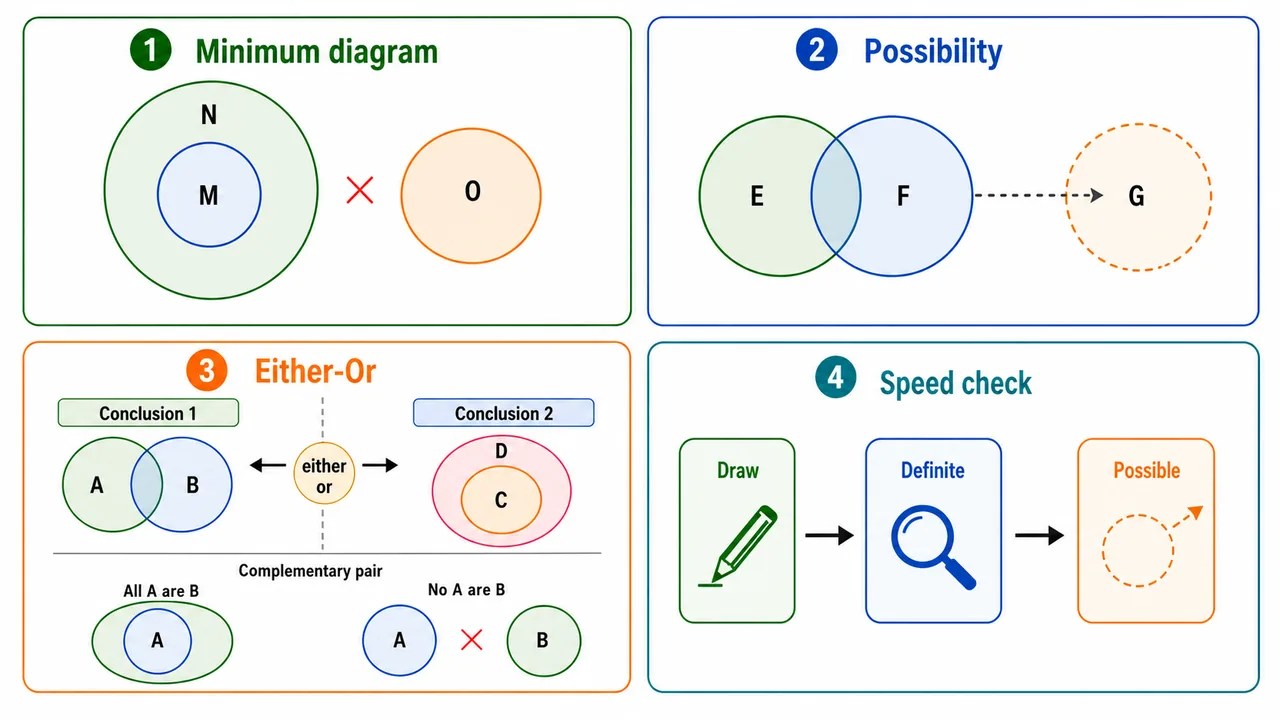
What Does "Some X are Y" Mean?
"Some X are Y" means at least one X is also Y. The overlap between X and Y exists, but we don't know how large it is.
All of these diagrams are valid for "Some X are Y":
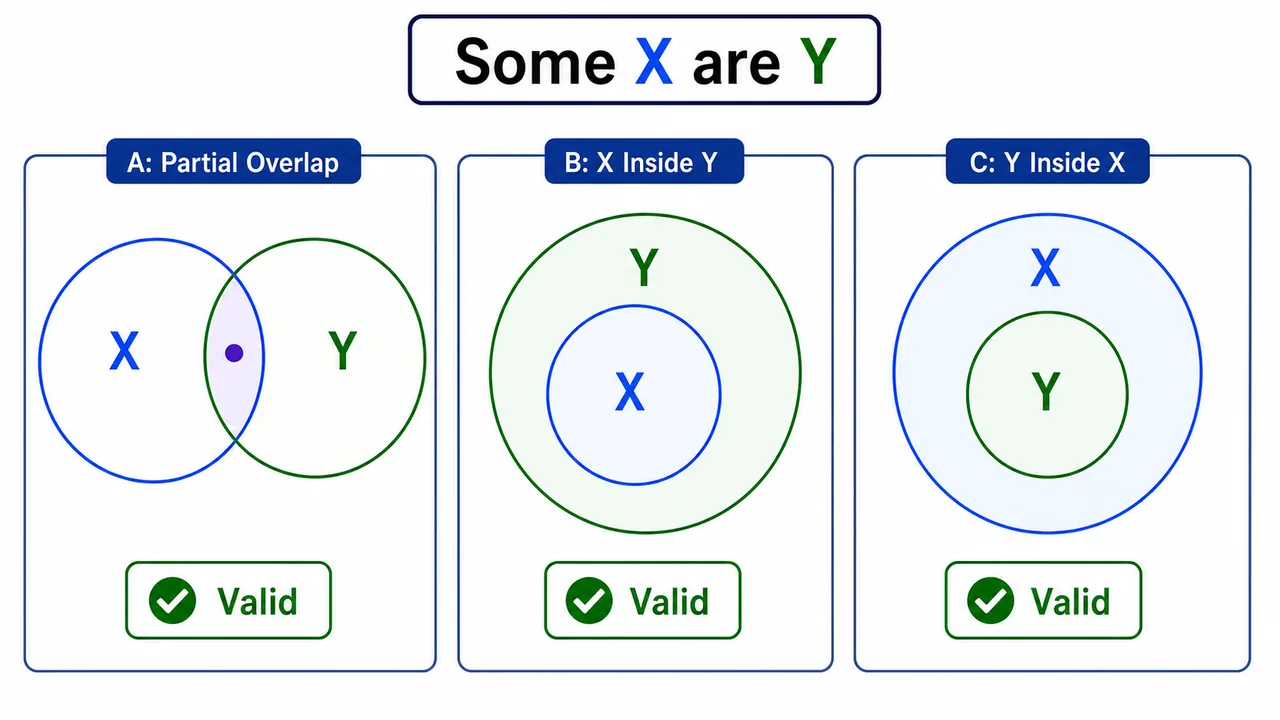
Key insight: "Some X are Y" is the weakest positive statement. It only guarantees overlap exists.
Pro Content Locked
Upgrade to Pro to access this lesson and all other premium content.
Pay once for one year · Effective ₹99/mo
- All Agriculture & Banking Courses
- AI Lesson Questions (100/day)
- AI Doubt Solver (50/day)
- Glows & Grows Feedback (30/day)
- AI Section Quiz (20/day)
- 22-Language Translation (100/day)
- Recall Questions (20/day)
- AI Quiz (15/day)
- AI Quiz Paper Analysis (100/day)
- AI Step-by-Step Explanations (100/day)
- Spaced Repetition Recall (FSRS)
- AI Tutor
- Immersive Text Questions
- Audio Lessons — Hindi & English
- Mock Tests & Previous Year Papers
- Summary & Mind Maps
- XP, Levels, Leaderboard & Badges
- Generate New Classrooms
- Voice AI Teacher (AgriDots Live)
- AI Revision Assistant
- Knowledge Gap Analysis
- Interactive Revision (LangGraph)
🔒 Secure one-time yearly payment via Razorpay · No hidden fees
Some & Possibility Concept
"Some" is the trickiest statement type because it allows multiple valid Venn diagrams. Understanding what "Some" means — and what it does NOT mean — is essential for accuracy.
What Does "Some X are Y" Mean?
"Some X are Y" means at least one X is also Y. The overlap between X and Y exists, but we don't know how large it is.
All of these diagrams are valid for "Some X are Y":
Key insight: "Some X are Y" is the weakest positive statement. It only guarantees overlap exists.
Which Diagram Should You Actually Draw?
All three diagrams above are technically valid for "Some X are Y" — but you must always draw the first one (partial overlap). This is the minimum diagram principle from Lesson 1, and it's especially critical for "Some" statements.
Why partial overlap? Because it's the arrangement that assumes the least. If you draw X inside Y (which is also valid for "Some"), you've accidentally assumed "All X are Y" — and you'll start seeing conclusions that don't actually follow from just "Some".
The rule for "Some":
- Draw just enough overlap to show that at least one element is shared
- Keep the rest of X outside Y and the rest of Y outside X
- This way, when you check conclusions, only genuinely definite ones will appear true
Common mistake: A student reads "Some rivers are tributaries" and draws Tributaries fully inside Rivers (because that feels right in real life). But in syllogism, we go strictly by the statement — "Some" means partial overlap only. Real-world knowledge is irrelevant; draw only what the statement tells you.
Complete "Some" Conclusion Table
Given: Some X are Y
| Conclusion | Definite? | Possible? |
|---|---|---|
| Some Y are X | ✓ Definite | ✓ Yes |
| All X are Y | ✗ Not definite | ✓ Possible |
| All Y are X | ✗ Not definite | ✓ Possible |
| No X is Y | ✗ Not definite | ✗ Not possible |
| Some X are not Y | ✗ Not definite | ✓ Possible |
| Some Y are not X | ✗ Not definite | ✓ Possible |
The ONLY definite conclusion from "Some X are Y" is "Some Y are X" — the reverse.
The ONLY impossible conclusion is "No X is Y" — because we know overlap exists.
Everything else is doubtful (possible but not certain).
Definite vs Possible — The Critical Distinction
Exam questions ask two types of questions:
Type 1: "Which conclusion follows?" → Only definite conclusions are correct answers
Type 2: "Which is a possibility?" / "Which can be true?" → Both definite and doubtful conclusions are correct answers
Type 3: "Which is definitely false?" / "Which is NOT a possibility?" → Only conclusions that are impossible in ALL diagrams are correct
Example: Statement: Some planets are comets.
| Question Type | "All planets are comets" | "No planet is a comet" |
|---|---|---|
| Follows? | ✗ No | ✗ No |
| Possible? | ✓ Yes | ✗ No |
| Definitely false? | ✗ No | ✓ Yes |
"Some" in Chain Reasoning
"Some" BREAKS the chain.
All E are F + Some F are G
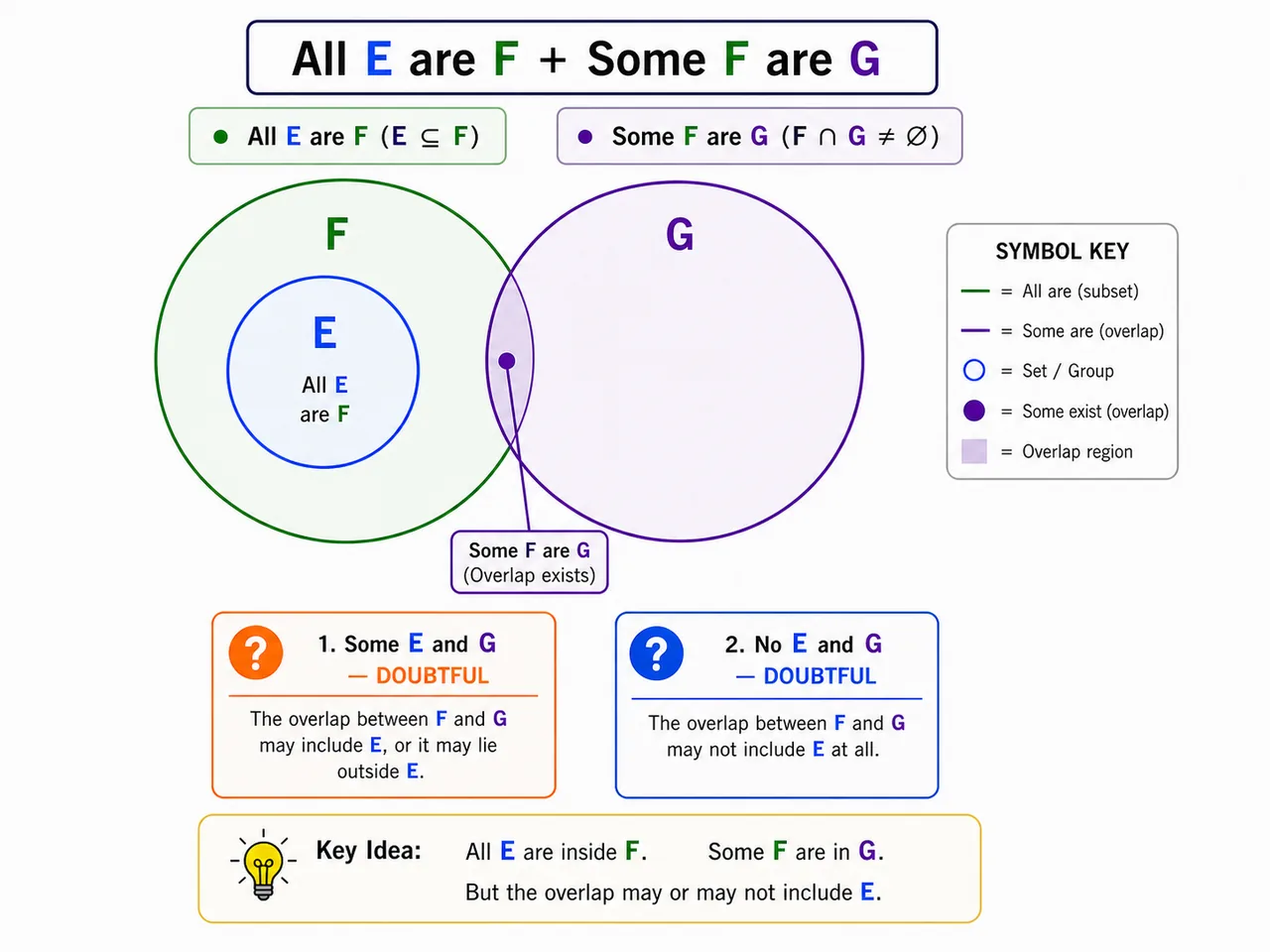
The overlap between F and G could be in the part of F that contains E, or in the part that doesn't. We don't know!
What follows:
- Some E are G → ? Doubtful (E and the F-G overlap might not intersect)
- No E is G → ? Doubtful (they might intersect)
Rule: "Some" in the middle of a chain makes the connection between outer elements UNCERTAIN.
"Some" + "All" Chain
Some E are F + All F are G
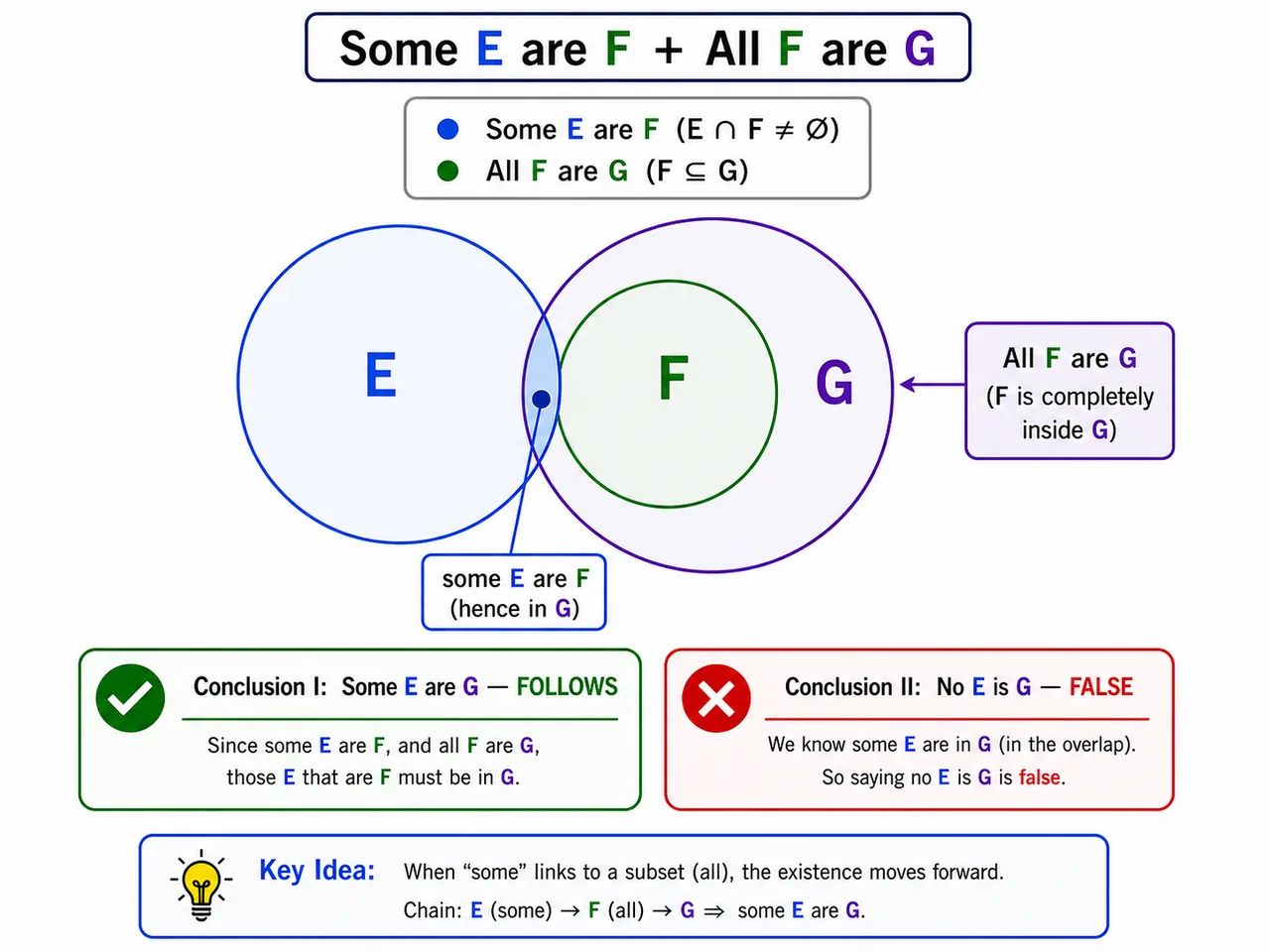
E overlaps with F, and F is inside G. The overlapping part of E and F is inside G.
What follows:
- Some E are G → ✓ Follow (the E-F overlap is inside G, so some E are in G)
- Some G are E → ✓ Follow
- All E are G → ? Doubtful
- No E is G → ✗ Definitely False
Rule: "Some E are F" + "All F are G" → "Some E are G" (definite)
This works because ALL of F is inside G, so the overlap part must also be inside G.
"Some" + "No" Chain
Some E are F + No F is G
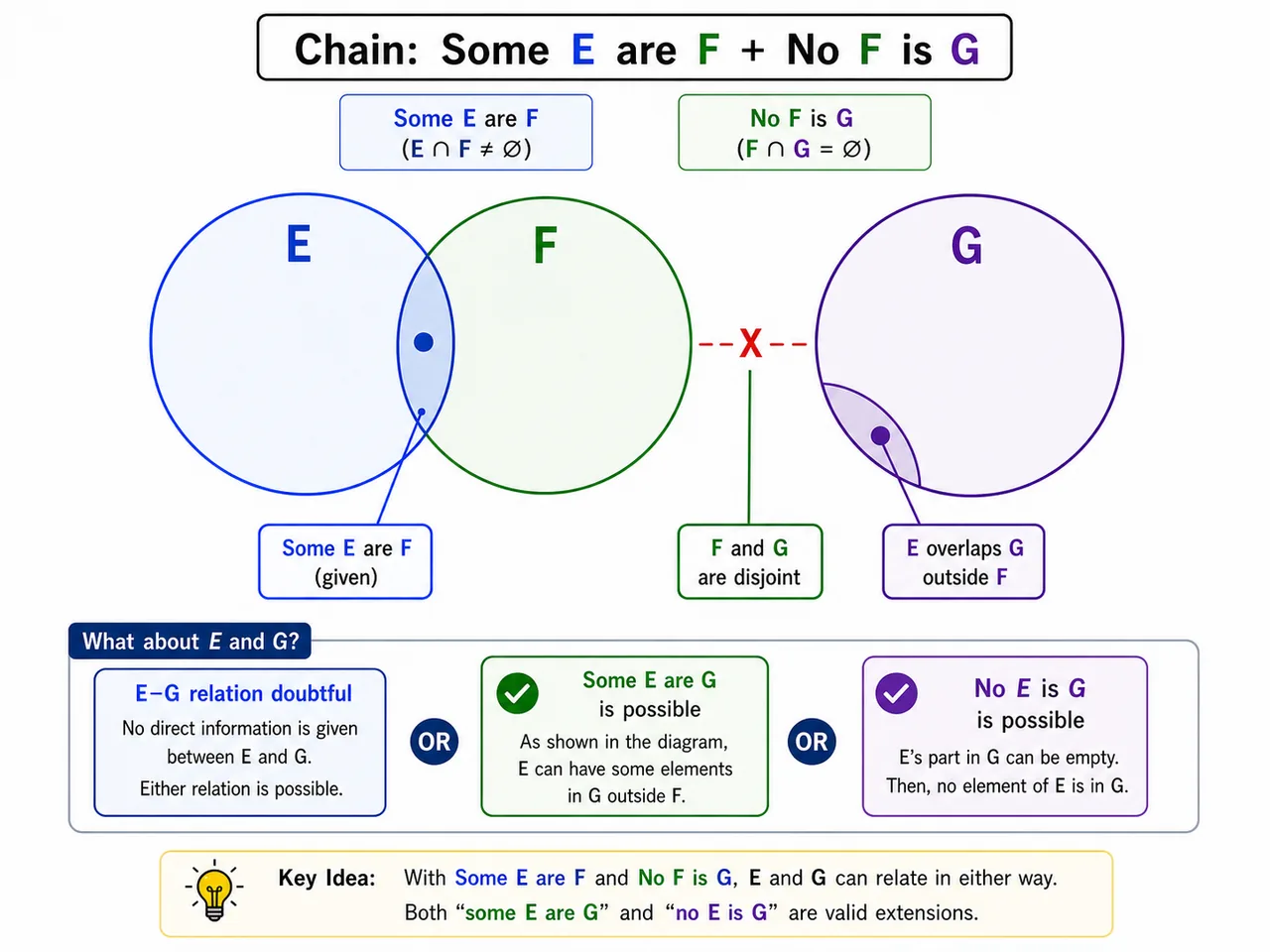
E overlaps with F, but G is completely separate from F. What about E and G?
The part of E that is NOT overlapping with F could overlap with G!
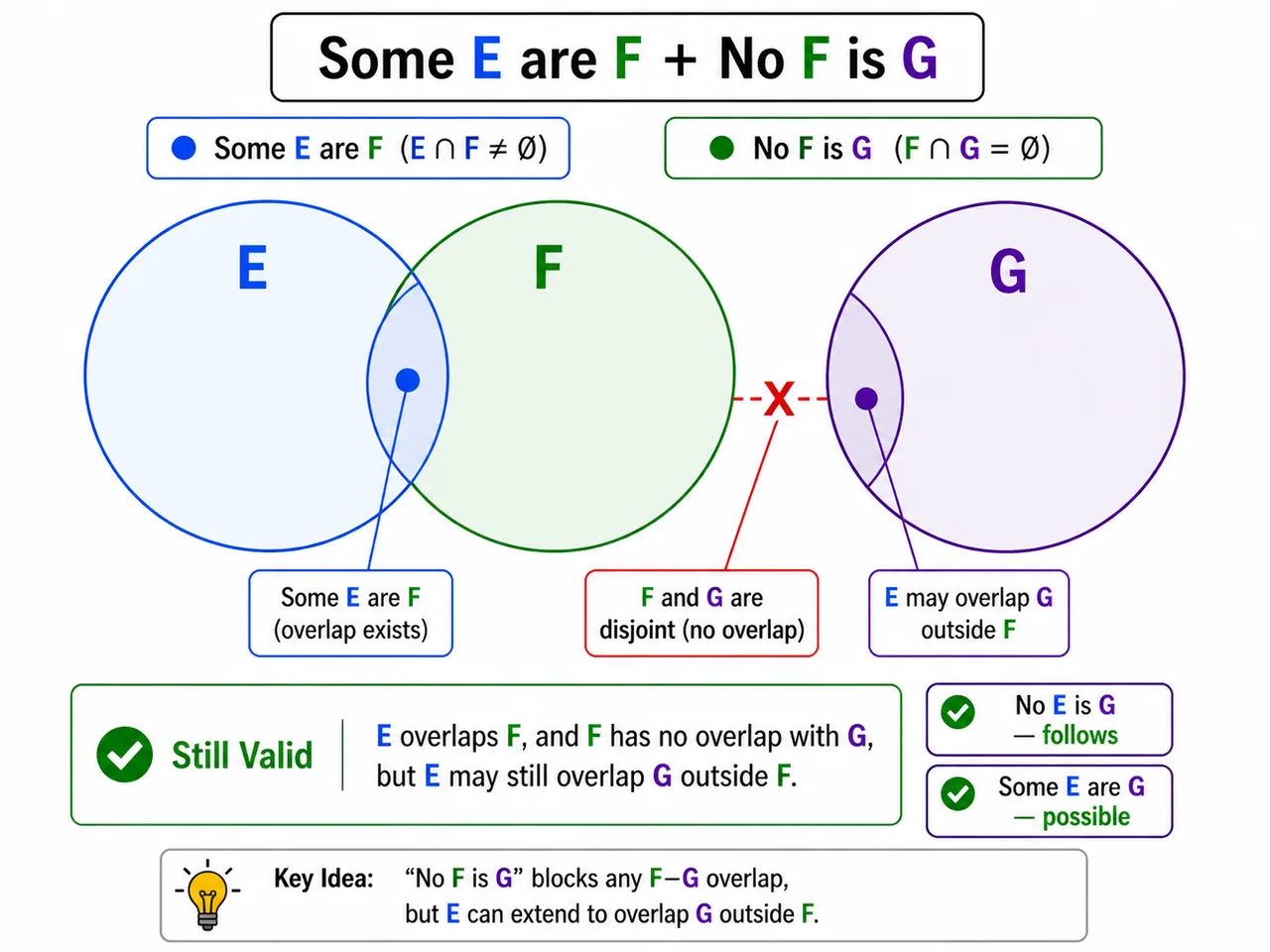
What follows:
- Some E are not G → ? Doubtful
- No E is G → ? Doubtful
- Some E are G → ? Doubtful
Rule: "Some" + "No" chain gives NO definite conclusion about the outer elements.
Possibility Questions — Solving Strategy
When the question asks "Which of the following is a possibility?"
Step 1: Check if the conclusion contradicts any given statement
Step 2: If it contradicts → NOT a possibility
Step 3: If it doesn't contradict → IS a possibility
Contradictions (impossible pairs):
| If you have... | Then this is NOT possible... |
|---|---|
| All X are Y | No X is Y |
| No X is Y | Some X are Y / All X are Y |
| Some X are Y | No X is Y |
Example: Statements: All E are F. No F is G.
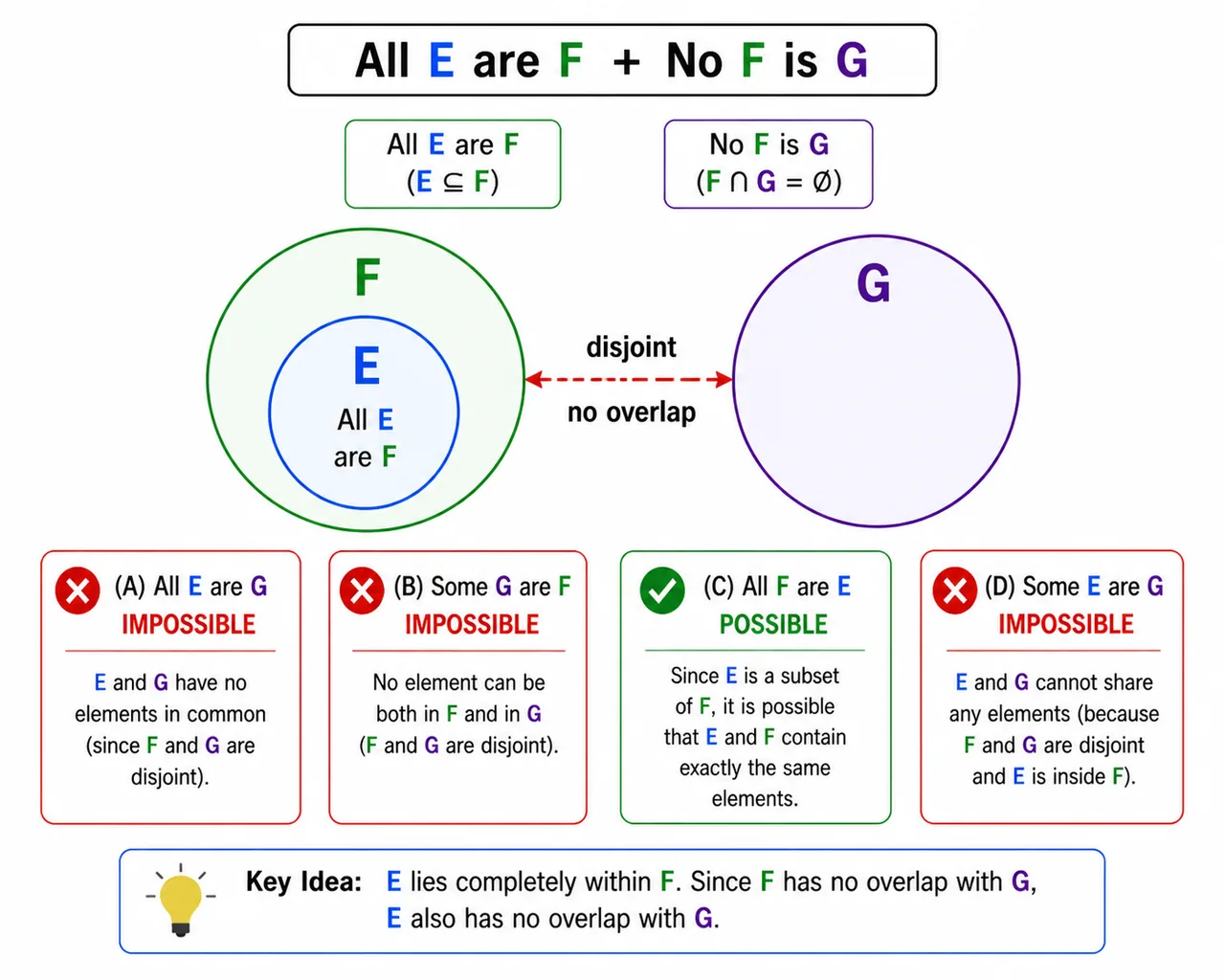
Q: Which is a possibility?
(a) All E are G (b) Some G are F (c) All F are E (d) Some E are G
Answer & Explanation
Answer: (c)
Explanation:
- (a) All E are G → Check: All E are F, No F is G → E inside F, G separate from F → E separate from G → "All E are G" contradicts → NOT possible
- (b) Some G are F → Check: No F is G → G and F are separate → "Some G are F" contradicts → NOT possible
- (c) All F are E → Check: All E are F → E inside F → F could equal E → "All F are E" doesn't contradict → IS a possibility
- (d) Some E are G → Check: E is inside F, G is separate from F → E is separate from G → contradicts → NOT possible
Keywords That Mean "Some"
In exam questions, "Some" appears in many forms:
| Keyword | Meaning | Diagram |
|---|---|---|
| Some X are Y | Standard | Partial overlap |
| A few X are Y | Same as "Some" | Partial overlap |
| At least some X are Y | Same as "Some" | Partial overlap |
| Several X are Y | Same as "Some" | Partial overlap |
| Many X are Y | Same as "Some" | Partial overlap |
| Most X are Y | Same as "Some" | Partial overlap (large) |
| 30% of X are Y | Same as "Some" | Partial overlap |
| 50% of X are Y | Same as "Some" | Partial overlap |
| 75% of X are Y | Same as "Some" | Partial overlap |
| 90% of X are Y | Same as "Some" | Partial overlap |
Any percentage between 1% and 99% = "Some" 0% = "No" 100% = "All"
Practice Problems
Problem 1: Statements:
- Some spices are grains
- All grains are herbs
Conclusions:
- Some spices are herbs → ?
- All herbs are spices → ?
- Some herbs are grains → ?
Solution:
- Spices overlap with Grains (Some), Grains inside Herbs (All)
- The spice-grain overlap is inside Herbs → Some spices are herbs ✓ Follow
- All herbs are spices → ? Doubtful, does not follow
- Some herbs are grains → ✓ Follow (Grains inside Herbs → Some herbs are grains)
Problem 2: Statements:
- Some E are F
- Some F are G
- No G is H
Conclusions:
- Some E are G
- No E is H
- Some F are not H
Solution:
- E-F overlap exists (Some), F-G overlap exists (Some), H separate from G (No)
- Some E are G → Doubtful (two "Some" in chain = uncertain). Does not follow.
- No E is H → Doubtful. Does not follow.
- Some F are not H → Doubtful. We know F-G overlap exists and G-H are separate, but F could also overlap with H in other parts. Does not follow.
Wait — let's reconsider conclusion 3: "Some F are G" and "No G is H" → The part of F that overlaps with G is definitely NOT in H. So "Some F are not H" → ✓ Follow.
Corrected:
- Does not follow
- Does not follow
- ✓ Follow
Possibility Practice Drills
These questions test whether you can distinguish "follows", "possible", and "definitely false". Practice until this becomes automatic.
Drill 1: Statements: All E are F. No F is G.
| Conclusion | Follows? | Possible? | Definitely False? |
|---|---|---|---|
| All E are G | ✗ | ✗ | ✓ (E inside F, F separate from G → E separate from G) |
| Some E are G | ✗ | ✗ | ✓ |
| No E is G | ✓ | ✓ | ✗ |
| All F are E | ✗ | ✓ (F could equal E) | ✗ |
| Some G are not E | ✓ | ✓ | ✗ |
Drill 2: Statements: Some J are K. All K are L.
| Conclusion | Follows? | Possible? | Definitely False? |
|---|---|---|---|
| Some J are L | ✓ | ✓ | ✗ |
| All J are L | ✗ | ✓ (J could be inside K inside L) | ✗ |
| No J is L | ✗ | ✗ | ✓ (overlap guaranteed through K) |
| All L are J | ✗ | ✓ | ✗ |
| Some J are not L | ✗ | ✓ (J could extend beyond L) | ✗ |
| All K are J | ✗ | ✓ | ✗ |
Drill 3: Statements: Some R are S. Some S are T. No T is V.
| Conclusion | Follows? | Possible? | Definitely False? |
|---|---|---|---|
| Some R are T | ✗ (Some+Some = uncertain) | ✓ | ✗ |
| No R is V | ✗ | ✓ | ✗ |
| Some S are not V | ✓ (S-T overlap exists, T separate from V → those S are not V) | ✓ | ✗ |
| All R are V | ✗ | ✓ (R could overlap with V independently) | ✗ |
| No S is V | ✗ | ✓ | ✗ |
Drill 4: Statements: All W are N. Some N are T. No T is Q.
| Conclusion | Follows? | Possible? | Definitely False? |
|---|---|---|---|
| Some W are T | ✗ (W inside N, but N-T overlap might miss W) | ✓ | ✗ |
| No W is Q | ✗ (W-Q relationship unknown) | ✓ | ✗ |
| Some N are not Q | ✓ (N-T overlap exists, T separate from Q → those N are not Q) | ✓ | ✗ |
| All W are Q | ✗ | ✓ | ✗ |
| No N is Q | ✗ | ✓ | ✗ |
How to solve Possibility questions quickly:
- Draw the Venn diagram for the given statements
- For each conclusion, ask: "Can I redraw the diagram (without breaking any given statement) so this becomes true?"
- If YES → it's a possibility
- If NO (it contradicts a given statement) → it's definitely false
The key shortcut: A conclusion is a possibility unless it directly contradicts a definite conclusion. If the relationship between two elements is uncertain/doubtful, then BOTH "Some X are Y" and "No X is Y" are possibilities.
Speed Tips
- "Some" = at minimum, partial overlap. Don't assume more.
- "Some" is reversible: Some X are Y ↔ Some Y are X (always)
- Chain shortcut: "Some + All = Some (definite)". Write this on your rough sheet.
- Chain break: "Some + Some = Nothing definite" and "Some + No = Nothing definite"
- For possibility questions: Just check for contradictions. If no contradiction → it's possible.
Common Mistakes
- Assuming "Some" means "Not All": "Some X are Y" does NOT mean "Some X are not Y". It's possible that All X are Y.
- Chain error with "Some + Some": Two consecutive "Some" statements give NO definite conclusion about outer elements.
- Forgetting the reverse: If "Some X are Y" follows, then "Some Y are X" also follows automatically.
- Possibility confusion: A conclusion can be "possible" even if it "does not follow". These are different questions!
Summary Cheat Sheet
| Concept / Topic | Key Details / Explanation |
|---|---|
| "Some X are Y" meaning | At least one X is also Y. Overlap exists, but size is unknown. The weakest positive statement. |
| Always draw partial overlap for "Some" | Never draw X inside Y for "Some" — that assumes "All". Minimum diagram = partial overlap only. |
| "Some X are Y" — only definite conclusion | Some Y are X ✓ (the reverse). That's it. |
| "Some X are Y" — only impossible conclusion | No X is Y ✗ (because overlap is confirmed). |
| Everything else from "Some" | Doubtful (possible but not certain): All X are Y, All Y are X, Some X are not Y, Some Y are not X. |
| Question Type 1: "Which conclusion follows?" | Only definite conclusions are correct. |
| Question Type 2: "Which is a possibility?" | Both definite and doubtful conclusions qualify. |
| Question Type 3: "Which is definitely false?" | Only conclusions impossible in ALL diagrams qualify. |
| Chain: Some + All | Some E are F + All F are G → Some E are G (definite). The E-F overlap is entirely inside G. |
| Chain: All + Some | All E are F + Some F are G → uncertain (overlap might miss E). Does not follow. |
| Chain: Some + Some | Two "Some" links → nothing definite about outer elements. |
| Chain: Some + No | Some E are F + No F is G → nothing definite about E and G (the non-F part of E could still reach G). |
| Possibility check shortcut | A conclusion is possible unless it directly contradicts a given statement. |
| Contradictions (impossible pairs) | All X are Y ↔ No X is Y; Some X are Y ↔ No X is Y; All X are Y ↔ Some X are not Y. |
| Keywords that mean "Some" | Some, A few, At least some, Several, Many, Most, any percentage 1%–99%. |
| 0% = No, 100% = All | Only the endpoints are definite statement types. Anything between = Some. |
| "Some" is reversible | Some X are Y ↔ Some Y are X. Always. Write this on rough paper. |
| "Some" does NOT mean "Not All" | "Some X are Y" allows for the possibility that All X are Y. Never assume "some" excludes "all". |