📐 All & No — Rules and Conclusions
Deep dive into "All X are Y" and "No X is Y" statements with complete conclusion tables, chain reasoning, and multi-statement practice problems
All & No — Rules and Conclusions
This lesson covers the two definite statement types — "All" and "No" — in complete detail. Master these and you'll handle 60% of syllogism questions with confidence.
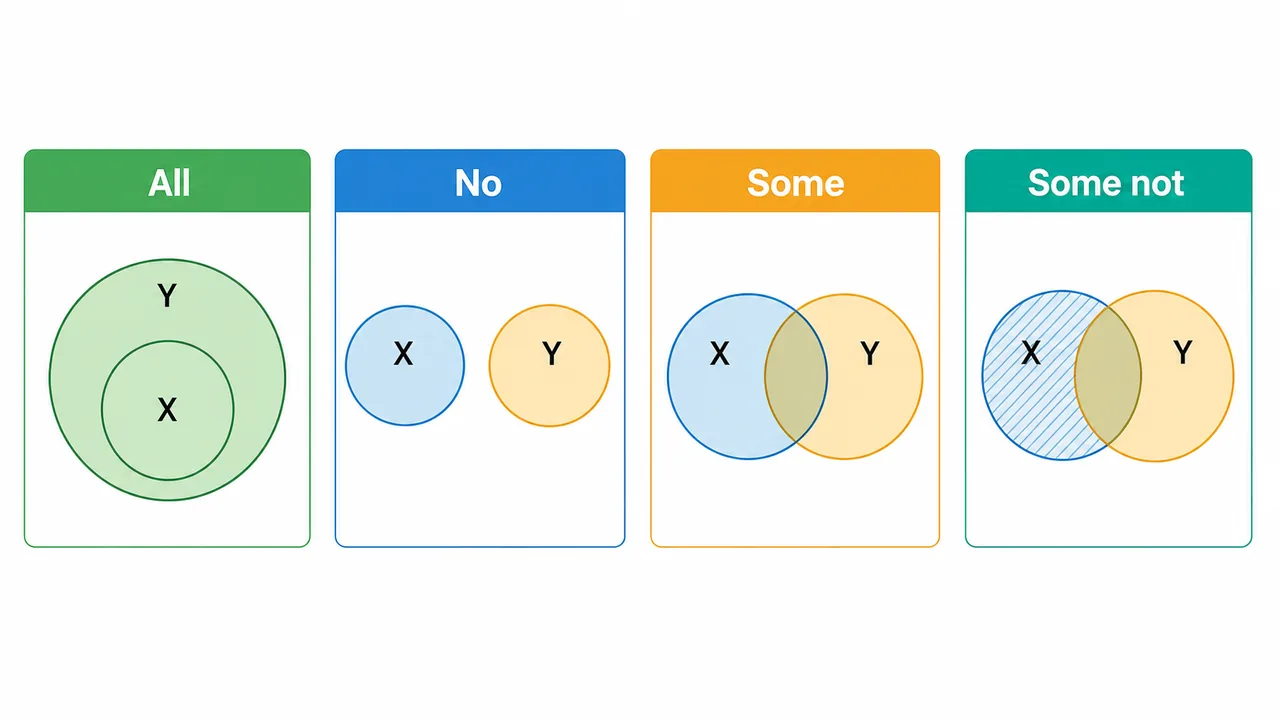
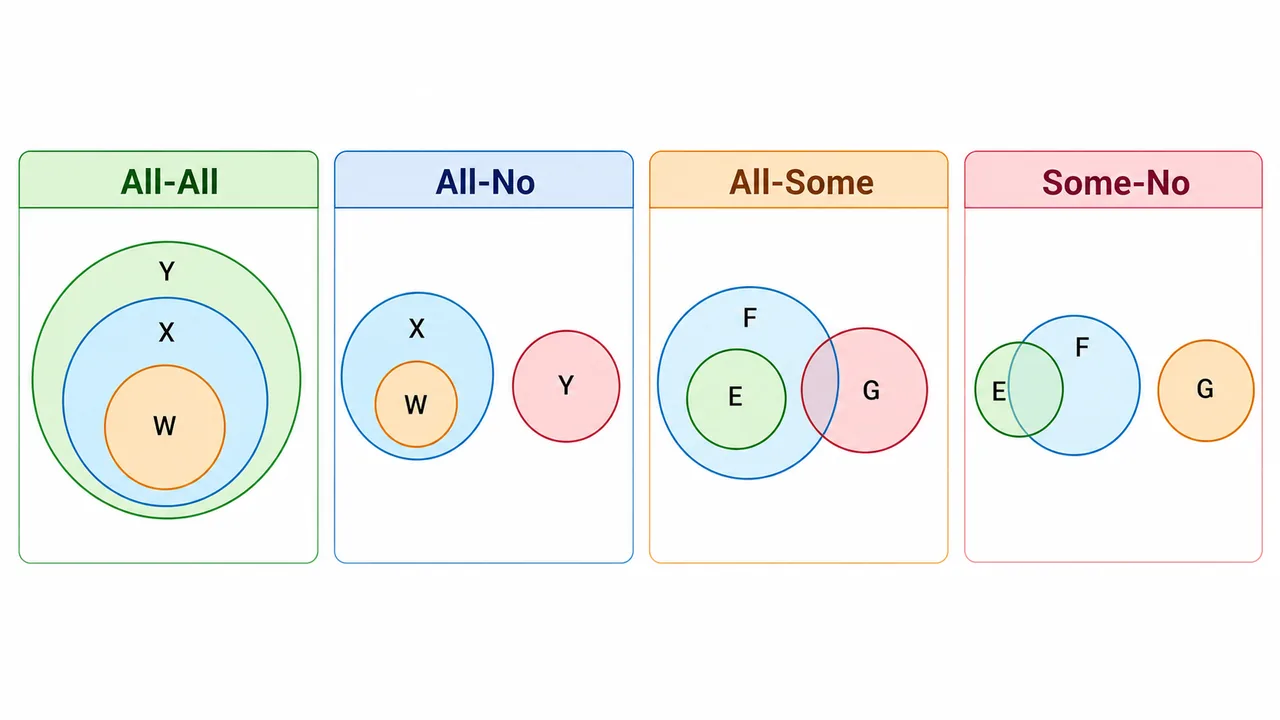
Complete "All" Conclusion Table
Given: All X are Y
| Conclusion | Definite? | Possible? |
|---|---|---|
| Some X are Y | ✓ Definite | ✓ Yes |
| Some Y are X | ✓ Definite | ✓ Yes |
| All Y are X | ✗ Not definite | ✓ Possible |
| No X is Y | ✗ Not definite | ✗ Not possible |
| Some X are not Y | ✗ Not definite | ✗ Not possible |
| No Y is X | ✗ Not definite | ✗ Not possible |
| Some Y are not X | ✗ Not definite | ✓ Possible |
Why "Some Y are not X" is possible: Y might be bigger than X, so the part of Y outside X exists.
Pro Content Locked
Upgrade to Pro to access this lesson and all other premium content.
Pay once for one year · Effective ₹99/mo
- All Agriculture & Banking Courses
- AI Lesson Questions (100/day)
- AI Doubt Solver (50/day)
- Glows & Grows Feedback (30/day)
- AI Section Quiz (20/day)
- 22-Language Translation (100/day)
- Recall Questions (20/day)
- AI Quiz (15/day)
- AI Quiz Paper Analysis (100/day)
- AI Step-by-Step Explanations (100/day)
- Spaced Repetition Recall (FSRS)
- AI Tutor
- Immersive Text Questions
- Audio Lessons — Hindi & English
- Mock Tests & Previous Year Papers
- Summary & Mind Maps
- XP, Levels, Leaderboard & Badges
- Generate New Classrooms
- Voice AI Teacher (AgriDots Live)
- AI Revision Assistant
- Knowledge Gap Analysis
- Interactive Revision (LangGraph)
🔒 Secure one-time yearly payment via Razorpay · No hidden fees
All & No — Rules and Conclusions
This lesson covers the two definite statement types — "All" and "No" — in complete detail. Master these and you'll handle 60% of syllogism questions with confidence.
Complete "All" Conclusion Table
Given: All X are Y
| Conclusion | Definite? | Possible? |
|---|---|---|
| Some X are Y | ✓ Definite | ✓ Yes |
| Some Y are X | ✓ Definite | ✓ Yes |
| All Y are X | ✗ Not definite | ✓ Possible |
| No X is Y | ✗ Not definite | ✗ Not possible |
| Some X are not Y | ✗ Not definite | ✗ Not possible |
| No Y is X | ✗ Not definite | ✗ Not possible |
| Some Y are not X | ✗ Not definite | ✓ Possible |
Why "Some Y are not X" is possible: Y might be bigger than X, so the part of Y outside X exists.
Why "All Y are X" is possible: X and Y could be equal sets (same circle). We only know X is inside Y — they could be the same size.
Complete "No" Conclusion Table
Given: No X is Y
| Conclusion | Definite? | Possible? |
|---|---|---|
| No Y is X | ✓ Definite | ✓ Yes |
| Some X are not Y | ✓ Definite | ✓ Yes |
| Some Y are not X | ✓ Definite | ✓ Yes |
| All X are Y | ✗ Not definite | ✗ Not possible |
| Some X are Y | ✗ Not definite | ✗ Not possible |
| All Y are X | ✗ Not definite | ✗ Not possible |
| Some Y are X | ✗ Not definite | ✗ Not possible |
"No" is the strongest separator — it makes ALL overlap-based conclusions impossible.
Chain Reasoning with "All"
When multiple "All" statements form a chain:
All W are X + All X are Y → All W are Y
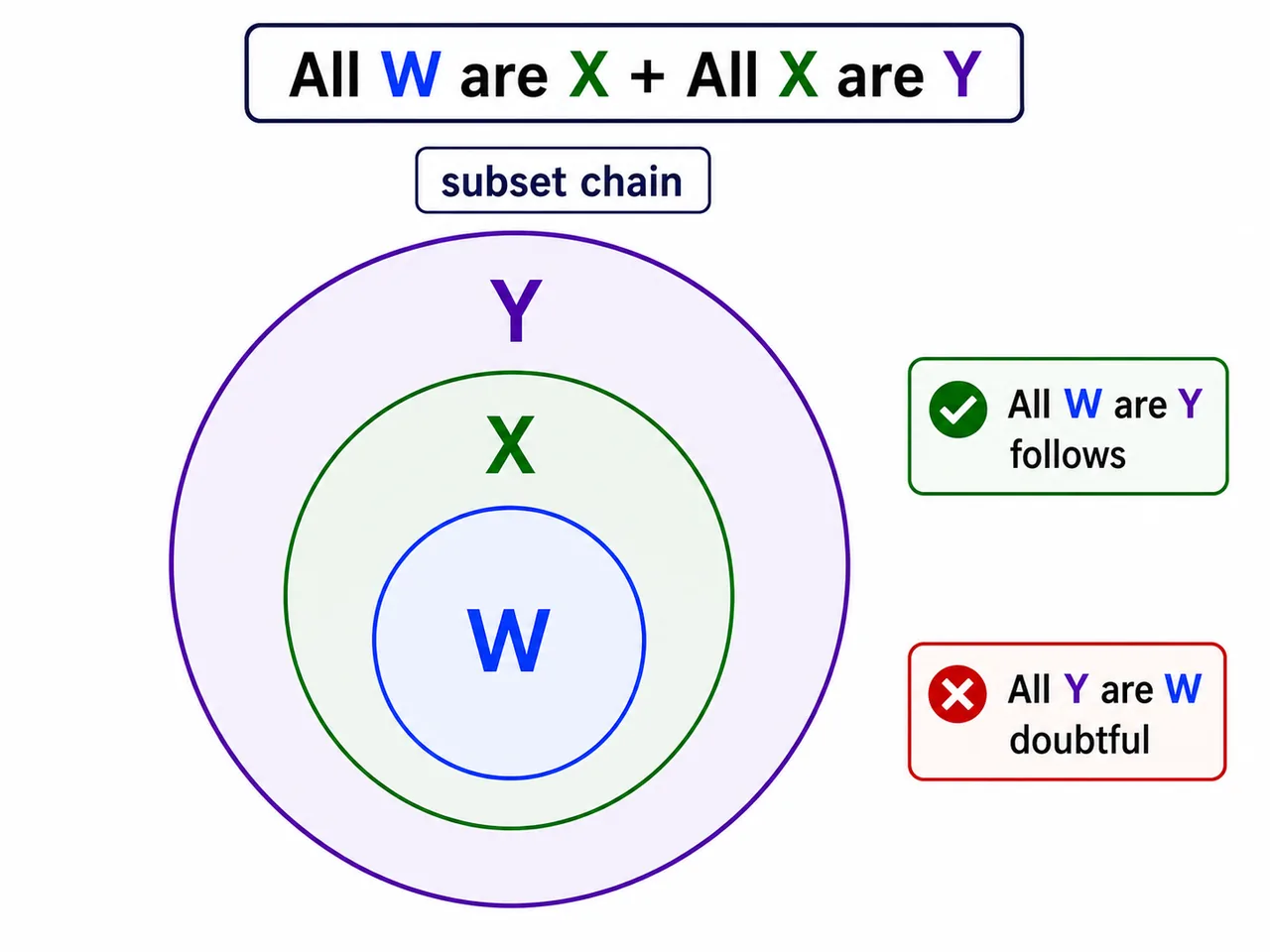
W is inside X, X is inside Y → W is inside Y.
What follows:
- All W are Y → ✓ Follow
- Some Y are W → ✓ Follow
- All Y are W → ? Doubtful
- All X are W → ? Doubtful
Chain Reasoning with "All" + "No"
All W are X + No X is Y
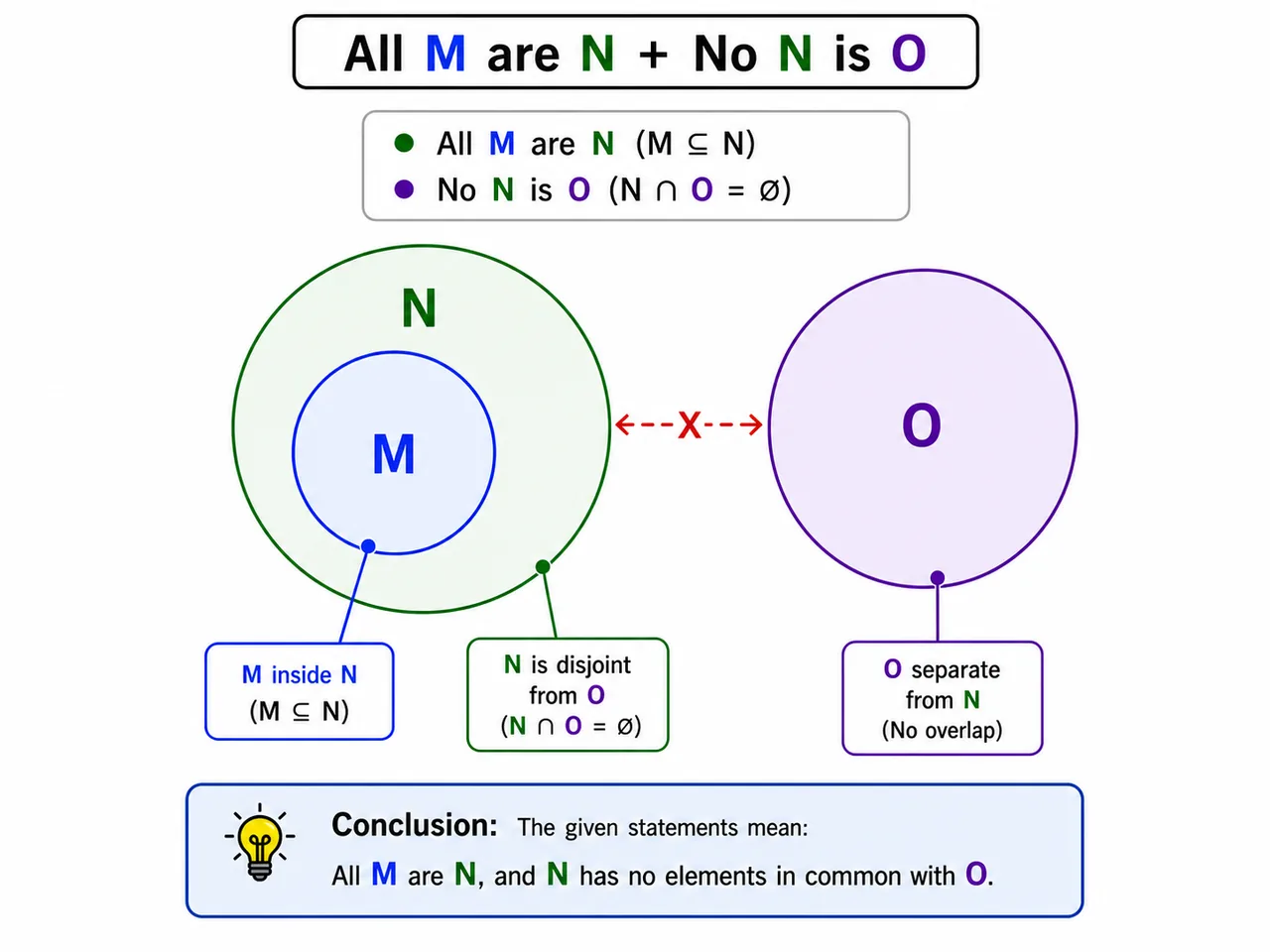
What follows:
- No W is Y → ✓ Follow (W inside X, Y separate from X)
- No Y is W → ✓ Follow
- Some W are not Y → ✓ Follow
- Some W are Y → ✗ Definitely False
Chain Reasoning with "No" + "All"
No W is X + All X are Y
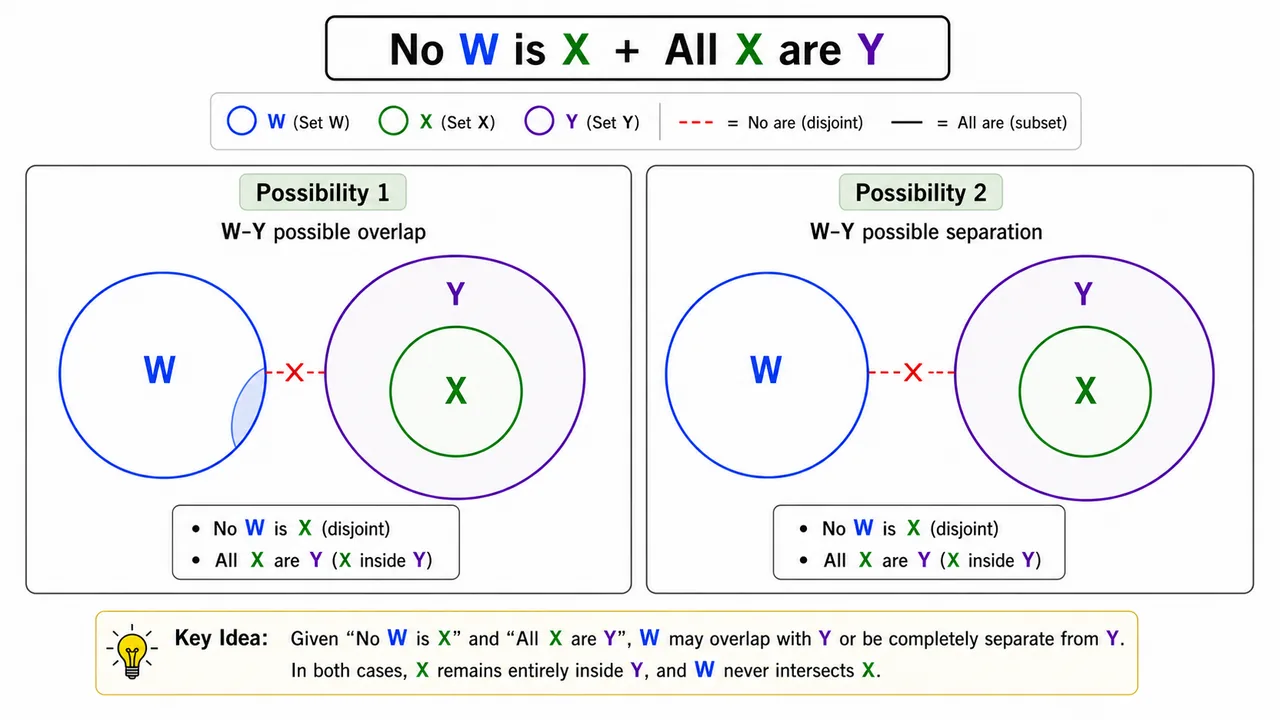
Wait — W is separate from X, but where does W sit relative to Y?
W could be inside Y or outside Y! We only know W is separate from X.
What follows:
- No W is X → ✓ Follow
- Some X are not W → ✓ Follow
- No W is Y → ? Doubtful (could be inside or outside)
- Some W are Y → ? Doubtful
Key insight: When "No" comes first in the chain, the relationship between W and Y is uncertain.
The "All" Reversal Trap
Most common exam mistake:
Statement: All gems are diamonds. Conclusion: All diamonds are gems.
Answer: Does NOT follow.
"All gems are diamonds" means gems ⊆ diamonds. Diamonds could contain things that are not gems.
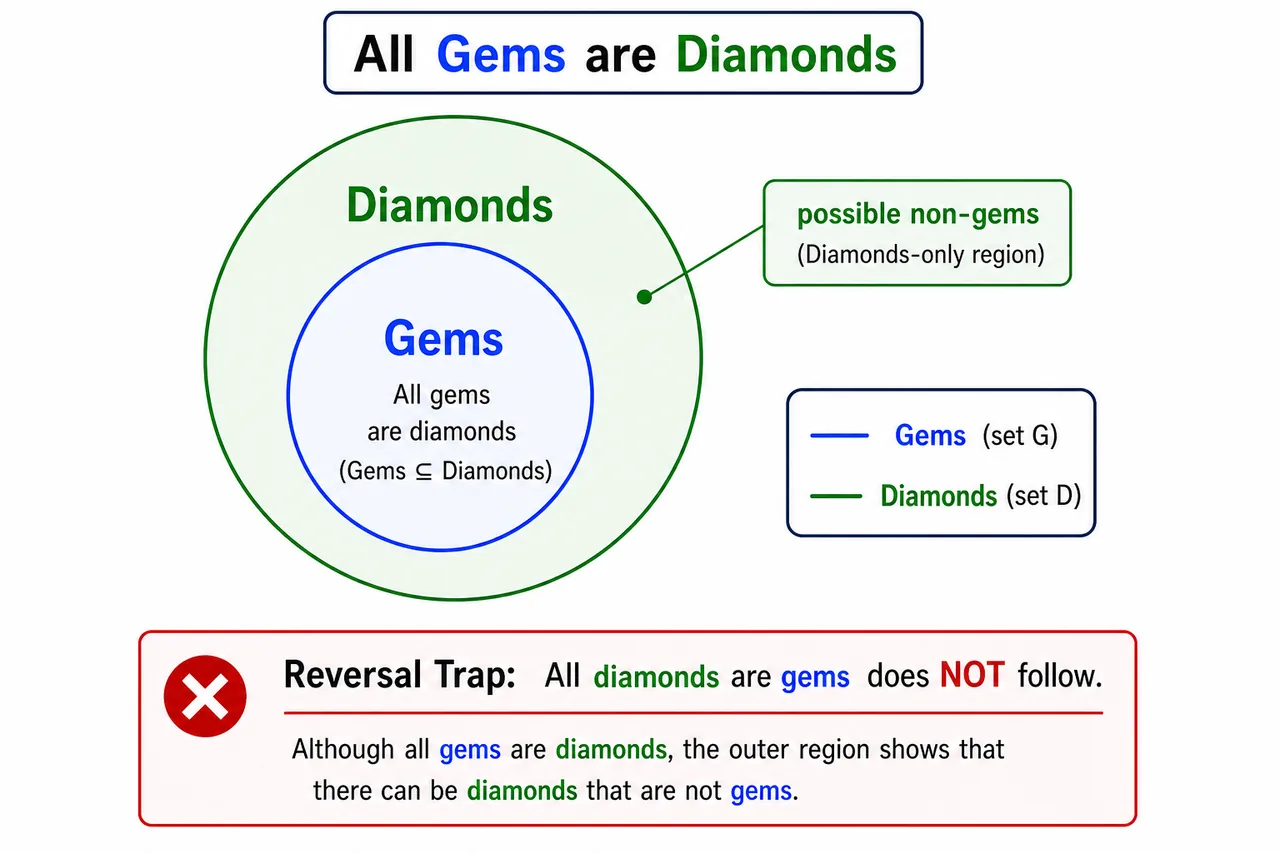
However: "All diamonds are gems" is a possibility (if the sets are equal).
Multi-Statement Practice
Problem 1: Statements:
- All tablets are keyboards
- All keyboards are monitors
- No monitor is a speaker
Draw step by step:
- Tablets inside Keyboards
- Keyboards inside Monitors
- Speakers separate from Monitors
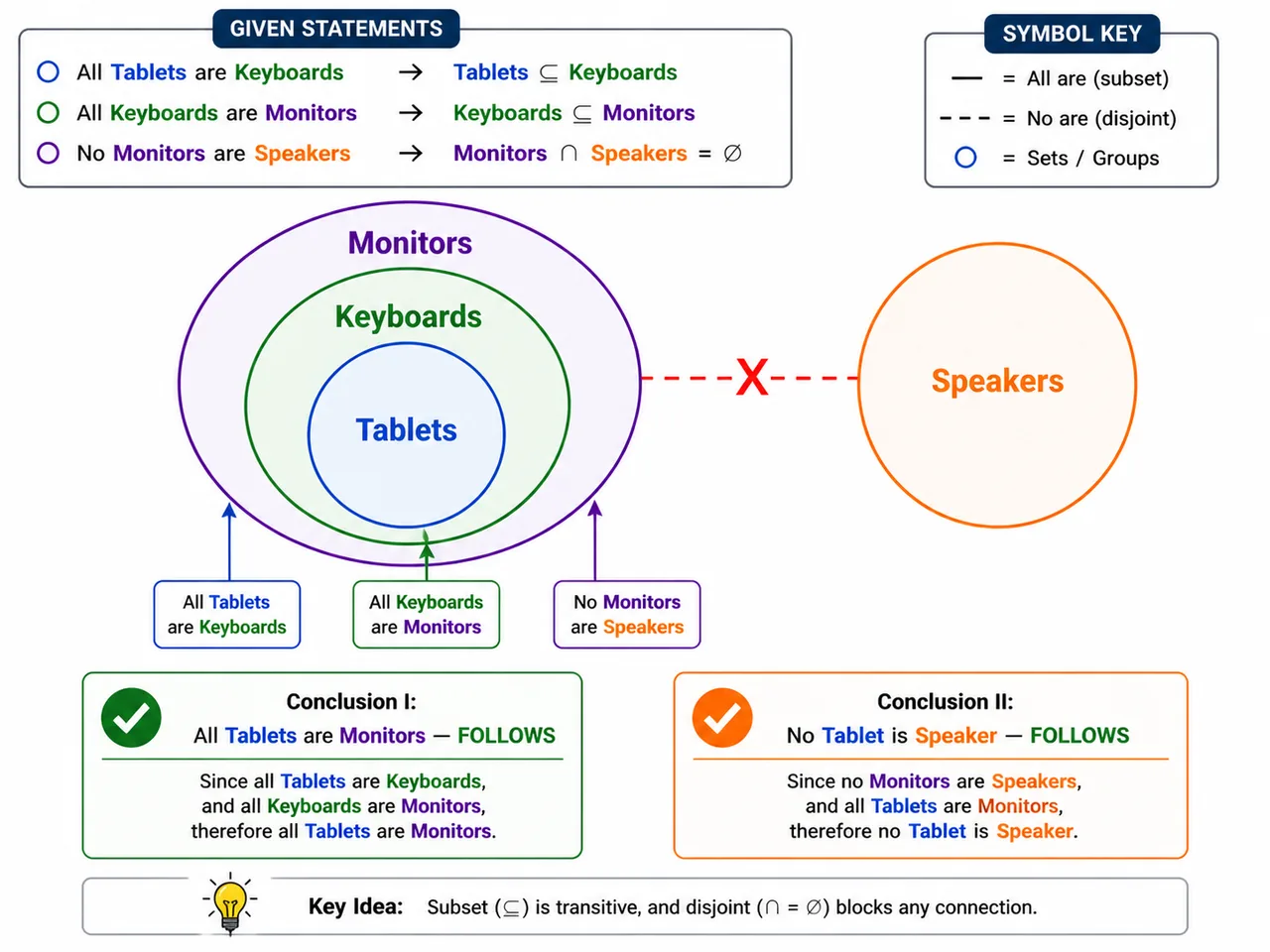
| Conclusion | Answer |
|---|---|
| All tablets are monitors | ✓ Follow |
| No tablet is a speaker | ✓ Follow |
| Some monitors are tablets | ✓ Follow |
| All monitors are tablets | Does not follow |
| No speaker is a keyboard | ✓ Follow |
| Some speakers are tablets | ✗ Definitely False |
Problem 2: Statements:
- All W are X
- No X is Y
- All Y are Z
Draw:
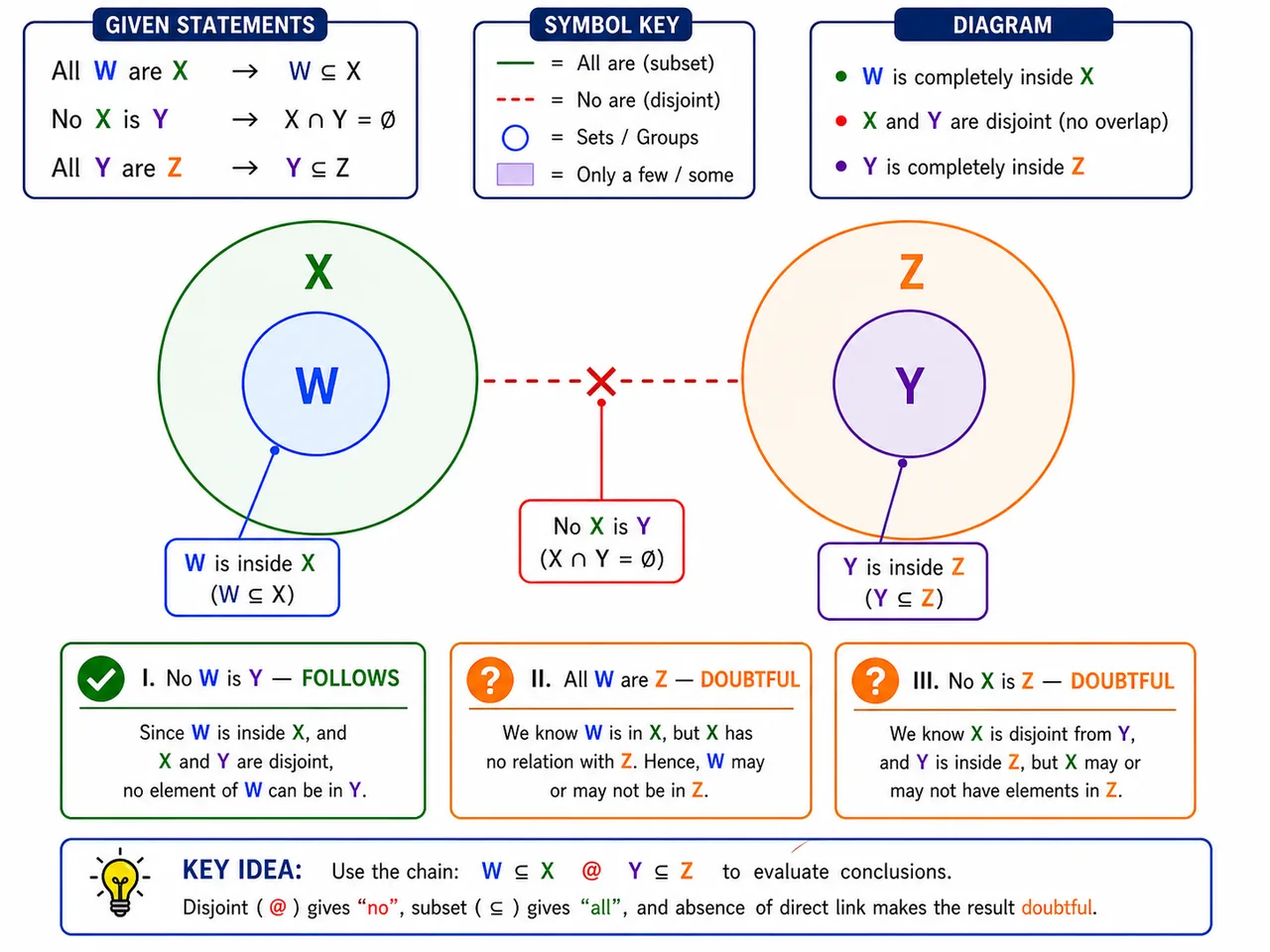
Wait — this is tricky. Let me reconsider:
- X and Y are separate (No X is Y)
- Y is inside Z
- Where is X relative to Z? Unknown!
Correct diagram — X could be inside or outside Z:
| Conclusion | Answer |
|---|---|
| No W is Y | ✓ Follow (W inside X, Y separate from X) |
| All W are Z | ? Doubtful (X might or might not be inside Z) |
| Some Z are Y | ✓ Follow (Y inside Z → Some Z are Y) |
| No X is Z | ? Doubtful |
Speed Tips
- Chain rule shortcut: If the chain is All→All→All, then the first is inside the last. Definite.
- Chain breaks at "No": Any "No" in the chain breaks the definite connection for elements on opposite sides.
- Draw minimum diagrams: For 3 statements, you need only 1 diagram. Don't redraw.
- Check conclusions against the diagram, not by memory. Look at the circles.
- Mark definite conclusions with ✓ immediately as you draw — don't wait to check all at once.
Complex Chain Reasoning with "No" — Worked Examples
These multi-step chains are where students lose marks. Practice these until the pattern is automatic.
Example 1: 4-statement chain with "No" in the middle
Statements:
- All W are X
- All X are Y
- No Y is Z
- All Z are V
Step-by-step:
- W ⊂ X ⊂ Y (from statements 1+2 → All W are Y ✓)
- Y and Z are completely separate (statement 3)
- Z ⊂ V (statement 4)
| Conclusion | Answer | Why |
|---|---|---|
| No W is Z | ✓ Follow | W is inside Y, and Y is separate from Z |
| No W is V | ? Doubtful | V extends beyond Z — V could overlap with Y |
| No X is Z | ✓ Follow | X is inside Y, Y is separate from Z |
| Some V are not Y | ✓ Follow | Z is inside V, Z is separate from Y → those V members that are Z are definitely not Y |
| No X is V | ? Doubtful | Same logic — V could extend to overlap with X through Y |
Key insight: "No" blocks the chain for the two sides of the "No" statement. But elements further down (like V beyond Z) are NOT guaranteed to be separate — they might extend back.
Example 2: "No" at the start of a chain
Statements:
- No J is K
- All K are L
- All L are H
Step-by-step:
- J and K are completely separate
- K ⊂ L ⊂ H
| Conclusion | Answer | Why |
|---|---|---|
| No J is K | ✓ Follow (given) | |
| No J is L | ? Doubtful | L extends beyond K — L could overlap with J |
| No J is H | ? Doubtful | H extends beyond L beyond K — even more room to overlap with J |
| Some L are not J | ? Doubtful | We can't guarantee this — L and J relationship is unknown |
Key insight: When "No" is at the start, it ONLY blocks the direct pair. The chain does NOT propagate "No" forward — because outer circles (L, H) can extend to overlap with J.
Example 3: Double "No" in a chain
Statements:
- All W are X
- No X is Y
- No Y is Z
- All Z are V
| Conclusion | Answer | Why |
|---|---|---|
| No W is Y | ✓ Follow | W inside X, X separate from Y |
| Some W are Z | ? Doubtful | Two "No" breaks don't reconnect — W and Z have no guaranteed relationship |
| Some V are not Y | ✓ Follow | Z inside V, Z separate from Y |
| No W is Z | ? Doubtful | W is separate from Y, Y is separate from Z — but W and Z could still overlap independently |
Key insight: Two consecutive "No" statements do NOT give "All/Some" — they give NOTHING definite between the outer elements. The elements are simply unrelated.
Common Mistakes
- Forgetting "Some" derivatives: "All X are Y" automatically gives you "Some X are Y" AND "Some Y are X"
- Reversing "All": All X are Y ≠ All Y are X. Never.
- Chain breaks: "All W are X" + "No X is Y" gives "No W is Y". But "No W is X" + "All X are Y" does NOT give "No W is Y"
- "No" does NOT propagate: "No X is Y" + "All Y are Z" does NOT give "No X is Z" — Z extends beyond Y
- Double "No" = Unknown: Two "No" breaks give NO definite relationship between outer elements
Summary Cheat Sheet
| Concept / Topic | Key Details / Explanation |
|---|---|
| "All X are Y" — definite conclusions | Some X are Y ✓, Some Y are X ✓ |
| "All X are Y" — possible (not definite) | All Y are X (possible), Some Y are not X (possible) |
| "All X are Y" — impossible | No X is Y ✗, Some X are not Y ✗, No Y is X ✗ |
| "No X is Y" — definite conclusions | No Y is X ✓, Some X are not Y ✓, Some Y are not X ✓ |
| "No X is Y" — impossible | All X are Y ✗, Some X are Y ✗, All Y are X ✗, Some Y are X ✗ |
| "No" is the strongest separator | Makes ALL overlap-based conclusions impossible. |
| Chain: All + All | All W are X + All X are Y → All W are Y (definite). Also: Some Y are W ✓. |
| Chain: All + No | All W are X + No X is Y → No W is Y (definite), No Y is W ✓, Some W are not Y ✓. |
| Chain: No + All | No W is X + All X are Y → W-Y relationship uncertain. W could be inside or outside Y. |
| "No" at start of chain | Blocks ONLY the direct pair. Does NOT propagate forward — outer circles can extend to overlap. |
| "No" in middle of chain | Blocks definite connection for elements on both sides of the "No". Elements beyond (like V beyond Z) may still overlap back. |
| Double "No" in chain | Two consecutive "No" statements give NO definite relationship between outer elements. |
| All Reversal Trap | "All gems are diamonds" → "All diamonds are gems" is WRONG. Never reverse "All". |
| "Some" derivative rule | "All X are Y" automatically gives you both "Some X are Y" AND "Some Y are X". Don't forget either. |
| Chain shortcut | All→All→All: first is inside last (definite). Any "No" in the chain breaks the definite connection for opposite-side elements. |
| Missing third element | In 3-statement problems, always check the relationship between first and third elements through the middle one. |
| Speed tip | Draw ONE diagram for all statements. Mark definite conclusions with ✓ as you draw — don't wait until conclusion-checking phase. |
- Missing the third element: In 3-statement problems, always check relationships between the first and third elements through the middle one