🔍 IBPS AFO PYQ Analysis 2026 — Mains Questions Decoded
8-year IBPS AFO PYQ analysis: subject weightage, question types, difficulty trend 2026–2026, high-frequency topics, and classic traps in Mains.
Most students prepare for IBPS AFO by reading textbooks cover to cover — but the exam doesn't test textbooks uniformly. After analysing 8 years of IBPS AFO Mains Professional Knowledge papers (2017–18 to 2024–25), clear patterns emerge about exactly what gets asked, how it gets asked, and how the exam has evolved.
This lesson is your unfair advantage: skip guessing what to study and study what actually comes.
IBPS AFO is conducted by the Institute of Banking Personnel Selection (IBPS), the official exam body. Check the IBPS AFO exam pattern and complete syllabus for the full picture.
The Paper at a Glance
| Parameter | Detail |
|---|---|
| Section | Professional Knowledge (Agriculture) |
| Questions | 60 |
| Maximum Marks | 60 |
| Duration | 45 minutes |
| Negative Marking | −0.25 per wrong answer |
| Options per Question | 5 (A–E) |
| Question Type | MCQ only |
Important: Prelims tests Reasoning, English, Quant and General Awareness — standard banking pattern. Your agriculture preparation is entirely for Mains. This analysis covers Mains Professional Knowledge only.
Subject-wise Weightage (8-Year Average)
This is the most reliable data you'll find — derived from systematic review of 16 PYQ sets across 8 years.
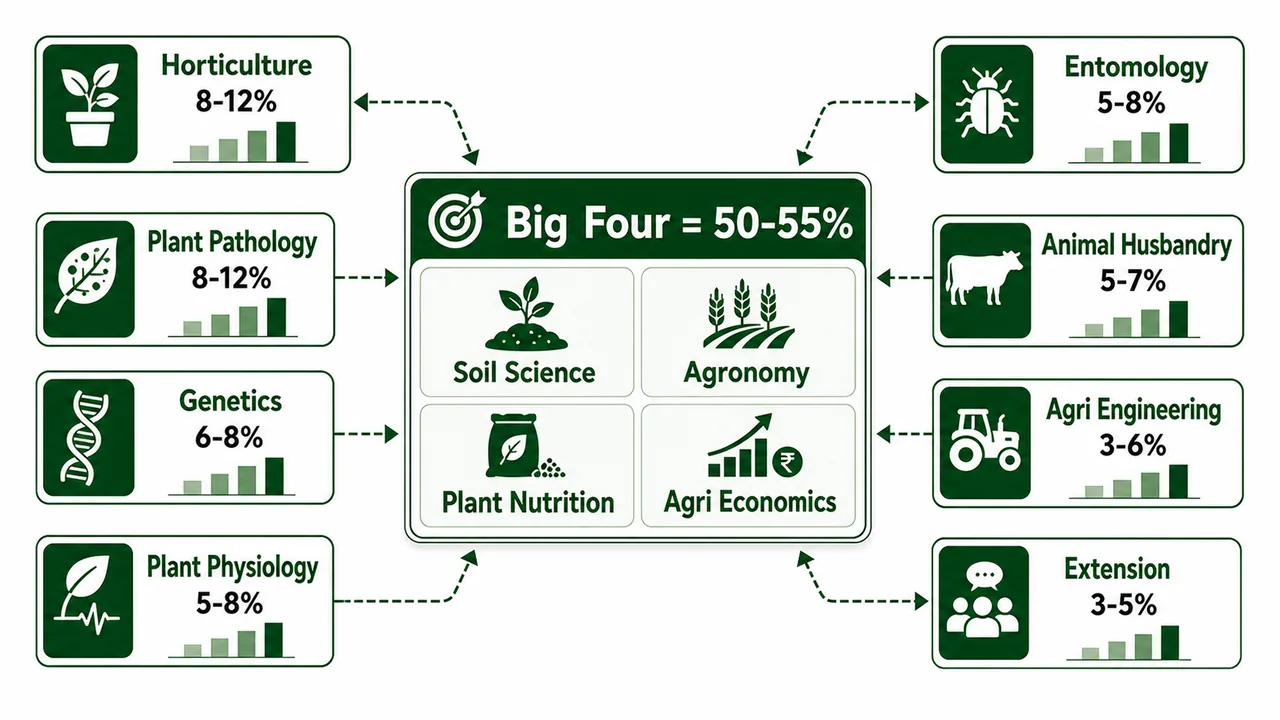
| Subject | Avg Questions | Typical Range | Share |
|---|---|---|---|
| Soil Science & Fertility | 10–12 | 8–14 | 17–20% |
| Agronomy & Crop Production | 10–12 | 8–13 | 17–20% |
| Plant Nutrition & Fertilizers | 6–8 | 5–10 | 10–13% |
| Agricultural Economics & Govt Schemes | 6–8 | 5–10 | 10–13% |
| Horticulture | 5–7 | 4–8 | 8–12% |
| Plant Pathology & Protection | 5–7 | 4–8 | 8–12% |
| Genetics & Plant Breeding | 4–5 | 3–6 | 6–8% |
| Plant Physiology & Biochemistry | 3–5 | 2–5 | 5–8% |
| Entomology & Pest Management | 3–5 | 3–6 | 5–8% |
| Animal Husbandry & Fisheries | 3–4 | 2–5 | 5–7% |
| Agricultural Engineering | 2–4 | 1–4 | 3–6% |
| Extension & Rural Development | 2–3 | 1–3 | 3–5% |
The Big Four — Soil Science, Agronomy, Plant Nutrition, and Agricultural Economics — together make up 50–55% of the paper. If you master these four, you're already halfway to clearing Mains.
Start with the Soil Science lessons, Agronomy course, and Agricultural Economics notes on AgriDots.
How Questions Are Asked: 4 Question Types
Understanding how a concept is tested matters as much as knowing the concept.
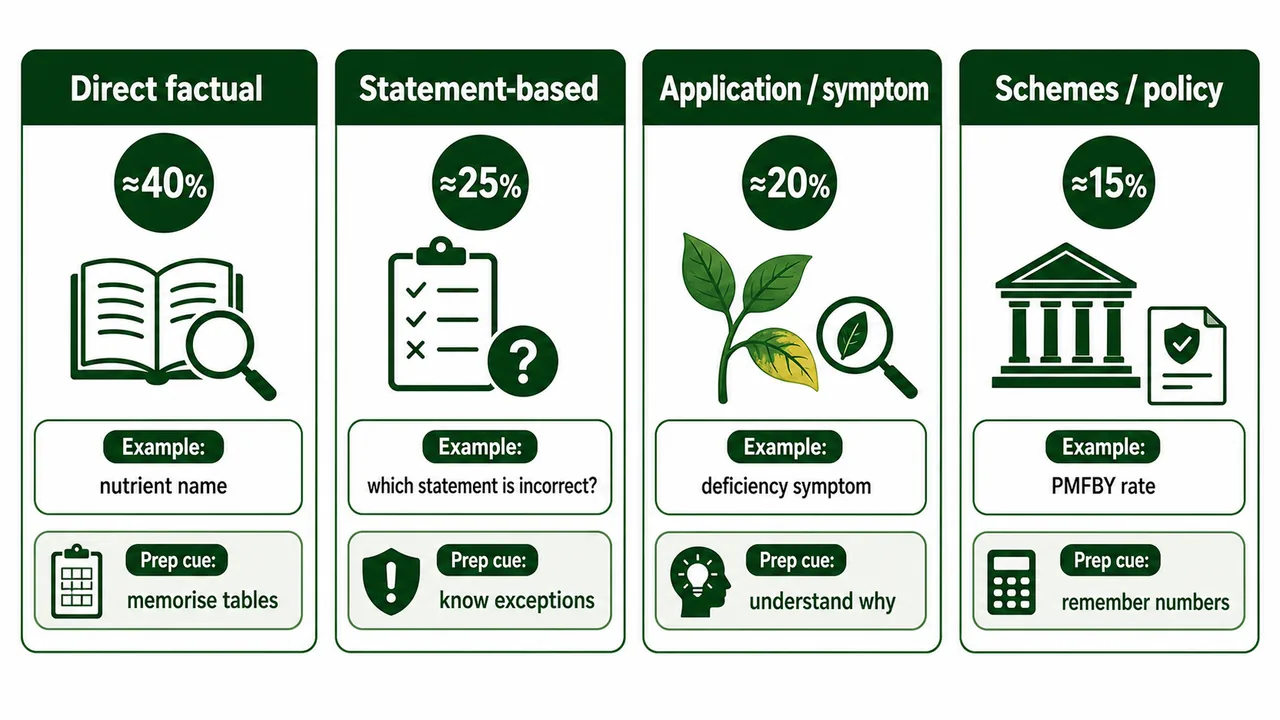
Type 1 — Direct Factual (≈40% of paper)
Simple recall: definitions, specific values, names, and classifications.
Examples from PYQs:
- "Which nutrient is phloem-immobile?"
- "What is the maximum premium under PMFBY for Kharif crops?"
- "Which state has the maximum area of alkali soil in India?"
- "The Green Revolution wheat variety released from Mexico is ___"
How to prepare: Precise memorisation. Wrong answers here are almost always due to confusion between similar values or names. Make tables for nutrient properties, scheme percentages, and crop varieties.
Type 2 — Statement-Based (≈25% of paper)
"Which of the following statements is CORRECT/INCORRECT?" These are the most discriminating question type — they separate students who truly understand from those who half-remember.
Examples from PYQs:
- "Consider the following statements about forest soils. Which is INCORRECT?"
- "Which of the following statements about N-fixation is NOT true?"
- Format: 4–5 statements; you must identify the odd one out
How to prepare: For every concept, know the exception and the nuance — not just the main fact. A statement like "all dicots have tap root systems" is false because bamboo exists. IBPS AFO specifically uses edge cases.
Type 3 — Application / Symptom Identification (≈20% of paper)
Given a scenario, disease symptom, soil condition, or crop behaviour — identify the cause or mechanism.
Examples from PYQs:
- "Boron deficiency first appears on ___" (young vs old leaves)
- "Luxury consumption of which nutrient causes lodging in cereals?"
- "A soil with pH 9.2, dispersed structure, and white efflorescence is most likely ___"
- "Wilting that does NOT recover at night is characteristic of ___"
How to prepare: Understand the why, not just the what. If you know why boron is phloem-immobile, you can derive which leaves show deficiency without memorising it separately.
Type 4 — Schemes / Policy / Current Affairs Agriculture (≈15% of paper)
Government schemes with specific numerical details, recent policy changes, India agriculture statistics.
Examples from PYQs:
- PMFBY premium rates for Kharif, Rabi, Commercial/Horticulture crops
- PM-KISAN annual amount and number of beneficiaries
- e-NAM — which APMCs, mandate, and integration details
- Soil Health Card frequency, budget, testing parameters
- FPO — government target of 10,000 FPOs, equity grant details
How to prepare: Do not just know the scheme name — know the specific numbers (percentages, amounts, dates, coverage). IBPS AFO questions are typically about the detail, not the concept.
Difficulty Trend: 2017 to 2025
The exam has gotten harder every single year without exception.
| Year | Difficulty | Nature of Change |
|---|---|---|
| 2017–18 | Easy–Moderate | Direct factual, highly predictable topics |
| 2018–19 | Moderate | More application questions introduced |
| 2019–20 | Moderate | Scheme questions became more specific |
| 2020–21 | Moderate–Hard | More statement-based, fewer direct facts |
| 2021–22 | Moderate–Hard | Cross-topic questions, mechanisms tested |
| 2022–23 | Hard | Analytical questions, paired topics |
| 2023–24 | Hard | High specificity — advanced plant nutrition, forest soils |
| 2024–25 | Very Hard | Conceptual pairs, phloem mobility edge cases, precision agriculture |
What this means for you: Preparing at 2020–21 difficulty level is no longer sufficient. The 2024–25 paper requires you to understand mechanisms and cross-topic connections. Memorising isolated facts will not get you a rank today.
Topics That Appear Every Single Year
These topics have appeared in all 8 years of PYQ analysis. If you skip them, you are deliberately leaving marks on the table.
Soil Science (always present):
- Soil texture, pH, salinity/sodicity distinction and reclamation
- Phloem-mobile vs phloem-immobile nutrients (complete table)
- Deficiency symptoms of N, P, K, Fe, Zn, Mn, B, Cu, Mo
- India's alkali soil states (UP, Rajasthan, Maharashtra)
Agronomy (always present):
- Kharif/Rabi/Zaid crops — specific crops with sowing details
- Major HYV and hybrid crop varieties (IR-8, Sonalika, Jaya, etc.)
- Irrigation methods — drip, sprinkler, furrow and their efficiency %
Schemes & Economics (always present):
- PMFBY premium rates (2% Kharif, 1.5% Rabi, 5% Horticulture)
- PM-KISAN ₹6,000/year details
- NABARD and RIDF — functions and loan categories
- MSP mechanism — which crops are covered
Plant Pathology (always present):
- Disease classification by pathogen (fungal/bacterial/viral/nematode)
- Major disease–crop pairs (e.g., Khaira disease of rice = Zn deficiency)
- Contact vs systemic fungicides
Emerging Topics (2022–2025 Only)
These have entered the paper in recent years and are increasingly common. Expect more from 2026 onwards.
| Topic | First Appeared | Why It Matters |
|---|---|---|
| Precision Agriculture & Drone Usage | 2022–23 | Government push, SMAM scheme |
| Natural Farming / ZBNF | 2022–23 | Andhra Pradesh model, AP Natural Farming scheme |
| Biofortification | 2023–24 | Golden Rice, Fe-rich beans, HarvestPlus programme |
| Direct Seeded Rice (DSR) | 2023–24 | Water saving, PM Krishi Sinchai integration |
| Soil Carbon Sequestration | 2023–24 | Climate resilience, 4 per 1000 initiative |
| FPO — Farmer Producer Organisations | 2022–23 | 10,000 FPOs target, equity grant ₹15 lakh |
| Agroforestry Systems | 2023–24 | National Agroforestry Policy 2014, NMSA |
| Climate-Resilient Varieties | 2024–25 | DRR Dhan 310, VL Dhan 221, Pusa Basmati 1847 |
The Classic Traps: Where Marks Disappear
These are the patterns IBPS AFO examiners use repeatedly to catch students who half-know a concept.
1. Phloem Mobile vs Immobile N, P, K, Mg, S, Cl are mobile → deficiency on old/lower leaves first Fe, Zn, Mn, B, Cu, Mo, Ca are immobile → deficiency on young/upper leaves first
The trap: Boron deficiency = young leaves (immobile). Boron toxicity = old leaves (accumulates where it can't leave). Students confuse deficiency with toxicity.
2. Saline vs Sodic (Alkali) Soil
| Parameter | Saline | Sodic (Alkali) |
|---|---|---|
| EC | > 4 dS/m | < 4 dS/m |
| pH | < 8.5 | > 8.5 |
| ESP | < 15% | > 15% |
| Structure | Flocculated (good) | Dispersed (poor) |
| Reclamation | Leaching | Gypsum (CaSO₄) |
The trap: "Which soil is reclaimed by gypsum?" → Sodic/Alkali, NOT saline. Many students flip this.
3. India vs World Leaders
PYQ questions often ask for India's rank in a commodity where India is NOT #1.
- Milk production: India is #1 globally
- Mango production: India is #1 globally
- Rice production: India is #2 (China is #1)
- Wheat production: India is #2 (China is #1)
- Spice production: India is #1 globally
The trap: "Which country leads in rice production?" → China, not India. IBPS AFO has asked this exact fact multiple times.
4. PMFBY Premium Rate Confusion
| Crop Type | Farmer's Premium |
|---|---|
| Kharif crops | 2% of Sum Insured |
| Rabi crops | 1.5% of Sum Insured |
| Commercial/Horticulture | 5% of Sum Insured |
| Annual Commercial (Rabi) | Actual or 1.5%, whichever is less |
The trap: Swapping Kharif and Rabi rates, or saying the premium is the full rate (it's the farmer's share only — government pays the rest).
5. Statement "INCORRECT" Questions
When the question asks "which statement is INCORRECT", students often mark what they think is correct. Re-read the question every time. This type of question has a significantly higher error rate in PYQs — examiners know it works.
Strategic Takeaway: Where to Invest Your Preparation Time
Based on the 8-year analysis, here's the return-on-effort ranking for IBPS AFO Mains:
Highest ROI (study deeply, not just superficially):
- Plant Nutrition — nutrient mobility table, deficiency symptoms, fertilizer calculations
- Soil Science — pH, texture, salinity/sodicity, reclamation, organic matter
- Agronomy — crop seasons, varieties, irrigation, tillage
- Government Schemes — precise numbers for PMFBY, PM-KISAN, KCC, e-NAM, NABARD
Medium ROI (cover thoroughly but not exhaustively): 5. Plant Pathology — disease-pathogen-crop triads, fungicides 6. Horticulture — propagation, post-harvest, protected cultivation 7. Genetics & Breeding — heterosis, selection methods, HYV history
Lower ROI (basics only — limited questions but must not leave blanks): 8. Agricultural Engineering — irrigation efficiency, farm machinery basics 9. Animal Husbandry — breeds, Operation Flood, fisheries basics 10. Extension — KVK, FFS, ATMA concepts
Frequently Asked Questions
Q: How many questions come from current affairs/agriculture news? Approximately 5–8 questions per paper are linked to current agriculture events, new schemes, or recent government policies. These are not predictable from textbooks — follow IBPS AFO current affairs monthly.
Q: Can I clear IBPS AFO without knowing animal husbandry? Not safely. Animal husbandry contributes 3–4 questions. At cut-off margins (typically 70–80% of scored marks), skipping a whole subject costs you dearly.
Q: Has IBPS AFO ever repeated questions from previous years? The exact question is rarely repeated. However, the same concept is retested frequently — just with different wording or a different parameter asked. This is why pattern analysis matters more than memorising old questions verbatim.
Q: What is the expected cut-off for 2026? IBPS does not publish subject-wise cut-offs — only overall Mains cut-offs. Historically, candidates who score 75%+ in Professional Knowledge (45+ out of 60) with a reasonable banking paper score make it to the interview. Aim for 42–48 correct answers.
What to Study Next
Use this analysis as your preparation compass:
- Understand the exam → IBPS AFO Exam Pattern 2026 — full 3-stage selection process
- Get the syllabus → IBPS AFO Complete Syllabus — topic-by-topic breakdown
- Top-priority subject → Soil Science for IBPS AFO — highest-weightage subject
- Practice under pressure → IBPS AFO Agriculture Mock Tests — full 60-question Mains simulations
- Know the cut-offs → IBPS AFO Cut-off Analysis — state-wise and category-wise trends
Based on systematic PYQ analysis of 8 years of IBPS AFO Mains papers (2017–18 to 2024–25).
Last updated: April 2026