🍐 Papaya
Important points, varities, pests
- Botanical Name: Carica papaya
- Family: Caricaceae
- Origin: Tropical America
- Papaya was introduced in India in 16th century. It was brought to India by the Portuguese and has since become one of the most commonly grown tropical fruits across the country.
- It is a tropical fruit and more sensitive to frost.
- Carica candamarcensis -- Mountain papaya.
- Highest productivity after Banana. Papaya yields more fruit per hectare than almost any other fruit crop except banana, making it highly profitable for small-scale farmers.
- India has 4th rank in papaya production in the world.
- Highest producing state in India - Andhra Pradesh
- Frost is the most limiting factor in papaya cultivation in north India. Even a mild frost can kill papaya plants, which is why commercial papaya cultivation in North India is restricted to frost-free pockets or requires frost protection measures.
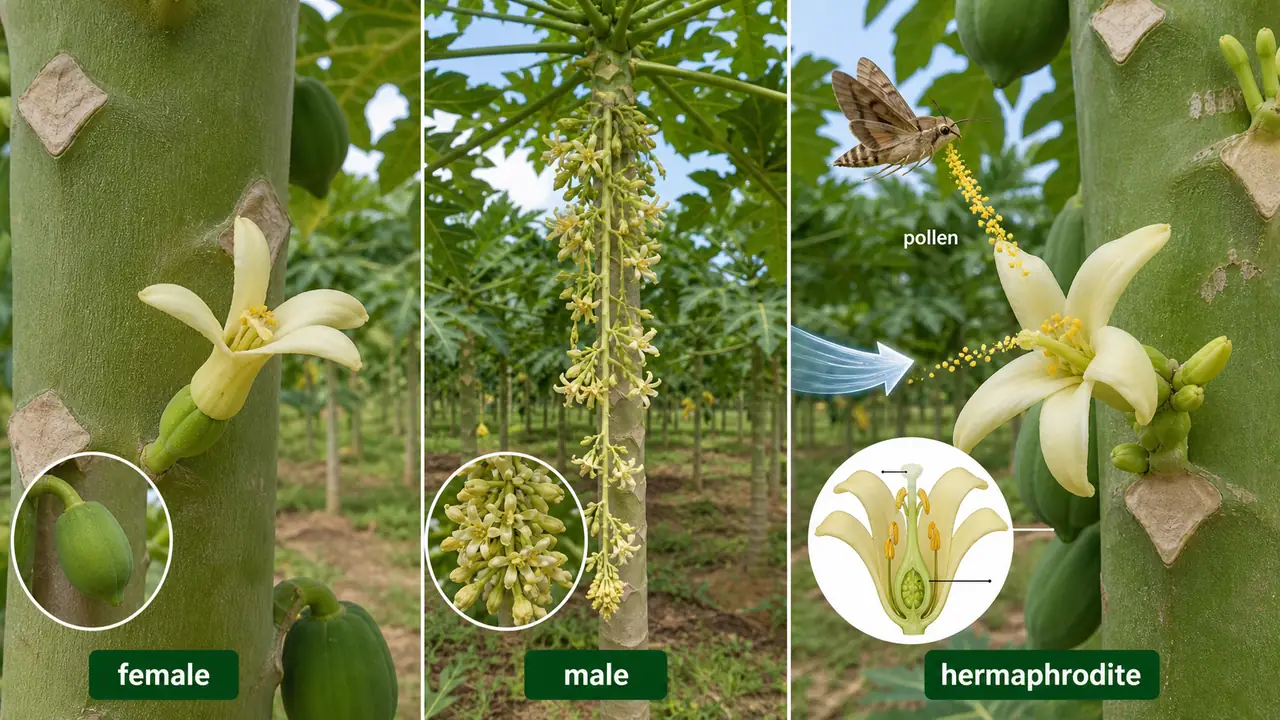
- Papaya is thermosensitive crop. Sex expression in papaya is strongly influenced by temperature -- high temperatures tend to produce more male flowers, while moderate temperatures favour hermaphrodite (bisexual) flowers that are commercially desirable.
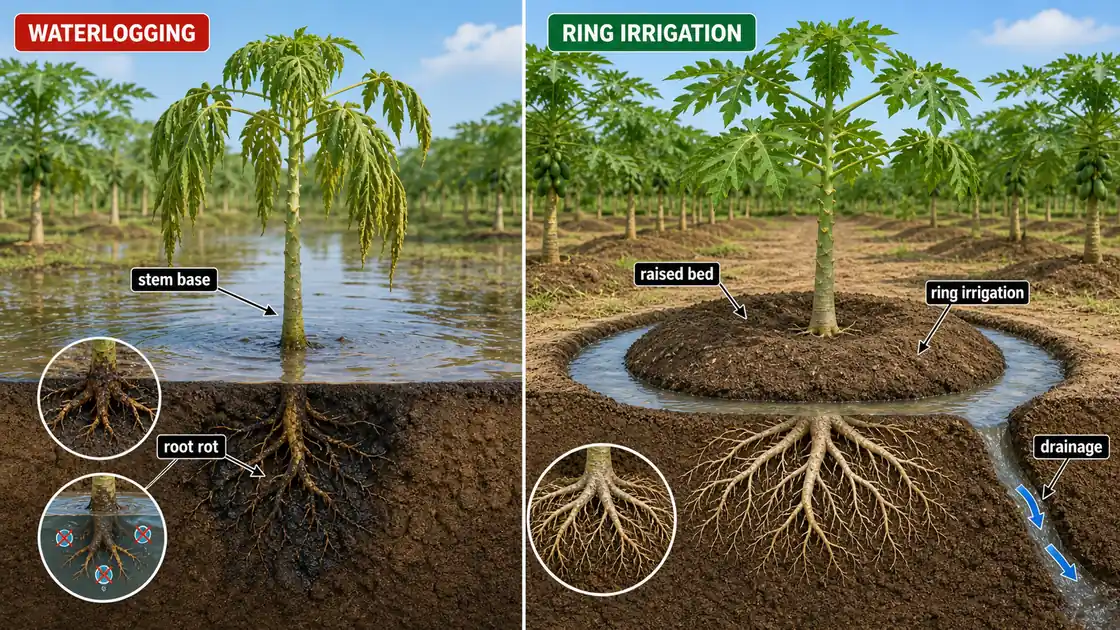
- Papaya plants are very susceptible to water logging. Even brief periods of waterlogging cause root rot and plant death. Well-drained soils and raised bed planting are essential for successful papaya cultivation.
- Yellow pigment in papaya -- Caricaxanthin. This carotenoid pigment gives the flesh its characteristic yellow to orange colour and acts as an antioxidant beneficial for human health.
- Carpine obtained from papaya, is utilized as a diuretic and heart stimulent. Carpaine is an alkaloid found in papaya leaves and has been used in traditional medicine for treating cardiac and kidney disorders.
- Pepsin - Dried latex of Papaya contains this enzyme.
- Papain - Enzyme present in papaya for marinating meat and meat products. Papain is a powerful proteolytic enzyme (protein-digesting) found in the latex of unripe papaya. It breaks down tough meat fibres, making it an excellent natural meat tenderizer widely used in the food industry.
- Papain contain 72.2% protein.
- Papaya is highly cross-pollinated plant. Wind and insects (primarily moths) are the main agents of pollination in papaya.
- Papaya is commercially propagated by seed. Since papaya is a short-lived perennial (productive for only 3-4 years), raising new plants from seed every few years is economically practical.
- Papaya is Polygamous plant i.e. Bearing some flowers with stamens only, some with pistils only, and some with both, on the same or different plants. This means papaya trees can be male, female, or hermaphrodite (bisexual). Hermaphrodite plants are commercially preferred because they are self-pollinating and produce uniform, elongated fruits.
- Seed Rate for Gynodioecious (Gynodioecy is the evolutionary intermediate stage between hermaphroditism (exhibiting both female and male parts) and dioecy (having two distinct morphs: male and female variety) - 250-300 gm/ha. Gynodioecious varieties produce a population of both female and hermaphrodite plants, so fewer seeds are needed since all plants can bear fruit.
- Seed Rate for Dioecous (Plant in which male and female reproductive parts occur in different plants) - 400-500gm/ha. Higher seed rates are needed for dioecious varieties because the male plants (which produce no fruit) must be thinned out after sex identification, wasting planted material.
- 1 gram = 20 seeds of papaya.
- Seed are enclosed in gelatinous sarcotesta. The sarcotesta is a mucilaginous outer layer of the seed coat that must be removed before sowing to improve germination percentage and speed.
- Recommended spacing for Pusa Nanha is 1.25 X 1.25 m2 (6000 plants/hac). Pusa Nanha is an extremely dwarf variety, so very close spacing is possible, achieving ultra-high density planting and maximum yield per unit area.
- Damping off is most serious disease of papaya seedlings. Caused by soil-borne fungi (Pythium, Rhizoctonia), damping off kills seedlings before or after emergence, making nursery management critical for successful papaya production.
- 10% male plant is planted where dioecious varieties are cultivated. These male plants are retained solely to provide pollen for the female plants. Excess males are removed once sex identification is possible (usually at flowering).
- Sunrise solo type of papaya produce no male plants. Being gynodioecious, Sunrise Solo produces only female and hermaphrodite plants, eliminating the problem of non-productive male plants.
- Irrigation by ring method. In the ring method, a shallow basin is made around each plant for irrigation, ensuring water reaches the root zone without wetting the stem base, which helps prevent collar rot.
Varieties
-
Gynodioecous [DMCTSS]
🔐
Pro Content Locked
Upgrade to Pro to access this lesson and all other premium content.
Pro
Popular Save ₹100/mo
₹ 99 /mo
₹99 charged monthly · Cancel anytime
- All Agriculture & Banking Courses
- AI Lesson Questions (100/day)
- AI Doubt Solver (50/day)
- Glows & Grows Feedback (30/day)
- AI Section Quiz (20/day)
- 22-Language Translation (100/day)
- Recall Questions (20/day)
- AI Quiz (15/day)
- AI Quiz Paper Analysis (100/day)
- AI Step-by-Step Explanations (100/day)
- Spaced Repetition Recall (FSRS)
- AI Tutor
- Immersive Text Questions
- Audio Lessons — Hindi & English
- Mock Tests & Previous Year Papers
- Summary & Mind Maps
- XP, Levels, Leaderboard & Badges
- Generate New Classrooms
- Voice AI Teacher (AgriDots Live)
- AI Revision Assistant
- Knowledge Gap Analysis
- Interactive Revision (LangGraph)
🔒 Secure via Razorpay · Cancel anytime · No hidden fees
- Botanical Name: Carica papaya
- Family: Caricaceae
- Origin: Tropical America
- Papaya was introduced in India in 16th century. It was brought to India by the Portuguese and has since become one of the most commonly grown tropical fruits across the country.
- It is a tropical fruit and more sensitive to frost.
- Carica candamarcensis -- Mountain papaya.
- Highest productivity after Banana. Papaya yields more fruit per hectare than almost any other fruit crop except banana, making it highly profitable for small-scale farmers.
- India has 4th rank in papaya production in the world.
- Highest producing state in India - Andhra Pradesh
- Frost is the most limiting factor in papaya cultivation in north India. Even a mild frost can kill papaya plants, which is why commercial papaya cultivation in North India is restricted to frost-free pockets or requires frost protection measures.
- Papaya is thermosensitive crop. Sex expression in papaya is strongly influenced by temperature -- high temperatures tend to produce more male flowers, while moderate temperatures favour hermaphrodite (bisexual) flowers that are commercially desirable.
- Papaya plants are very susceptible to water logging. Even brief periods of waterlogging cause root rot and plant death. Well-drained soils and raised bed planting are essential for successful papaya cultivation.
- Yellow pigment in papaya -- Caricaxanthin. This carotenoid pigment gives the flesh its characteristic yellow to orange colour and acts as an antioxidant beneficial for human health.
- Carpine obtained from papaya, is utilized as a diuretic and heart stimulent. Carpaine is an alkaloid found in papaya leaves and has been used in traditional medicine for treating cardiac and kidney disorders.
- Pepsin - Dried latex of Papaya contains this enzyme.
- Papain - Enzyme present in papaya for marinating meat and meat products. Papain is a powerful proteolytic enzyme (protein-digesting) found in the latex of unripe papaya. It breaks down tough meat fibres, making it an excellent natural meat tenderizer widely used in the food industry.
- Papain contain 72.2% protein.
- Papaya is highly cross-pollinated plant. Wind and insects (primarily moths) are the main agents of pollination in papaya.
- Papaya is commercially propagated by seed. Since papaya is a short-lived perennial (productive for only 3-4 years), raising new plants from seed every few years is economically practical.
- Papaya is Polygamous plant i.e. Bearing some flowers with stamens only, some with pistils only, and some with both, on the same or different plants. This means papaya trees can be male, female, or hermaphrodite (bisexual). Hermaphrodite plants are commercially preferred because they are self-pollinating and produce uniform, elongated fruits.
- Seed Rate for Gynodioecious (Gynodioecy is the evolutionary intermediate stage between hermaphroditism (exhibiting both female and male parts) and dioecy (having two distinct morphs: male and female variety) - 250-300 gm/ha. Gynodioecious varieties produce a population of both female and hermaphrodite plants, so fewer seeds are needed since all plants can bear fruit.
- Seed Rate for Dioecous (Plant in which male and female reproductive parts occur in different plants) - 400-500gm/ha. Higher seed rates are needed for dioecious varieties because the male plants (which produce no fruit) must be thinned out after sex identification, wasting planted material.
- 1 gram = 20 seeds of papaya.
- Seed are enclosed in gelatinous sarcotesta. The sarcotesta is a mucilaginous outer layer of the seed coat that must be removed before sowing to improve germination percentage and speed.
- Recommended spacing for Pusa Nanha is 1.25 X 1.25 m2 (6000 plants/hac). Pusa Nanha is an extremely dwarf variety, so very close spacing is possible, achieving ultra-high density planting and maximum yield per unit area.
- Damping off is most serious disease of papaya seedlings. Caused by soil-borne fungi (Pythium, Rhizoctonia), damping off kills seedlings before or after emergence, making nursery management critical for successful papaya production.
- 10% male plant is planted where dioecious varieties are cultivated. These male plants are retained solely to provide pollen for the female plants. Excess males are removed once sex identification is possible (usually at flowering).
- Sunrise solo type of papaya produce no male plants. Being gynodioecious, Sunrise Solo produces only female and hermaphrodite plants, eliminating the problem of non-productive male plants.
- Irrigation by ring method. In the ring method, a shallow basin is made around each plant for irrigation, ensuring water reaches the root zone without wetting the stem base, which helps prevent collar rot.
Varieties
-
Gynodioecous [DMCTSS]
- Pusa Delicious
- Pusa Majesty: One of highest papain yielders. This variety is specifically selected for papain extraction due to its high latex yield.
- Coorg honey dew: Selection from honey dew (Madhu Bindu) - Hermaphrodite
- Taiwan -- (Blood red flesh). The deep red flesh colour indicates very high lycopene content, which is a powerful antioxidant.
- Sunrise solo -- (Pink flesh)
- Surya
-
Dioecious Varieties
- Pusa Nanha: Extremely dwarf, suitable for HDP (pot garden). Its compact size allows it to be grown even in kitchen gardens and pots, making it a unique variety for urban horticulture.
- Pusa Giant: Suitable for tooty fruity and candies used in canning industry and have good wine resistance. The large fruit size and firm flesh of Pusa Giant make it ideal for processing into various preserved products.
- Pusa Dwarf
- Hatras gold
- Betty
- Pant C-1
- CO-1: Dwarf
- CO-2
- CO-5: Cultivated mainly for papain extraction (Pupain yield 1500 -- 1600 kg/ha). CO-5 is the most productive variety for commercial papain production, yielding significantly more latex than other varieties.
- CO-6: Selection from Pusa Majesty
- Pink flesh sweet: TSS -- 12-14° Brix
- Sunny bank
- Improved Peresons
-
Hybrid
- CO-3: CO-2 x Sunrise Gold
- CO-4: CO-2 x Washinghton
- CO-7: Pusa delicious x Coorg honey dew. Hybrid varieties combine the superior quality traits of both parents, offering improved yield, disease tolerance, and fruit quality.
Disease
- Stem rot / Foot rot / damping off
- Pythium aphanidermatum
- It is most serious disease of papaya seedlings. This oomycete pathogen thrives in waterlogged, poorly drained nursery beds and can destroy an entire seedling crop within days.
-
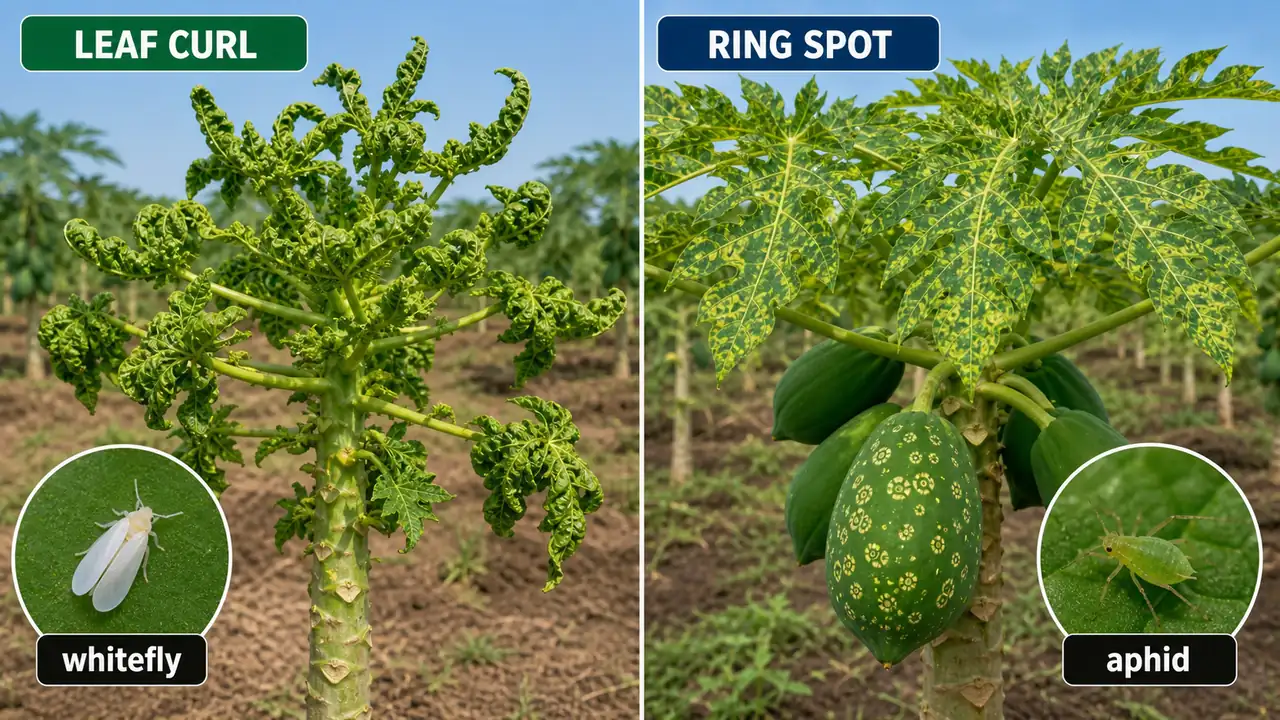
Papaya Leaf curl
- Papaya leaf curl virus
- Spread by whitefly Bemisia tabaci. The whitefly transmits the virus while feeding on plant sap, and once infected, the leaves curl severely, growth is stunted, and fruit production drops dramatically.
-
Papaya ring spot
- Papaya ring spot virus
- Upper leaves of papaya is mottled. The virus causes mosaic mottling on leaves and characteristic ring-shaped spots on fruits, rendering them unmarketable.
- Transmitted by aphid (Aphis gossipi).
- Management:
- Both white flies and aphids can be managed by spraying of any systemic insecticides i.e. Acephate @ 1.0 mllliter of water or Dimethoate 30 EC @ 1 ml/liter of water or
- Imidacloprid @ 0.5 ml/liter of water with Streptocyclin a 0.1 g /liter of water is also effective. Systemic insecticides are absorbed by the plant and kill the insect vectors when they feed, providing longer-lasting protection than contact insecticides. Managing the vectors (whiteflies and aphids) is the primary strategy for controlling these viral diseases, since there is no direct cure for plant viruses.
Summary Cheat Sheet
| Concept / Topic | Key Details / Explanation |
|---|---|
| Papaya identity | Carica papaya of Caricaceae originated in tropical America, was introduced into India by the Portuguese, and is a tropical fruit crop highly sensitive to frost. |
| Production and climate | Papaya is one of the highest-yielding fruit crops after banana, Andhra Pradesh is noted here as the leading producing state, frost is the biggest limit in North India, and the crop is highly sensitive to waterlogging. |
| Special traits and useful compounds | Mountain papaya is Carica candamarcensis; yellow pigment is caricaxanthin; carpaine is the medicinal alkaloid; papaya latex contains pepsin and papain, and papain is used as a proteolytic meat-tenderizing enzyme. |
| Pollination and sex expression | Papaya is highly cross-pollinated, polygamous, and thermosensitive, with temperature influencing whether more male or hermaphrodite flowers are produced. |
| Propagation and seed facts | Commercial propagation is by seed, gynodioecious types need about 250-300 g/ha seed, dioecious types need about 400-500 g/ha, 1 g has roughly 20 seeds, and the seed is enclosed in sarcotesta. |
Summary Continued
| Concept / Topic | Key Details / Explanation |
|---|---|
| Orchard management | Pusa Nanha is planted at 1.25 x 1.25 m, about 10% male plants are retained in dioecious orchards, Sunrise Solo produces no male plants, and ring irrigation is recommended. |
| Important variety groups | Gynodioecious lines listed are Pusa Delicious, Pusa Majesty, Coorg Honey Dew, Taiwan, Sunrise Solo, and Surya; dioecious lines include Pusa Nanha, Pusa Giant, Pusa Dwarf, Hatras Gold, Betty, Pant C-1, CO-1, CO-2, CO-5, CO-6, Pink Flesh Sweet, Sunny Bank, and Improved Peresons. |
| Hybrids and processing types | CO-3, CO-4, and CO-7 are the named hybrids; Pusa Giant is suited for processing; CO-5 is highlighted for papain extraction; and Pusa Majesty is one of the higher papain yielders. |
| Major diseases | Damping off, stem rot, and foot rot are linked to Pythium aphanidermatum; papaya leaf curl virus is spread by whitefly Bemisia tabaci; and papaya ring spot virus is spread by aphids. |
| Disease management | Management in this lesson focuses on controlling whiteflies and aphids with systemic insecticides such as acephate, dimethoate, or imidacloprid, since vector control is central for viral disease management. |