🧲 Copper, Uranium & Rare Minerals
Study of metallic and strategic minerals in UP — Sonrai copper deposit, uranium in Sonbhadra, bauxite, diaspore, pyrophyllite, and rare earth potential for Uttar Pradesh GK.
Copper — Sonrai Mines, Lalitpur
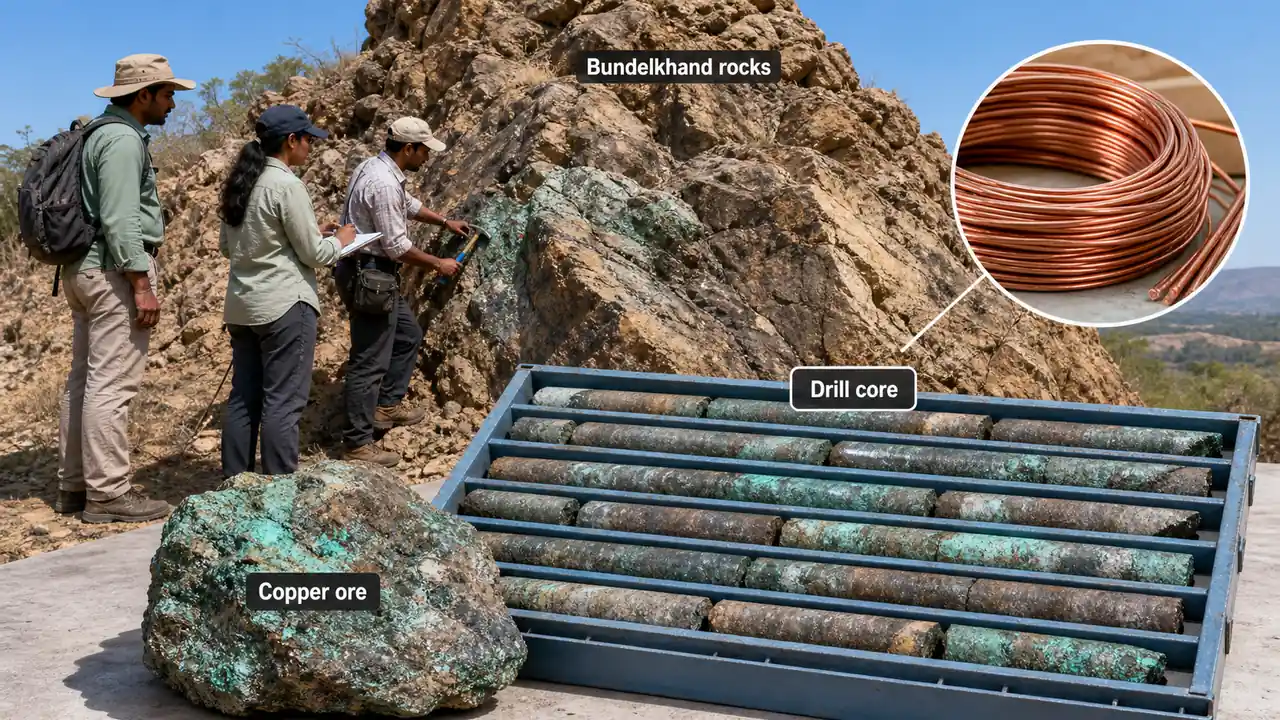
The most significant metallic mineral occurrence discussed in UP GK is the Sonrai copper area in Lalitpur district (Bundelkhand region). It is important mainly because metallic mineral occurrences in UP are otherwise limited.
The Sonrai deposit lies within the Bundelkhand Gneissic Complex — ancient Precambrian rocks that are among the oldest geological formations in the subcontinent. Copper here occurs as sulphide ore (primarily chalcopyrite) in quartz-reef veins.
For exam purposes, the key point is not large-scale copper production, but the association Lalitpur -> Sonrai -> copper occurrence.
| Parameter | Details |
|---|---|
| Location | Sonrai, Lalitpur district |
| Geological Formation | Bundelkhand Gneissic Complex |
| Ore Type | Copper sulphide (chalcopyrite) |
| Reserve status | Explored occurrence / reserve estimate zone |
| Copper Content | Low-to-moderate grade ore reported in surveys |
| Exploration Agency | GSI + Hindustan Copper Limited (HCL) |
Exam Tip: Sonrai (Lalitpur) copper deposit is frequently asked. Remember: Lalitpur = Copper, Sonbhadra = Coal + Uranium. Do not confuse the two districts.
Why Sonrai Matters
India depends heavily on domestic and imported copper sources. Sonrai matters in GK because it represents UP's metallic-mineral potential, even though it has not become a major producing copper centre.
However, development has remained limited due to:
- Environmental clearance challenges (forest and wildlife concerns)
- Land acquisition issues in a tribal-dominated area
- Water table concerns from open-pit mining
Uranium — Strategic Discovery in Sonbhadra
Uranium deposits have been identified in Sonbhadra district, making it one of the few locations outside the traditional uranium belt of Jharkhand (Jaduguda) and Andhra Pradesh (Tummalapalle) where this strategic mineral has been found.
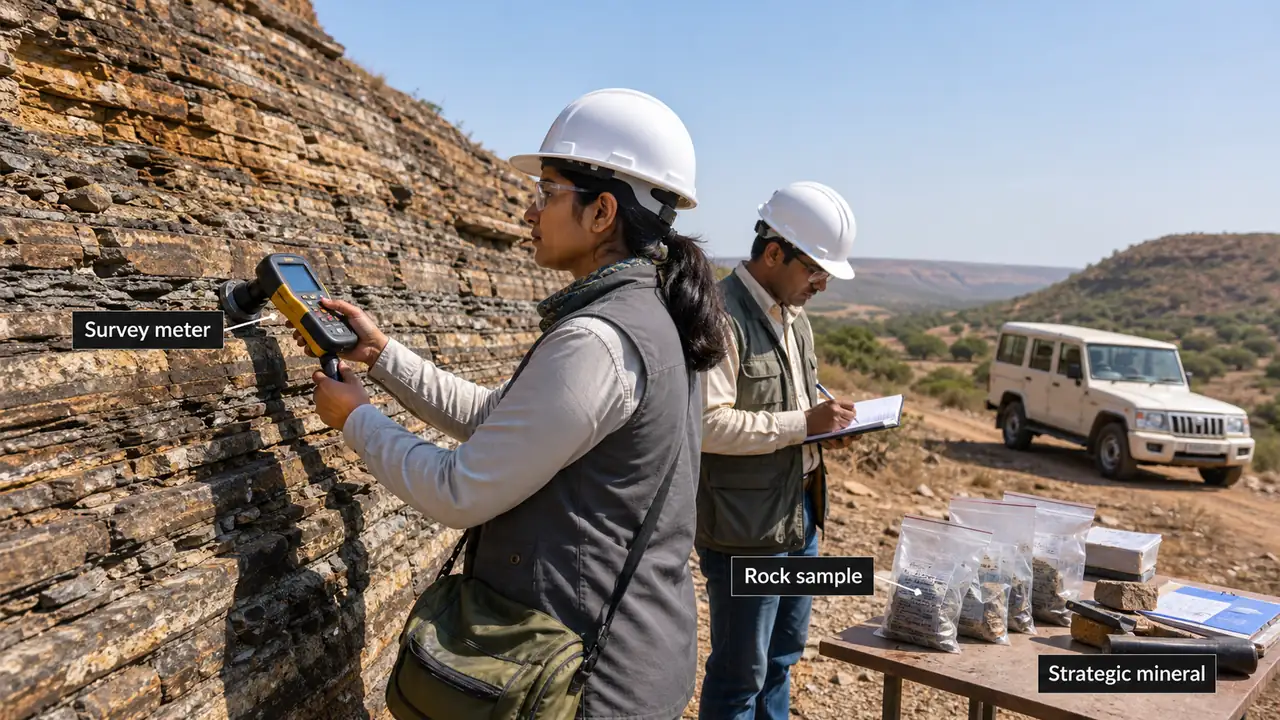
The Atomic Energy Commission (AEC) and the Atomic Minerals Directorate for Exploration and Research (AMD) have confirmed the presence of uranium in the Vindhyan and Son Valley formations of Sonbhadra.
| Parameter | Details |
|---|---|
| Location | Sonbhadra district (Son Valley) |
| Exploration Agency | AMD (under Department of Atomic Energy) |
| Strategic Status | Controlled under Atomic Energy Act, 1962 |
| Associated Minerals | Phosphorite, rare earths |
| Current Status | Exploration stage — not in normal commercial production |
Strategic Importance
Uranium is classified as a prescribed substance under the Atomic Energy Act. All exploration and extraction is controlled by the central government through:
- Uranium Corporation of India Limited (UCIL) — mining
- Nuclear Fuel Complex (NFC) — processing
India's nuclear power programme requires steady uranium supply. Sonbhadra is relevant mainly as an exploration and strategic-control topic, not as an active uranium-mining district.
Exam Tip: Uranium mining in India is entirely under central government control — state governments have no jurisdiction over atomic minerals.
Bauxite — Limited but Present
Bauxite (aluminium ore) deposits exist in Banda and Sonbhadra districts, though they are limited in both quantity and quality compared to major producers like Odisha and Gujarat.
| Parameter | Details |
|---|---|
| Locations | Banda, Sonbhadra |
| Ore Quality | Low to medium grade |
| Status | Marginally economic — limited extraction |
| National Context | India's major bauxite: Odisha, Gujarat, Jharkhand, Chhattisgarh |
UP's bauxite deposits are too small and too low-grade to support an aluminium smelter, so they have limited commercial significance.
Diaspore — Alumina Source
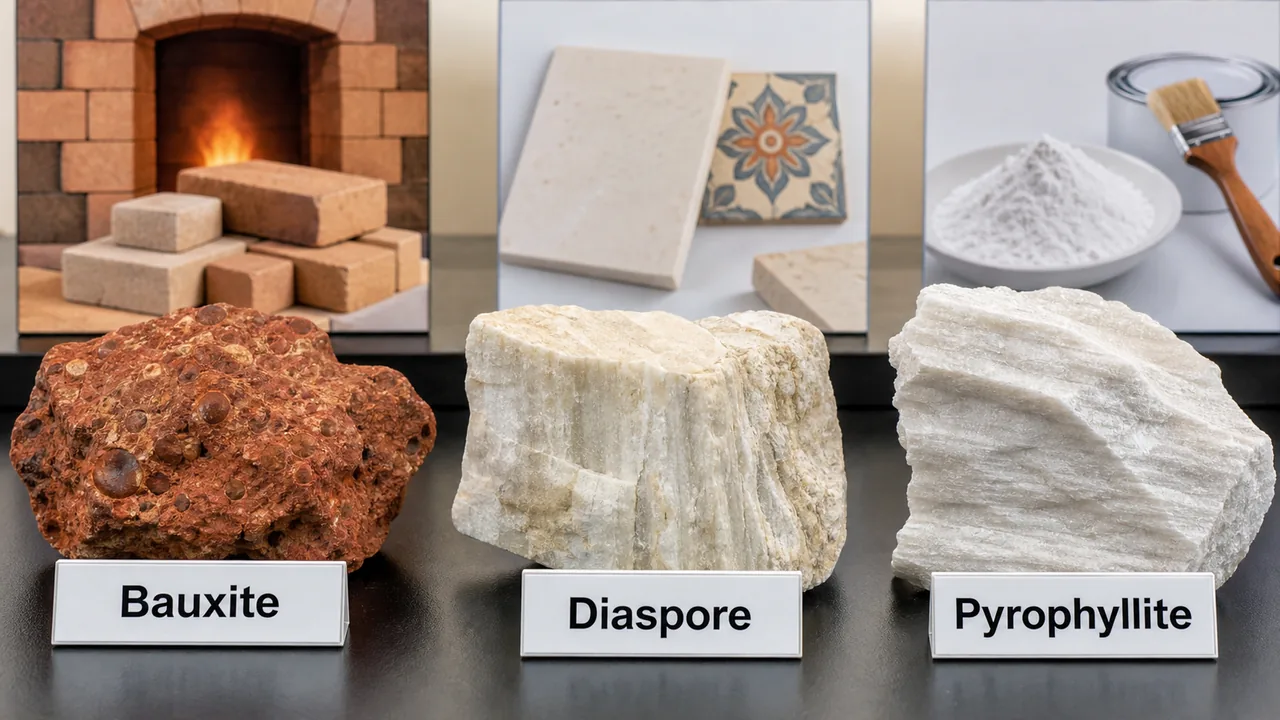
Diaspore is an aluminium hydroxide mineral (AlOOH) that serves as a source of alumina. Significant deposits have been found in Sonbhadra district.
| Parameter | Details |
|---|---|
| Chemical Formula | AlOOH (aluminium oxyhydroxide) |
| Location | Sonbhadra |
| Uses | Refractory industry, alumina extraction |
| Associated With | Bauxite and laterite formations |
Diaspore from Sonbhadra is primarily used in the refractory industry — to make heat-resistant linings for furnaces and kilns used in steel and cement production.
Pyrophyllite — Hamirpur and Lalitpur
Pyrophyllite is a soft, layered silicate mineral used in ceramics, paper, and paint industries. UP has notable deposits in the Bundelkhand region.
| Parameter | Details |
|---|---|
| Locations | Hamirpur, Lalitpur |
| Chemical Formula | Al₂Si₄O₁₀(OH)₂ |
| Uses | Ceramics, insecticide filler, paint, rubber |
| Texture | Soft, soapy feel (similar to talc) |
Exam Tip: Pyrophyllite is sometimes confused with talc in exams. Both are soft minerals, but pyrophyllite is an aluminium silicate while talc is a magnesium silicate.
Iron Ore and Other Traces
Iron ore deposits in UP are negligible. Small traces of iron-bearing minerals have been reported in the Bundelkhand Gneissic Complex, but they are not commercially viable.
| Mineral | Status in UP |
|---|---|
| Iron Ore | Traces in Bundelkhand — not economic |
| Manganese | Very small occurrences — not mined |
| Gold | Alluvial traces in some rivers — not significant |
| Mica | Minor deposits — not commercially extracted |
UP is entirely dependent on imports from other states (Odisha, Jharkhand, Karnataka) for iron and steel raw materials.
Rare Earth Potential
The Bundelkhand Gneissic Complex has shown potential for rare earth elements (REEs) in recent GSI surveys. Rare earths are critical for:
- Electronics and semiconductors
- Electric vehicle batteries and magnets
- Defence and aerospace applications
- Renewable energy (wind turbine magnets)
India's current rare earth processing is dominated by Indian Rare Earths Limited (IREL), which extracts REEs from beach sands in Kerala and Odisha. If Bundelkhand deposits prove viable, they could diversify India's rare earth sourcing.
| Element Group | Potential Location | Status |
|---|---|---|
| Light Rare Earths (La, Ce, Nd) | Bundelkhand Complex | Under exploration by GSI |
| Heavy Rare Earths | Not confirmed | Requires further survey |
Summary Cheat Sheet
| Mineral | District | Key Fact |
|---|---|---|
| Copper | Lalitpur (Sonrai) | Bundelkhand copper occurrence / exploration zone |
| Uranium | Sonbhadra | Strategic, AMD exploration, Atomic Energy Act |
| Bauxite | Banda, Sonbhadra | Limited, low-to-medium grade |
| Diaspore | Sonbhadra | AlOOH, refractory use |
| Pyrophyllite | Hamirpur, Lalitpur | Ceramics, paint, filler uses |
| Iron Ore | Bundelkhand traces | Not commercially viable |
| Rare Earths | Bundelkhand | Under GSI exploration |
Lesson Doubts
Ask questions, get expert answers