⚒️ Mining Policy & Environmental Balance
UP Mining Policy 2026, illegal sand mining crisis, environmental clearance, Supreme Court interventions, sustainable mining framework, and rehabilitation for Uttar Pradesh GK.
UP Mining Policy 2017
The Uttar Pradesh Mining Policy 2017 was introduced to bring transparency, efficiency, and sustainability to the state's mineral extraction sector. It replaced older ad-hoc licensing systems with a more structured framework.
For exam preparation, this lesson is easiest to remember through three themes:
- transparent allocation of leases
- control of illegal mining
- balancing extraction with environmental protection
Key Objectives
| Objective | Description |
|---|---|
| Transparency | E-auction and online licensing for mineral concessions |
| Revenue Maximization | Competitive bidding to eliminate under-pricing |
| Sustainable Mining | Mandatory environmental management plans |
| Employment | Promote local hiring in mining operations |
| Illegal Mining Control | Stricter surveillance and penalties |
Major Provisions
- E-auction system — all mining leases granted through online competitive bidding, reducing corruption and middlemen
- District Mineral Foundation (DMF) — mandatory contribution by miners for welfare of mining-affected communities
- Single-window clearance — simplified approval process for minor minerals
- GPS tracking — mandatory for vehicles transporting mined material
- Environmental compliance — mining plan approval required before operations begin
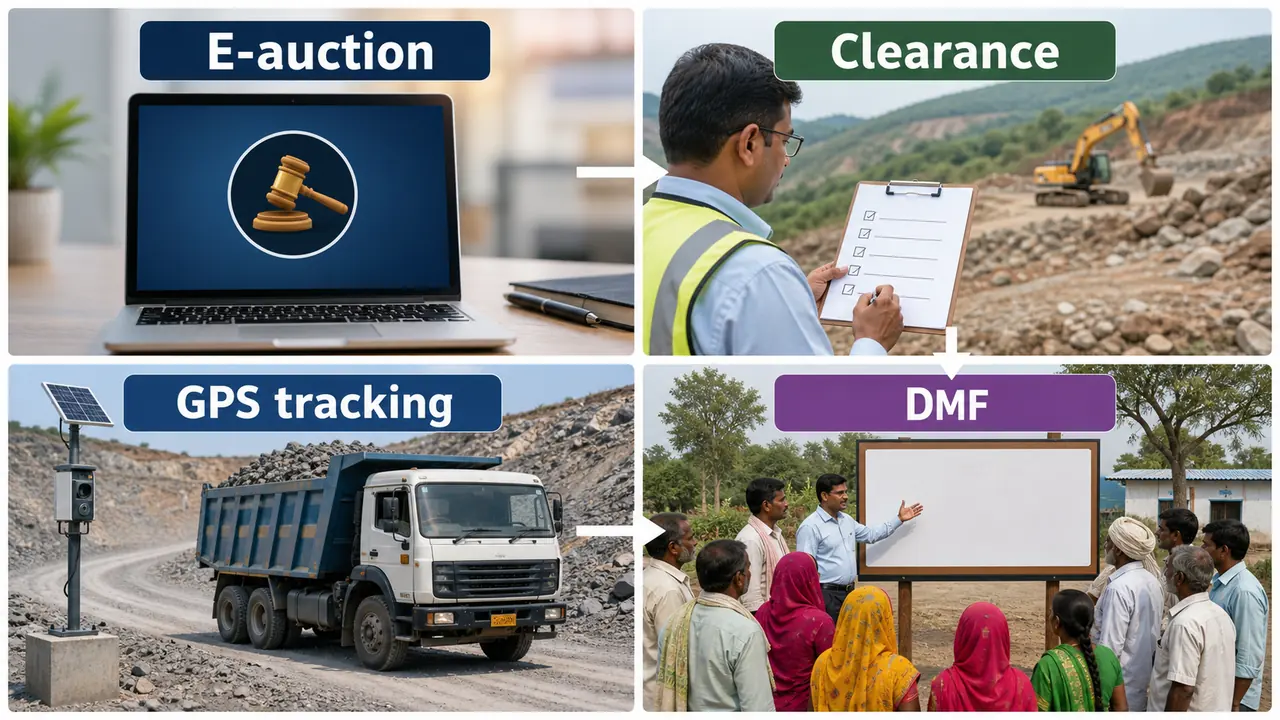
Exam Tip: The District Mineral Foundation (DMF) was mandated by the central MMDR Amendment Act 2015. Miners contribute 10–30% of royalty to DMF for community welfare.
The Illegal Sand Mining Crisis
Sand mining is arguably the most contentious mining issue in Uttar Pradesh. Rivers like the Ganga, Yamuna, Betwa, Ken, and Son have faced illegal or excessive extraction that damages riverbeds, ecosystems, and groundwater systems.
Scale of the Problem
| Aspect | Details |
|---|---|
| Affected Rivers | Ganga, Yamuna, Betwa, Ken, Son, Gomti |
| Revenue Loss | Large but difficult to measure precisely |
| Key Hotspots | Saharanpur, Shamli, Hamirpur, Jalaun, Fatehpur |
| Criminal Networks | Organized mining mafias with political patronage |
| Violence | Multiple incidents of attacks on officials and journalists |
Why Sand Mining Is So Harmful
- Riverbed deepening — lowers water table, dries up wells in adjacent areas
- Bank erosion — destabilizes riverbanks, causes land loss for farmers
- Aquatic habitat loss — destroys spawning grounds for fish, turtles, gharials
- Bridge and infrastructure damage — undermines foundations
- Biodiversity loss — disturbs nesting sites of birds and river dolphins
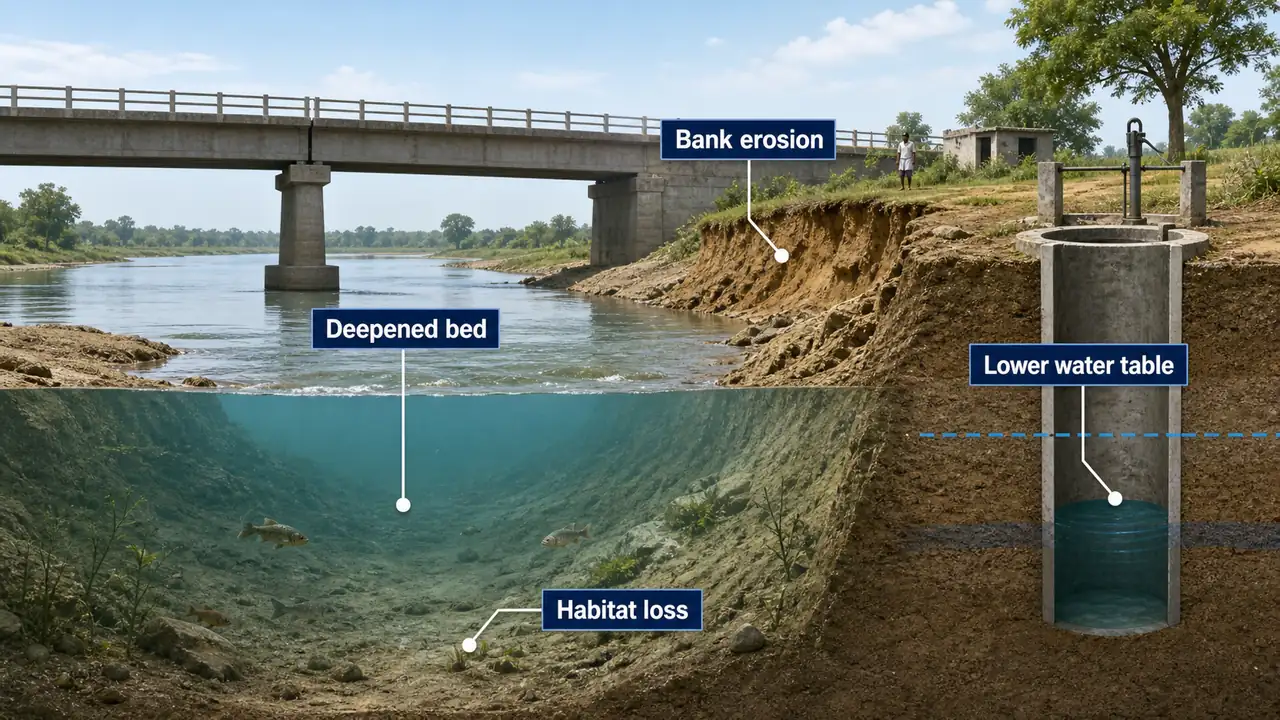
Exam Tip: The NGT (National Green Tribunal) has issued multiple orders against illegal sand mining in UP. Sand mining near bridges requires specific environmental clearance.
Environmental Clearance Process
Mining operations in India require environmental clearance under the Environmental Impact Assessment (EIA) Notification, 2006 and later amendments/orders. The exact procedure can vary by project size, mineral type, and current regulatory notifications, so students should remember the framework more than memorizing every threshold.
Clearance Categories
| Category | General Meaning | Typical Authority |
|---|---|---|
| Category A | Larger or more significant mining projects | MoEFCC / central appraisal framework |
| Category B1 | State-level appraised projects requiring fuller scrutiny | SEIAA / SEAC |
| Category B2 | Smaller projects under simplified appraisal conditions | State-level environmental framework |
| Minor Minerals | Often handled through state-specific administrative and environmental procedures | State / district implementation framework |
Steps in EIA Process
- Screening — determine if EIA is required
- Scoping — define terms of reference for the study
- EIA Study — assess environmental impact (air, water, land, biodiversity)
- Public Hearing — mandatory community consultation
- Appraisal — expert committee reviews the EIA report
- Decision — grant or reject environmental clearance
- Monitoring — post-clearance compliance checks
Mining Revenue Contribution
Despite its modest mineral base, UP still generates notable mining revenue — primarily from minor minerals such as sand, stone, and gravel rather than major minerals.
| Revenue Source | Approximate Share |
|---|---|
| Sand and Bajri (gravel) | Largest share |
| Limestone | Important industrial share |
| Coal Royalty | Important but more localized |
| Sandstone and Building Stone | Significant in the Vindhyan belt |
| Other Minerals | Smaller share |
The key exam idea is that minor minerals drive much of the state's mining revenue, while illegal mining reduces both state income and environmental protection.
Major Challenges
1. Illegal Mining Mafias
Organized criminal networks control sand mining in several districts. They operate with impunity, often threatening or attacking enforcement officials. The state government has launched multiple crackdowns, but the problem persists due to high demand and lucrative profits.
2. Riverbed Degradation
Unregulated mining alters river morphology. In many stretches, excessive extraction deepens channels, destabilizes banks, and disrupts floodplain behaviour. The Yamuna in western UP and the Ken-Betwa region in Bundelkhand are often cited in this context.
3. Deforestation
Mining in the Vindhyan and Bundelkhand regions requires forest land diversion. Despite the Forest Conservation Act 1980 mandating central approval for forest diversion, encroachment continues in some areas.
4. Community Displacement
Large-scale mining projects (such as the Singrauli coalfield expansion) have displaced thousands of families. Rehabilitation under the Right to Fair Compensation and Transparency in Land Acquisition Act, 2013 (LARR Act) has been inconsistent.
Supreme Court Interventions
The Supreme Court of India has intervened multiple times on mining-related issues in UP:
| Case/Order | Year | Key Outcome |
|---|---|---|
| Deepak Kumar v. State of Haryana | 2012 | Banned mining in riverbeds without environmental clearance |
| M.C. Mehta Cases | Various | Orders against Ganga pollution from mining |
| Common Cause v. Union of India | 2017 | Directed states to auction mining leases transparently |
| NGT Orders | Ongoing | Multiple orders restricting sand mining in UP |
Exam Tip: The NGT (National Green Tribunal, established 2010) has quasi-judicial powers on environmental matters and has been very active in checking illegal mining.
Sustainable Mining Framework
Moving towards sustainable mining requires balancing economic extraction with environmental preservation:
| Component | Action Required |
|---|---|
| Technology | Drone surveillance for illegal mining detection |
| Regulation | Real-time GPS tracking of mining vehicles |
| Revenue | 100% e-auction of mining leases |
| Rehabilitation | Mandatory mine closure plans with land restoration |
| Community | DMF funds for schools, hospitals, roads in mining areas |
| Alternative Materials | Promote manufactured sand (M-sand) to reduce river sand demand |
M-sand (manufactured sand) — produced by crushing rocks — is being promoted as an alternative to river sand. UP has encouraged M-sand plants, but adoption remains low due to cost and quality perception issues.
Rehabilitation of Mined Areas
Post-mining rehabilitation is mandated but poorly implemented. The Mining Plan requires:
- Backfilling of open-cast mines
- Plantation on overburden dumps
- Water body creation in abandoned pits
- Topsoil conservation for future reclamation
The Singrauli region has some rehabilitation projects where abandoned coal mines have been converted into water reservoirs and green belts, but such examples are still limited when compared with the scale of mining disturbance.
Summary Cheat Sheet
| Item | Quick Fact |
|---|---|
| Mining Policy | UP Mining Policy 2017 |
| Key Feature | E-auction + GPS tracking of vehicles |
| DMF | District Mineral Foundation — community welfare fund |
| Biggest Problem | Illegal sand mining on Ganga/Yamuna |
| Revenue Pattern | Minor minerals form the largest share |
| EIA Authority | Large projects central; many others state-level |
| Green Tribunal | NGT — active on mining restrictions |
| Alternative | M-sand (manufactured sand) promotion |
Lesson Doubts
Ask questions, get expert answers