🌧️ Kharif Crops — Rice, Maize & Millets
Kharif season crops of Uttar Pradesh including rice, maize, bajra, arhar, and sugarcane with varieties, districts, and production data for Uttar Pradesh GK.
Introduction
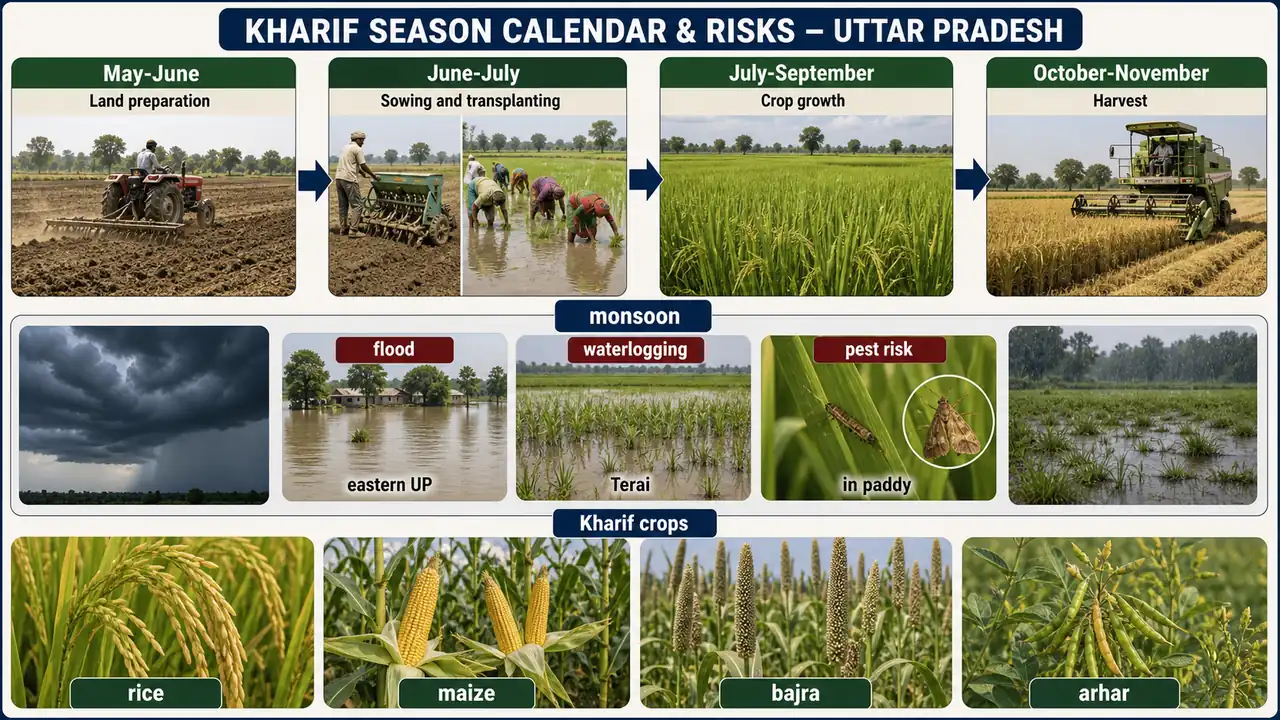
Kharif crops are sown at the onset of the southwest monsoon (June-July) and harvested mainly in October-November. In Uttar Pradesh, kharif season is dominated by rice (dhan), but maize, bajra, arhar, and several pulses, oilseeds, and vegetables are also important. The monsoon's performance directly shapes kharif output, which is why this season is generally more risk-prone than rabi.
Kharif Season Calendar in UP
| Stage | Timing |
|---|---|
| Land preparation | May-June |
| Sowing / Transplanting | June-July |
| Growing period | July-September |
| Harvesting | October-November |
| Monsoon influence | Southwest monsoon (June-September) |
Rice (Dhan) — The Principal Kharif Crop
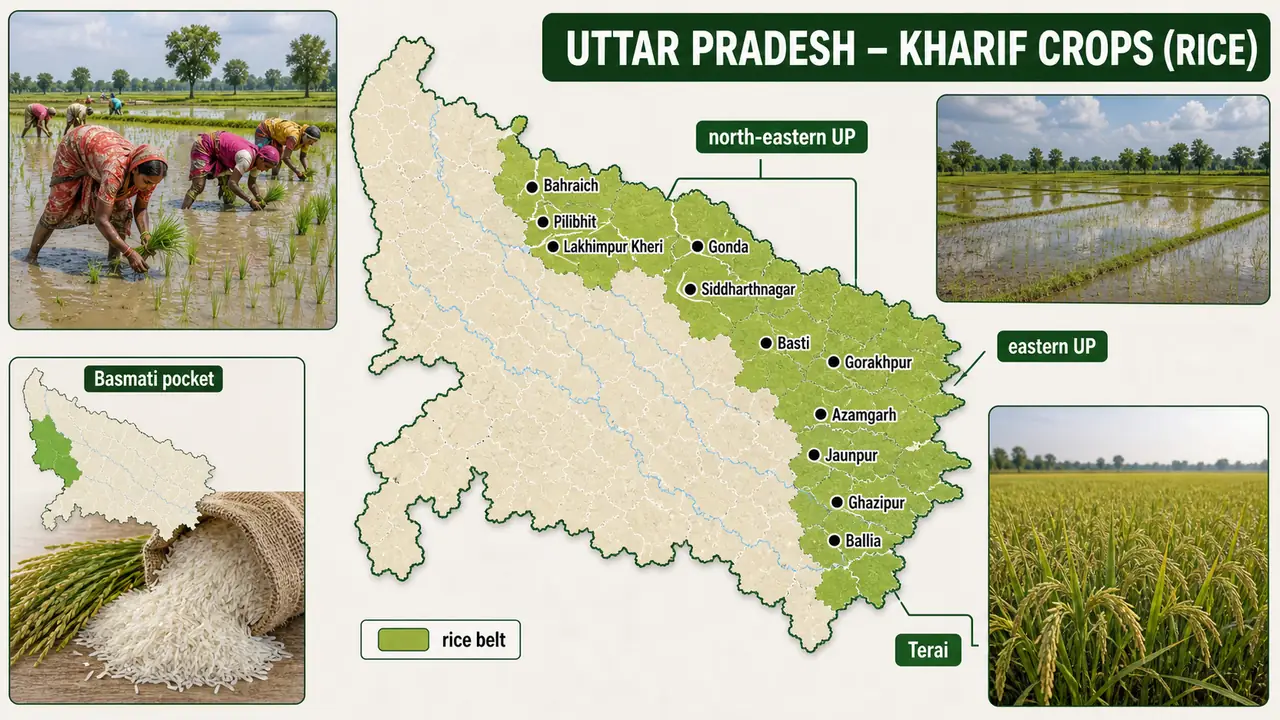
Rice is the principal kharif crop of UP. It occupies the largest kharif area and is especially important in eastern, north-eastern, and Terai districts.
| Parameter | Details |
|---|---|
| State importance | Principal kharif cereal of UP |
| Production pattern | Very high in wetter eastern and Terai districts |
| Area | Largest kharif area among crops in UP |
| Transplanting | June-July (after monsoon onset) |
| Harvest | October-November |
Major Rice-Growing Districts
| Region | Key Districts |
|---|---|
| Eastern UP | Gorakhpur, Basti, Azamgarh, Jaunpur, Ghazipur, Ballia |
| North-Eastern | Bahraich, Gonda, Siddharthnagar |
| Terai | Pilibhit, Lakhimpur Kheri |
| Central | Sitapur, Hardoi |
The basic pattern to remember is that wetter eastern and north-eastern UP is strongly rice-oriented, while the drier western belt gives relatively less importance to paddy except in irrigated or premium-rice pockets.
Important Rice Varieties in UP
| Variety | Characteristics |
|---|---|
| Sarjoo-52 | Very widely remembered UP rice variety |
| IR-36 | Early maturing, disease-resistant |
| Type-3 | Fine grain, Basmati-type aroma |
| Pusa Basmati-1 | Premium aromatic rice, western UP |
| NDR-359 | Developed by NDUA&T, flood-tolerant |
| Swarna | High yielding, late maturing, eastern UP |
Basmati rice is grown in western UP (Saharanpur, Bijnor, Muzaffarnagar) as a premium export crop.
Maize (Makka)
Maize is another important kharif cereal, though far less dominant than rice.
| Parameter | Details |
|---|---|
| Area | Important but much smaller than rice area |
| Production | Moderate compared with rice and wheat |
| Key districts | Azamgarh, Ghazipur, Ballia, Bahraich, Sultanpur |
| Uses | Animal feed, corn flour, poultry feed, starch industry |
| Baby corn | Growing commercial production in western UP |
Maize is increasingly used for poultry feed manufacturing, and UP's expanding poultry industry is driving demand upward.
Bajra (Pearl Millet)
Bajra is the primary millet crop in UP, grown in semi-arid regions of western and south-western UP.
| Parameter | Details |
|---|---|
| Key districts | Agra, Aligarh, Mathura, Bulandshahr |
| Rainfall requirement | 300-600 mm (drought-tolerant) |
| Nutritional value | High in iron, zinc, protein |
| National push | 2023 — International Year of Millets |
Bajra matters because it is a climate-resilient crop for drier belts. It performs better than paddy in low-rainfall conditions and fits the south-western agro-climatic pattern.
Arhar / Tur Dal (Pigeon Pea)
| Parameter | Details |
|---|---|
| Type | Kharif pulse (180-270 day duration) |
| Key districts | Eastern UP (Sultanpur, Pratapgarh) and Bundelkhand (Hamirpur, Banda) |
| State role | Important kharif pulse in mixed and intercropping systems |
| Sowing | June-July |
| Harvest | January-February (long-duration crop) |
Arhar is often grown as an intercrop with maize or sorghum, maximizing land use efficiency.
Sugarcane — The 12-18 Month Kharif Crop
Though sugarcane does not fit neatly into a short seasonal crop cycle, students often revise it alongside kharif because of its monsoon dependence and field overlap with the broader crop calendar. It is a long-duration crop (12-18 months) that spans multiple seasons.
| Parameter | Details |
|---|---|
| Planting season | Spring (Feb-Mar) or Autumn (Oct) |
| Duration | 12-18 months |
| Harvest | October-March (crushing season) |
| UP importance | UP is India's leading sugarcane state |
Covered in detail in Lesson 80 (Sugarcane & Sugar Industry).
Other Kharif Crops
| Crop | Key Districts | Notes |
|---|---|---|
| Soybean | Bundelkhand (Jhansi, Lalitpur) | Expanding oilseed crop |
| Urad (Black Gram) | Eastern UP, Bundelkhand | Short-duration pulse |
| Moong (Green Gram) | Central and eastern UP | Zaid + Kharif |
| Til (Sesame) | Bundelkhand, Hamirpur | Traditional oilseed |
| Okra (Bhindi) | All districts | Major kharif vegetable |
| Cucurbits | Alluvial plains, river beds | Watermelon, bottle gourd, cucumber |
Challenges of Kharif Season in UP
| Challenge | Impact |
|---|---|
| Erratic monsoon | Delayed or deficit rainfall causes crop failure |
| Flooding | Eastern UP rivers (Ghaghra, Rapti, Gandak) inundate paddy fields |
| Pest attacks | Brown plant hopper, stem borer in rice |
| Waterlogging | Terai and north-eastern plains |
| Stubble issue | Post-harvest rice stubble burning causes pollution |
Summary Cheat Sheet
| Crop | UP Rank | Key Districts | Variety |
|---|---|---|---|
| Rice | Principal kharif crop | Gorakhpur, Basti, Azamgarh | Sarjoo-52, Type-3 |
| Maize | — | Azamgarh, Ghazipur, Ballia | — |
| Bajra | — | Agra, Aligarh, Mathura | Drought-tolerant millet |
| Arhar | Important kharif pulse | Sultanpur, Pratapgarh, Banda | Long-duration pulse |
| Sugarcane | Leading state crop | Lakhimpur Kheri, Muzaffarnagar | Co 0238 |
| Basmati Rice | — | Saharanpur, Bijnor | Pusa Basmati-1 |
Lesson Doubts
Ask questions, get expert answers