❄️ Rabi Crops — Wheat, Mustard & Pulses
Rabi season crops of UP including wheat, mustard, gram, pea, potato, barley, and lentil with production data and MSP for Uttar Pradesh GK.
Introduction
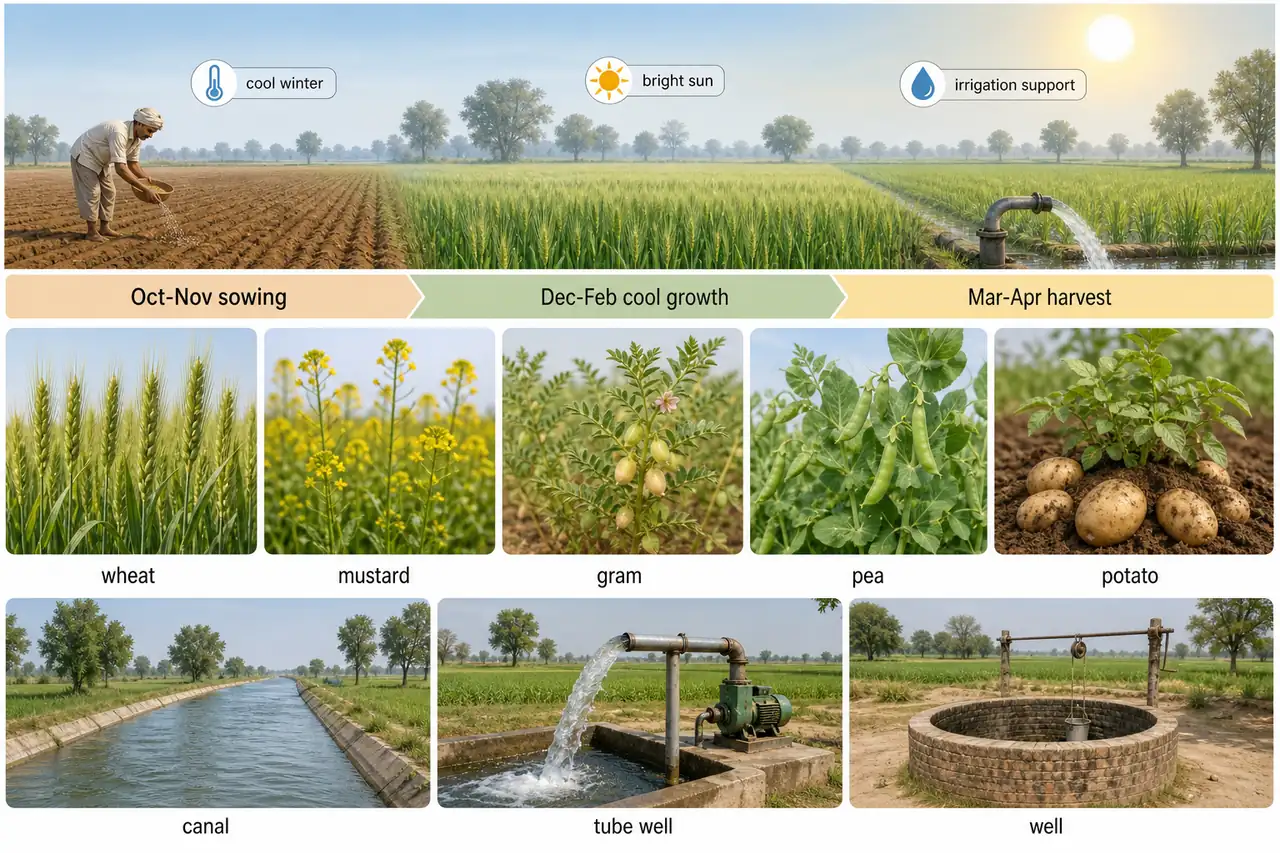
Rabi crops are sown after the withdrawal of the monsoon (October-November) and harvested mainly in March-April. This is UP's most productive agricultural season because wheat, mustard, gram, pea, potato, barley, and lentil all benefit from cool winter conditions and relatively stronger irrigation support.
Rabi Season Calendar
| Stage | Timing |
|---|---|
| Sowing | October-November |
| Growing period | December-February (cool, dry) |
| Harvesting | March-April |
| Irrigation source | Canal, tube well, wells (not rain-dependent) |
Rabi crops require cool growing conditions and bright sunshine during grain filling, which UP's winter provides perfectly.
Wheat (Gehun) — UP's Crown Crop
Wheat is the single most important crop in Uttar Pradesh and the state's biggest contribution to India's foodgrain system.
| Parameter | Details |
|---|---|
| State importance | UP is one of India's leading wheat states |
| Production pattern | Very high because of large area plus irrigation support |
| Area | One of the largest wheat areas in the country |
| Yield pattern | Highest in better-irrigated western districts |
| National role | Major contributor to the public foodgrain system |
Major Wheat-Growing Districts
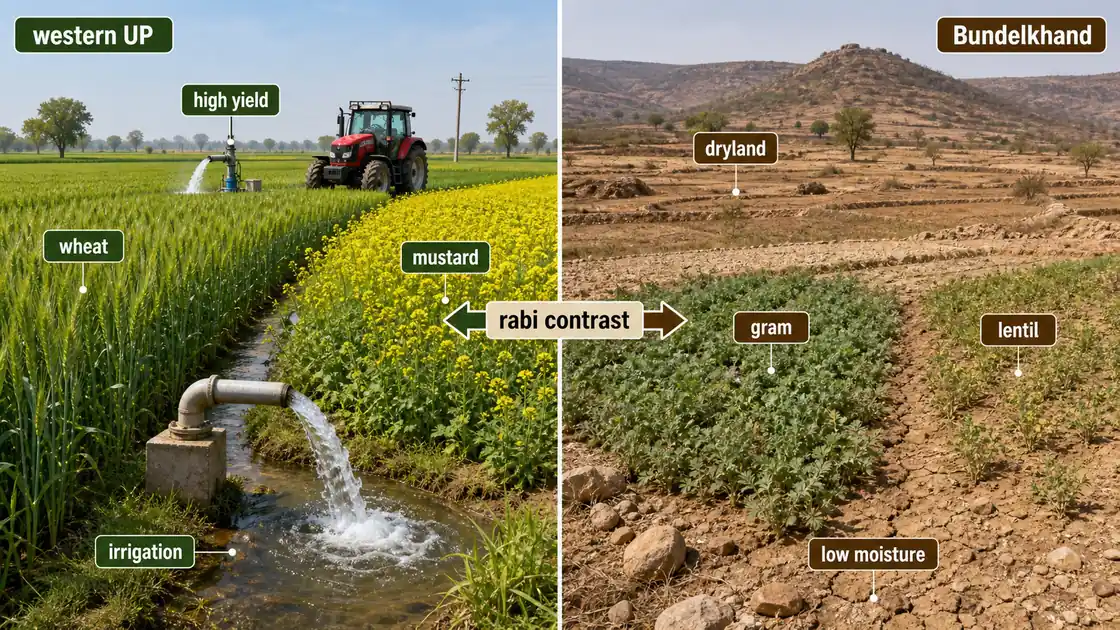
The western UP wheat belt is the most productive because of better irrigation, input use, mechanization, and market access.
| Region | Key Districts |
|---|---|
| Western UP (highest yield) | Meerut, Muzaffarnagar, Bulandshahr, Aligarh, Agra, Mathura |
| Central UP | Kanpur, Lucknow, Hardoi, Unnao |
| Eastern UP | Varanasi, Azamgarh, Jaunpur (lower yields) |
| Bundelkhand | Jhansi, Banda (rainfed, low productivity) |
Important Wheat Varieties
| Variety | Characteristics |
|---|---|
| HD-2967 | Very widely grown high-yielding variety |
| PBW-343 | Former dominant variety; replaced by HD-2967 |
| UP-2338 | Developed specifically for UP; late-sown tolerance |
| HD-3086 | High yielding, rust-resistant |
| DBW-187 | Recent release, excellent grain quality |
The key exam point is not the global superlative, but that HD-2967 is a major and widely remembered wheat variety.
Mustard (Sarson) — UP's Oilseed Powerhouse
| Parameter | Details |
|---|---|
| State role | Important rabi oilseed crop in UP |
| Key districts | Aligarh, Agra, Etah, Mainpuri, Mathura, Firozabad |
| Sowing | October-November |
| Harvest | February-March |
| Oil content | 38-42% |
The Aligarh-Agra-Etah belt is the strongest mustard region in UP. Mustard matters because it fits relatively drier rabi conditions better than crops that demand heavier irrigation.
Mustard Varieties
- Pusa Bold, Varuna (T-59), Kranti — widely cultivated
- GM mustard (DMH-11) is under regulatory review but not yet commercially released
Gram / Chana (Chickpea)
| Parameter | Details |
|---|---|
| State role | Major rabi pulse in drier areas |
| Key districts | Bundelkhand: Hamirpur, Banda, Jhansi, Lalitpur |
| Other growing areas | Kanpur Dehat, Fatehpur, Prayagraj |
| Type | Desi chana (brown, smaller) — dominant in UP |
| Uses | Dal, besan (gram flour), chana sattu |
Gram is the most important rabi pulse in UP and a lifeline crop for Bundelkhand's dryland farmers because it tolerates relatively low moisture better than wheat.
Pea (Matar)
| Parameter | Details |
|---|---|
| State role | Important pea-growing state with both green and dry pea cultivation |
| Key districts | Jhansi, Varanasi, Lucknow, Kanpur, Bareilly |
| Season | Early rabi (October sowing, January-February harvest) |
| Types | Green pea (vegetable) and dry pea (pulse) |
For exam purposes, remember pea mainly through its dual role: as a vegetable crop and as a pulse-type dry crop.
Potato (Aloo) — A Rabi Vegetable Crop
Though technically a vegetable, potato is grown at scale as a rabi field crop in UP.
| Parameter | Details |
|---|---|
| State importance | UP is India's leading potato state |
| Production pattern | Very high because of concentration in the Agra-Farrukhabad-Kannauj belt |
| Key districts | Agra, Farrukhabad, Kannauj, Firozabad, Etawah |
| Cold storage | Very extensive cold storage network supports the crop |
| Planting | October-November |
| Harvest | February-March |
The Agra-Farrukhabad-Kannauj belt is the strongest potato zone of UP. Potato is important not only because of production, but because storage, transport, and market timing are central to the crop's economics.
Other Important Rabi Crops
| Crop | Key Feature | Districts |
|---|---|---|
| Lentil (Masoor) | Major rabi pulse; Bundelkhand belt | Hamirpur, Banda, Prayagraj |
| Barley (Jau) | Historically important; now lower area | Agra, Aligarh, Mathura |
| Linseed (Alsi) | Oilseed; small but significant | Bundelkhand, eastern UP |
| Coriander | Spice crop; expanding area | Bundelkhand, south-western UP |
| Sunflower | Minor oilseed, irrigated areas | Scattered cultivation |
MSP and Procurement
The Minimum Support Price (MSP) system is especially important for wheat and some pulses/oilseeds, but the lesson value here is mainly conceptual: rabi farming in UP is closely tied to procurement, storage, and market support.
| Crop | MSP 2024-25 (₹/quintal) | Procurement Agency |
|---|---|---|
| Wheat | ₹2,275 | FCI, UP State Warehousing |
| Mustard | ₹5,650 | NAFED |
| Gram | ₹5,440 | NAFED |
| Lentil | ₹6,425 | NAFED |
| Barley | ₹1,850 | — |
UP plays an important role in wheat procurement for the national food buffer.
Summary Cheat Sheet
| Crop | UP Rank | Key Districts | Key Variety/Fact |
|---|---|---|---|
| Wheat | Leading rabi crop | Meerut, Muzaffarnagar, Bulandshahr | HD-2967 |
| Mustard | Important oilseed | Aligarh, Agra, Etah | Pusa Bold, Varuna |
| Potato | Leading potato state crop | Agra, Farrukhabad, Kannauj | Extensive cold storage network |
| Gram | Major rabi pulse | Hamirpur, Banda, Jhansi | Bundelkhand lifeline crop |
| Pea | Important vegetable + pulse crop | Jhansi, Varanasi, Lucknow | Green + dry pea role |
| Lentil | Major pulse in dry belts | Hamirpur, Banda, Prayagraj | Bundelkhand pulse belt |
| Wheat MSP 2024-25 | — | — | ₹2,275/quintal |
Lesson Doubts
Ask questions, get expert answers