Agriculture Marketing
Agricultural market types, MSP and procurement, APMC markets, cold chain infrastructure, regulated markets, e-NAM, futures trading, agri export-import policy — high-weightage for exams.
Frequently Asked Questions
How many crops have MSP and how is it determined?
The Government of India announces MSP (Minimum Support Price) for 22 mandated crops: 14 kharif crops (paddy, jowar, bajra, maize, ragi, arhar, moong, urad, groundnut, sunflower, soybean, sesamum, nigerseed, cotton), 6 rabi crops (wheat, barley, gram, lentil, rapeseed/mustard, safflower), and 2 commercial crops (raw jute and copra). Sugarcane has a separate FRP (Fair and Remunerative Price). MSP is recommended by CACP (Commission for Agricultural Costs and Prices) based on A2+FL cost (paid-out cost + family labour).
What are the WTO Agreement on Agriculture (AoA) boxes?
WTO AoA classifies agricultural subsidies into three boxes: (1) Green Box — no trade distortion, unlimited (e.g., research, extension, food security stockholding, direct income support decoupled from production); (2) Blue Box — production-limiting programs, conditionally permitted; (3) Amber Box — trade-distorting support, subject to reduction commitments (India's AMS limit = 10% of value of production for developing countries — the 'de minimis' clause). India's food procurement at MSP is classified under Amber Box by some WTO members.
What is e-NAM and how many states have joined?
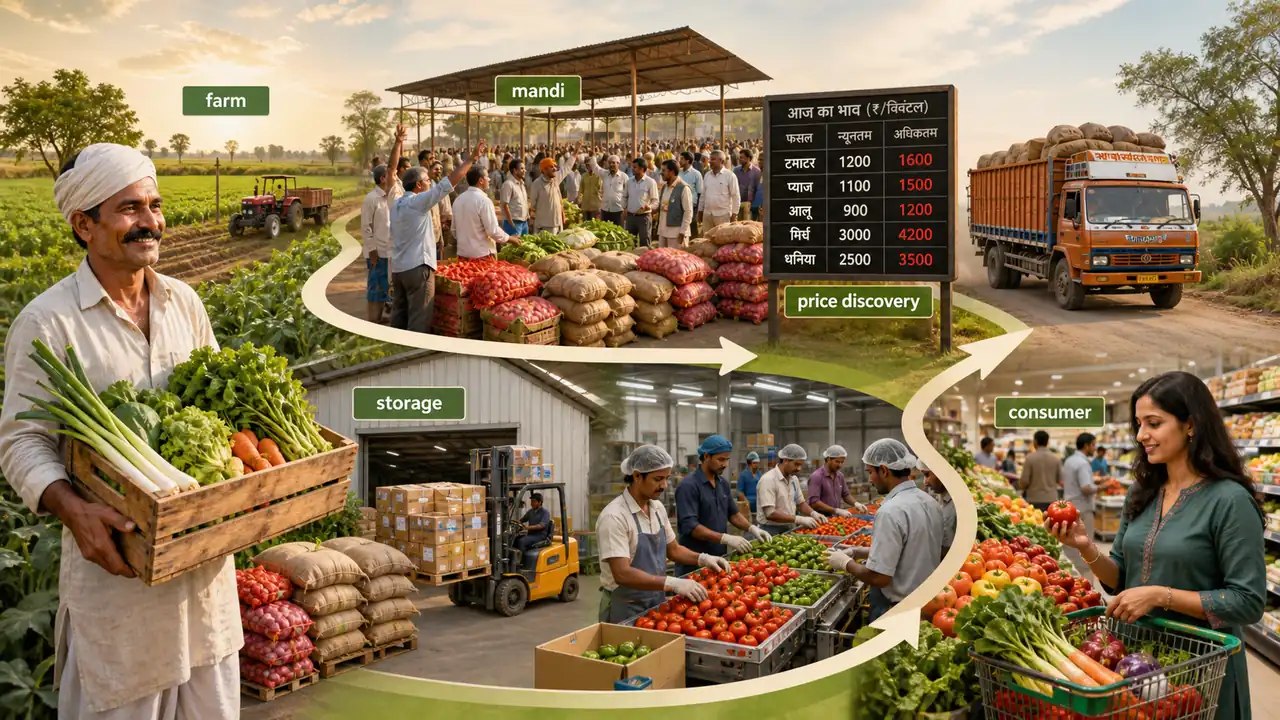
e-NAM (Electronic National Agriculture Market) is a pan-India online trading platform launched in April 2016 under the Small Farmers Agribusiness Consortium (SFAC). It connects APMC mandis across states, enabling farmers to get price discovery through online bidding. As of 2024, e-NAM covers ~1,361 mandis across 23 states and 3 UTs. Farmers can upload produce quality data and receive payment directly in their bank accounts.
What is the marketing margin formula?
Marketing Margin = Retail price − Farm price. Price Spread = Consumer price − Producer price (includes all costs and margins in the marketing channel). Marketing Efficiency = (Producer's share in consumer's rupee) × 100. Shepherd's formula: Marketing Efficiency = (Net Marketing Income) / (Marketing Costs) × 100. Higher producer's share and lower price spread indicate a more efficient marketing system.
What is market integration and how is it measured?
Market integration measures whether price changes in one market (usually a wholesale market) are transmitted to another (retail or distant markets). High integration means efficient information flow and arbitrage — price differences between markets equal only transfer costs. It is measured using correlation analysis of price series across markets. Vertical integration measures farm-to-retail price linkage; spatial (horizontal) integration measures price linkage across geographically separate markets.
Which exams test Agricultural Marketing most heavily?
Agricultural Marketing is one of the top-3 topics in IBPS AFO Professional Knowledge (Section B), with 8–12 questions per exam. It is also heavily tested in NABARD Grade A (Agriculture + Economics), ICAR JRF/SRF, and state PSC Agriculture Officer exams. MSP crop count, WTO box classification, e-NAM statistics, APMC reforms, and marketing efficiency formula are the most tested items.