Beneficial Insects
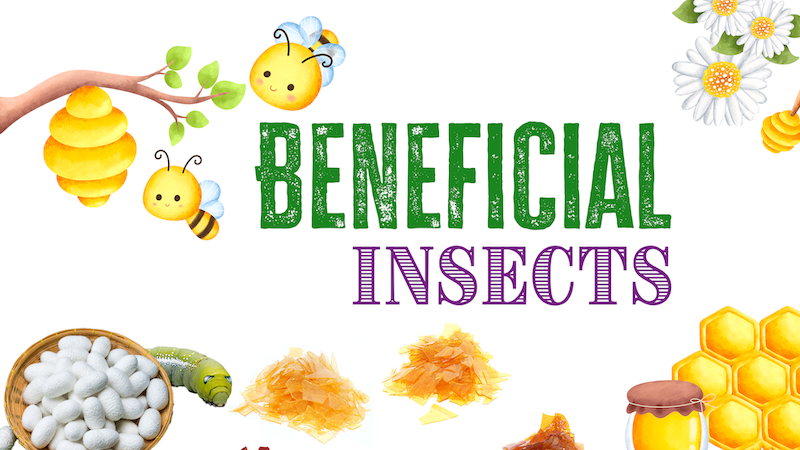
Economic insects — honey bees (Apis species), silkworm sericulture, lac insects, pollinators and natural enemies. Biology, rearing practices, products and economic importance for exams.
Frequently Asked Questions
What are the four Apis species found in India?
India has four Apis species: Apis dorsata (rock bee / giant honey bee) — largest, cannot be domesticated, makes single large combs on cliffs and trees; Apis florea (little bee / dwarf bee) — smallest, makes small single combs in open; Apis cerana indica (Indian hive bee) — domesticated in traditional hives, produces 6–8 kg honey/colony/year; Apis mellifera (European/Italian bee) — most widely domesticated, produces 25–40 kg honey/colony/year, used in commercial apiculture.
What is the difference between mulberry and non-mulberry silk?
Mulberry silk is produced by Bombyx mori (domesticated silkworm) fed exclusively on mulberry leaves (Morus alba). It accounts for ~90% of global silk production and is the finest, most lustrous silk. Non-mulberry (vanya) silks include Tasar (Antheraea mylitta — oak/arjun leaves), Eri (Samia cynthia ricini — castor leaves), and Muga (Antheraea assama — som/sualu leaves, golden-coloured, unique to Assam). Muga silk has GI tag from Assam.
What is the lac insect and how is shellac produced?
The lac insect is Kerria lacca (formerly Laccifer lacca), a scale insect (Hemiptera: Kerriidae) that feeds on host trees (kusum, ber, palash, semur) and secretes a resinous protective covering — lac. The encrusted branches (stick lac) are harvested, crushed (seed lac), and processed into shellac by melting and straining. India produces ~50% of the world's lac. Key hosts: kusum (Schleichera oleosa) gives best quality lac.
What is the waggle dance in honey bees?
The waggle dance is a figure-eight movement performed by forager bees on the vertical surface of the comb to communicate the direction and distance of a food source to hive-mates. The angle of the straight run relative to vertical = angle of the food source relative to the sun. Duration of waggle run = distance (longer = farther). Discovered by Karl von Frisch (Nobel Prize 1973). Round dance signals food within 50 metres.
What are the main bee products and their economic uses?
Honey — food and medicine; moisture content must be <20% for storage without fermentation. Beeswax — cosmetics, polishes, candles; produced by wax glands on worker bee abdomen. Royal jelly — secreted by nurse bees, fed to queen larvae and young larvae; used in nutrition supplements. Propolis — resinous substance collected from plants, used by bees to seal the hive; antimicrobial properties. Bee venom — melittin is the main component; used in apitherapy. Bee pollen — protein-rich, used as health supplement.
Which government schemes support apiculture and sericulture in India?
Apiculture: National Bee Board (NBB) under Ministry of Agriculture implements the National Beekeeping & Honey Mission (NBHM) with subsidies on bee boxes and equipment; KVIC (Khadi and Village Industries Commission) provides training and infrastructure. Sericulture: Central Silk Board (CSB) under Ministry of Textiles runs the Silk Samagra scheme — covering mulberry plantation, silkworm seed production, reeling technology upgradation, and export promotion. Tasar silk is promoted through tribal development boards in Jharkhand and Chhattisgarh.