🏛️ Political Firsts & Records of UP
An exam-focused guide to Uttar Pradesh's legislature, major political firsts, Prime Ministers linked with UP, chief-minister records, governors, and key state-political milestones.
UP in the Indian Legislature
Uttar Pradesh dominates India's political landscape by sheer numbers. Its representation in both houses of Parliament is the highest of any state, which is why UP is often called the political heartland of India (भारत की राजनीतिक हृदयस्थली).
This lesson becomes easier if you separate three kinds of facts:
- institutional facts: Lok Sabha, Rajya Sabha, Vidhan Sabha, Vidhan Parishad
- historical firsts: first CM, first Governor, first Dalit CM
- current officeholders: these can change and must be treated carefully
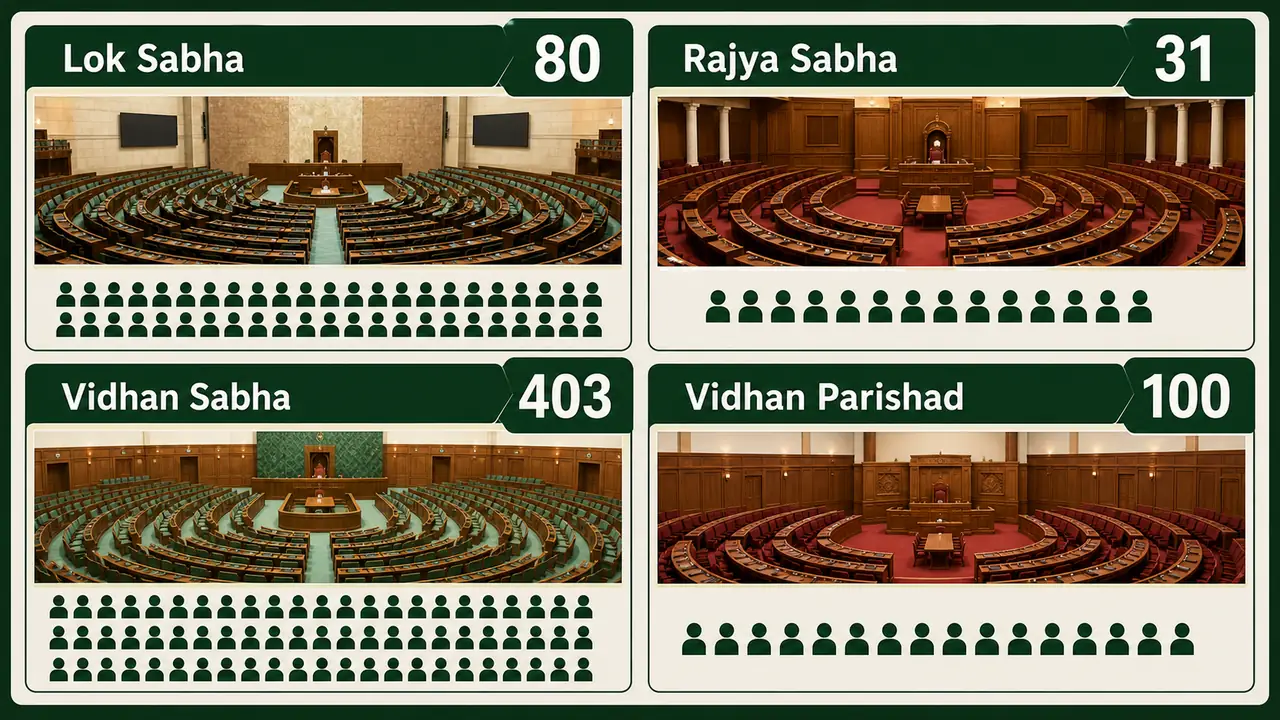
| House | UP's Seats | India Total | UP's Share |
|---|---|---|---|
| Lok Sabha | 80 | 543 | ~14.7% |
| Rajya Sabha | 31 | 245 | ~12.6% |
Exam Tip: UP sends 80 MPs to Lok Sabha — the highest for any state. Maharashtra is second with 48. This massive representation makes UP decisive in national elections.
State Legislature — Bicameral System
UP is one of the few Indian states with a bicameral legislature (द्विसदनीय विधानमण्डल), meaning it has both an upper and a lower house.
| House | Hindi Name | Total Seats |
|---|---|---|
| Vidhan Sabha (Legislative Assembly) | विधान सभा | 403 elected seats |
| Vidhan Parishad (Legislative Council) | विधान परिषद | 100 |
Vidhan Sabha Details
- 403 elected seats (highest in India for any state assembly)
- Earlier references to an Anglo-Indian nominated seat belong to the older framework; standard current exam memory should use 403 seats
- Term: 5 years
- Presiding Officer: Speaker (अध्यक्ष)
Vidhan Parishad Details
- 100 members — making it the largest Legislative Council in India
- Composition: 1/3 elected by MLAs, 1/3 by local bodies, 1/12 by teachers, 1/12 by graduates, remaining nominated by the Governor
- Term of each member: 6 years (1/3 retire every 2 years)
- Presiding Officer: Chairman (सभापति)
Exam Tip: Only 6 states currently have a Legislative Council — UP, Bihar, Maharashtra, Karnataka, Andhra Pradesh, and Telangana. UP has the largest council (100 seats).
Prime Ministers from Uttar Pradesh
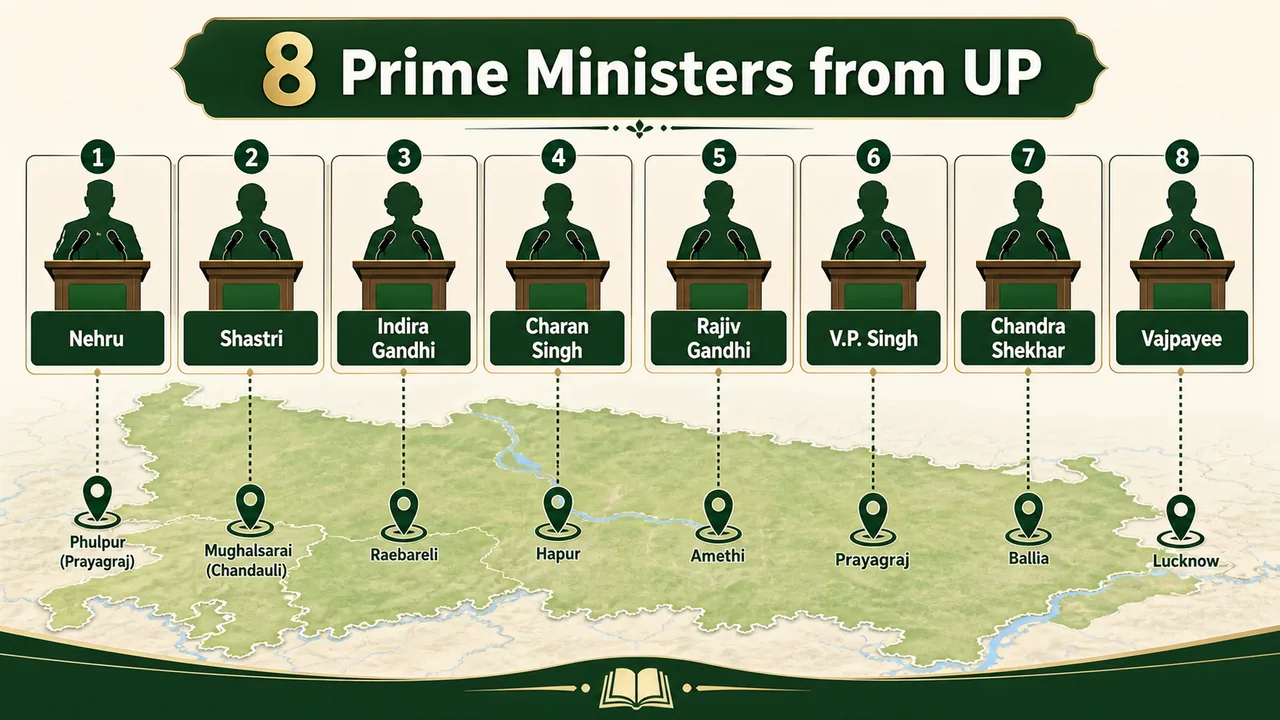
UP is associated with the highest number of Prime Ministers in standard Indian GK preparation. The connection is not always by birthplace alone. Sometimes it is by constituency, sometimes by political association, and sometimes by both.
| S.No. | Prime Minister | Tenure | Constituency / Connection |
|---|---|---|---|
| 1 | Jawaharlal Nehru | 1947–1964 | Phulpur (Prayagraj) |
| 2 | Lal Bahadur Shastri | 1964–1966 | Born in Mughalsarai (Chandauli) |
| 3 | Indira Gandhi | 1966–77, 1980–84 | Raebareli |
| 4 | Chaudhary Charan Singh | 1979–1980 | Born in Hapur (then Ghaziabad) |
| 5 | Rajiv Gandhi | 1984–1989 | Amethi |
| 6 | Vishwanath Pratap Singh | 1989–1990 | Born in Prayagraj |
| 7 | Chandra Shekhar | 1990–1991 | Ballia |
| 8 | Atal Bihari Vajpayee | 1996, 1998–2004 | Born in Gwalior, Lucknow seat |
Memory Trick for PMs from UP
"Ne Sha In Cha Ra Vi Chan At" — Nehru, Shastri, Indira, Charan Singh, Rajiv, V.P. Singh, Chandra Shekhar, Atal.
Exam Tip: Questions often ask "How many PMs from UP?" (Answer: 8) or "Which PM was from Ballia?" (Answer: Chandra Shekhar). Know the district connections.
Chief Ministers of UP — Key Firsts
| Record | Person | Detail |
|---|---|---|
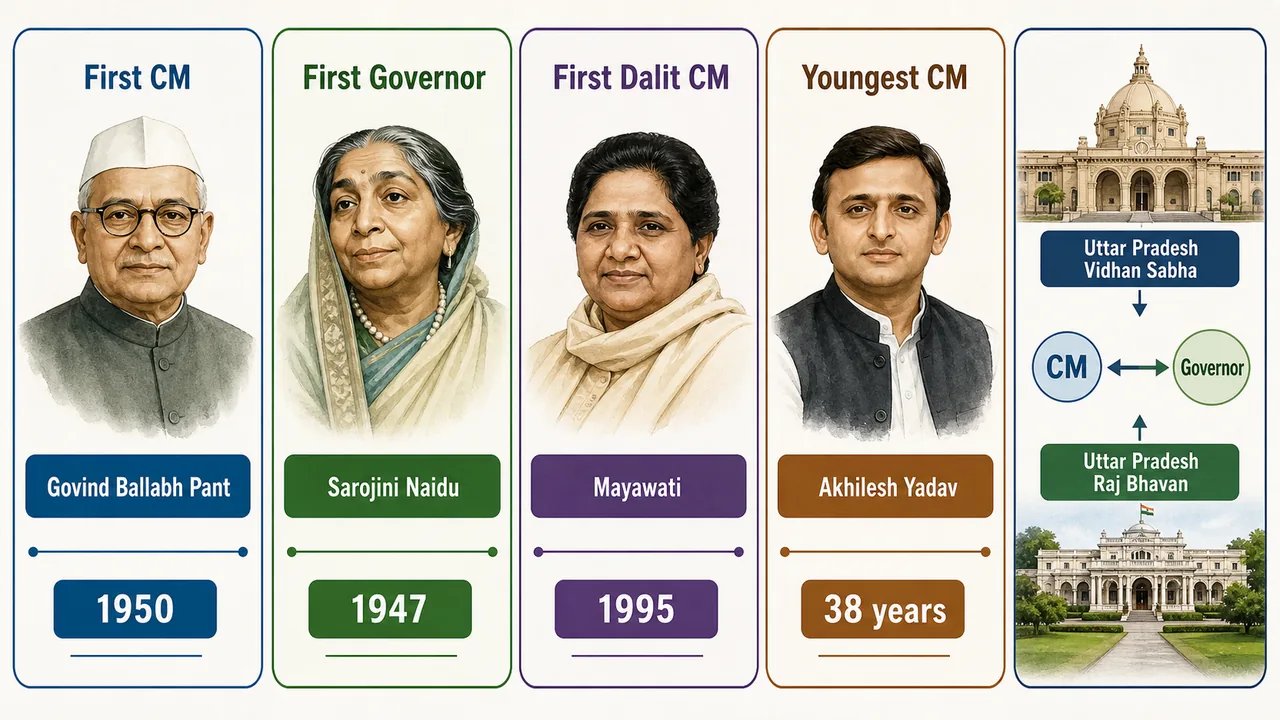
| First Chief Minister | Govind Ballabh Pant | 1950–1954; later became India's Home Minister |
| First CM of United Provinces (pre-1950) | Govind Ballabh Pant | Served from 1946 under provincial government |
| Longest-serving CM (undivided UP) | Govind Ballabh Pant | ~8 years (1946–1954) |
| First Dalit CM | Mayawati | 1995 (first of four terms) |
| First Muslim CM | None (as of date) | — |
| Youngest CM | Akhilesh Yadav | Became CM in 2012 at age 38 |
| Most terms as CM | Mayawati | 4 terms (1995, 1997, 2002, 2007) |
Notable Chief Ministers
| CM | Party | Significance |
|---|---|---|
| Govind Ballabh Pant | INC | First CM, freedom fighter, Bharat Ratna (1957) |
| Sampurnanand | INC | Scholar, educationist |
| Chandra Bhanu Gupta | INC | Served 3 times |
| Hemvati Nandan Bahuguna | INC | Father of Vijay Bahuguna (Uttarakhand CM) |
| Mulayam Singh Yadav | SP | Founded Samajwadi Party, served 3 terms |
| Mayawati | BSP | First Dalit woman CM in India |
| Akhilesh Yadav | SP | Youngest CM of UP at age 38 (2012) |
| Yogi Adityanath | BJP | Chief Minister from 2017; head of Gorakhnath Math |
Current Leadership
As of 3 June 2026, the following current leadership details remain in place:
| Position | Incumbent |
|---|---|
| Current Chief Minister | Shri Yogi Adityanath (BJP, from 2017) |
| Current Governor | Smt. Anandiben Patel |
| Cabinet Minister of Agriculture | Shri Surya Pratap Shahi |
| State Minister of Agriculture | Shri Baldev Singh Olakh |
Exam Tip (AGTA-specific): For UPSSSC AGTA, knowing the Agriculture Ministers is crucial. Surya Pratap Shahi (Cabinet rank) and Baldev Singh Olakh (State rank) handle agriculture policy in UP.
Governors — Key Firsts
| Record | Person |
|---|---|
| First Governor of UP | Sarojini Naidu (also first woman Governor in India) |
| Longest-serving Governor | B. Gopala Reddi (~7 years) |
| Current Governor | Smt. Anandiben Patel |
Exam Tip: Sarojini Naidu was both the first Governor of UP and the first woman Governor in all of India. She was appointed in 1947 and served until her death in 1949. She was known as the "Nightingale of India" (भारत कोकिला).
Key Political Milestones
| Year | Event |
|---|---|
| 1946 | Govind Ballabh Pant becomes Premier of United Provinces |
| 24 January 1950 | United Provinces renamed to Uttar Pradesh |
| 1952 | First general elections held in UP |
| 1967 | First non-Congress government (Chaudhary Charan Singh) |
| 1993 | SP-BSP coalition government |
| 1995 | Mayawati becomes first Dalit woman CM |
| 2000 | Uttarakhand carved out (13 hill districts separated) |
| 2017 | BJP wins with largest majority in decades (312/403 seats) |
| 2029–30 (Target) | UP's $1 Trillion Economy target — the state aims to become a trillion-dollar economy by 2029-30 |
Uttarakhand's Separation
On 9 November 2000, the Uttar Pradesh Reorganisation Act, 2000 led to the creation of Uttarakhand (initially named Uttaranchal, renamed in 2007). A total of 13 districts from northwestern UP — including Dehradun, Nainital, Almora, Haridwar, and others — formed the new state.
After the bifurcation:
- UP retained its capital at Lucknow
- The number of districts dropped temporarily but has since grown to 75
- Uttarakhand's capital was initially at Dehradun (interim), later Gairsain was declared the summer capital
Summary Cheat Sheet
| Item | Quick Fact |
|---|---|
| Lok Sabha Seats | 80 (highest in India) |
| Rajya Sabha Seats | 31 |
| Vidhan Sabha Seats | 403 (highest in India) |
| Vidhan Parishad Seats | 100 (largest council in India) |
| PMs from UP | 8 (Nehru to Vajpayee) |
| First CM | Govind Ballabh Pant (1950) |
| First Governor | Sarojini Naidu (1947) |
| First Woman Governor of India | Sarojini Naidu (UP) |
| First Dalit CM | Mayawati (1995) |
| Most Terms as CM | Mayawati (4 terms) |
| Youngest CM | Akhilesh Yadav (age 38, 2012) |
| Uttarakhand Carved Out | 9 Nov 2000 (13 districts) |
| UP Renamed | 24 Jan 1950 (from United Provinces) |
| Current Governor | As of 3 June 2026: Smt. Anandiben Patel |
| Current CM | As of 3 June 2026: Shri Yogi Adityanath (BJP, 2017–) |
| Agriculture Minister (Cabinet) | As of 3 June 2026: Shri Surya Pratap Shahi |
| Agriculture Minister (State) | As of 3 June 2026: Shri Baldev Singh Olakh |
| $1 Trillion Economy Target | 2029-30 |
| Bicameral States | UP, Bihar, Maharashtra, Karnataka, AP, Telangana |
Lesson Doubts
Ask questions, get expert answers