💧 Greenhouse Irrigation
Learn the main irrigation systems used in greenhouses and understand how watering rules affect crop quality under protected cultivation.
In greenhouse cultivation, irrigation mistakes quickly become crop-quality problems. The protected structure reduces rainfall uncertainty, but it also means the grower becomes fully responsible for deciding when, how, and how much water the crop receives.
Why Irrigation Must Be More Precise in a Greenhouse
A greenhouse irrigation system should supply only the amount of water actually needed by the crop. Water need depends on:
- crop type
- growing medium or soil mix
- weather and season
- container size or bed type
- ventilation and heating conditions
Under-watering causes stress and poor growth, while over-watering reduces aeration, weakens roots, and may increase disease risk.
Watering is one of the most sensitive management decisions in protected cultivation because both excess and deficiency damage crop quality.
Basic Rules of Watering
Three practical watering rules guide greenhouse irrigation:
Use a well-drained root medium
If the rooting medium is poorly aerated or drains badly, no irrigation schedule will work well. Good greenhouse substrates must retain moisture while still allowing air around the roots.
Water thoroughly each time
Partial wetting should be avoided. Irrigation should wet the effective root zone properly, with a small excess to ensure complete wetting and prevent salt concentration.
Irrigate before serious moisture stress begins
The aim is to water before the plant reaches damaging stress, not after severe wilting appears. This requires observation of crop condition and substrate moisture.
Manual and Simple Irrigation Methods
Hand watering
Hand watering is the traditional method and is still useful for:
- nurseries
- seedbeds
- small-scale units
- selective correction of dry spots
Its disadvantages are:
- high labor requirement
- uneven application
- strong dependence on worker skill
A water breaker on the hose helps reduce force and prevents disturbance of the substrate surface.
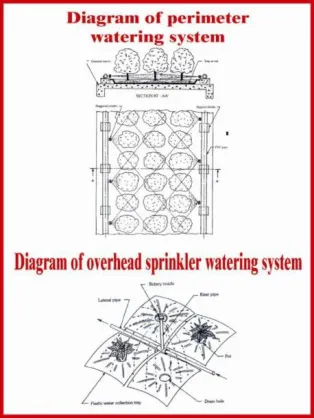
Perimeter watering
In perimeter watering, pipes and nozzles are arranged around benches so that water is applied below the foliage.
This method is suitable where wetting the foliage must be minimized and bench layouts are regular.
Overhead and Boom Watering
Overhead sprinklers
Overhead systems are useful for crops that tolerate wet foliage and for situations where wide-area watering is needed.
Their advantages are:
- simpler coverage over larger areas
- low complexity in some setups
Their limitation is that prolonged leaf wetting can favor diseases in sensitive crops.
Boom watering
Boom watering uses a moving pipe or boom fitted with nozzles that travels over the crop. It is especially useful for plug trays and seedling production.
Its major advantage is control: the amount of water applied can be adjusted by the speed of movement and nozzle arrangement.
Drip Irrigation in Greenhouses
Drip irrigation is one of the most important greenhouse irrigation systems. Water is supplied at frequent intervals through emitters placed close to the crop root zone.
Its main advantages are:
- precise water application
- reduced wastage
- compatibility with plastic mulch and protected structures
- easy fertigation integration
- better control over moisture variation
Drip irrigation is often the most suitable system for protected cultivation because it combines water efficiency with high control.
Choosing the Right Irrigation System
| System | Best suited for | Main limitation |
|---|---|---|
| Hand watering | Small units, nurseries, selective watering | Labor-intensive and less uniform |
| Perimeter watering | Bench systems | Layout dependent |
| Overhead sprinklers | Crops tolerant of wet foliage | Disease risk if foliage stays wet |
| Boom watering | Seedlings and tray systems | Higher equipment complexity |
| Drip irrigation | High-value protected cultivation | Needs proper maintenance and clog prevention |
Summary Cheat Sheet
| Topic | Key point |
|---|---|
| Greenhouse irrigation goal | Supply precise water according to crop need |
| Watering rule 1 | Use a well-drained, well-aerated root medium |
| Watering rule 2 | Wet the root zone thoroughly |
| Watering rule 3 | Irrigate before serious moisture stress develops |
| Hand watering | Flexible but labor-intensive |
| Overhead watering | Useful for some crops, but may wet foliage excessively |
| Boom watering | Good for tray and nursery systems |
| Drip irrigation | Most precise and widely preferred for protected cultivation |
Lesson Doubts
Ask questions, get expert answers