Protected Cultivation and Secondary Agriculture
Lecture notes covering Protected Cultivation and Secondary Agriculture as per ICAR 5th Dean Committee syllabus. Course Code: AENG 252 | Credits: 2(1+1).
Frequently Asked Questions
What is Protected Cultivation and Secondary Agriculture in BSc Agriculture?
Protected Cultivation and Secondary Agriculture is the AENG 252 course that combines greenhouse-based crop production with post-harvest handling, drying, storage, and processing basics. It helps students understand how controlled cultivation and better handling improve quality, value, and marketability.
What is protected cultivation in agriculture?
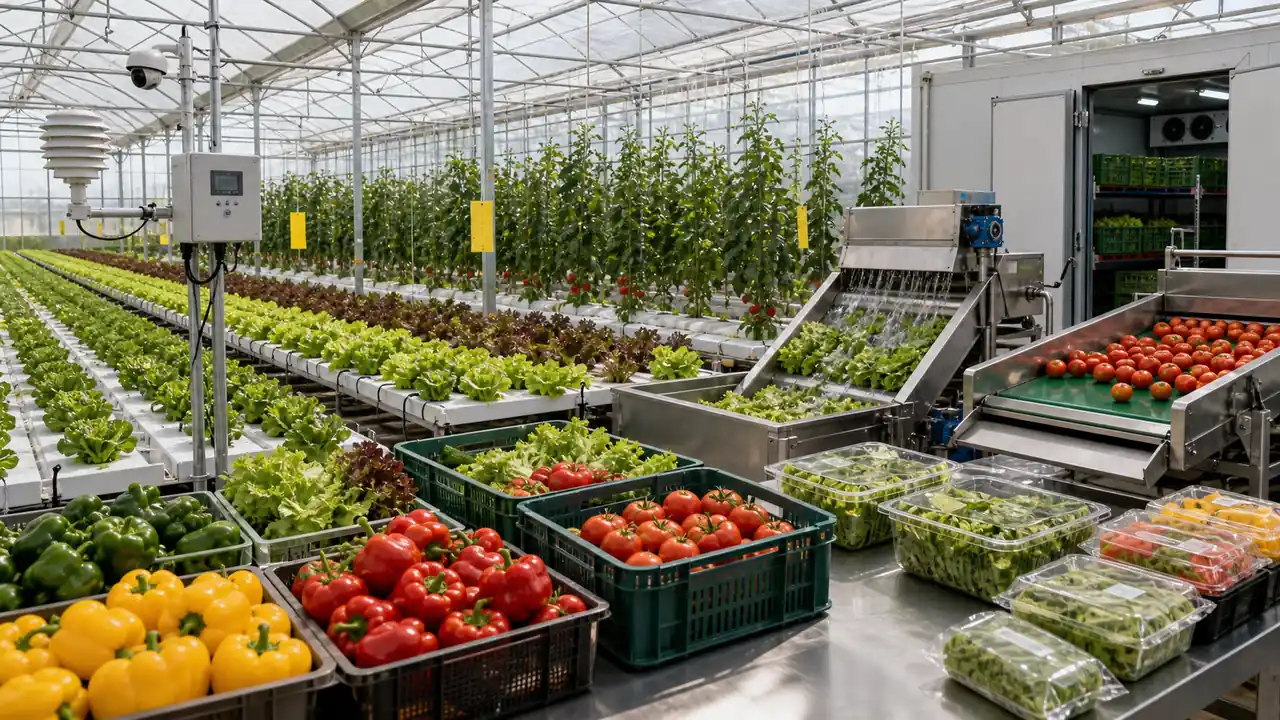
Protected cultivation means growing crops under partially or fully controlled structures such as greenhouses, polyhouses, net houses, or similar systems. It is important because it helps manage temperature, humidity, light, irrigation, and crop protection more precisely than open-field cultivation.
What is the difference between greenhouse and polyhouse?
In practical student use, the terms are often closely related, but greenhouse is the broader controlled-environment concept while polyhouse usually refers to a structure covered with polyethylene material. The important exam point is to understand the structure, covering material, and level of environmental control rather than only the name.
Why is protected cultivation important for high-value crops?
Protected cultivation is important because it supports better crop quality, off-season production, reduced weather damage, and more efficient use of inputs like water and nutrients. It is especially relevant for high-value vegetables, flowers, nursery crops, and intensive small-area production.
What irrigation systems are used in greenhouses?
Greenhouses commonly use controlled irrigation systems such as drip or related precise application methods because the crop environment is managed more carefully than in open fields. In this course, irrigation is studied as part of maintaining crop health, water efficiency, and greenhouse performance.
Why is drying important in post-harvest technology?
Drying is important because it reduces excess moisture and helps protect grains or other produce from spoilage, quality loss, and unsafe storage conditions. In post-harvest technology, moisture control is one of the most important steps for extending storage life and maintaining quality.
What is moisture content and why is it measured?
Moisture content is the amount of water present in an agricultural product, and it is measured to decide whether the produce is safe for drying, handling, storage, or processing. This is a key concept because incorrect moisture levels can lead to spoilage, fungal problems, and poor storage performance.
How should I prepare AENG 252 for exams?
Prepare AENG 252 by understanding greenhouse concepts, environmental control, irrigation, drying, moisture measurement, grading, and storage through practical examples. Students usually do better when they connect each machine or method to the exact post-harvest or cultivation problem it is meant to solve.