🌼 Rapeseed-Mustard
Importance, species groups, uses, and practical agronomy of rapeseed-mustard under Indian Rabi conditions.
Rapeseed-mustard is one of the most important Rabi oilseed groups in India. It is valued for edible oil, diversified industrial use, and its large role in winter-season cropping systems.
What Is Rapeseed-Mustard?
The term rapeseed-mustard refers mainly to several species belonging to the mustard group, especially within Brassica, along with related types used for oil production.
For agronomic study, the main practical idea is that this is not one single crop type. It is a crop group with different species and varietal forms adapted to different regions and uses.
Importance in Indian Agriculture
Rapeseed-mustard matters because it:
- is a major Rabi oilseed crop,
- provides edible oil for cooking and food use,
- supplies raw material for several industrial products,
- gives oilcake that can be used in farming systems,
- supports diversification beyond wheat-based Rabi systems.
Uses of rapeseed-mustard
- edible oil,
- pickles and culinary flavoring,
- soap and selected industrial uses,
- oilcake in limited feed or manure roles,
- vegetable use in tender green forms in some situations.
Major Species and Types
Important mustard-group crops commonly discussed in India include:
- Indian mustard (Brassica juncea),
- rapeseed types such as toria and sarson,
- yellow sarson and brown sarson forms,
- gobhi sarson (Brassica napus),
- taramira (Eruca sativa),
- other locally relevant mustard types.
Why species distinction matters
Different species vary in:
- duration,
- adaptation,
- oil content,
- seed quality,
- suitability for specific regions.
Oil Quality and Canola Concept
One of the most important quality ideas in rapeseed-mustard is the distinction between ordinary mustard oils and improved low-toxic-quality oils.
The canola concept is associated with:
- very low erucic acid in oil,
- low glucosinolate level in meal.
This matters because oil quality influences:
- nutritional safety,
- market acceptance,
- industrial and edible use value.
Climate and Soil
Rapeseed-mustard is mainly a cool-season crop.
It generally prefers:
- cool weather during vegetative growth,
- relatively dry and bright conditions during reproductive stages,
- well-drained soils,
- avoidance of severe waterlogging.
Practical implication
If sowing is delayed too much, the crop may face yield reduction due to poor establishment or late-season stress.
Practical Agronomy
Land preparation and sowing
Good seedbed preparation and timely sowing are critical because mustard has small seed and needs uniform establishment.
Nutrient management
Balanced fertilization is important, especially:
- nitrogen for growth,
- phosphorus for root development,
- sulphur because oilseed crops respond strongly to it.
Water management
In many regions mustard is grown with limited irrigation, so one or two timely irrigations at critical stages may greatly influence seed set and oil yield.
Crop protection
Attention is usually needed against:
- aphids,
- Alternaria and other foliar diseases,
- weather stress at flowering and pod filling.
Summary Cheat Sheet
| Topic | Key Point |
|---|---|
| Crop group | Rapeseed-mustard includes several important oilseed species |
| Main value | Edible oil, industrial use, and Rabi diversification |
| Important quality idea | Canola types are low in erucic acid and glucosinolates |
| Agronomic focus | Timely sowing, sulphur nutrition, and critical-stage irrigation |
| Practical risk | Small seed, aphids, and late stress can reduce yield sharply |
Character | Rapeseed (Sarson/Toria/Lahi) | Mustard (Rai, Raya, Laha) ---|---|--- Plant height (cm) | 45 – 150 | 90-200 Leaves | Sessile, leaf lamina claps the stalk | Leaves stalked but do not clasp Siliquae (pod) | Short or thicker | Long & slender Pollination | Cross pollinated | Self pollinated Seed coat | Smooth | Rough
Brown sarson vs. Yellow sarson
| Character | Brown sarson | Yellow sarson |
|---|---|---|
| Leaves | Pale, thin | Dark green and fleshy |
| Branching | Erect, spreading | Erect |
| Siliquae (pod) | Thin, narrow | Thick and broad |
| Seed coat | Dark brown to reddish brown & mucilaginous | Yellow & non mucilaginous |
Types of Mustard varieties
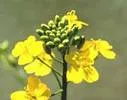

 Turnip rape Yellow sarson Indian mustard Wild mustard
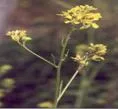
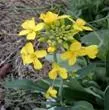 Ethiopian mustard Black mustard Indian mustard
Origin
- Rai – China
- Toria – East Afghanistan
- Brown sarson – E. Afghanistan & adjoining Indian sub-continent
- Yellow sarson – N.E. India
Rapeseed: Area cultivated in the world (1997) – (Million ha & million t)
Country | Area | Production | Productivity
---|---|---|--- India | 7.28 | 8.13 | 1.12 China | 6.74 | 12.65 | 1.88 Canada | 5.32 | 9.11 | 1.71 France | 1.41 | 4.14 | 2.95 Germany | 1.43 | 5.34 | 3.73
World | 27.80 | 48.97 | 1.76
(FAOSTAT, 2006)
Rapeseed-Mustard – Indian Scenario
State | Area
( '000 ha) | Production
( '000 t) | Productivity (kg/ha)
---|---|---|--- Rajasthan | 3665.3 | 4416.9 | 1205 UP | 790.2 | 907.8 | 1149 Gujarat | 338 | 456 | 1349 Haryana | 709 | 792 | 1117 MP | 809.4 | 847.5 | 1047 WB | 421.5 | 383 | 909 Assam | 212.5 | 97 | 456 Punjab | 49 | 54 | 1102
India | 7276.5 | 8131.2 | 1117
(Ministry of Agriculture, Govt. of India, 2005-06)
Brassicas Area in India
- Till independence area remained constant (2.0million ha)
- From 50’s area rose steadily
- Due to increase in irrigated area
- Increased productivity, varieties and agronomic practices
- Maximum area was in 6.87 million ha -96-97
- Major states growing are
- Rajasthan, UP, Gujarat, Haryana, MP, WB, Assam & Punjab
Climate
- A crop of temperate
- Can be in higher elevation of tropics
- Rabi season crop in India,
- Sep-Oct to Mar-Apr
- Temperature range 3 to 40°C
- Optimum 18-25°C with cool, dry clear weather
- High RF, high humidity, cloudy atmosphere at flowering undesirable
- Most susceptible to frost
Season
- Sowing starts from August ends in November
- Sowing of rapeseed is ahead of mustard
- Taramira is sown from mid-Sep to Oct end
- Region wise season varies
Varieties
- Mustrad
- Varuna (T 59), TM 2, TM 4, Seetha
- Brown sarson
- KNS 3, KOS 1
- Yellow sarson
- PUSA GOLD, YS 93
- Toria
- Jawahar Toria, Panchali, TS 29
- Taramira
- RTM 13, TMC 1
Soil
- Varying soil from sandy loam to clay
- Thrives well in light soil
- Mustard on any soil but rapeseed in light
- Well drained soil is more suitable
- Waterlogging should not be
- Saline alkaline soils are unsuitable
- pH 6.5 to 7.5, neutral soil is ideal
Land preparation
- Fine seed bed since seeds are small
- Flat bed to perform ferti cum seed drill
Seed rate & spacing
- 4-6 kg depending upon seed weight
- 3-5 g/1000 depending upon crop and variety
- 30 x 10 to 30 x 15cm
- 22.2 to 33.3 plants m-2
Sowing
- Treat the seeds with fungicides well before sowing
- May be behind the country plough
- Ferti cum seed drill
- Depth of sowing 3-4cm
- Avoid shallow sowing
- Cover the seeds after sowing
- Sowing may be on conserved soil moisture
Manuring
- Oil seed crops removes huge nutrients
- S is removed in large and needs return
- General recommendation varies to States
- 60-40-40 for irrigated
- Half N 30 DAS
- If SSP is applied S is taken care, if not
- 20-40kg elemental sulphur, if soil analyzed with <10ppm
- 30-20-20 for rainfed (half of irrigated)
- All basal
- Nutrient requirement may be calculated by critical concentration
- 6.07 – 6.62% N in top 2-3rd leaf at 60 DAS
- 0.408 – 0.412% S in 4-5th leaf from top
- Integration with biofertlizer ‘Azotobactor’ is desirable
Irrigation
- Total water requirement - 400mm
- Moisture at pre-flowering and pod filling stage is critical
- Two irrigations for mustard
- One at rosette stage (20-30DAS)
- Another at siliqua atage (50-60DAS)
- In light soils three irrigations, the third at 90DAS
- Two irrigations for mustard
- IW/CPE ratio of 0.6 is optimum
Weed management
- Dominant weeds
- Chenpodium album
- C. murale
- Convolvulus arvensis
- Melitotus alba
- Intercultural operation 5-10days after 1st irrigation
- Hand hoeing is desirable, it aerates the soil
- Soil aeration is to conserve soil moisture
- Herbicides can also be used
- Pendimethalin pre-emergence 0.5-1.5 kg/ha based on soil
- Fluchloralin 1.25kg pre-plant incorporation
- Post emergence Isoproturan 0.75 kg /ha for
- Wheat+mustard mixed systems
Harvesting maturity
- Color of leaves, stem and silique turn green to pale yellow
- Lower silique looks – dried appearance
- Upper may be green
- Seeds in the silique makes rattling sound
- Silique with 2 carpels and a false septum
- During over maturity the two carpels split and seeds shed
- Premature harvest leads to shriveled grains
Threshing
* After sun drying for few hours
* Beating pods along with the plants

  * Either manually
  * Machine
  * Walking bullocks, or running tractor

* Cleaning and drying to 8-10% moisture for storage
* Average yield

  * Irrigated rapeseed 1.5 to 2.0 t
  * Rainfed rapeseed 1.0 to 1.5t
  * Irrigated mustard 2.0 to 2.5 t
  * Rainfed mustard 1.5 to 2.0t
Cropping systems
* Fallow / millets / pulses – mustard
* Rice – rapeseed
* Intercroppings
  * Mustard + chickpea
  * Mustard + sugarcane
  * Mustard + barley / wheat / chickpea
  * Potato + mustard
Multiple choice questions
- Total production of rapeseed-mustard in the world is _________m tonnes a. 25.15 b. 35.15 c.45.15
- Total production of rapeseed-mustard in India is _________m tonnes a. 8.15 b. 6.96 c.9.15
- The peculiar pungency of rapeseed-mustard is due to the presence of _____ a. erusic acid b. sinigrin c. Glucosinolates
- Oil content of Brassica juncea is ______ a. 45 % b. 43 % c. 35 %
- Oil content of Brassica campestris Var.yellow sarson is ______ a. 45 % b. 43 % c. 35 %
- Oil content of Brassica campestris Var.brown sarson is ______ a. 45 % b. 43 % c. 35 %
- Seed rate of rapeseed-mustard is _______ kg/ha a. 6 - 8 b. 4 - 6 c. 2 – 4
- Spacing recommended for rapeseed-mustard is _______ a. 35 x 15 – 20 cm b. 30 x 15 – 20 cm c. 30 x 10 – 15 cm
- Fertilizer dose for irrigated rapeseed-mustard is _______ kg NPK /ha a. 60-40-40 b. 30-20-20 c. 40-20-20
- Fertilizer dose for rainfed rapeseed-mustard is _______ kg NPK /ha a. 60-40-40 b. 30-20-20 c. 40-20-20
- Rate of sulphur recommended for rapeseed-mustard is _______ kg /ha a. 10-20 b. 20-40 c. 30-40
---|---
Lesson Doubts
Ask questions, get expert answers