🌻 Sunflower
Importance, oil quality, adaptation, and agronomic management of sunflower under Indian field conditions.
Sunflower is an important oilseed crop known for high-quality edible oil and broad adaptability. Its agronomy is strongly influenced by season, moisture, and pollination.
Why Sunflower Matters
Sunflower is grown mainly for its oil-rich seed. It is important because:
- it produces high-quality edible oil,
- it contains a high proportion of unsaturated fatty acids,
- it fits into diversified oilseed systems,
- it can be cultivated in more than one season in some regions.
Oil-quality importance
Sunflower oil is valued for:
- high linoleic acid content,
- good edible quality,
- suitability for household and food-industry use.
Origin and Spread
Sunflower is generally associated with American origin and later spread into Europe and other parts of the world. Over time, it became an important commercial oilseed rather than merely an ornamental crop.
For exam preparation, the key idea is: origin in the Americas -> spread to Europe -> later commercial oilseed development.
Agronomic Adaptation
Sunflower is adaptable, but best performance depends on suitable environment and management.
Important features:
- can fit multiple seasons in some Indian regions,
- responds well to good sunshine,
- sensitive growth stages must be protected from severe moisture stress,
- pollination and seed set are important practical concerns.
Climate and Soil
Sunflower generally prefers:
- moderate temperatures,
- well-drained soils,
- good sunlight,
- conditions free from severe waterlogging.
Practical significance
Because sunflower root growth and head development depend on balanced moisture, both drought stress and excess water can reduce productivity.
Practical Agronomy of Sunflower
Sowing and spacing
Proper spacing is needed because plant population affects head size, light interception, and final seed yield.
Nutrient management
Balanced fertilization is important for vigorous growth, head development, and seed filling.
Pollination management
Sunflower productivity is strongly influenced by pollination. Good pollinator activity improves seed set and grain filling.
Water management
Timely irrigation is especially useful at critical reproductive stages if rainfall is not sufficient.
Crop protection
Integrated management is needed against:
- insect pests,
- foliar diseases,
- seed and head damage under adverse conditions.
Summary Cheat Sheet
| Topic | Key Point |
|---|---|
| Main value | High-quality edible oilseed crop |
| Oil feature | High unsaturated fatty-acid content |
| Agronomic focus | Good stand, balanced nutrients, pollination, and moisture management |
| Soil need | Well-drained soils are preferred |
| Practical risk | Poor pollination or reproductive-stage stress reduces yield |
India | 2339.6 | 1439 | 615
(Ministry of Agriculture, Govt. of India, 2005-06)
Favourable features for growth of sunflower in India
- Wide adaptability
- Photoperiod insensitiveness
- Shorter duration (60-100 days)
- High quality edible oil (PUFA)
- High seed multiplication ratio (>1: 80)
- Easier & cheaper cultivation
- Remunerative market price
- Suitable for mechanization
Stages of Sunflower
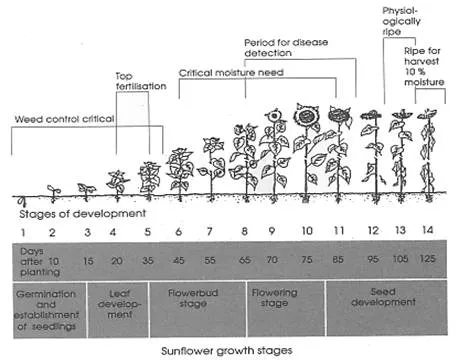
Erect, tall usually un-branched
- Plant height, head size, days to flowering & maturity are all vary due to environment
- Root – tap root - but thick root mat with short tap root is common
- May be problem in light soil to heavy mass - lodging
- Limitations in the exploitation of soil moisture & nutrients
- Earthing-up interferes with roots
- Irrigation frequency should be short to meet the demand
- Waterlogging adversely affects the crop due to weakening of anchorage and proliferation of fungal diseases
- The stem
- Mostly unbranched
- Branching is not desirable
- Basal branching may be useful
- Leaf axil branching problem
- N triggers branching
- Green stem contributes for photosynthesis
- Ht varies
- 80-120 short can accomododate more plants
- 120-150 medium
- 150-180 tall
- The leaf
- Varies with plant type and environment
- Limited to number of nodes
- 8 to as many as 70
- Arranged alternate at right angle
- The inflorescence
- Capitulum borne terminally
- Surrounded by one or more whorls of bracts called involucre (modified leaves)
- Head diameter is yield deciding factor
- Anthesis and fertilization
- Flowering from periphery
- Outermost opens first
- Daily 1-5 rows continues up to 5-10 days
- The seed
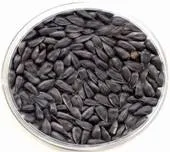
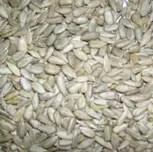
- Seed is called ‘achene’
- Seed size 7-25mm long, 4-13m long,3 -7.5mm thick
- Dormancy normally 10-45 days
- Oil content 36-37%
- 1000 seed weight 43-45g
The climate
Temp range 8-34°C Optimum 20 & 25°C Requires cooler (15-20°C) growing period and warmer maturing period (20-25°C) Base minimum is 10°C High temp (>38°C) in post-anthesis inhibit quantity and quality of oil Rainfall of 500mm, with 300 mm it can yield Avoid flowering coincide continuous drizzle
Soil
- Can be in wide range of soils
- Any soil with good drainage is more important
- Neutral to moderately alkaline soils
- pH ranges 6.5 to 8.0
- Complete failure in sandy soil with pH 4.6
Varieties
CO1, CO2, CO 3, CO 4 Modern, K2, K1, BSH 1 EC 68415
Hybrids have advantage than varieties
- High yield potential
- Uniform crop stand
- More self-fertile, less problem of seed set
- MSFH 1, BSH 1
Seasons
Rainfed June-July, Kharif in North Oct-Nov Irrigated
- Dec - Jan
- April – May
Field preparation
- Fine tilth
- Apply FYM / Compost incorporate
- Ridges and furrows
Spacing
- 30 to 60cm according to variety
- 10 to 15 cm for short & medium stature
- 15 to 30 cm for tall (>120cm)
Seed rate
- @ 2 seeds per hole
- Seed weight of 45g/1000
- 30 x 10 30 kg
- 30 x 15 20kg
- 30 x 30 10kg
- 60 x 30 5kg
Seed treatment
- Trichderma 4 g /kg
- Azospirillum 600 g to one ha
- Soaking the seeds
- 2% ZnSO4 for 12hrs and
- Shade drying for rainfed sowing is desirable
Sowing
- Well prepared deep, friable seedbed is more preferable
- Depth of sowing 3-5cm

Plant population
- 55,000 to 98,000 /ha almost same yield
- If the head diameter is <10cm more population
- If >20cm less population
Thinning
- Highly sensitive to intra-specific competition
Nutrient management
- Fast growing high oil yielding thus requires more nutrients
- Low yield in India is attributed to poor fertile soil, cultivated in rainfed conditions
- A crop yielding 2 t seed, 3.2t stover and 0..8t root uptakes
82 kg N, 13 kg P, 60 kg K, 9.4 kg S, 37 kg Ca and 21 kg Mg.
State wise nutrient recommendation
- TN 40-20-20
- UP 80-60-40
- AP - Rainfed 60-30-0
- Irrigated Hybrids 60-90-30; Variety 30-60-30
Weed management
* Fluchloralin / Pendimethalin
  * 2.0kg as pre-mergence
  * High volume spray
* Hoeing and weeding on 15th day & 30th day
* Within three days irrigate the filed
Water management
* Immediately after sowing
* 4-5 days later once
* Interval of 7-8 days
* Seeding, flowering and seed development stages are critical
Seed setting and filling
* Problem is seen with poor seed setting
* This problem is more in warmer regions
* In India seed filling under good management is only 75%
* It will be as low as 10-20%
* Reasons
  * Genetic
  * Environmental
  * Physiological
  * Availability of pollinators
Maturity
Physiological maturity (30-40% seed moisture
When the back of the head turns green to lemon yellow
There will be 5-6 green leaves at this stage
Harvest maturity (10-12%)
Delay beyond harvest maturity severe yield loss
Cropping systems
Sequential cropping
  * Southern India
    * Rainfed - Sunflower – millets/pulses
    * Irrigated- Rice – sunflower
  * North
    * Rainfed - SF – wheat / chickpea
* Row intercrop
  * Groundnut + SF
  * Pigeanpea + SF
  * Castor + SF
  * Pulses + SF
Multiple choice questions
- Origin of sunflower is _____ a. India b. Argentina c. South west America
- Scientific name of sunflower is ______ a. Helianthus annuus b. Carthamus tinctorious c. Sesamum indicum
- Total production of sunflower in the world is ____ m tonnes a. 22.27 b. 28.48 c. 33.23
- Total production of sunflower in India is ______ m tonnes a. 2.25 b.1.25 c.3.25
- Oil content of sunflower is _________ a. 38-40 % b. 30-32 % c. 36-37 %
- Nutrient recommendation for sunflower in Tamil Nadu is ________ kg NPK/ha a. 80:60:40 b. 60:30:0 c.40:20:20
- Saturated fatty acid content in sunflower is ________ a. 12 % b. 15 % c. 10 %
- Mono unsaturated fatty acid content in sunflower is ________ a. 16 % b. 15 % c. 10 %
---|---
Lesson Doubts
Ask questions, get expert answers