🧶 Safflower
Importance, oil quality, uses, adaptation, and agronomic management of safflower under dryland and Rabi conditions.
Safflower is an important though less widely grown oilseed crop, especially valued in dry regions. It is notable for high-quality oil, hardy adaptation, and multiple by-product uses.
Why Safflower Matters
Safflower is important because:
- it produces oil rich in polyunsaturated fatty acids,
- it can fit drought-prone or limited-moisture systems,
- its oil, cake, flowers, and other plant parts all have use value,
- it contributes to diversification in Rabi or post-rainy-season agriculture.
Main economic uses
- edible and industrial oil,
- food-industry and specialty uses,
- dye value from flowers,
- cake for manure or feed after appropriate handling,
- biomass and by-product uses.
Origin and Distribution
Traditional literature links safflower with origin zones involving India, Afghanistan, Arabia, Ethiopia, and nearby regions. The exact historical center may vary by source, but the main agronomic point is that safflower is an old crop adapted to dry climates.
Climate and Adaptation
Safflower is known for its adaptation to moisture-stressed environments.
Important features:
- tolerates relatively dry conditions,
- performs well in low- to moderate-moisture systems,
- useful where deep rooting and stress adaptation are advantageous.
Soil and Agronomic Requirements
Soil
Safflower performs better in:
- well-drained soils,
- soils that allow root penetration,
- fields where severe water stagnation is avoided.
Sowing
Timely sowing is important to use available soil moisture and to avoid terminal stress later in the season.
Nutrient management
Balanced nutrition supports branching, capitulum development, and seed filling. Response may differ between rainfed and irrigated conditions.
Water management
Although hardy, safflower benefits from moisture at critical stages if irrigation is available. Under strictly rainfed systems, moisture conservation becomes especially important.
Practical Value in Farming Systems
Safflower is useful because it:
- broadens crop choice in dry environments,
- provides oilseed value where other crops may fail,
- fits into diversified systems with lower water availability,
- has by-product value beyond seed alone.
Summary Cheat Sheet
| Topic | Key Point |
|---|---|
| Main identity | Hardy oilseed crop suited to dry conditions |
| Main value | High-PUFA oil plus useful by-products |
| Agronomic advantage | Good fit in drought-prone or residual-moisture systems |
| Soil need | Well-drained soil with low water stagnation |
| Practical lesson | Diversification crop for Rabi and dryland farming |
( '000 ha) | Production
( '000 t) | Productivity (kg/ha)
---|---|---|--- Maharastra | 263 | 159 | 605 Karnataka | 81 | 60 | 741 AP | 17 | 80 | 471 Orissa | 1.3 | 0.8 | 615 MP | 1.0 | 0.3 | 300
India | 364.6 | 228.6 | 627
(Ministry of Agriculture, Govt. of India, 2005-06) Climate
- A day neutral plant
- But short day can prolong rosette stage
- Temp is more important than day length
- Thermo-sensitive
- Extremes of cold and heat not suitable
- Tolerance to low temp at vegetative
- But susceptible to high temp during flowering
- For germination 15°C
- Vegetative : 20-21°C
- Flowering: 24 to 32°C
- Thermo-sensitive
- Rainfall at flowering affects pollination
- Excessive humidity at any stage affects
- More suitable for rabi season in India
The Plant
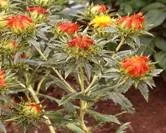
- Highly branched, herbaceous
- Annual height varying from 30-150cm
- Well defined fleshy tap root system
- Stem is stiff cylindrical fairly thick at base and thin at top
- Central stem branches at 15-20cm to secondary
- Each branch terminates in a flower head
- The angle of branching is varietals but can be by environment also
- The leaf deeply serrated on lower stem, short, stiff, ovate at the inflorescence
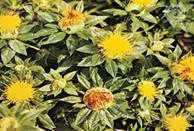
- The inflorescence – numerous florets
- Flower color may vary from whitish yellow to red-orange
- The capitula, head size may vary from 1.25 to 4.0 cm
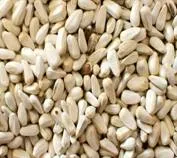
- The fruit achene, resembles small slightly rectangular sunflower seeds
- Seed weighs 250 – 800mg/grain
 Soils
Soils
- Fertile, fairly deep and well-drained
- pH range of 5-8
- Shallow soils irrespective of fertility seldom produces high yield
- In traditional belts it is black cotton soil
- On heavy soils
- This crop follows early Kharif crops
- Or may often single crop in Rabi
- It is considered as salt tolerant next to cotton
- Tolerant to Na salts but < to Ca & Mg
- Salinity reduces seed size and oil content
Seeds and sowing
Varieties
- K1 120 days, CO 1 125 days
- Bhima (33% oil) - Maharastra
- JSF 1 (30%) – Rajasthan & MP
- Manjira - AP
- Nira – (30%) Maharastra & TN
- HUS 305 (35%) for Peninsular India
Seed rate
- 7-20 kg depending upon spacing and variety
Spacing
- 45 x 15 cm in TN
- 45 x 20 cm
- 60 x 30 cm etc
Seed treatment
- Pre-sowing seed hardening
- Use fresh seeds every year
Sowing
- From last week of Sep to end of Oct
- Early sowing has advantage
- Line sowing using improved seed drill
- Ferti cum seed drill is more desirable
- Seeds can be sown behind the plough also
- Small furrow may be opened and seeds dropped and half coved
- Depth of sowing may be 5-7.5cm
- Light planking for the soils which looses moisture
Nutrient management
Rainfed crops
- N ranges from 25 kg N to 50 kg
- P2O5 – 20 to 50 kg
- K2O – Mostly not recommended
- General: 40:20:0
Irrigated
- 60:30:20 (Chatisgarh) to
- 75:75: 35 (Karnataka)
Time of fertilizer application
- Rainfed – basal – deep placed by ferti-cum seed drill
- Irrigated 50% N+ full P & K as basal
- Remaining half N at 5th week during 1st irrigation
Water management
- It is deep rooted xerophytic plant, can thrive under scarce soil moisture
- One or two irrigations (25 & 75 DAS) is optimum
- Sensitive to excess moisture at any stage
- If the soil profile contains 250mm ASM
- ET of the season is 250-300mm- no response to irrigation
- Under irrigated condition the crop may be sown under Broad beds of 1.35 to 1.8m and furrow
- To drain the excess water
- Points to remember:
- If one irrigation is possible , provide it at critical period
- Avoid contact of above ground parts with irrigation water
Weed management
- Being wider spaced
- critical periods for weed management extends up to end of rosette (25-50DAS)
- Hand weeding and hoeing
- at 20 and 35 DAS is good
- Herbicides
- PPI – Fluchloralin 0.75 to 1.0 kg
- PE – Oxadiazone – 0.75 -1.0 kg or
- PE – Pentimethalin – 0.75 kg
Important intercultural operations
- Thinning to single plant and filling the gap at the early stage (before 15DAS)
- Nipping of central shoot to induce branching
- Bird damage
- By parrots at Isolated pockets
- Cultivate in contiguous block
- Bird scaring - morning and evening during
- Seed filling to physiological maturity
Harvesting
- Duration of the crop varies due to regions
- 115-140 days
- 120-125 days in TN
- Gujarat & Orissa – 140-150days
- In cooler regions 150-180days
- Maturity
- When the lower leaves and most of the bracteoles dry and brown
- Harvest in the early hours
- Shattering minimum
- Spines relatively soft
- Combine harvester is becoming popular now since
- Manual harvesting, bundling, threshing are all becoming problematic
- Duration of the crop varies due to regions
- 115-140 days
- 120-125 days in TN
- Gujarat & Orissa – 140-150days
- In cooler regions 150-180days
- Maturity
- When the lower leaves and most of the bracteoles dry and brown
- Harvest in the early hours
- Shattering minimum
- Spines relatively soft
- Combine harvester is becoming popular now since
- Manual harvesting, bundling, threshing are all becoming problematic
- Yield
- In improved agro-techniques are used
- Under scanty moisture – 800-1200kg/ha
- Under favourable 1500-2000 kg
- Under irrigated – 1800-2800kg/ha
- In improved agro-techniques are used
- Storage
- 5% moisture, clean and dry
Cropping system
- It is potential crop to replace dry rabi crops
- Wheat, coriander, linseed, chickpea, pulses
- In traditional areas it is raised as intercrops
- Sorghum, wheat, linseed, chickpea, coriander etc.
- Sequence cropping
- Farmers rarely raise more than one crop due to non availability of moisture
- There is scope for double cropping either preceding with Kharif crop or after rabi by irrigation.
Multiple choice questions
- Scientific name of safflower is ______ a. Helianthus annuus b.Carthamus tinctorious c. Sesamum indicum
- Oil content of safflower is ______ a. 24-28 % b. 26-28 % c. 28-32 %
- Which of the following is used for dye extraction a. Sunflower b. Safflower c. Sesame
- Total production of safflower in the world is _________ m tonnes a. 0.93 b. 0.98 c. 0.88
- Total production of safflower in India is _________ m tonnes a. 0.70 b. 0.43 c. 0.67
- Spacing followed for safflower in Tamil Nadu is______ a. 40 x 20 cm b. 60 x 30 cm c. 45 x 15 cm
- Seed rate for safflower varies from _______ to _______ kg/ha depending upon the variety and spacing a. 7 – 20 b. 5 – 10 c. 20 – 25
- General fertilizer recommendation for rainfed safflower is ______ kg NPK /ha a. 60:30:20 b. 40:20:0 c. 75:75:35
- Saturated fatty acid content in safflower is ________ a. 12 % b. 15 % c. 10 %
- Mono unsaturated fatty acid content in safflower is ________ a. 12 % b. 15 % c. 14 %
---|---
Lesson Doubts
Ask questions, get expert answers