🐞 Factors Affecting Insect Abundance
Environmental and biological factors that influence insect population build-up and distribution.
Insects dominate nearly every agricultural landscape, from crop canopies and stored grain to soil, water edges, and even extreme habitats. Their abundance is not accidental. It results from a powerful combination of evolutionary age, structural adaptations, reproductive strength, and survival mechanisms.
How We Recognize Insect Dominance
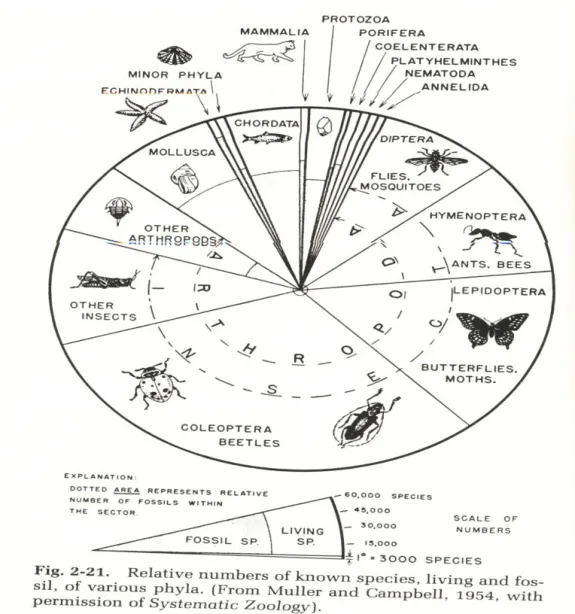
Insect abundance can be understood first by looking at how strongly insects dominate the animal kingdom:
- Very high species diversity: More than 85 per cent of animal species belong to the insect group, and more than 9 lakh insect species have been described.
- Huge population size within a species: Some insects occur in enormous numbers. A locust swarm, for example, may contain an extremely large number of individuals spread over a vast area.
- Wide habitat range: Insects survive successfully under highly varied environmental conditions.
- Long geological history: Insects have existed on earth for more than 350 million years, giving them a long period for adaptation and diversification.
Flight and Habitat Adaptability
Capacity for Flight
Insects were the earliest animals to achieve flight and remain the only flying invertebrates. Wings, which are lateral extensions of the exoskeleton, give insects a major ecological advantage.
Flight helps insects:
- find food, mates, shelter, and oviposition sites
- colonize new habitats
- escape enemies and unfavourable conditions
- migrate over long distances, as seen in locusts
Adaptability or Universality
Insects also succeed because they occupy an extraordinary range of habitats.
- They survive across wide climatic conditions, from about -50°C to 40°C.
- Psilopa petroli has been reported from crude petroleum wells.
- Ephydra fly survives in the Great Salt Lake.
- Flowering plants support many phytophagous insects.
- Decomposing organic matter supports many saprophagous insects.
- Many carnivorous insects live as predators or parasites on other animals and insects.
Small Size, Exoskeleton, and Water Balance
Importance of Small Size
The small size of most insects gives them several ecological and physiological benefits:
- access to tiny ecological niches unavailable to larger animals
- lower requirements for space, food, time, and energy
- efficient energy use
- reduced gravitational effect
- effective muscular action and tracheal respiration
- easier escape from predators
Exoskeleton Advantage
The insect body is covered by a cuticle called the exoskeleton, made largely of the cuticular protein chitin. It is light, strong, rigid, and flexible.
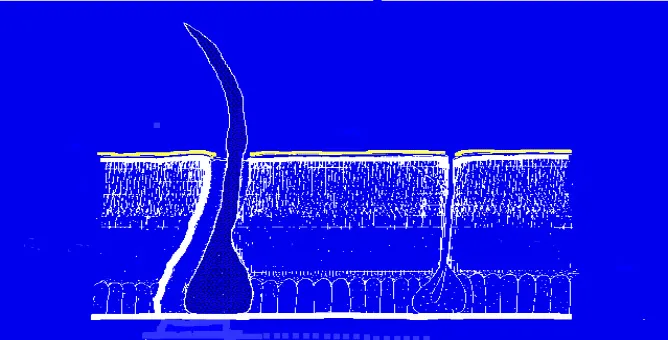
Main uses of the exoskeleton:
- acts as external armour
- provides surface for muscle attachment
- prevents excessive water loss
Resistance to Desiccation
Insects reduce water loss in two major ways.
Prevention of water loss
- lipids and polyphenols in the epicuticle help in waterproofing
- the wax layer reduces escape of water
- spiracles can close to reduce water loss
- the egg shell protects the embryo from desiccation
Conservation of water
- use of metabolic water
- rectal resorption of water from faeces
- excretion of nitrogen mainly as uric acid, which requires less water
Respiration, Reproduction, and Metamorphosis
Tracheal Respiration
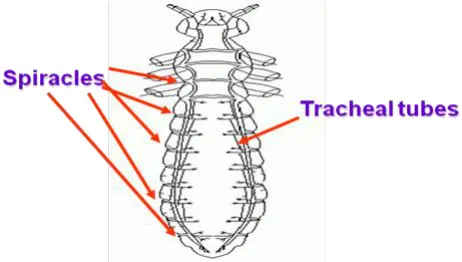
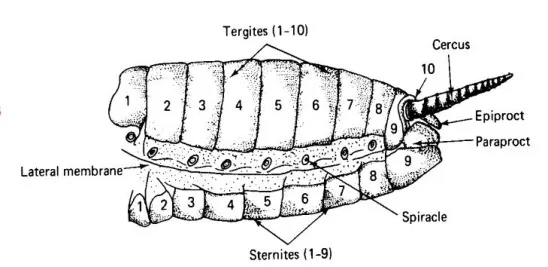
The tracheal system delivers oxygen directly to actively respiring tissues. Spiracles regulate air entry while also helping restrict water loss.
Reproductive Potential
Insects multiply rapidly because:
- fecundity is high; for example, a queen termite may lay 6000-7000 eggs per day for many years
- development is often short; a corn aphid may produce 16 nymphs per female that become adults in about 16 days
- egg-laying sites are often carefully selected and eggs protected
- some insects show parental care such as progressive provisioning in bees and mass provisioning in wasps
- several special reproductive modes also occur
Special reproductive forms include:
- Polyembryony: many individuals develop from a single egg, as in some parasitic wasps
- Parthenogenesis: reproduction without fertilization, as in aphids
- Paedogenesis: reproduction by immature stages, seen in certain flies
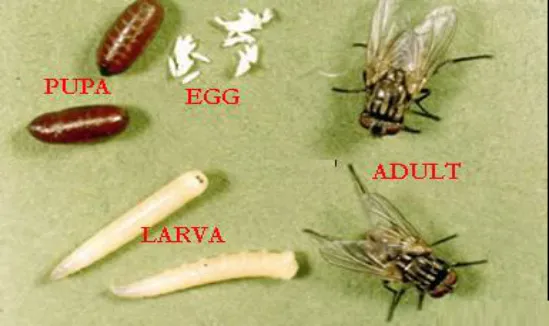
Complete Metamorphosis
More than 82 per cent of insects undergo complete metamorphosis (holometaboly) with four stages:
- Egg: inactive and protected stage where the embryo develops
- Larva: active feeding and growing stage
- Pupa: inactive stage of internal reorganization and resistance to adverse conditions
- Adult: active stage for reproduction and dispersal
Because larvae and adults often use different food sources, competition within the species is reduced.
High fecundity, short generation time, and complete metamorphosis are major reasons for the rapid build-up and persistence of insect populations.Defence Mechanisms and Stable Locomotion
Insects improve survival through multiple defence strategies:
- Behavioural defence: thanatosis, where the insect pretends to be dead
- Structural defence: hardened forewings such as elytra in beetles
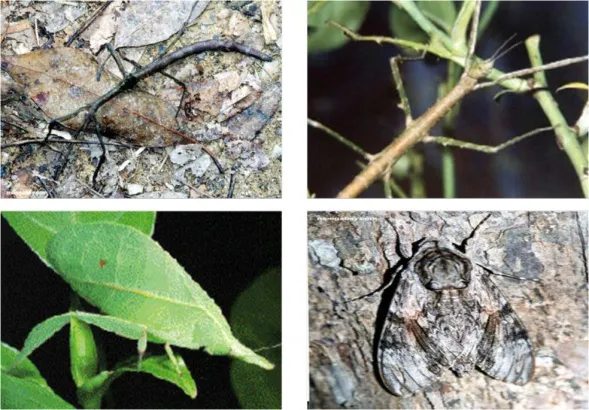
- Protective coloration: as seen in stick insects
- Chemical defence: for example, venom production in bees
Another success factor is hexapod locomotion. Insects typically move using three legs at a time while the other three provide support, giving stable movement.
Summary Cheat Sheet
- Insects dominate the animal kingdom because of very high species diversity, large population size, wide habitat range, and long geological history.
- Flight helps insects find resources, colonize habitats, escape enemies, and migrate.
- Adaptability allows insects to live in extreme climates and specialized habitats.
- Small size and exoskeleton improve protection, mobility, efficiency, and water conservation.
- Water balance is maintained through epicuticle waterproofing, wax layer, spiracle control, rectal resorption, and uric acid excretion.
- The tracheal system supplies oxygen directly to tissues.
- High reproductive potential comes from high fecundity, short life cycle, protected eggs, parental care, and special reproductive modes.
- More than 82 per cent of insects show complete metamorphosis, reducing competition between larval and adult stages.
- Defence mechanisms include behavioural, structural, colour-based, and chemical protection.
- Hexapod locomotion gives insects stable and efficient movement.
References
2 sources • [1] [2]
References
Fundamentals of Entomology
Insect Morphology and Systematics
Lesson Doubts
Ask questions, get expert answers