🕷️ Classification of Phylum Arthropoda
Major taxonomic divisions of Arthropoda with emphasis on insect-relevant groups.
Insects are only one class within a much larger arthropod lineage. To understand why insects are placed separately from spiders, crustaceans, centipedes, and millipedes, we first need the core characters of Arthropoda and then the comparative features of its major classes.
Core Characters of Phylum Arthropoda
Insects belong to phylum Arthropoda. In older course language, insects are often placed under subphylum Uniramia.
The name Arthropoda comes from:
- arthro = joint
- poda = foot
Major characters of arthropods:
- segmented body
- segments grouped into two or three body regions, called tagmosis
- renewable chitinous exoskeleton
- growth by moulting
- bilateral symmetry
- body cavity largely represented by haemocoel
- complete alimentary canal with mouth and anus
- dorsal heart with ostia
- dorsal brain with ventral nerve cord
- striated muscles
- absence of cilia
- paired segmented appendages
Major Classes of Arthropoda
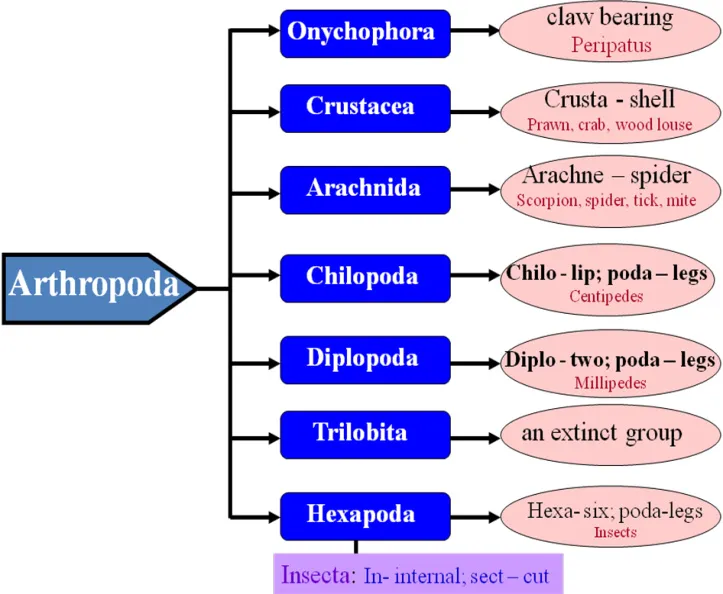
The lesson groups Arthropoda into seven major classes:
- Onychophora - claw-bearing forms such as Peripatus
- Crustacea - prawn, crab, and wood louse
- Arachnida - scorpion, spider, tick, and mite
- Chilopoda - centipedes
- Diplopoda - millipedes
- Trilobita - an extinct group
- Hexapoda or Insecta - insects
This classification is useful because insect characters become clearer when compared with the neighbouring arthropod groups.
Position of Insects in the Animal Kingdom
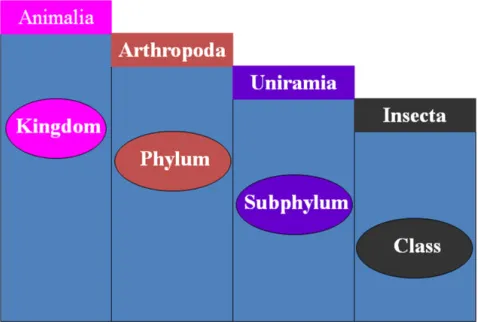
Within Arthropoda, insects are distinguished by their body plan and appendages. The most familiar identifying characters are:
- body divided into head, thorax, and abdomen
- one pair of antennae
- three pairs of legs attached to the thorax
- usually two pairs of wings on meso- and metathorax
- mostly mandibulate mouthparts
- tracheal respiration
These features explain why insects are recognized as Hexapoda, meaning six-legged arthropods.
Relationship of Insects with Other Arthropods
The comparative table below organizes the main differences among the major arthropod groups discussed in this lesson.
| Character | Onychophora | Crustacea | Arachnida | Chilopoda | Diplopoda | Insects (Hexapoda) |
|---|---|---|---|---|---|---|
| Habit | Terrestrial | Mostly aquatic, few terrestrial | Terrestrial | Terrestrial | Terrestrial | Mostly terrestrial, few aquatic |
| Body regions | Not distinctly separated | Cephalothorax and abdomen | Usually two or three regions depending on group | Head and multisegmented trunk | Head and multisegmented trunk | Head, thorax, and abdomen |
| Antennae | One pair | Two pairs: antennule and antenna | Absent | One pair | One pair | One pair |
| Visual organs | Not distinct | Stalked compound eyes | Simple eyes | Simple eyes | Simple eyes | Compound eyes with or without simple eyes |
| Locomotory organs | Many pairs of unjointed legs | At least five pairs of biramous legs | Four pairs of legs | One pair of legs per segment; first pair modified as poison claws | Two pairs of legs per segment | Three pairs of thoracic legs; usually two pairs of wings |
| Mouthparts | Non-mandibulate | Mandibulate | Non-mandibulate, with chelicerae | Mandibulate | Mandibulate | Mandibulate |
| Respiration | Cutaneous | Gills | Book lungs or tracheae | Tracheal | Tracheal | Tracheal |
| Body fluid | Haemolymph | Haemolymph | Haemolymph | Haemolymph | Haemolymph | Haemolymph |
| Circulatory system | Heart with ostia | Heart with ostia | Heart with ostia | Heart with ostia | Heart with ostia | Heart with ostia |
| Development | Anamorphosis | Anamorphosis | Variable; absent in some, present in others | Metamorphic development | Metamorphic development | Metamorphosis |
| Feeding habit | Organic matter feeding | Herbivorous and carnivorous | Phytophagous and predatory forms present | Carnivorous | Herbivorous | Phytophagous, predatory, and parasitoid forms |
| Special note | Link between Annelida and Arthropoda | Calcification strengthens exoskeleton | Chelicerae and special body organization | Opisthogoneate reproductive opening | Progoneate reproductive opening | Genital opening associated with abdominal segments 8 and 9 |

Summary Cheat Sheet
- Arthropoda means jointed appendages and includes animals with segmented body, chitinous exoskeleton, haemocoel, moulting, and paired appendages.
- The seven classes listed here are Onychophora, Crustacea, Arachnida, Chilopoda, Diplopoda, Trilobita, and Hexapoda/Insecta.
- Insects are separated from other arthropods by head-thorax-abdomen body division, one pair of antennae, three pairs of legs, and usually two pairs of wings.
- Crustacea usually have two pairs of antennae and are mainly aquatic.
- Arachnida lack antennae and possess four pairs of legs.
- Chilopoda have one pair of legs per segment, while Diplopoda have two pairs per segment.
- Insects respire mainly through a tracheal system and show great feeding diversity, including phytophagous, predatory, and parasitoid forms.
References
2 sources • [1] [2]
References
Fundamentals of Entomology
Insect Morphology and Systematics
Lesson Doubts
Ask questions, get expert answers