🛡️ Insect Cuticle Structure
Layers, composition, and functional importance of the insect cuticle and moulting process.
The insect cuticle is far more than a simple body covering. It acts like armour, support, a water-saving barrier, and a platform for movement, sensation, and moulting. Understanding its structure explains how insects survive, grow, and repeatedly shed their outer covering without losing protection.
Integument and Main Body Wall Structure
The insect body wall is called the integument or exoskeleton. It is ectodermal in origin and forms the external covering of the body. It is light, strong, flexible, and modified in different regions according to function.
The body wall has two main parts:
- an inner cellular layer called the epidermis
- an outer non-cellular layer called the cuticle
Epidermis
The epidermis is a unicellular layer resting on the basement membrane. Its major functions are:
- secretion of cuticle
- digestion and absorption of old cuticle during moulting
- wound repair
- maintenance of the external body surface
Cuticle
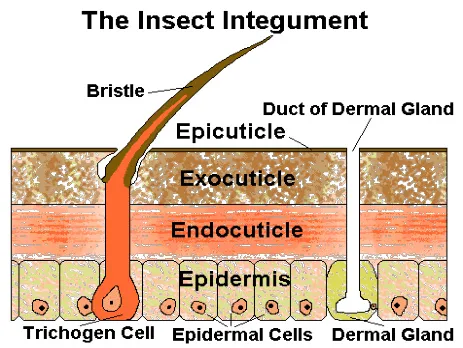
The cuticle is divided into three main layers:
- Endocuticle - the inner and thickest layer; soft, colourless, and flexible; made mainly of chitin and arthropodin
- Exocuticle - harder and darker; composed mainly of chitin and sclerotin
- Epicuticle - the outermost thin layer
The epicuticle is further differentiated into:
- inner epicuticle containing wax filaments
- outer epicuticle associated with cuticulin
- cuticulin, a non-chitinous polymerized lipoprotein layer
- wax layer preventing desiccation
- cement layer protecting the wax layer
Composition of Cuticle and Endoskeleton
Important cuticular components include:
- Chitin - the main structural material; a nitrogenous polysaccharide and polymer of N-acetylglucosamine
- Arthropodin - an untanned cuticular protein that is water soluble
- Sclerotin - a tanned cuticular protein that is water insoluble
- Resilin - an elastic cuticular protein giving flexibility to movable sclerites, such as wing articulatory regions
Endoskeleton
The inward cuticular growth of the body wall that provides space for muscle attachment is called the endoskeleton.
Its two forms are:
- Apodeme - hollow invagination of the body wall
- Apophysis - solid invagination of the body wall
Cuticular Appendages and Glands
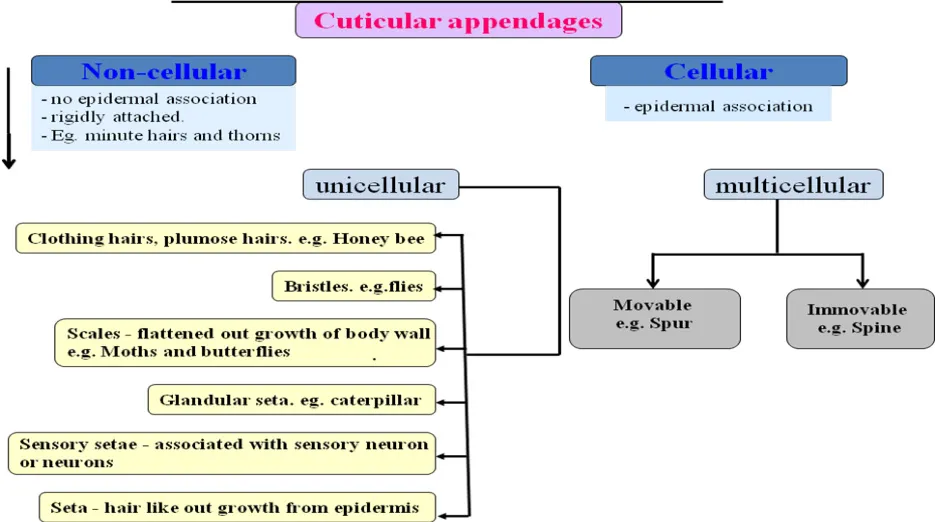
Cuticular appendages may be non-cellular or cellular.
Non-cellular appendages
These do not have epidermal association and remain rigidly attached. Examples include minute hairs and thorns.
Cellular appendages
These are associated with the epidermis.
Unicellular appendages include:
- clothing hairs and plumose hairs, as in honey bee
- bristles, as in flies
- scales, as in moths and butterflies
- glandular setae, as in caterpillars
- sensory setae associated with sensory neurons
A seta is a hair-like outgrowth. The epidermal cell that forms the seta is the trichogen, while the socket-forming cell is the tormogen. The study of seta arrangement is called chaetotaxy.
Multicellular appendages include:
- spur - movable structure
- spine - immovable structure
Cuticular glands
Cuticular glands may be unicellular or multicellular. Important examples include:
- wax gland in honey bee and mealy bug
- lac gland in lac insects
- moulting gland secreting moulting fluid
- androconia or scent scale in moths
- poison gland in slug caterpillar
Functions of the Body Wall
The insect body wall performs several essential functions:
- acts as an external armour
- strengthens structures such as jaws and ovipositor
- protects against physical injury, harmful chemicals, parasites, predators, and pathogens
- protects internal organs, foregut, hindgut, and tracheae
- provides attachment for muscles and gives body shape
- prevents excessive water loss
- supports sensory organs for interaction with the environment
- contributes colour through cuticular pigments
Moulting or Ecdysis
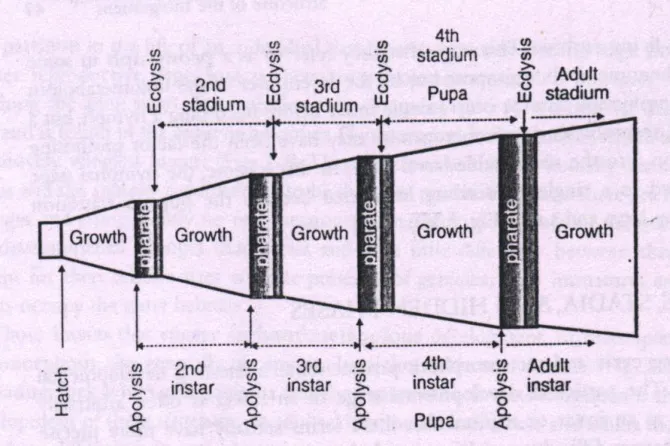
Moulting or ecdysis is the periodic shedding of the old cuticle followed by formation of a new one. The discarded cuticle is called exuvia.
Moulting occurs repeatedly during immature stages before adulthood. The interval between two moults is called a stadium, and the form assumed during one stadium is called an instar.
Steps in moulting
- Behavioural changes - the larva stops feeding and becomes inactive
- Changes in epidermis - epidermal cells enlarge, divide, and increase metabolic activity
- Apolysis - detachment of cuticle from epidermis
- Formation of subcuticular space
- Secretion of moulting gel rich in chitinase and protease
- Formation of new epicuticle
- Formation of procuticle below epicuticle
- Activation of moulting gel into moulting fluid and digestion of old endocuticle
- Formation of wax layer
- Formation of cement layer
- Actual moulting
During actual moulting:
- the old cuticle ruptures along a pre-determined weak line called the ecdysial line
- body movements and moulting fluid help remove the old cuticle
- discarded parts include cuticular coverings of legs and linings of foregut, hindgut, and tracheae
After ecdysis:
- the upper procuticle becomes exocuticle by tanning and protein addition
- the lower procuticle becomes endocuticle by addition of chitin and protein
Hormonal control
Moulting is controlled by endocrine glands. The prothoracic gland secretes moulting hormone, and its activity is stimulated by prothoracicotropic hormone released from neurosecretory cells of the brain.
Summary Cheat Sheet
- The insect body wall is called the integument or exoskeleton and is made of epidermis + cuticle.
- The cuticle has three major layers: endocuticle, exocuticle, and epicuticle.
- Chitin is the main structural constituent of cuticle.
- Arthropodin is untanned protein, sclerotin is tanned rigid protein, and resilin provides elasticity.
- The inward cuticular skeleton for muscle attachment is the endoskeleton, seen as apodemes and apophyses.
- Cuticular appendages may be non-cellular or cellular; important terms include seta, trichogen, tormogen, and chaetotaxy.
- Main body wall functions include protection, support, muscle attachment, prevention of water loss, sensation, and coloration.
- Moulting (ecdysis) is the periodic shedding of old cuticle; discarded cuticle is exuvia.
- Important moulting terms are stadium, instar, apolysis, subcuticular space, ecdysial line, and moulting fluid.
- Moulting is hormonally controlled mainly by the prothoracic gland under stimulation from the brain.
References
2 sources • [1] [2]
References
Fundamentals of Entomology
Insect Morphology and Systematics
Lesson Doubts
Ask questions, get expert answers