🦋 Metamorphosis and Diapause
Types of metamorphosis and the role of diapause in insect development and survival.
Metamorphosis explains how an insect changes form from egg to adult, while diapause explains how development can pause to survive unfavorable conditions. Both topics are important because they connect insect biology with seasonality, pest outbreaks, and field management.
Metamorphosis in Insects
All insects molt during growth, but the degree of change between juvenile and adult stages differs among groups. In some insects the young stage closely resembles the adult, while in others the body form changes completely through distinct larval and pupal stages.
No Metamorphosis
In insects showing no metamorphosis, the young resemble miniature adults and do not pass through sharply distinct developmental forms. Growth mainly involves increase in size through repeated molting.
Aphids are commonly cited as examples of this simple pattern. Their rapid reproduction under favorable conditions makes them agriculturally important despite their apparently simple life cycle.
Gradual Metamorphosis
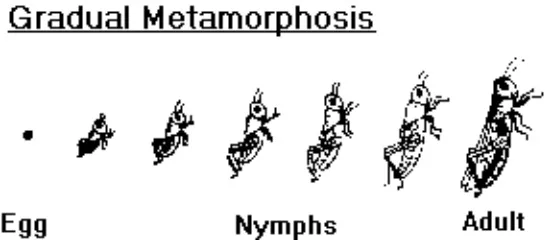
In gradual metamorphosis, the juvenile stage resembles the adult, but wings and reproductive structures are not fully developed. With each molt, body proportions change gradually, and wing buds appear only in later stages.
Examples include praying mantis and grasshopper. Newly hatched young already possess the general adult body plan with six legs, antennae, and similar mouthparts, but they are smaller and wingless.
Incomplete Metamorphosis
Incomplete metamorphosis involves nymphal stages followed by an abrupt transformation into the winged adult. This pattern is common in many aquatic insects where the juvenile stages are called naiads.
Dragonflies and damselflies are classic examples. Their naiads possess structures suited for aquatic life, such as external respiratory adaptations, but the adult becomes winged, aerial, and structurally very different. Compared with gradual metamorphosis, the final change is more dramatic.
Complete Metamorphosis
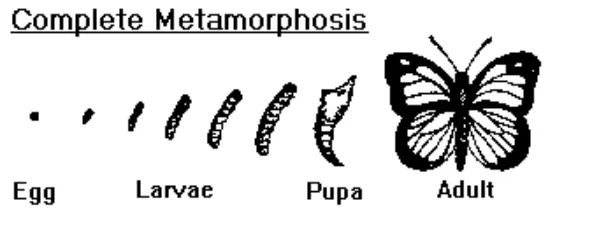
Complete metamorphosis is the most extensive type of developmental change. After hatching, the insect passes through four distinct stages:
- Egg
- Larva
- Pupa
- Adult or imago
Larvae are usually very different from the adult in body form, feeding habit, and habitat. The pupa is a transitional non-feeding stage in which larval tissues are reorganized and adult structures become functional. Butterflies, moths, beetles, flies, and wasps are common examples.
Metamorphosis of Various Insects
The following visuals and tables summarize the major metamorphic patterns across insect orders.
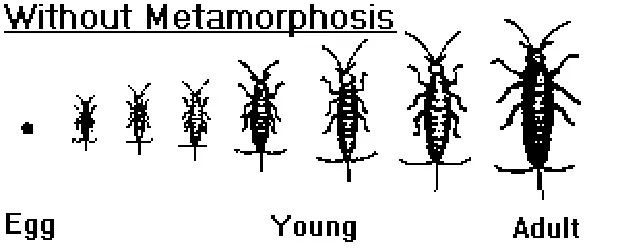
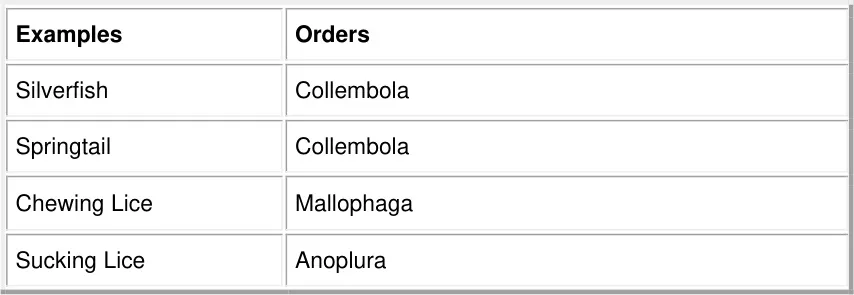
Orders commonly showing gradual or simple nymphal development
| Example | Order |
|---|---|
| Grasshoppers | Orthoptera |
| Termites | Isoptera |
| Booklice | Psocoptera (Corrodentia) |
| Thrips | Thysanoptera |
| True bugs | Hemiptera |
| Aphids | Homoptera |
| Earwigs | Dermaptera |
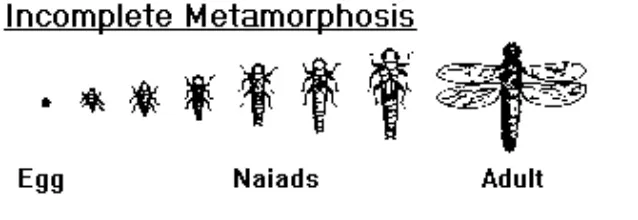
Orders with aquatic immature stages and marked transformation
| Example | Order |
|---|---|
| Mayflies | Ephemeroptera |
| Dragonflies | Odonata |
| Stoneflies | Plecoptera |
Orders showing complete metamorphosis
| Example | Order |
|---|---|
| Lacewing | Neuroptera |
| Beetles | Coleoptera |
| Scorpionfly | Mecoptera |
| Caddisfly | Trichoptera |
| Moths and butterflies | Lepidoptera |
| Flies | Diptera |
| Fleas | Siphonaptera |
| Wasps and bees | Hymenoptera |
Diapause
Diapause is a hormonally regulated resting phase in which growth, development, or reproduction is temporarily suspended even when conditions may appear suitable for activity. It is an adaptive mechanism that helps insects survive unfavorable seasons such as drought, winter, or host unavailability.
Key features of diapause
- It is a programmed physiological arrest, not just short-term inactivity.
- It helps synchronize the life cycle with favorable environmental conditions.
- It may occur in egg, larval, pupal, or adult stage depending on the species.
- It is commonly triggered by environmental signals such as photoperiod, temperature, moisture, and food availability.
Importance of diapause in agriculture
- It allows pests to survive between crop seasons.
- It influences the timing of emergence and seasonal infestation.
- It helps explain why some pests suddenly reappear after long inactive periods.
- It is useful in forecasting pest incidence and planning management schedules.
Summary Cheat Sheet
- Metamorphosis: Change in body form during development.
- No metamorphosis: Young resemble adults; change is mainly in size.
- Gradual metamorphosis: Nymph resembles adult and develops wings gradually.
- Incomplete metamorphosis: Naiad or nymph changes abruptly into winged adult.
- Complete metamorphosis: Egg -> larva -> pupa -> adult.
- Larva: Active feeding stage in holometabolous insects.
- Pupa: Resting transitional stage where adult structures develop.
- Imago: Fully formed adult insect.
- Diapause: Physiological resting period that helps survival during adverse conditions.
- Exam tip: Be ready to distinguish gradual, incomplete, and complete metamorphosis with one insect order example for each.
References
2 sources • [1] [2]
References
Fundamentals of Entomology
Insect Morphology and Systematics
Lesson Doubts
Ask questions, get expert answers