🥚 Insect Reproductive System
Male and female reproductive organs and their importance in insect development and taxonomy.
Insect reproduction is closely tied to population growth, pest outbreaks, and species survival. Understanding the male and female reproductive organs also helps in taxonomy, physiology, and applied insect control studies.
General Features of Insect Reproduction
In most insects, the sexes are separate. Sexual dimorphism is common, meaning males and females differ in body form or secondary sexual characters.
Examples include:
- Bee
- Mosquito
- Cockroach
Two special reproductive conditions are commonly noted.
Gynandromorph An abnormal individual showing both male and female secondary sexual characters in different body regions. It is often called a sexual mosaic. Example: mutant Drosophila.
Hermaphrodite A single individual possesses both male and female gonads. Example: cottony cushion scale.
Female Reproductive System
The main functions of the female reproductive system are:
- Production of eggs
- Storage of sperm until fertilization
- Protection and deposition of eggs
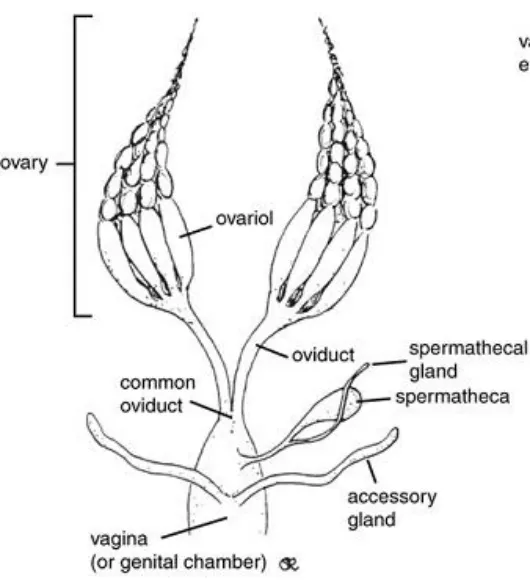
The basic female reproductive system includes:
- Paired ovaries
- Lateral oviducts
- Common or median oviduct
- Genital chamber
- Spermatheca
- Accessory glands
Ovaries and oviducts
Each ovary releases mature oocytes through the calyx into a lateral oviduct. The two lateral oviducts unite to form the common oviduct.
The opening of the common oviduct is the gonopore. It usually opens into a cavity called the genital chamber, which during mating functions as a copulatory pouch known as the bursa copulatrix. The external opening is the vulva. In some insects, the genital chamber forms an enclosed tube called the vagina.
Spermatheca
The spermatheca is a sac-like ectodermal organ that stores spermatozoa until the eggs are ready to be fertilized. It often has:
- A slender duct
- A diverticulum
- A spermathecal gland that nourishes stored sperm
Accessory glands
Female accessory glands open into the genital chamber. They are often called colleterial glands or cement glands because their secretions protect eggs or help attach them to a surface.
Functions and examples:
- Egg case formation in mantis
- Ootheca formation in cockroach
- Venom-related glandular secretion in bees
Ovarioles
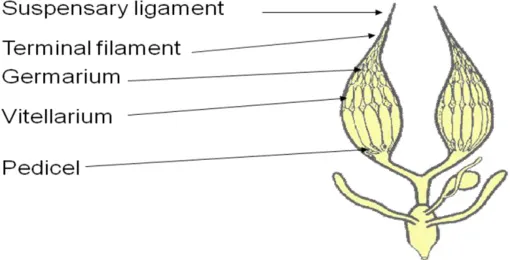
Each ovary consists of several ovarian tubes called ovarioles. Each ovariole has:
- Terminal filament
- Germarium
- Vitellarium
- Pedicel
The germarium forms primary oocytes by mitosis. In the vitellarium, the oocytes enlarge through deposition of yolk, a process called vitellogenesis. Each developing oocyte is surrounded by follicle cells, together forming a follicle.
Types of Ovarioles
Ovarioles are classified by how the developing oocytes receive nourishment.
1. Panoistic ovariole
No specialized nurse cells are present. Oocytes receive nutrients directly from the haemolymph through the follicular epithelium. Example: cockroach.
2. Telotrophic or acrotrophic ovariole
Trophocytes remain in the germarium and stay connected to oocytes by cytoplasmic strands as the oocytes move downward. Example: bugs.
3. Polytrophic ovariole
Each oocyte is associated with its own trophocytes, which move with it and provide nourishment. Examples: moths and flies.
Structure of Egg
Important parts of an insect egg include:
- Chorion
- Vitelline membrane
- Micropyle
- Periplasm with yolk
Male Reproductive System
The male reproductive system is mainly concerned with:
- Production of spermatozoa
- Storage of sperm
- Transfer of sperm to the female in a viable condition
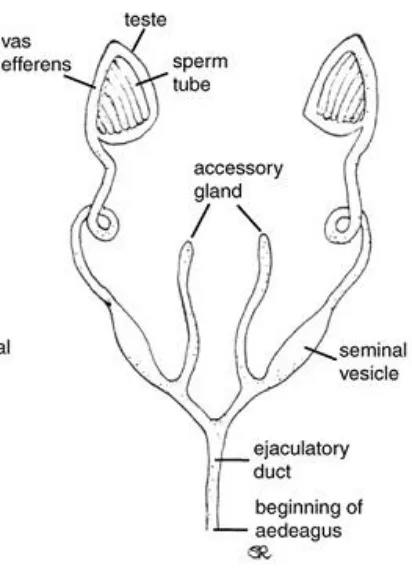
The male tract typically consists of:
- Paired testes
- Testicular follicles
- Vasa deferentia
- Seminal vesicles
- Accessory glands
- Ejaculatory duct
Testes and sperm ducts
Each testis contains a series of testicular follicles where spermatozoa are produced. These open into the vas deferens, which often widens posteriorly to form a seminal vesicle for sperm storage.
Accessory glands
Accessory glands may be one to three pairs. They may arise from the vasa deferentia or ejaculatory duct and may be mesodermal or ectodermal in origin.
Their functions include:
- Secretion of seminal fluid
- Formation of spermatophores, which are sperm-containing capsules
Ejaculatory duct
The paired vasa deferentia unite and lead into the ejaculatory duct, which transports semen to the gonopore.
Summary Cheat Sheet
- Sexes in insects: Usually separate.
- Sexual dimorphism: Male and female differ morphologically.
- Gynandromorph: Individual with both male and female secondary sexual traits.
- Hermaphrodite: One organism with both male and female gonads.
- Female organs: Ovaries, oviducts, genital chamber, spermatheca, accessory glands.
- Spermatheca: Stores sperm for later fertilization.
- Ovarioles: Functional units of the ovary.
- Ovariole types: Panoistic, telotrophic, polytrophic.
- Male organs: Testes, vasa deferentia, seminal vesicle, accessory glands, ejaculatory duct.
- Seminal vesicle: Stores sperm.
- Spermatophore: Capsule containing sperm.
- Exam tip: Learn the parts of female and male systems separately and compare the three ovariole types with one example each.
References
2 sources • [1] [2]
References
Fundamentals of Entomology
Insect Morphology and Systematics
Lesson Doubts
Ask questions, get expert answers