🧠 Insect Nervous System Structure
Central, visceral, and peripheral nervous systems and their role in insect coordination.
The insect nervous system coordinates sensation, movement, feeding, respiration, reproduction, and behavior. Even though the insect body is small, its neural organization is highly specialized, with distinct ganglia and nerve networks that allow fast and precise control of body functions.
Structure and Functions of the Nervous System
The basic structural and functional unit of the nervous system is the neuron or nerve cell. A neuron consists of:
- A cell body
- One or more dendrites that receive stimuli
- An axon that carries impulses away from the cell body
The axon may show:
- Collateral branches
- Terminal arborization
- A synapse, where one neuron communicates with another neuron or an effector organ such as a muscle
Neurons release chemical transmitters at synapses. Important insect neurotransmitters include:
- Acetylcholine
- Catecholamines such as dopamine
Types of Neurons
Structural classification
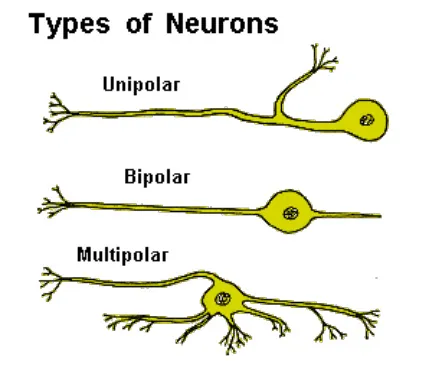
1. Monopolar neuron Has a single axon.
2. Bipolar neuron Has one proximal axon and one distal dendrite.
3. Multipolar neuron Has one proximal axon and many distal dendrites.
Functional classification
1. Sensory neuron Carries impulses from sense organs to the central nervous system.
2. Motor neuron Carries impulses from the central nervous system to muscles or other effector organs.
3. Interneuron or association neuron Links sensory and motor neurons and helps integrate responses.
The cell bodies of interneurons and motor neurons are often grouped together with nerve fibers to form ganglia, which act as nerve centers.
Mechanism of Impulse Conduction
Nerve impulses are conducted in two main ways.
A. Axonic conduction
Variation in ionic composition between the inside and outside of the axon creates an excitable state. This leads to conduction of impulses as an electrical response along the neuron.
B. Synaptic conduction
At the synapse, neurochemical transmitters help carry the impulse across the synaptic gap.
A commonly cited reaction involving acetylcholine is:
- Acetyl Co-A + choline --choline acetylase--> acetylcholine
- Acetylcholine + water --acetylcholine esterase--> choline + acetic acid
Divisions of the Nervous System
The insect nervous system is commonly divided into:
- Central nervous system
- Visceral nervous system
- Peripheral nervous system
Central Nervous System
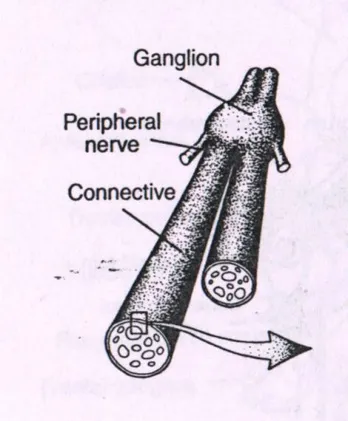
The central nervous system contains a double series of nerve centers called ganglia. These ganglia are connected by:
- Connectives: longitudinal nerve tracts
- Commissures: transverse nerve tracts
Major components are as follows.
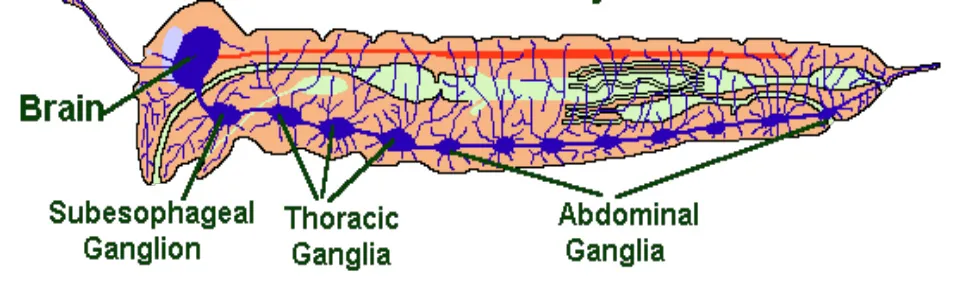
1. Brain
The brain is formed by fusion of the first three cephalic neuromeres.
Protocerebrum
- Largest part
- Innervates compound eyes and ocelli
Deutocerebrum
- Lies below the protocerebrum
- Innervates antennae
Tritocerebrum
- Bilobed
- Innervates the labrum
Main function of brain
- Acts as the chief sensory and behavioral control center
2. Ventral nerve cord
This is a median chain of segmental ganglia lying below the oesophagus.
3. Suboesophageal ganglion
Formed by fusion of the last three cephalic neuromeres. It innervates:
- Mandibles
- Maxillae
- Labium
4. Thoracic ganglia
Usually three pairs, one in each thoracic segment. These are well developed and control:
- Legs
- Thoracic muscles
5. Abdominal ganglia
Commonly eight pairs, though the number may vary because of fusion. These ganglia innervate abdominal organs including spiracles.
6. Thoraco-abdominal ganglia
In some insects, thoracic and abdominal ganglia fuse into a compound ganglion that also innervates genital organs and cerci.
Visceral Nervous System
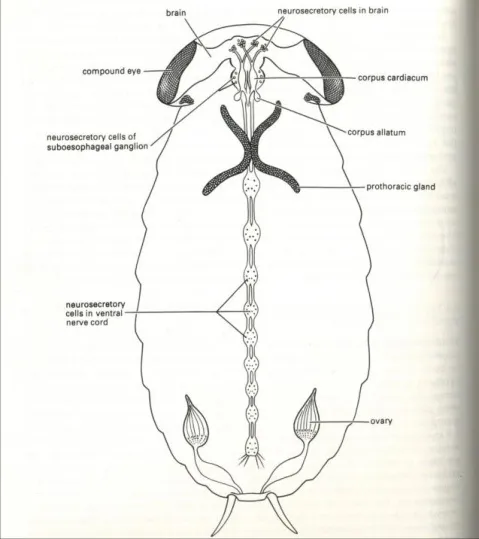
The visceral or sympathetic nervous system is associated mainly with internal organs. It has three subsystems:
- Stomodeal or stomatogastric system
- Ventral visceral system
- Caudal visceral system
Together, these nerves and ganglia innervate:
- Anterior and posterior gut
- Corpora cardiaca
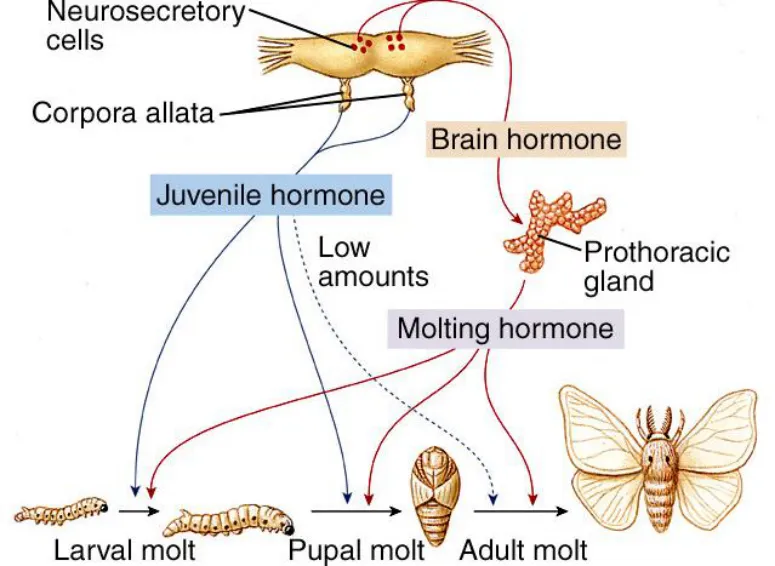
- Corpora allata
- Reproductive organs
- Tracheal system including spiracles
Peripheral Nervous System
The peripheral nervous system consists of:
- Motor axons radiating from the ganglia to muscles
- Sensory neurons associated with cuticular sense organs
These sensory structures receive:
- Mechanical stimuli
- Chemical stimuli
- Thermal stimuli
- Visual stimuli
Summary Cheat Sheet
- Basic unit: Neuron.
- Receiving process: Dendrite.
- Transmitting process: Axon.
- Nerve center: Ganglion.
- Sensory neuron: Carries impulses to CNS.
- Motor neuron: Carries impulses from CNS to effectors.
- Interneuron: Connects sensory and motor pathways.
- Brain parts: Protocerebrum, deutocerebrum, tritocerebrum.
- Main CNS features: Brain, suboesophageal ganglion, ventral nerve cord, thoracic and abdominal ganglia.
- Visceral nervous system: Supplies gut, endocrine glands, reproductive organs, and spiracles.
- Peripheral nervous system: Connects ganglia with muscles and sensory organs.
- Key neurotransmitter example: Acetylcholine.
- Exam tip: Learn the divisions of the nervous system and one main function of each part of the brain.
References
2 sources • [1] [2]
References
Fundamentals of Entomology
Insect Morphology and Systematics
Lesson Doubts
Ask questions, get expert answers