🌬️ Insect Respiratory System Structure
Tracheal system organization and gaseous exchange in insects.
Insects meet their oxygen demand through a highly specialized tracheal system rather than through blood-based gas transport. Air is delivered directly to tissues by branching tubes, making respiration fast and efficient even in very small body spaces.
Structure and Functions of the Respiratory System
Like all aerobic organisms, insects must take in oxygen and eliminate carbon dioxide. In insects, this gas exchange takes place through a network of internal air-filled tubes called tracheae.
Important points:
- Air is supplied directly to tissues
- Haemolymph does not usually transport respiratory gases
- Gas exchange mainly occurs through tracheae and tracheoles
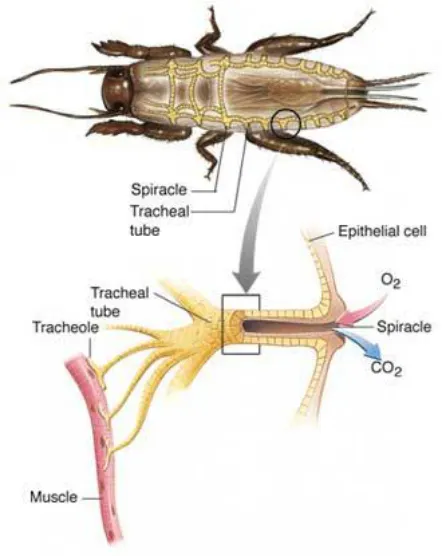
- Spiracles serve as the external openings of the system
The finest tracheal branches are called tracheoles. These extend close to all active tissues and are especially abundant in organs with high oxygen demand.
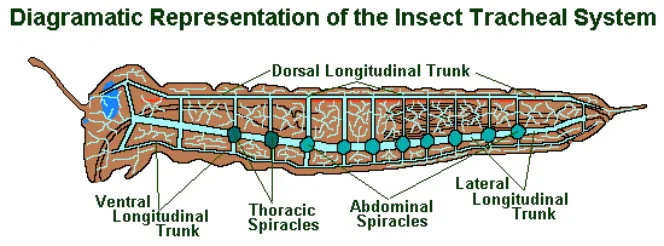
No insect has more than ten pairs of spiracles:
- 2 thoracic pairs
- 8 abdominal pairs
Classification Based on Functional Spiracles
Respiratory systems are classified by the number and distribution of functional spiracles.
| Type | Functional spiracles | Example |
|---|---|---|
| Holopneustic | 10 pairs: 2 thoracic + 8 abdominal | Grasshopper |
| Hemipneustic | Out of 10 pairs, one or two are non-functional | General pattern |
| Peripneustic | 9 pairs: 1 thoracic + 8 abdominal | Caterpillar |
| Amphipneustic | 2 pairs: one anterior and one posterior | Maggot |
| Propneustic | 1 anterior pair only | Puparium |
| Metapneustic | 1 posterior pair only | Mosquito wriggler |
| Hypopneustic | 7 functional out of 10 | Head louse |
| Apneustic | Spiracles absent or closed; closed tracheal system | Mayfly naiad |
Organs of Respiration
Spiracles
Spiracles are the external openings of the respiratory system. Each spiracle has:
- An atrium
- A valve for opening and closing
- A sclerotized cuticular border called the peritreme
The valve regulates entry and exit of air and helps reduce water loss.
Tracheae
Tracheae are invaginations of the epidermis, and their lining is continuous with the body cuticle. Their ringed appearance is due to spiral thickenings called taenidia.
Functions of taenidia:
- Keep tracheae flexible
- Prevent collapse during body movements
Tracheal lining is shed during moulting.
Tracheoles
Tracheoles are the finest branches of the tracheal system and are usually less than 1 micrometer in diameter.
Important features:
- Blind-ending
- Closely associated with respiring tissues
- Main sites of gaseous exchange
- Lack taenidia and wax layer
- Lined by permeable cuticulin
- Associated with tracheal cells called tracheoblasts
Tracheal trunks
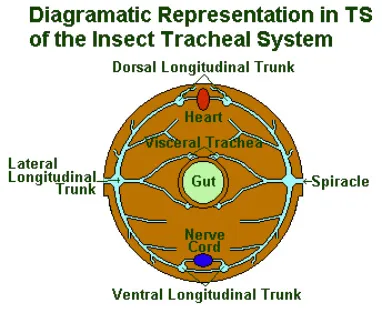
Four major tracheal trunks are commonly recognized:
- Lateral
- Dorsal
- Ventral
- Visceral
These conduct air to different body regions.
Air sacs
Some tracheae form thin-walled, collapsible dilations called air sacs. These lack taenidia.
Functions of air sacs:
- Act as oxygen reservoirs
- Provide buoyancy in aquatic insects
- Lighten the body in flying insects
- Provide space for growing organs
- Act as sound resonators
- Help in insulation
Mechanism of Respiration
Oxygen enters through spiracles and moves along the tracheae into the tracheoles, finally reaching body cells. This movement occurs by a combination of:
- Ventilation
- Diffusion
The movement follows a concentration gradient:
- Oxygen moves inward from higher concentration in air to lower concentration in tissues
- Carbon dioxide and water vapor move outward
Thus:
- Inward movement of oxygen is inspiration
- Outward movement of carbon dioxide and water vapor is expiration
Respiration in Aquatic Insects
Aquatic insects show several special respiratory adaptations.
1. Closed tracheal system
In some aquatic and many endoparasitic larvae, spiracles are absent. The tracheae divide extensively near the body surface, allowing cutaneous respiration.
Examples of tracheated gills:
- Lamellate gills: mayfly naiads
- Filamentous gills: damselfly naiads
- Rectal gills: dragonfly naiads
2. Open tracheal system
Some aquatic insects retain spiracular contact with air or store air externally.
Examples:
- Air store or physical gill: air bubble beneath wings in water bugs
- Respiratory siphon: mosquito wriggler
- Caudal breathing tube: water scorpion
- Plastron: thin air film held by hydrofuge hairs of epicuticle
Summary Cheat Sheet
- Main respiratory organ: Tracheal system.
- External openings: Spiracles.
- Main tubes: Tracheae.
- Finest branches: Tracheoles.
- Gas exchange site: Tracheoles.
- Supportive spiral ridges: Taenidia.
- Spiracle border: Peritreme.
- Air sacs: Tracheal dilations lacking taenidia.
- Maximum spiracles: 10 pairs.
- Holopneustic: 10 functional spiracles.
- Amphipneustic: Only anterior and posterior spiracles functional.
- Apneustic: No functional spiracles; common in some aquatic immatures.
- Exam tip: Learn the spiracle-based classification and one aquatic respiratory adaptation example for each type.
References
2 sources • [1] [2]
References
Fundamentals of Entomology
Insect Morphology and Systematics
Lesson Doubts
Ask questions, get expert answers