💧 Insect Excretory System Structure
Excretory organs and waste-removal mechanisms operating in insects.
Excretion in insects is not only about removing nitrogenous wastes. It is also essential for maintaining water balance, ionic balance, and overall physiological homeostasis. Because insects often live in dry terrestrial habitats, their excretory system is highly adapted for conserving water while still eliminating toxic wastes.
Structure and Functions of the Excretory System
Excretion is the process by which metabolic wastes, especially nitrogenous compounds, are removed from the insect body. The excretory system also helps regulate:
- Salt balance
- Water balance
- Osmotic pressure
- Internal physiological stability
Several structures contribute to excretion in insects.
Different Excretory Organs and Their Roles
1. Malpighian tubules
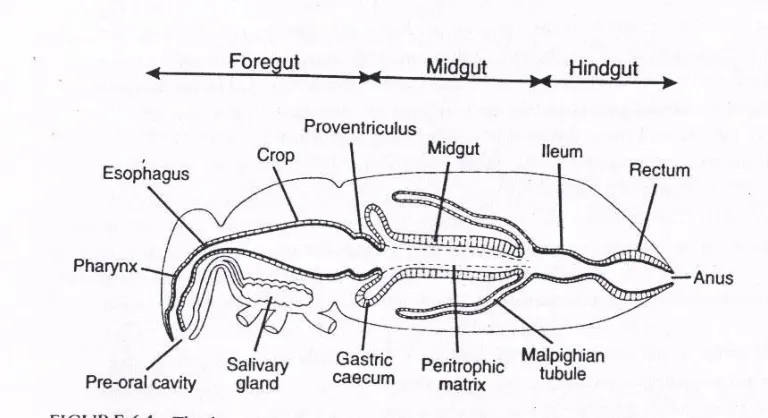
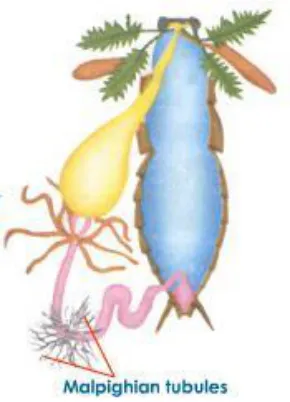
These are thin, blind-ending tubules arising near the junction of the midgut and hindgut. They are the principal organs of excretion and osmoregulation in most insects.
2. Nephrocytes
These are specialized cells, often called pericardial cells, that sieve the haemolymph and remove certain metabolic products.
3. Fat body
The fat body is a loose or compact mass of cells, mainly trophocytes, suspended in the haemocoel. It is involved in storage and in some forms of storage excretion.
4. Oenocytes
These cells occur in the haemocoel, epidermis, or fat body and perform several metabolic functions, including roles connected with excretion.
5. Integument
The insect body wall also participates in removal or deposition of certain waste products.
6. Tracheal system
The gas exchange system may assist in removal of gaseous metabolic wastes.
7. Rectum
The posterior part of the hindgut plays a major role in reabsorption of water and salts before waste is eliminated.
Among all these, the Malpighian tubules are the major excretory organs.
Excretion and Osmoregulation
In insect excreta, undigested food and metabolic wastes are eliminated together. The form of excreta depends on habitat.
- Aquatic insects can flush dilute wastes directly into the surrounding water
- Terrestrial insects must conserve water and therefore excrete more concentrated wastes
Thus, insect excretion is closely linked with osmoregulation, which means maintaining favorable osmotic pressure and ionic concentration of body fluids.
Freshwater insects often face ion loss to the surrounding medium. In some aquatic immature insects, special chloride cells help absorb inorganic ions from dilute solutions. Example: naiads of dragonflies and damselflies.
Malpighian Tubules
Malpighian tubules are the chief organs of excretion and osmoregulation. They function together with the rectum or ileum.
General features
- They are outgrowths of the alimentary canal
- Each tubule is long, thin, and blind-ended
- The wall consists of a single layer of cells surrounding a lumen
- They are usually free in the haemocoel and bathed by haemolymph
- They are externally covered by a peritoneal coat
- They are supplied with tracheoles and muscle fibers
Number in different insects
- Absent in springtails and aphids
- 2 in scale insects
- 4 in bugs
- 5 in mosquitoes
- 6 in moths and butterflies
- About 60 in cockroach
- More than 200 in locusts
Functional differentiation is often seen:
- Distal region: mainly secretory
- Proximal region: mainly absorptive
Physiology of Malpighian Tubules
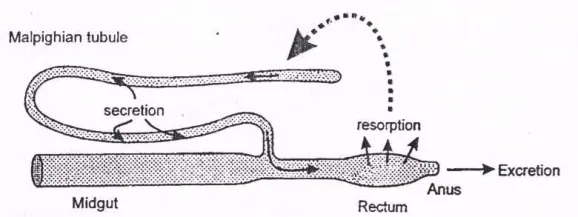
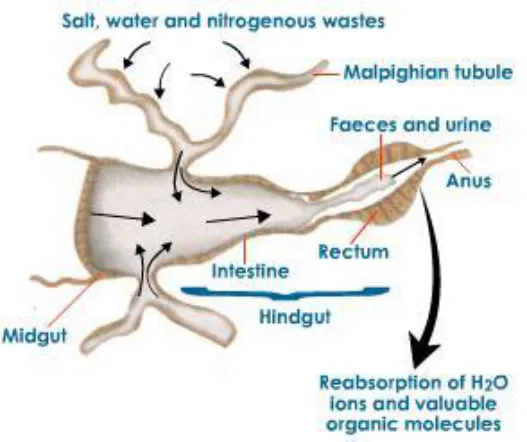
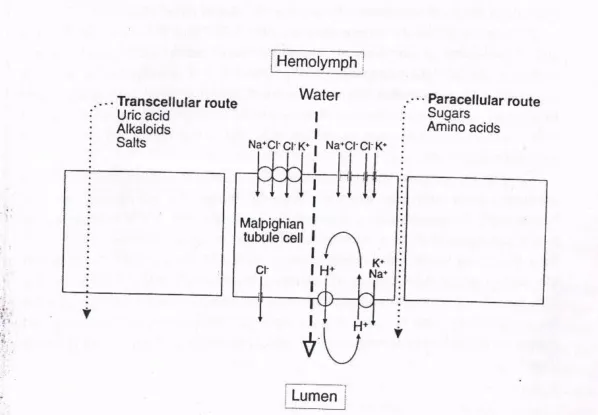
Malpighian tubules produce a primary urine that is usually isosmotic with haemolymph but differs in ionic composition.
Important features of the process:
- Potassium ions are actively transported into the tubule lumen
- Chloride acts as the major accompanying anion
- Water follows passively because of the osmotic gradient
- Sugars and amino acids may enter passively
- Some toxic compounds are actively secreted into the lumen
- Useful substances may later be reabsorbed
The primary urine then passes into the hindgut, where water and solutes are reabsorbed according to the needs of the insect.
Nitrogen Excretion
The nitrogenous waste product differs with habitat.
Uricotelism
Terrestrial insects usually excrete uric acid or urates. These are poorly soluble in water and therefore conserve body water.
Ammonotelism
Aquatic insects often excrete ammonia, which is highly soluble in water but requires abundant water for elimination.
Cryptonephry
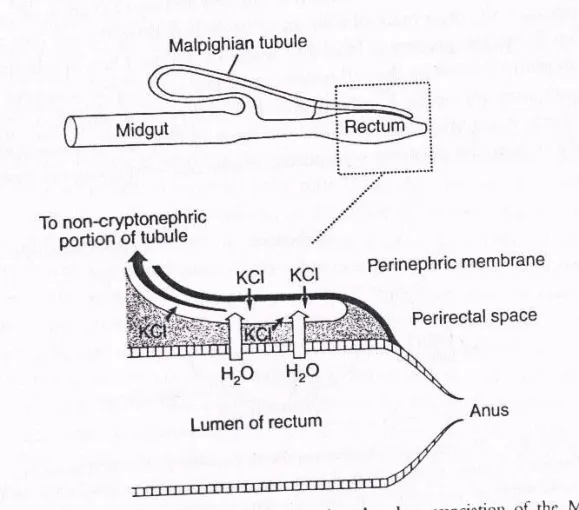
In some insects, the distal ends of Malpighian tubules remain in close contact with the rectal wall by means of a perinephric membrane. This condition is called cryptonephry.
Its importance includes:
- Efficient dehydration of faeces
- Improved ionic regulation
It is found in:
- Adult Coleoptera
- Larval Lepidoptera
- Larval Symphyta
Functions of Malpighian Tubules
The major function is removal of nitrogenous waste, but some accessory roles are also reported.
- Excretion of nitrogenous wastes
- Water and ion regulation
- Spittle secretion in spittle bug
- Light production in Bolitophila
- Silk production in larval Neuroptera
Storage Excretion
In storage excretion, waste products are retained in different parts of the body instead of being eliminated immediately.
Examples:
- Uric acid stored in fat body cells, as in American cockroach
- Uric acid stored in body wall, giving white coloration in red cotton bug
- Uric acid stored in male accessory glands to form the outer coating of spermatophore
- Uric acid stored in wing scales, producing white coloration in pierid butterflies
- Meconium, the waste of pupal metabolism, is stored and discharged during adult emergence
Summary Cheat Sheet
- Main excretory organ: Malpighian tubules.
- Main functions of excretion: Waste removal, water balance, salt balance, and homeostasis.
- Malpighian tubules arise from: Junction of midgut and hindgut.
- Tubule wall: Single layer of cells surrounding a lumen.
- Primary urine: Formed in Malpighian tubules; modified in rectum or ileum.
- Uricotelism: Excretion of uric acid, common in terrestrial insects.
- Ammonotelism: Excretion of ammonia, common in aquatic insects.
- Cryptonephry: Close association of Malpighian tubules with rectum for water conservation.
- Nephrocytes: Haemolymph-filtering cells.
- Chloride cells: Help absorb ions in certain aquatic immature insects.
- Storage excretion: Waste retained in fat body, body wall, glands, scales, or meconium.
- Exam tip: Compare uricotelism and ammonotelism, and be ready to draw the Malpighian tubule association with hindgut.
References
2 sources • [1] [2]
References
Fundamentals of Entomology
Insect Morphology and Systematics
Lesson Doubts
Ask questions, get expert answers