❤️ Insect Circulatory System Structure
Open circulatory system, haemolymph flow, and dorsal vessel structure in insects.
Insects do not have a closed system of arteries and veins like vertebrates. Instead, they possess an open circulatory system in which haemolymph flows through the body cavity and bathes the organs directly. This system is important for transport, internal pressure, immunity, and physiological coordination.
Structure and Functions of the Circulatory System
Circulation in insects is maintained by muscular pumps that move haemolymph through body compartments separated by fibromuscular membranes. The main pumping organ is the dorsal vessel.
Dorsal vessel
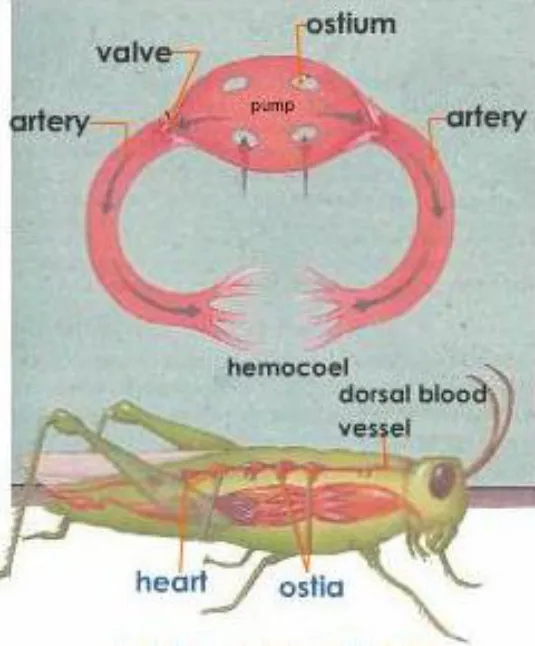
The dorsal vessel is a longitudinal tube lying dorsally in the body cavity. It is generally made of a single layer of myocardial cells.
- The anterior portion is called the aorta
- The posterior portion is called the heart
- Segmentally arranged openings called ostia allow haemolymph to enter
- Valves associated with ostia prevent backflow
There may be up to three pairs of thoracic ostia and nine pairs of abdominal ostia.
Pericardial sinus and dorsal diaphragm
The dorsal vessel lies in the pericardial sinus, a compartment above the dorsal diaphragm. The dorsal diaphragm is a fibromuscular septum formed with connective tissue and segmental pairs of alary muscles.
Alary muscles support the dorsal vessel and help maintain its position.
Haemolymph flow
Haemolymph enters the pericardial sinus and then passes into the dorsal vessel through the ostia during relaxation. Contraction waves usually begin at the posterior end and pump haemolymph forward through the heart and out via the aorta into the head. It then circulates through the head and thorax before moving posteriorly and returning again.
Ventral diaphragm
Another important structure is the ventral diaphragm, a fibromuscular septum located near the ventral nerve cord. Its peristaltic contractions help move haemolymph backward and laterally in the perineural sinus.
Functions of the ventral diaphragm include:
- Assisting haemolymph circulation
- Facilitating exchange between haemolymph and ventral nerve cord
- Supporting thermoregulation in some insects
Accessory pulsatile organs
Haemolymph flow to appendages such as antennae, legs, and sometimes wings is aided by accessory pumps called accessory pulsatile organs.
- At the base of antennae and legs they ensure unidirectional flow
- Antennal pulsatile organs may help transport neurohormones
- In wings of young adults, circulation may also be aided by air movement in the wing veins
Haemolymph and Its Functions
Haemolymph is the circulating body fluid of insects. It performs the combined role of blood and lymph, but unlike vertebrate blood, it generally does not carry respiratory gases. It is usually clear and colorless, though it may sometimes be pigmented. In a few aquatic or endoparasitic larvae such as chironomid larvae, haemoglobin may be present.
Haemolymph has two main components:
- Plasma or fluid portion
- Haemocytes or cellular components
Plasma
Plasma is an aqueous solution containing inorganic ions, sugars, amino acids, proteins, lipids, organic acids, and waste products.
Important features:
- pH is usually around 6.7
- Density ranges from 1.01 to 1.06
- Water content is about 84 to 92 percent
- Main blood sugar is trehalose
- Nitrogenous waste is commonly present as uric acid
- Glycerol may occur in high-altitude insects and acts as an antifreezing compound
Common protein forms include lipoproteins, glycoproteins, and enzymes. High amino acid concentration may produce aminoacidemia, which affects osmotic balance.
Haemocytes
Haemocytes are nucleated blood cells found in haemolymph. Major types include:
- Prohaemocyte: smallest cell with relatively large nucleus
- Plasmatocyte: important in phagocytosis
- Granular haemocyte: contains many cytoplasmic inclusions
- Spherule cell: inclusions may obscure the nucleus
- Cystocyte or coagulocyte: involved in coagulation
- Oenocytoid: large cell with eccentric nucleus
- Adipohaemocyte: contains fat droplets
- Podocyte: large flattened cell with projections
- Vermiform cell: rare, thread-like cell
Functions of Haemolymph
1. Lubrication
Haemolymph keeps internal tissues moist and makes organ movement easier.
2. Hydraulic medium
Hydrostatic pressure generated by haemolymph helps in:
- Ecdysis or moulting
- Wing expansion after adult emergence
- Eclosion in Diptera using the ptilinum
- Eversion of penis in male insects
- Eversion of osmeteria in papilionid larvae
- Eversion of the labial mask in dragonfly naiads
- Maintenance of body shape in soft-bodied larvae
3. Transport and storage
Haemolymph transports digested nutrients, hormones, metabolites, and in rare cases respiratory pigments. It also carries waste to excretory organs and stores water and raw materials required for histogenesis.
4. Protection
Haemolymph participates in:
- Phagocytosis
- Encapsulation
- Detoxification
- Coagulation
- Wound healing
Non-cellular factors such as lysozymes also help destroy invading microbes.
5. Heat transfer
Movement of haemolymph helps regulate body temperature in some insects.
6. Osmotic regulation
Ions, amino acids, and organic acids in haemolymph help maintain osmotic pressure required for normal physiological processes.
7. Reflex bleeding
Some insects exude haemolymph through pores or body openings as a defense against predators. This is called reflex bleeding. Example: aphids.
8. Metabolic medium
Haemolymph serves as a medium for ongoing metabolic reactions, including interconversion of stored and circulating nutrients such as trehalose and glucose.
Summary Cheat Sheet
- Circulatory type: Open circulatory system.
- Main pumping organ: Dorsal vessel.
- Anterior part: Aorta.
- Posterior part: Heart.
- Ostia: Segmental openings that allow haemolymph entry into the heart.
- Pericardial sinus: Region containing the dorsal vessel.
- Dorsal diaphragm: Fibromuscular septum associated with alary muscles.
- Ventral diaphragm: Helps haemolymph circulation near the ventral nerve cord.
- Accessory pulsatile organs: Pumps at appendage bases for circulation in antennae and legs.
- Haemolymph components: Plasma and haemocytes.
- Main sugar: Trehalose.
- Respiration note: Haemolymph generally does not transport oxygen.
- Exam tip: Be ready to write the path of haemolymph flow and list the major functions of haemolymph separately.
References
2 sources • [1] [2]
References
Fundamentals of Entomology
Insect Morphology and Systematics
Lesson Doubts
Ask questions, get expert answers