🐞 History of Beekeeping
Trace the development of beekeeping from early honey collection to organized apiary practice and scientific apiculture.
This lesson introduces the historical development of beekeeping and explains key honey bee species, castes, behavior patterns, and colony management concepts important for apiculture and crop pollination systems.
Lecture 2: Honey bees:- History of bee keeping
Honey bees and their usefulness are known to man from prehistoric times. Mention of bees are found in vedas, Ramayan and Quran. The modern bee keeping became possible after the discovery of movable frame hive in 1851 by Rerd. L.L.Langshoth. In India beekeeping was introduced in 1882 in Bengal. Rerd. Newton introduced beekeeping to south India in 1911. But still India is much behind USA, Canada, Europe, Australia and Newzealand in beekeeping.
Bee species
There are five important species of honey bees as follows. Apis dorsata : The rock bee Apidae. Apis cerana indica: The Indian hive bee Apidae. Apis florea : The little bee Apidae. Apis mellifera : The European or Italian bee Apidae. Melipona irridipennis : Danner bee, Meliporidae stingless bee.
Apis dorsata:-
- They construct single comb in open (About 6ft long and 3ft deep)
- They shift the place of the colony often.
- Rock bees are ferocious and difficult to rear.
- They produce about 36 Kg honey /comb/year.
- The bees are the largest among the bee described.
Apis florea
- They also construct comb in open of the size of palm in branches of bushes,
hedges, buildings, caves, empty cases etc. 2. They produce about 1/2Kg honey/year/hive. 3. They are not rearable as they frequently change their palce. 4. The size of the bees is smallest among 4 Apis Sp. Described. (smaller than Indian
bee). 5. They distributed only in plains and not in hills above 450M.
Apis cerana indica (Indian bee/Asian bee)
- They make multiple parallel combs on trees and cavities in darkness.
- The bees are larger than Apis florae but smaller than Apis mellifera.
- They produce about 5Kg of honey/year/hive.
- They are more prone to swarming and absconding.
- They are native of India/Asia.
Apis mellifera (Italian bee or European bee)
- They also make multiple parallel combs in cavities in darkness.
- They are larger than Indian bees but smaller than Rock bees.
- They have been imported from European countries.(Italy)
- They yield on an average 35Kg/hive/year.
- They are less prone to swarming and absconding.
Honey bee castes
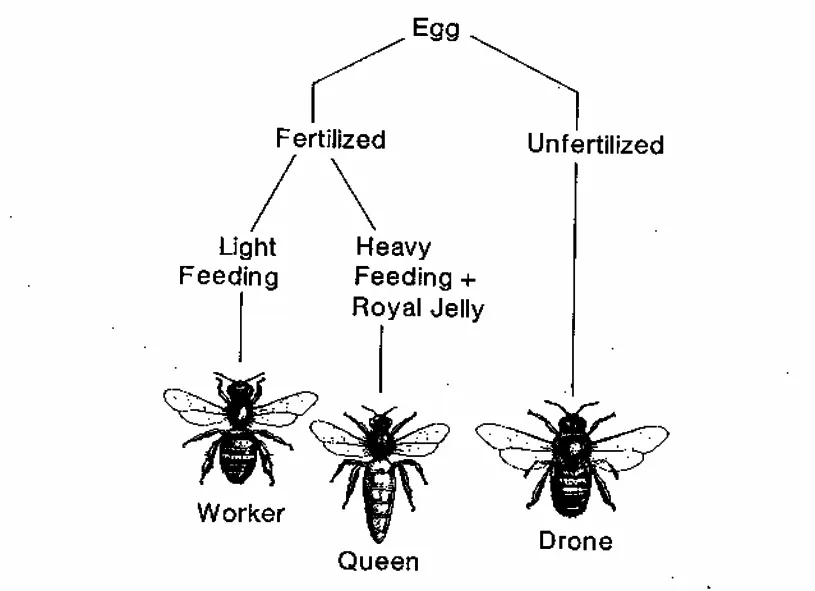
Every honey bee colony comprises of a single queen, a few hundred drones and several thousand worker castes of honey bees. Queen is a fertile, functional female, worker is a sterile female and the drone is a male insect.
Duties of a queen
- The only individual which lays eggs in a colony .(Mother of all bees).
- Lays upto 2000/day in Apis mellifera.
- Five to Ten days after emergence, she mates with drones in one or more nuptial
flights. 4. When her spermatheea is filled with sperms, she will start laying eggs and will not
mate any more. 5. She lives for 3 years. 6. The secretion from mandibular gland of the queen is called queen’s substance. 7. The queen substance if present in sufficient quantity performs following functions. a) Prevent swarming and absconding of colonies. b) Prevent development of ovary in workers. c) Colony cohesion is maintained. 8. The queen can lay either fertilized or sterile eggs depending on the requirement.
Duties of a drone
- Their important duty is to fertilize the queen.
- They also help in maintenance of hive temperature.
- They cannot collect nectar / pollen and they do not possess a sting.
Duties of a worker
- Their adult life span of around 6 weeks can be divided into a) First three weeks- house hold duty. b) Rest of the life- out door duty.
House hold duty includes a. Build comb with wax secretion from wax glands. b. Feed the young larvae with royal jelly secreted from hypopharyngeal gland. c. Feed older larvae with bee-bread (pollen+ honey)
d. Feeding and attending queen. e. Feeding drones. f. Cleaning, ventilating and cooling the hive. g. Guarding the hive. h. Evaporating nectar and storing honey.
Outdoor duties
- Collecting nectar, pollen, propolis and water.
- Ripening honey in honey stomach.
Bee behaviour
a) Swarming: Swarming is a natural method of colony multiplication in which a part
of the colony migrates to a new site to make a new colony. Swarming occurs when a colony builts up a considerable strength or when the queen’s substance secreted by queen falls below a certain level. Swarming is a potent instinct in bees for dispersal and perpetuation of the species.
Steps involving in swarming
- Strong colonies develop the instinct of swarming.
- Development of drone brood and emergence of large number of drones is first sing
of swarming. 3. New queen cells are built at the bottom of comb.
 4. When the queen cells are sealed after pupation the old queen along with 1/3 rd or
half colony strength moves out of the hive. 5. They first settle in a nearby bush and hang in a perdant cluster. 6. The scout bees go in search of appropriate place for colonization and later the entire
colony moves to the suitable site. 7. The first swarm which comes of the parent colony with the old queen is called
primary swarm. 8. The new queen which emerges kills all other stages of queen present inside the
queen cell. 9. Sometimes the new queen is not allowed to destroy stages of other queens. 10. In this case the new queen leaves the hive along with a group of workers. This is
called after swarm or cast.
Supersedure:
When a old queen is unable to lay sufficient eggs, she will be replaced or superseded by supersedure queen. Or when she runs out of spermathezoa in her supermatheca, and lays many unfertilized eggs from which only drones emerge.
In this case, one or 2 queen cells are constructed in the middle of the comb and not at the bottom. At a given time both new and old queens are seen simultaneously. Later the old queen disappears.
Emergency queen
In the event of death of the queen the eggs (less than 2½ days old) in worker cells are selected and the cell extended like a queen cell. It is fed with abundant royal jelly and covered into queen. In this case many queen cells are built in the middle of the comb. The first queen which comes out of the emergency queen cells kills other stages of queen inside the cells and then go for mating. After mating they laying fertile eggs.
Laying workers
In the event of loss of a queen and in the event of absence of worker eggs less than 2½ days old the chance of producing new queen is lost. In this case, the worker status laying eggs. Since the worker cannot mate, they lay unfertilized eggs. From these eggs only drones emerge. Moreover, a worker lays more than one egg per cell and there is competition among the larva, stuited drones are produced. Colony odour : Every colony has a specific odour. This is brought about by scent fanning of secretion of vasanov gland present in last abdominal segment of worker bees recognise colony odour and return to same hives. Hive temperature maintenance: Brought about by fanning of wings in hot weather to reduce temperature. In cold weather they sit on the brood and prevent heat loss. Division of labour: Each and every caste of bees have their own role to play as described earlier.
Queen controls colony with her queen’s substance Guarding the hive:- The workers perform this duty by sitting at hive entrance and preventing and stinging intrudes.
Royal fidelity or Blossom faithfulness
Bees restrict themselves to a single source of pollen and hectar until it is available. Only if the pollen and nectar from a plant species is exhausted they more to the next plant species.
Communication in bees
Bees communicate using various phenomones, including the queen’s substance, vasanov gland secretion, alarm pheromone emitted from sting and secretion of tarsal gland. In addition the bees also communicate by performing certain dances.
When scout bees return to the box after foraging they communicate to the other forages present in the box about the direction and distance of the food source from the hive by performing dances. The important types of dances are noticed.
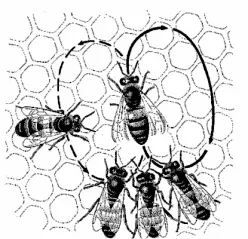
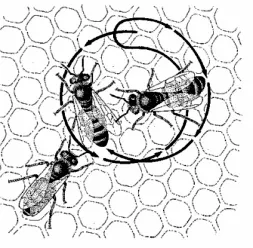
- Round dance is used to indicate a short distance (Less than 50m in case of
A.mellifera). The bee runs in circles, first in one direction and then in opposite direction, (clockwise and anticlockwise).
Round dance Wag tail dance
2. Tail wagging dance or Wag-tail dance.
This is used to indicate long distance.(more than 50m in case of A.mellifera). Here the bee makes two half circles in opposite directions with a straight run in between. During the straight run, the bee shakes (wags) its abdomen from side to side, the number of wags per unit time inversely proportional to the distance of the food (more the wags, less the distance.). The direction of food source is conveyed by the angle that the dancing bee makes between its straight run and top of the hive which is the same as between the direction of the food and direction of the sun. The bees, can know the position of the sun even if it is cloudy.
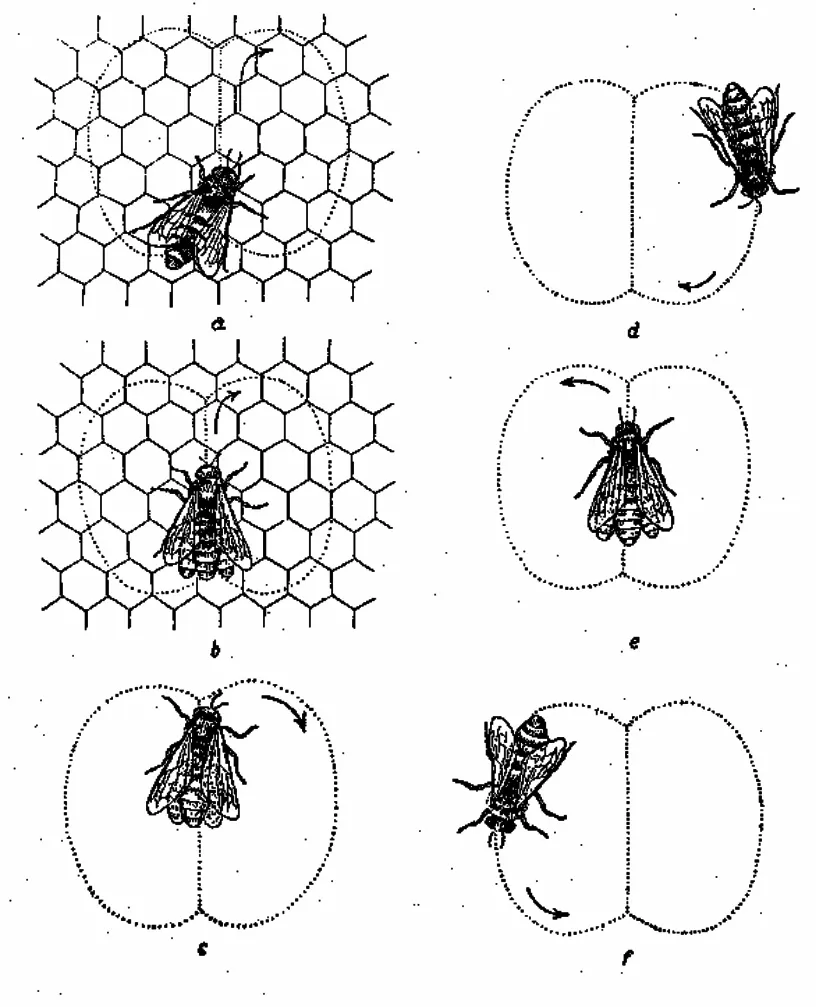
Wag tail dance to communicate the direction and distance of food source
lastmod: 2026-05-24T00:00:00+05:30
Summary Cheat Sheet
-
Beekeeping developed from wild honey collection into a managed agricultural enterprise.
-
The history of apiculture explains how hive design, colony handling, and honey harvesting became more scientific over time.
-
Modern beekeeping depends on understanding bee biology, colony behavior, and the economic role of pollinators.
-
Review core concepts, definitions, and field-level application points from this lesson.
-
Prioritize economic threshold-based decisions and integrated management logic where relevant.
References
1 source
References
Lesson Doubts
Ask questions, get expert answers