🐞 Apiary Management
Learn practical apiary management, including site selection, colony inspection, seasonal care, feeding, swarming control, and bee forage planning.
This lesson explains practical apiary management from site selection and seasonal colony care to forage planning, with a focus on maintaining healthy, productive bee colonies.
Lecture 3: APIARY MANAGEMENT
Pre-requisites to start beekeeping a. Knowledge/Training on beekeeping b. Knowledge on local bee flora c. Sufficient on local bee flora d. If necessary practice migratory beekeeping
Apiary site requirements
a. The site should be dry without dampness. High RH will affect bee flight and
ripening of nectar. b. Water - Natural source/Artificial provision c. Wind breaks - Trees serve as wind belts in cool areas d. Shade - Hives can be kept under shade of trees. Artificial structures can also be
constructed e. Bee pasturage/Florage - Plants that yield pollen/nectar to bees are called bee
pasturage/florage
General apiary management practices
i. Hive inspection - Opening the hive atleast twice a week and inspecting for
following details.
-
Presence of queen
-
Presence of eggs and brood
-
Honey and pollen storage
-
Hive record to be maintained for each hive
-
Presence of bee enemies like wax moth, mite, disease
ii. Expanding brood net
- Done by providing comb foundation sheet in empty frame during honey flow
period.
iii. Sugar syrup feeding
-
Sugar dissolved in water at 1:1 dilution
-
Used to feed bees during dearth period
iv. Supering (Addition of frames in super chamber)
-
This is done when brood chamber is filled with bees on all frames are covered
-
Comb foundation sheet or constructed comb provided in super chamber
v. Honey extraction
-
Bee escape board - Kept between brood and super chamber
-
Bees bushed away using brush
-
Cells uncapped using uncapping knife
-
Honey extracted using honey extractor
-
Combs replaced in hive for reuse
vi. Swarm management
-
Remove brood frames from strong colony and provide to weak
-
Pinch off the queen cells during inspection
-
Divide strong colonies into 2 or 3
-
Trap and hive primary swarm
vii. Uniting bee colonies - Done by Newspaper method
-
Bring colonies side by side by moving 30 cm/day
-
Remove queen from week colony
-
Keep a newspaper on top of brood chamber of queen - Right colony
-
Make holes on the paper
-
Keep queenless colony on top
-
Close hive entrance (the smell of bees will mix)
-
Unite bees to the brood chamber and make it one colony
SEASONAL MANAGEMENT
- Pollen and nectar available only during certain period
Honey flow season (surplus food source) x Dearth period (Scarcity of food)
- Extremes in climate like summer, winter and monsoon - Need specific
management tactics
Honey flow season management (Coincides with spring)
-
Provide more space for honey storage by giving CFS or built combs
-
Confine queen to brood chamber using queen excluder
-
Prevent swarming - As explained
-
Prior to honey flow - Provide sugar syrup and build sufficient population
-
Divide strong colonies into 2-3 new colonies - if colony multiplication need
-
Queen rearing technique may be followed to produce new queens for new
colonies
Summer management
-
Bees have to survive intense heat and dearth period
-
Provide sufficient shade (under trees or artificial structure)
-
To increase RH and reduce heat - Sprinkle water twice a day on gunny bag or
rice straw put on hive
-
Increase ventilation by introducing a splinter between brood and super chamber
-
Provide sugar syrup, pollen supplement/substitute and water
Winter management
-
Maintain strong and disease free colonies
-
Provide new queen to the hives
-
Winter packing in cooler areas (Hilly areas)
Management during dearth period
-
Remove empty combs (and store in air tight container)
-
Use dummy division board to confine bees to small area
-
Unite weak colonies
-
Provide sugar syrup, pollen supplement/substitute
Rainy season/monsoon management
-
Avoid dampness in apiary site. Provide proper drainage
-
In rain when bees are confined to the hive, provide sugar syrup feeding
BEE PASTURAGE/BEE FORAGE
Plants that yield pollen and nectar are collectively called bee pasturage or bee forage. Plants which are good source of nectar
- Tamarind 6. Moringa
- Neem 7. Prosopis juliflora
- Soapnut tree 8. Glyricidia maculata
- Eucalyptus 9. Tribulus terrestris
- Pungam
Plants which are good source of pollen
- Sorghum 6. Sweet potato
- Maize 7. Tobacco
- Millets like Cumbu, Tenai, 8. Coconut
Varagu, Ragi
-
Roses 9. Castor
-
Pome granate 10. Date palm
Plants which are good source of Pollen and Nectar
- Banana 7. Peach
- Citrus 8. Guava
- Apple 9. Sunflower
- Berries 10. Safflower
- Pear 11. Mango
- Plum
FORAGING
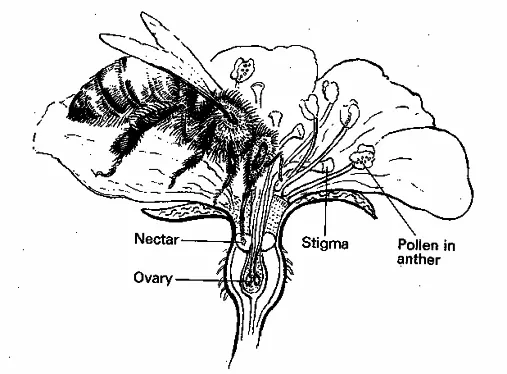
Refers to collection of nectar and pollen by bees.
Nectar foragers
- Collect nectar from flowers using lapping torigue

- Passes the nectar to hive bees

- Hive bees repeatedly pass the nectar between preoral cavity and tongue - to
ripen honey
- Later drops into cell
Pollen foragers
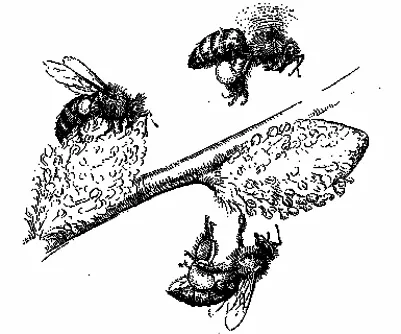
- Collects pollen by passing flower to flower. Pollen sticking to body removed
Using pollen comb
- Packed using pollen press into corbicula

- A single bee carries 10-30 mg pollen (25% of bee’s wt)

- Dislodge by middle log into cell

- Mix with honey and store
Floral fidelity
A bee visits same species of plant for pollen/nectar collection until exhausted. Bees travel 2-3 km distance to collect pollen/nectar.
lastmod: 2026-05-24T00:00:00+05:30
Summary Cheat Sheet
-
Good apiary management starts with proper site selection, water access, shade, wind protection, and nearby bee forage.
-
Routine hive inspection helps confirm queen presence, brood health, food storage, and early pest or disease problems.
-
Seasonal apiary care changes with honey flow, summer stress, winter protection, dearth periods, and monsoon conditions.
-
Review core concepts, definitions, and field-level application points from this lesson.
-
Prioritize economic threshold-based decisions and integrated management logic where relevant.
References
1 source
References
Lesson Doubts
Ask questions, get expert answers