🌾 Botanical Description and Floral Biology
Botanical and floral characters of important cereals used in breeding work.
This lesson covers core principles and exam-focused points from this topic in plant breeding.
Cereals
Characters of Cereals
Most of the cereals are herbaceous annuals. Stem or culm often erect, cylindrical,
hollow except at nodes. Tillering habit, shallow fibrous root system . Leaves alternate,
distichously with parallel venation and sheathing leaf base . Presence of ligules, lodicules .
Inflorescence is panicle or spike . Stamens usually three (in rice - six) . Fruit is a caryopsis.
Rice – _ Oryza sativa _ L. (2n = 24)
Systematic Position:
Division : Phanerogams
Sub-Division : Angeisperms
Class : Monocotyledon
Series : Glumacea
Sub class : Glumiflorae
Family : Poaceae
Sub family : Poaideae
Tribe : Oryzeae
Origin: India or Africa
Putative parents and origin of cultivated rice
There are two divergent views regarding the origin of cultivated rice.
i. Polyphyletic: Originated from several species.
Acording to this theory, the two forms of cultivated rice viz., Asian rice O. sativa and
African rice, O.glaberrima have evolved independently in their respective regions from several
species.
ii. According to this theory both Asian rice and African rice arose from a common parent. ( O.
perennis ). This view is the most accepted one because both Asian rice and African rice are
similar except in glume pubesence, ligule size and colour of pericarp which is red in African rice.
Species in the genus Oryza
According to the latest view the genus oryza include 22 valid species. Out of these, two
are cultivated diploids viz. O. sativa and O. glaberrima and rest are wild species with include
both diploid and tetraploid forms.
Subspecies in cultivated Oryza savita
Rice has been in cultivation for long period and adapted well under diverse climatic
conditions and soils. This has resulted in the evolution of three geographical races which has
been given subspecies status. The three subspecies are:
i. O. sativa subsp indica : Tall spreading, more tillering, awnless
ii. O. sativa subsp japonia : Short, errect, more tillering, awnless
iii. O. sativa subsp javanica : Tallest, errect, poor tillering, awned
Marked sterility barriers occur between the subspecies. It ranges up to 80% in case of
indica x japonica where as it is less in case of indica x javanica.
Wheat – _ Triticum sp _ . (X = 7)
Wheat is the most important cereal in the world, giving about one-third of the total
production, followed closely by rice. In temperate regions it is the major source of food. The
chief use of wheat is the flour for making bread.
Systematic position:
Division : Phanerogams
Sub-Division : Angeosperms
Class : Monocotyledon
Series : Glumacea
Sub class : Glumiflorae
Family : poaceae
Tribe : Triticeae
Subfamily : Pooideae
Chromosome number:
Diploid : 2n =14, Tetraploid : 2n = 28, Hexaploid : 2n = 42
Place of Origin:
Diploid: Asia minor, Tetraploid : Abyssinia, North Africa, Hexaploid : Central Asia
Classification:
Ploidy level Species Common name Genome
Wild einkorn
Einkorn
Wild Emmer
Emmer
Macaroni wheat
Persian wheat
Rivet wheat
Polish wheat
Common or bread
wheat
Club wheat
Dwarf wheat
Spelt wheat
Macha wheat
AA
AA
AA BB
AA BB
AABB
AABB
AABB
AABBDD
AABBDD
AABBDD
AABBDD
AABBDD
Diploid
(2n=14) 2 species
Tetraploid
(2n=28) 7 species
Hexaploid
(2n= 42) 5 species
T.boeticum
(T.aegilopoides)
T.monococum
T.dicoccoides
T.dicoccum
T.durum
T.persicum
T.turgidum
T.polonicum
T.timopheevi
T.aestivum
T.compactum
T.sphaerococcum
T.spelta
T.macha
Fourteen species of wheat are present according to Vavilov
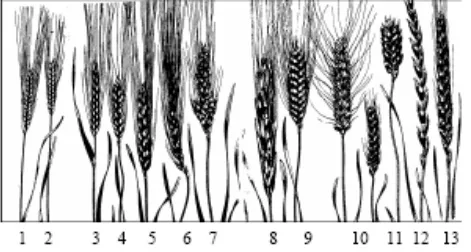
- T.boeoticum 2 .T.monococcum
3 .T.dicoccoides 4 .T.dicoccum
5 .T.durum 6.T.persicum
7 .T.turgidum 8 .T.polonicum
9 .T.timopheevi 10 .T.aestivum
11 .T.sphaerococcum 12 .T.compactum,
- T.spelta 14 .T.macha.
Origin of diploid wheat:
(Wild einkorn) T.boeticum (T.aegilopoides )
Natural mutation and selection
T.monoccocum
Cultivated diploid
AA (2n = 14)
T. boeoticum is probably the ancestor for all the cultivated wheats
Origin of Tetraploid wheats: Origin of hexaploid wheats (Fig.2):
T.boeoticum x Aegilops spelltoides T.dicoccum x Aegilops squarrosa
AABB DD
AA BB 2n = 28 2n = 14
2n = 14 2n 14 F
ABD(2n = 21)
F
Sterile 1 [Sterile (2n=14) (AB) ]
Natural mutation and Doubling Natural doubling
T.dicoccoides 2n = 28 T.aestivum
Wild emmer AABB AABBDD (2n = 42)
By natural selection (Cultivated)
T.dicoccum (Emmer wheat)
AABB (2n=28) Cultivated
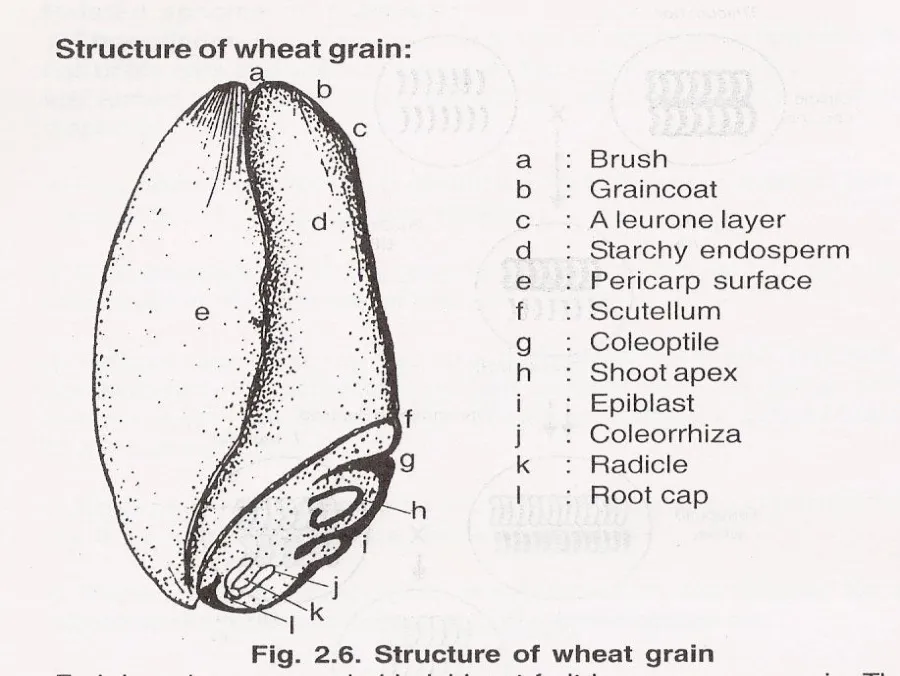
Structure of Wheat Grain
Fruit is a dry, one seeded indehisent fruit known as caryopsis. The grain may be either
hard or soft in texture with a creamy white, amber, red or purple colour depending upon variety.
The dorsal (back side) convex surface of kernal is smooth except at the base where the fruit coat
is wrinkled indicating the position of embryo the ventral surface (front side) is flat and
charactersed by a deep furrow or groove.
The following 4 structures are recognized in wheat grain
i.Grain coat, ii. Nucellar epidermis, iii. Endosperm and iv. Embryo.
Summary Cheat Sheet
Quick Recall Points
- This lesson focuses on key plant breeding concepts, terminology, and exam-relevant applications.
- Review major definitions, classifications, and method-wise distinctions from the sections above.
- Revise tables and examples from this lesson for fast pre-exam recall.
Exam Traps
- Do not confuse similarly named breeding methods without checking their core selection logic.
- Pay attention to crop-specific examples because the same principle can behave differently by species.
References
1 source • [1]
References
Standard Plant Breeding Class Notes (GPBR211)
BookLesson Doubts
Ask questions, get expert answers