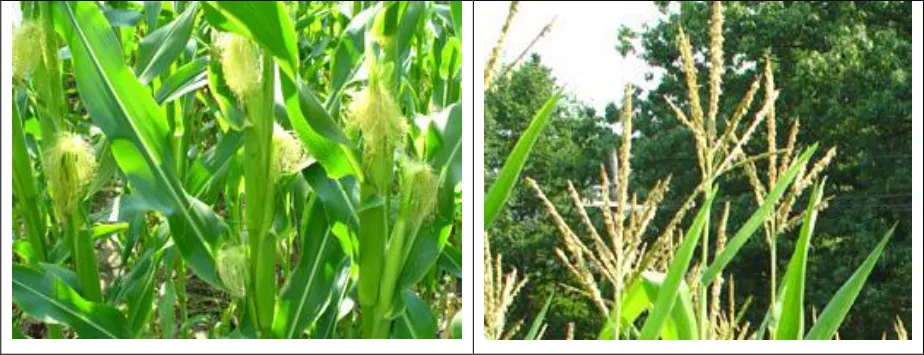
🧬 Maize - Zea mays (2n - 20)
Maize - Zea mays (2n.
This lesson covers core principles and exam-focused points from this topic in plant breeding.
Maize - Zea mays (2n - 20)
Maize is the most important cereal in the world after wheat and rice; it was also most
widely distributed. The genus Zea is considered to be monotypic previously. Recently Teosinte
the related genera of Zea has been included as Zea mexicana.
Centre of origin : Southern Mexico.
Systematic Position
Division : Phanerogams
Sub - Division : Anageosperms
Class : Monocotyledon
Series : Glumacea
Sub class : Glumiflorae
Family : Poaceae
Sub family : Poaideae
Tribe : Maydeae
Zea Mexicana - The Probable Three Species involved in The evolution ancester of Maize of
Cultivated Maize
Tripsacum dactyloides (2n= 36, 72) Gama grass:
A perennial grass which is used as fodder. Distributed in tropical and subtropical
North America.
Origin and putative parent:
There are three different views about the origin of maize.
- It originated from Teosinte (Euchlaena mexicana) (Zea maxicana) by direct selection,
mutation or hybridization with other grasses.
-
Another theory is that maize originated from a wild pod corn.
-
Another theory is that teosinte, tripsacum and maize, all descended from a common ancestor
by divergent evolution but the ancestor would have been lost.
Sorghum -Sorghum bicolor (L) Moench (2n = 20)
Sorghum is the fourth important world cereal, following wheat, rice and maize. It is the
staple food in the drier parts of tropical Africa, India and China. The threshed grain is ground
into a wholemeal flour, and used for making thin porridge or a thick paste or dough by boiling in
water.
Systematic Position:
Division : Phanerogams
Sub - Division : Anageosperms
Class : Monocotyledon
Series : Glumacea
Sub class : Glumiflorae
Family : Poaceae
Sub family : Poaideae
Tribe : Andropoganae
Sub tribe : Sorgasturm
Origin:
Africa in the primary centre. India is the secondary centre of origin.
Sorghum bicolor (2n = 20)
Origin: Africa
Progenitor of sorghum
- S.arundinaceum 2. S.verticilliflorum 3. S.sudanense 4. S.aethiopicum. The cultivated
sorghum Sorghum bicolor is divided in to five basic races based the coverage of glume on the
grain (Fig 1).
Hybrid races:
This consists of all combinations of the basic races.
1.Guniea bicolor (GB) 6.Guinea kaffir (GK)
2.Caudatum bicolor (CB) 7.Guinea durra (GD)
3.Kaffir bicolor (KB) 8.Kaffir caudatum (KC)
4.Durra bicolor (DB) 9.Kaffir durra (KD)
5.Guinea caudatum (GC) 10.Durra caudatum (DC)
Pearlmillet - _ Pennisetum glaucum _ L. (2n = 14)
Pearl millet is the staple food in the drier parts of Tropical Africa and in India, where it is
the fourth most important cereal after rice, sorghum and wheat. The grains are also fed to poultry
and other livestock. The green plants provide a useful fodder and it is sometimes grown for this
purpose. It also plays a major role in fodder improvement by crossing with Napier grass.
Systematic Position :
Division : Phanerogams
Sub – Division : Anageosperms
Class : Monocotyledon
Series : Glumacea
Sub class : Glumiflorae
Family : Poaceae
Tribe : Paniceae
Origin: Africa
Distribution : Africa, India, Pakistan, Bangladesh,
Origin and putative parents
Stapf included 32 species is Penicillaria. Of these 32 species found in Africa, six annuals
are considered wild and probable ancestors of the cultivated one. Pearl millet is a product of
multiple domestication. They are
- Pennisetum perottettii
2. P. molllissimum
3. P. violaceum
4. P. versicolor
5. P. adonense
6. P. gymnothrix
The cultivated species of Pennisetum is believed to have originated thro’ hybridization with in
these six species.
Characteristics features of Bajra :
-
Spikelet subtended by involucre of bristles.
-
Lodicules are absent (flower opening does not occur, only androecium and gynoecium
protrude out).
- Pennicillate anthers (anther tip cilliated - charecteristic of the genus
Pennisetum)
-
Fused style with bifid stigma.
-
Protogynous nature.
Ragi - Eleusine coracana Gaertn. (2n = 36)
Finger millet is an important staple food in parts of East and Central Africa, India,
particularly in Karnataka. It is used for malting and brewing.
Systematic Position:
Division : Phanerogams
Sub - Division : Anageosperms
Class : Monocotyledon
Series : Glumacea
Sub class : Glumiflorae
Family : Poaceae
Tribe : Eragrostideae
Place of origin: India
Characters of Eleusine:
Infloresence is contracted into a number of digitate spikes of spikelet. Spikelet
consists of more than two florets subtended by two glumes.
Summary Cheat Sheet
Quick Recall Points
- This lesson focuses on key plant breeding concepts, terminology, and exam-relevant applications.
- Review major definitions, classifications, and method-wise distinctions from the sections above.
- Revise tables and examples from this lesson for fast pre-exam recall.
Exam Traps
- Do not confuse similarly named breeding methods without checking their core selection logic.
- Pay attention to crop-specific examples because the same principle can behave differently by species.
References
1 source • [1]
References
Standard Plant Breeding Class Notes (GPBR211)
BookLesson Doubts
Ask questions, get expert answers