🫘 Botany of Pulse Crops
Botanical and floral characters of important pulse crops used in breeding.
This lesson covers core principles and exam-focused points from this topic in plant breeding.
Fabaceae
(Subfamily – Papilionaceae, caesalpinaceae, mimosceae.)
Distinguishing characters
Often climbers, bisexual flowers, generally Zygomorphic, sepals 5 with odd sepal anterior,
generally more or less united. 5 petals and papilionaceous, stamens mostly 10, mono or
diadelphous, carpel one with ventral suture posterior. Fruit mostly a legume.
Habit : Mostly herbs, shrubs or climbers wild as well as cultivated
Root : Taproot, which are branched and bear nodules containing nitrogen-fixing bacteria.
Stem : Erect herbaceous or woody, climbing by means of tendril.
Leaf : Leaves may be simple or compound. Mostly alternate with leafy stipules. The leaves may be
modified into tendrils.
Inflorescence : Usually racemose but may be Carymbose raceme.
Flower : Bracteate, bisexual, complete, Zygomorphic, irregular papilionaceous, and hypogynous.
Calyx : Five sepals, gamosepalous, odd sepal anterior with valvate aestivation inferior.
Corolla : 5 petals, polypetalous unequal with a descending imbricate aestivation papilionaceous, the
outermost (posterior) petal is largest and forms the broad free standard (vexillum). The lateral pair
of the side petals, which are also free and generally long clawed, forms the wings, while the
anterior pair are closely appressed and often more or less coherent and forms the keel (carina) in
which essential organs are closed.
Androecium : 10 stamens, diadelphous 9+1
Anthers 2 celled dehiscence by
longitudinal, inferior.
Gynoecium : Monocarpellary, superior,
unilocular with marginal placentation. Style
flattened
and hairy with a simple stigma.
Fruit : A legume (It develops from a monocarpellary superior ovary with marginal placentation. It
dehisces along both the sutures)
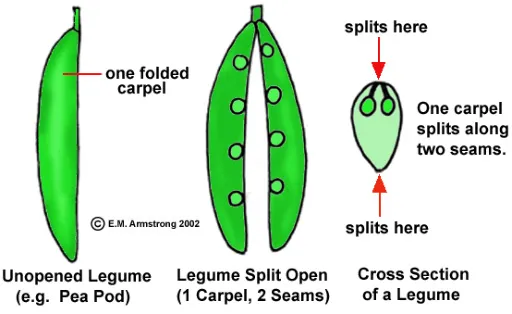 Seeds : Usually non-endospermic
- Legume or Pod : Composed of one carpel.
Note: Some legumes are indehiscent and do not split open.
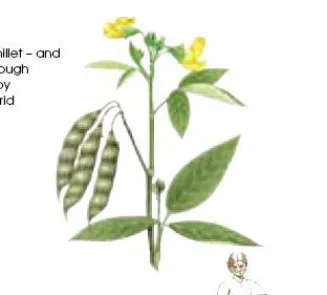
Red Gram - _ Cajanus cajan _ (2n=22)
There are two types of redgram varieties.1)
Cajanus cajan var, bicolor (Arhar). It is cultivated
extensively in N. India. The Plants are woody tall and
perennial in habit, large pod, bold grain. 2) C. cajan var,
flavus. (Tur).It is cultivated in peninsular India.(S. India)
pod. Fruit is a pod, which is variable in shape size,
constriction color texture, and pubescence. Pods, which have deep constriction, are known as
beaded while others are flattish. Seeds may be rounded or lens shaped and varying in color, size and
shapes.
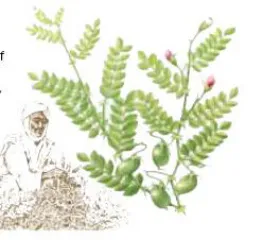
Bengal gram - _ Cicer arietinum _ (2n= 16)
In India it is one of the important pulse crop grown
throughout the country. It is grown as a cold weather crop both in
north and south India. It is drought resistant. There are two races
Desi smaller grain and Kabuli bigger grain.
Fruit turgid pod normally containing one or two seeds which
vary in size and shape and color. The seed coat may be smooth or
puckered and wrinkled or roughly granulate. Cotyledons thick and yellowish.
Green gram _ Vigna radiata _ (2n = 22)
Green gram is indigenous to India and has been in cultivation since prehistoric times. Erect
or semi erect herbaceous annual with slight tendency for twining in the upper branches. Leaves
trifoliate with long petioles, stipules with basal appendage, stipules minute and leaflets entire ovate,
flowers 10 – 20 crowded in axillary racemes on long pedicels, keel spirally coiled, stamens
diadelphous (9+1) ovary with long bearded style. Pod longer than in black gram with short hairs.
 Seeds globular with many five and wavy ridges on the surfaces, hilum flat cotyledonus yellowish.
Pod seed as food for human being, green and dry plant as fodder.
Black gram _ Vigna mungo _ (2n = 24)
Black gram is cultivated in many tropical and subtropical countries in several parts of Asia
Africa and C&S America. It is a twining herb, annual plant, densely hairy, stem slightly ridged,
leaves alternate, stipulate, petiolate, Pinnately trifolate. Inflorescence axillary raceme with flowers
congested at the top of the peduncle. Flowers 5-6. Shortly pedicelled bisexual, hypogynous,
Zygomorphic, Complete. Sepals 5 gamosepalous, imbricate corolla papilionaceous, petals five,
polypetalous keel in the form of spiral beak. Androecium diadelphous (9+1) filament alternately
long and short. Gynoecium superior ovary, monocarpellary unilocular marginal placentation. Fruit
- Legume densely hairy seeds, generally black.
Soybean - _ Glycine max _ (2n=40)
Soybean is one of the most important legume food of the people of far eastern countries like
China and Japan and are chiefly used as a pulse. The seeds are rich in protein and are of high
biological value. It is also rich in fat and vitamins, being good source of calcium and phosphorus. It
has oil content upto 20 % and protein 40 %.
Cowpea _ Vigna unguiculata _ (2n=22)
It is grown in warm parts of the world. Tender leaves are used as greens from the vegetable
type cowpea. Sprouted seed as vegetables. Grain as pulses. Whole plant as green fodder. Cow pea
and maize green fodder mixture is excellent for cattle. Vigna unguiculata sub species unguiculata
grain cowpea
Vigna unguiculata sub species sinensis grain cowpea
V. unguiculata sub species sesquipedalis yard long bean- vegetable cowpea
Dolichos group of pulses
The dolichos are twining herbs with stipullate, trifoliate leaves. Flowers are racemose or
axillary, calyx tube short, corolla is much exerted petals equal in length keel is obtuse not spiral,
stamens are diadelphous. Ovary nearly sessile. The pod is flat linear or oblong.
Lab-Lab _ : Lablab purpureus _ 2n=22, 24 (var. typicus)
Garden or pandal avarai is perennial, but cultivated as annual. The pods are long tapering. It
was no oil glands and no smell. Entire pod is edible. Lablab purpureus var lignosus (Field bean,
Mochai) it is a semi bushy type. Podes relatively shorter, oblong, and fibrous seeds. Plant give a
mochai odour
Gingelly - Sesame indicum (2n= 26) Pedaliaceae.
Botany of Pedaliaceae .
They are Annual or perennial, leaves opposite or upper alternate, simple, exstipulate,
flowers hermaphrodite, Zygomorphic, calyx 5 cleft, corolla gamopetalus 5 lobed, 2 lipped,
stamens 4, anthers convenient in pairs, 2 celled, disc hypogynous, ovary superior,1 celled with 2
intensive parietal placentas, the cell again often divided by superior septa, fruit a capsule or nut.
Seeds without endosperm, embryo. Straight with flattened cotyledons
Distinguishing characters
Stem quadrangular in shape, Basal leaf opposite, upper leaf alternate. Presence of extra
floral nectary gland as peduncle base. Corolla bell shaped, biliped and five lobed. Androecium
epipetalous didynamous stamens. Ovary bicarpellary, by presence of false septa appear as four
loculed. Seed color varies from pure white to various shades of brown and gray to black. Seed
coat may be rough or smooth.
Summary Cheat Sheet
Quick Recall Points
- This lesson focuses on key plant breeding concepts, terminology, and exam-relevant applications.
- Review major definitions, classifications, and method-wise distinctions from the sections above.
- Revise tables and examples from this lesson for fast pre-exam recall.
Exam Traps
- Do not confuse similarly named breeding methods without checking their core selection logic.
- Pay attention to crop-specific examples because the same principle can behave differently by species.
References
1 source • [1]
References
Standard Plant Breeding Class Notes (GPBR211)
BookLesson Doubts
Ask questions, get expert answers