🌻 Botany of Oilseed Crops
Breeding-relevant botanical traits of major oilseed crops such as castor and sesame.
This lesson covers core principles and exam-focused points from this topic in plant breeding.
Castor _ Ricinus communis _ (2n=20) Euphorbiaceae
Botany
Habit varies, mostly herbs but shrubs and trees are also common. Leaves simple or
compound stipulate, latex commonly present, inflorescence in its ultimate arrangements is
cymose, flowers small, regular, unisexual, perianth usually calycine, rarely petaloid sometimes
altogether wanting, male flower –stamens a many as double as many as perianth leaves or
numerous of flower or sometimes only one, the male flowers sometimes rudiment of the ovary,
female flower ovary generally three celled, ovules one or two in each chamber, styles and
stigmas as many as the cells, fruit (rigma) generally a capsule splitting into three coccid that
separate from a persistent central column
Distinguishing characters .
Presence of bloom –Ashy coating on the leaves and stem of the plant. Monoecious
condition- unisexual flowers, male at the bottom and female at the top. Androecium –
polyadelphous condition, filaments branched. The hilum almost concealed under the carancle.
Presence of thin leaf like cotyledon. Toxic alkaloids like ricin (blood coagulant) ricinin and
allergen are present.
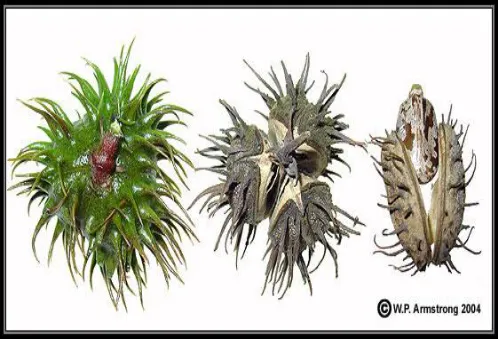
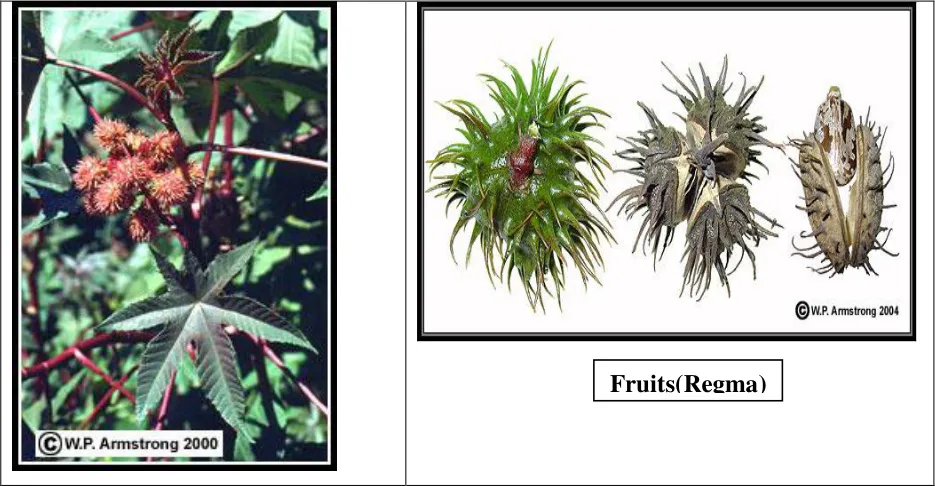
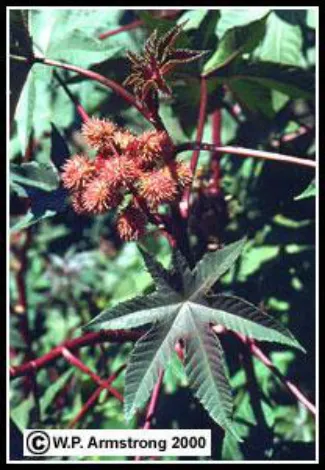 Fruits (Regma )
It develops from tricarpellary syncarpous superior trilocular ovary and splilts into many
parts called cocci. Four distinct size groups of fruits namely 1)very small fruits are found in
ornamental types and in some of the wild perennial types. 2) Small and 3) medium types are
preferred for cultivation since they fairly high oil content varying from 45 to 57 %. 4) Big seeds
have generally low oil content of less than 40%. Very small seeds are preferred for medicinal
purposes.
On the fruit the epicarp may be either smooth or warty or spiny. Attractively colored
types of horticultural value with colored inflorescences and fruits have been evolved. The seeds
color ranges from white to gray deep chocolate, purple and red. Mottling is also much varying.
The seed has no dormancy.
Sunflower - _ Helianthus annus _ (2n= 34) Asteraceae
Botany
Plants are usually herbs, leaves exstipulate,flowers aggregated into heads, an involucre
of bracts surrounds the head or capitulum, calyx reduced to bristles or modified into papas,
corolla (5) valvate in all disc florets, but in marginal ray florets which may sterile or lack
stamens and acts as an attraction for insects, inner hermaphrodite bisexual flowers . Stamens
epipetalous with syngenesious anthers forming a ring through which the style passes. Stigmas 2.
Ovary inferior, one chambered with one anatropous ovule, fruit-achene (A small hard dry
indenescent one seeded fruit. The wall of single seed is free from the hard pericarp or wall of the
fruit)
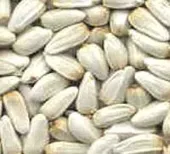
Safflower _ Carthamus tinctorius ( _ 2n = 24) Asteraceae
Safflower is an important oilseed crop in India. It is slowly becoming of increasing
importance as an oil crop for the drier parts of tropics and subtropic. In India it is cultivated for
both oil and reddish dye called safflower dye (cathamin) from florets. At the time of full bloom
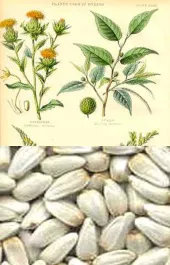
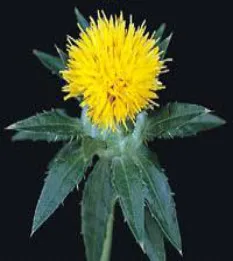
 flowers collected and corolla alones removed and dried. Yellow dye is obtained by washing and
dissolving it is water. There are two coloring matters. 1. Yellow pigment soluble in water and red
color soluble in alkalis. The seed /fruit is achene
Rape and Mustard Brassica sp. (2n=16, 18, 20, 22, 36)
Botany of cruciferae.
Annual, biennial or perennial herbs, a watery sap present, plants emit a sulphorous odour.
Stem covered by unicellular stellate hairs. Flowers arranged in typical racemes, usually
ebractate, sepals in two alternating dimerous whorls, petals 4, clawed diagonally placed stamens
tetra dynamous carpels 2, ovary two chambered, the development of a false septum,ovules
numerous on two parietal placentas. Fruit a Siliqua (It develops from bicarpellary syncarpous
gynoecium with parietal placentation and a false septum. It is a long narrow multiseeded fruit
which dehisces from below upwards by both sutures. Siliqula. It is a broad flat and shortened
form of siliqua.)
The group rape and mustard includes the oil yielding species of Brassica. The
commercial Indian rape seed and mustard are often mixture of rape seed, mustard and colza in
varying proportion. The seeds go by different name in different parts of the country. Generally
both colza (sarson) and rape (toria) are called together rape seed. Rai is mustard. Cultivated
Brassica can be broadly divided into two distinct types.
1. Vegetable type - cabbage,( Brassica oleraceae - var capitata.) cauliflower ( Brassica
oleraceae varbotrytis). Turnip ( Brassica oleraceae var rapa)
2. Oil seed type . 1) Rape seed Brassica compestris and 2 ) Mustard Brassica nigra .
Rape seed
a) Brassica compestris (2n= 20)
Indian rape seed is self sterile in natures. Important oilseed crop of N.India. There are three
cultivated types.
Brassica compestris var. brown sarson
Brassica compestris var. Yellow sarson
Brassica compestris var. toria
b) Brassica napus 2n=38 European rape seed. Self fertile grown in Europe
Mustard
a) B. nigra (2n=16) Black or true mustard. Banarasi rai contains 28% of fixed
oil used as medicine . Oil is pungent due to presence of glucoside sinigrin mostly used as
contiments.
b) B. alla 2n=24. White mustard or ujli sarson. Young seedlings used as salads. Seeds yellowish
in color contains 30% oil.
c) B. juncea 2n=36 Indian mustard.(Brown sarson).Popularly known as rai contains 35% oil.
Leaves are used as herbal medicines. Most pungent among cultivated oil seeds. It contains
glucoside sinigrin.
The oil producing species of Brasicca are all cross fertilized.
Key characters
Leaves two types 1) stem leaves bigger, lance shaped and serrated. Flower leaf small
smooth margin. Androecium tetradynamous . Fruit sliqua. The oil content of the seed varies
from 30-45% depending on the variety.
Fibers
The fibers are obtained from the sclerenchymatous cells found in the plant body and these
fiber cells occur either in groups or bundles. Chemically the fiber cell consists chiefly of
cellulose with lignin or semi cellulose or any other substances. The commercial term fiber
includes generally all thin and slender substances, which can be spun or made use of as fine
stuffing material. Fiber cells are non-living structures, when mature and serve as a purely
mechanical function, i.e. they impart strength and rigidity to the plant body.
Summary Cheat Sheet
Quick Recall Points
- This lesson focuses on key plant breeding concepts, terminology, and exam-relevant applications.
- Review major definitions, classifications, and method-wise distinctions from the sections above.
- Revise tables and examples from this lesson for fast pre-exam recall.
Exam Traps
- Do not confuse similarly named breeding methods without checking their core selection logic.
- Pay attention to crop-specific examples because the same principle can behave differently by species.
References
1 source • [1]
References
Standard Plant Breeding Class Notes (GPBR211)
BookLesson Doubts
Ask questions, get expert answers