🧬 Products of Somatic Hybridization and Cybridization
Somatic hybrids, cybrids, chromosome behavior, and practical outcomes of protoplast fusion.
After protoplast fusion, the main question is what type of product is actually obtained. This lesson helps distinguish somatic hybrids from cybrids and explains why chromosome behavior becomes a major selection issue after fusion.
Products of somatic hybrids and cybrids
Chromosome status of somatic hybrids
The chromosome numbers of the somatic hybrids successfully obtained through protoplast
fusion indicate that only few have exact number expected in an amphiploid. Hence selection will
also need to be applied at the cytological level, if true amphiploids need to be obtained. The
variability in chromosome number in hybrids could be due to any one of the following reasons:
(i) Multiple fusions give a higher chromosome number. In PEG-induced and electro
induced fusions between more than two protoplasts.
(ii) Asymmetric hybrids result from fusion of protoplasts isolated from actively dividing tissue
of one parent and quiescent tissue of the other parent.
(iii) Unequal rates of DNA replication in two fusing partners may also give asymmetric
hybrids.
(iv) Somaclonal variation in cultured cells used for protoplast isolation may also lead to
variation in chromosome number.
Practical applications of somatic hybridisation and cybridisation
Means of genetic recombination in asexual or sterile plants
Somatic cell fusion appears to be the only approach through which two different parental
genomes can be recombined among plants that cannot reproduce sexually. Further, protoplasts
of sexually sterile (haploid, triploid and aneuploid) plants can be fused to produce fertile diploids
and polyploids. There are several reports describing the amphidiploid and hexaploid plants
produced from fusion of haploid protoplasts of tobacco. Protoplasts isolated from dihaploid
potato clones have been fused with isolated protoplasts of Solanum brevidens to produce
hybrids of practical breeding value. Haploid protoplasts from an anther-derived callus of rice
cultivars, upon fusion also produce fertile diploid and triploid hybrids.
Overcoming barriers of sexual incompatibility
In plant breeding programmes, sexual crossings at interspecific or intergeneric levels often fail
to produce hybrids due to incompatibility barriers. The bottlenecks in sexual hybridisation may
therefore, be overcome by somatic cell fusion. In some cases somatic hybrids between two
incompatible plants have also found application in industry or agriculture.
Schieder (1978) obtained amphidiploid Datura innoxia (+) D. discolor and D. innoxia (+) D.
stramonium, by fusing their diploid mesophyll protoplasts. These hybrids did not exist in nature
as conventional breeding procedures proved unsuccessful. Somatically produced amphidiploids
of these combinations of Datura species are propagated for industrial uses as they demonstrate
heterosis and higher (20-25%) scopolamine content than in the parental forms.
Nicotiana repanda, N. nesophila and N. stockonii are resistant to a number of diseases but are
not sexually crossable with tobacco ( N. tabacum ). However, fertile hybrids have been reported
in combination N. tabacum (+) N. nesophila and N. tabacum (+) N. stocktonii by protoplast
fusion. Somatic hybridisation of dihaploid and tetraploid potato protoplasts with isolated
protoplasts of Solanum brevidens, S. phureja and S. pennelii resulted in the synthesis of fertile,
partially amphieuploid plants possessing important agricultural traits, e.g., resistance to potato
leaf virus, potato virus Y and Erwinia soft rot. Using this approach, tomato ( Lycopersicon
esculentum ) hybridised somatically with a number of wild species has resulted in the synthesis
of hybrids which are fertile and used in breeding programmes. Interspecific somatic
hybridisation involving species that are sexually incompatible with egg-plant ( Solanum
melongena ) has also resulted in the production of amphidiploids with traits resistant to
verticillium wilt.
Rapeseed ( Brassica napus ) is a natural amphidiploid of B. o l eracea and B. campestris . Schenk
(1982) was the first to resynthesise rapeseed in vitro using protoplast fusion. Somatic
hybridisation between B. napus and B. nigra cultivar, possessing the gene for resistance to
Phoma lingam, yielded amphidiploid plants carrying this gene. These hybrids possess all the
three Brassica genomes (A, B and C) and are now incorporated in breeding programmes.
Recently, hybrids have been produced parasexually by protoplast fusion, between Brassica
juncea (a major oilseed crop of the tropical world) and the sexually incompatible species
Diplotaxis muralis and Erica sativa .
The potential of somatic hybridisation in perennial tree breeding is best illustrated by
interspecific and intergeneric somatic hybridisation among citrus species. Somatic hybrids
produced through these experiments are amphidiploids featuring characteristics for scion
improvement and increased rootstock potential.
Somatic hybrids for cytoplasmic male sterility
Methods were also developed to substitute the nucleus of one species into the cytoplasm of
another species, whose mitochondria were inactivated. This type of substitution in some cases,
led to generation of cytoplasmic male sterility.
For this purpose, the two types of protoplasts, used for the production of somatic hybrids, were
treated differently, as follows:
(i) mesophyll protoplasts of tomato ( Lycopersicon esculentum ) were treated with
iodoacetamide (IOA) to inactivate mitochondria and
(ii) (ii) mesophyll protoplast of Solanum acaule (or S. tuberosum ) were irradiated with g or x
rays to inactivate nuclei.
The protoplasts were mixed in 1:1 ratio and induced to fuse using Ca [2+] and PEG, leading to the
production of heterologous or alloplasmic hybrids. Among the fusion products, some hybrid
tomato plants were indistinguishable from the original cultivars, with respect to morphology,
physiology and chromosome number (2n = 24), but exhibited various degrees of male sterility.
In five tomato cultivars, male sterility induced in this manner was inherited maternally over
several generations. Therefore, it was obviously cytoplasmic male sterility. The mitochondrial
DNA of these CMS hybrids did not resemble mtDNA of either parent, and was instead
recombinant type, representing a hybrid mitochondrial genome. Therefore, protoplast fusion can
be effectively used for production of CMS lines and has the following advantages:
(i) Only one step is required;
(ii) The nuclear genotype of the cultivar remains unaffected,
(iii) There are prospects that 100% of the progenies of somatic hybrids will be CMS. The
restorer lines for these CMS lines have also been shown to be available in tomato,
so that hybrid seed can be produced without manual emasculation.
Generation of cytoplasmic male sterility by fusion
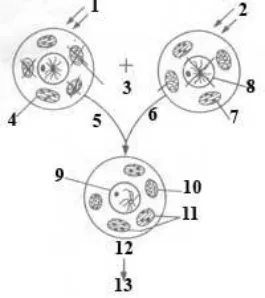
- IOA (damages mitochondria), 2. γ rays or x-rays (inactivate nuclei), 3. Mitochondria, 4.
chloroplast (tomato protoplasts), 5.Ca [++] + PEG, 6. Protoplast fusion, 7. chloroplast (potato or
S. acaule protoplasts), 8. Nucleus, 9. tomato nucleus, 10. recombinant mitochondira, 11.
chloroplasts (mixture), 12. fused protoplasts, 13. somatic hybrid plants (CMS)-resemble tomato
Cytoplasm transfer
Power et al . (1975) fused mesophyll protoplasts of Petunia with cultured cell protoplasts of the
crown gall of Parthenocissus and selected a line which contained the chromosomes of only
Parthenocissus but exhibited some of the cytoplasmic properties of Petunia for some time. This
was followed by direct application of cybridisation in agricultural biotechnology by transfer of
cytoplasmic male sterility from Nicotiana techne to N. tabacum, N. tabacum to N. sylvestris and
Petunia hybrida to P. axillaris . Besides cytoplasmic male sterility, the genophore of the
cytoplasm codes for a number of practically important traits, such as the rate of photosynthesis,
low or high temperature tolerance and resistance to diseases or herbicides. Recent experiments
on cybridisation have resulted in plants with reconstructed cytoplasm combining mitochondrial
DNA (mt DNA) and cp DNA encoded traits from both parents.
The best example illustrating the potential for protoplast fusion in reconstructing cytoplasm for
practical purposes is the genus Brassica . Two desirable traits coded by cytoplasmic genes have
been genetically manipulated through interspecific cybridisation between different species of
Brassica . These traits include cytoplasmic male sterility (cms) and resistance to atrazine
herbicides. The cms gene in Brassica plants, Diplotaxis muralis and Raphanus sativus is of
alloplasmic (the nucleus of one species into a foreign cytoplasm) origin. Raphanus sativus is of
interest because it leads to complete male sterility. Cms restorer genes have been introduced
into rapeseed ( Brassica napus ) from this plant. Mutants resistant to atrazine herbicide have also
been discovered both in Brassica napus and B. campesteris . Protoplast fusion experiments
(conducted in various laboratories) have resulted in the synthesis of cybrid plants with recon
structed cytoplasm combining both cms (coded by Raphanus mt DNA) and low temperature
tolerance or atrazine resistance (coded by Brassica cp DNA). Similarly, cytoplasmic genes
coding for atrazine resistance and cms have been transferred into cabbage, rice and potato.
In somatic hybridisation and cybridisation, the essential pre requisite is that parental protoplasts
and their fusion products regenerate to whole plants. Research in the past decade has shown
that plants can be raised in vitro from isolated protoplasts of species belonging to a range of
angiosperm families. Somatic hybrids have been produced between sexually compatible as
well as incompatible species. It could be possible to overcome prezygotic embryo/endosperm
( Petunia parodii (+) P. inflate ) and postzygotic ( Datura innoxia (+) D. stramonium ; Petunia
parodii (+) P. parviflora ), incompatibility barriers by protoplast fusion. Experiments on
intergeneric somatic hybridisation have also been successful in some cases such as potato (+)
tomato somatic hybrids and synthesis of ‘Arabidobrassica’. With these initial successes, and
subsequent advancements in protoplast technology it is desirable that efforts be concentrated
on important plant species which have potential in industry or for food production. Crops which
have not yielded satisfactory results through conventional methods of genetic manipulation
need to be aided by non-conventional in vitro techniques such as somatic
hybridisation/cybridisation, embryo culture, etc. to manifest their full potential.
| Interspecific hybrids produced through protoplast fusion | Col2 |
|---|---|
| Parent species and their chromosome numbers | Chromosome number of hybrid |
| Brassica oleracea (2n = 18) + B. Campestris (2n = 20) B. napus (2n = 38) + B. oleracea (2a = 18) B. napus (2a = 38) + B. nigra (2n = 16) B. napus (2n = 38) + B. carinata (2n = 34) B. napus (2n = 38) + B juncea (2n = 36) |
Wide variation |
| Nicotiana glauca (2n = 24) + N. longsdorfii (2n = 18) | 56-64 |
| N. tabacum (2n = 48) + N. alata (2n = 18) | 66-71 |
| N. tabacum (2n = 48) + N. glauca (2n = 24) | 72 |
| N. tabacum (2n = 48) + N. glutinosa (2n = 24) | 50-88 |
| N. tabacum (2n = 48) + N. Knightiana (2n = 24) | 44-137 |
| N. tabacum (2n = 48) + N. mesophile (2n = 48) | 96 |
| N. tabacum (2n = 48) + N. octophora (2n = 24) | 48 |
| N. tabacum (2n = 48) + N. rustica (2n = 48) | 60-91 |
| N. tabacum (2n = 48) + N. stocktonii (2n = 48) | 96 |
| N. tabacum (2n = 48) + N. sylvestris (2n = 24) | 72 |
| N. tabacum (2n = 48) + N. phumbaginifolia (2n = 20) | - |
| Petunia parodii (2n = -48) + P. hybrida (2n = 20) | 44-48 |
|---|---|
| P. parodii (2n = 14) + P. hybrida (2n = 14) | 46 |
| P. parodii (2n = 48) + P. parviflora (2n = 18) | 31-40 |
| Solnum tuberosun (2n = 24, 48) + S. chapcoense (2n = 14) | 60 |
| S. tuberosum (2n = 24, 48) + S. brevidens (2n = 24) | - |
| Lycopersicon esculentum (2n = 24) + L. Peruvianum (2n = 14) | 72 |
| Daucua carota (2n = 18) + D. capillifolius (2n = 18) | 36, 38 |
| Datura innoxia (2n = 24) + D. capillifolius (2n = 24) | 46, 48, 72 |
| D. innoxia (2n = 24) + d. sanguinea (2n = 24) | 46, 72, 96 |
| D. innoxia (2n = 24) + D. candida (2n = 24) | - |
| Intergeneric hybrids produced through protoplast fusion | Col2 |
|---|---|
| Plant species and their chromosome numbers | New genus |
| Raphanus sativus (2n = 18) + B. oberacea (2n = 18) | Raphanobrassica |
| Moricandia arvensis (2n = 24, 28) + B. oleracea (2n = 18) | Moricandiobrassica |
| Eruca sativa (2n = 22) + B. napus (2n = 38) | Erucobrassica |
| E. sativa (2n = 22) + B. juncea (2n = 36) | Erussica |
| Diplotaxis muralis (2n = 42) + B. napus (2n = 38) | Diplotaxobrassica |
| D. muralis (2n = 42) + B. juncea (2n = 36) | Diplotaxojuncea |
| Sinapis alba (2n = 24) + B. napus (2n = 38) | Sinapobrassica |
| S. alba (2n = 24) + B. oleracea (2n = 18) | Sinapo-oleracea |
| Nicotiana tabacum (2n = 24) + Lycopersicon esculentum (2n = 24) |
Nicotiopersicon |
| N. tabacum (2n = 24) + Petunia inflorata (2n = 14) | Nicotiopetunia |
| Solanum tuberosum (2n = 24) + Lycopersicon esculentum (2n = 24) |
Solanopersicon |
| Daucus carota (2n = 18) + Petroselinum hortense (2n = 22) | Daucoselenium |
| Datura innoxia (2n = 48) + Atropa belladonna (2n = 24) | Daturotropa |
| Oryza sativa (2n = 24) + Echinochloa oryzicola (2n = 24) | Oryzochloa |
Intertribal somatic hybrids produced within the family Brassicaceae
| Arabidopsis thaliana (Tribe Sisymbrieae) |
(2n = 10) + | B. Campestris (2n = 20) (Tribe Brassiceae) |
Arabidobrassica |
|---|---|---|---|
| Thlaspi perfoliatum (Tribe Lepideae) |
(2n = 14) + | B. napus (2n = 38) (Tribe Brassiceae) |
Thlaspobrassica |
| Barbarea vulgaris (Tribe Arabideae) |
(2n = 16) + |
B. napus (2n = 38) (Tribe Brassiceae) |
Barbareobrassica |
Even somatic hybrids of sexually compatible plants may exhibit new variations as a result of
interactions between plastomes donated by parental species during protoplast fusion. The
technique of cybridisation, besides transfer of male sterility, can be adopted for the introduction
of genes for resistance into the new species. The modification of plants with respect to nitrogen
fixation can also be contemplated through transformation of protoplasts by uptake of exogenous
DNA, or organelles, carrying this trait. Further, genetically heterogenous clones can be derived
from protoplast culture and fusion which display a high frequency of variations for several
agronomic traits.
The above developments suggest an immense potential for somatic cell genetics in crop
improvement. However, the genetic diversity that can be generated via somatic cell fusion is still
poorly understood. This is because only a very limited number of the synthesised somatic
hybrids or cybrids have been fertile or amphiploids. Induction and control over the degree of
species-specific chromosome elimination in wide or distant somatic hybridisation requires to be
mastered in order to understand the mechanism of producing desirable asymmetric nuclear
hybrids.
Questions
- The variability in chromosome number in somatic hybrids could be due to …………
a). Multiple fusions give a higher chromosome number
c). Somaclonal variation in cultured cells
- The somatic hybridisation is used …………
b). Asymmetric hybrids
d). All the above
a). Genetic recombination in asexual or b). Overcoming barriers of sexual sterile plants incompatibility
c). Both a and b d). None of the above
- The first somatic hybrids are produced in …………
a). Datura innoxia b). Nicotiana repanda c). N. nesophila d). N. stockonii
- The first somatic hybrids are produced by …………
a). Schieder b). Cocking c). Schenk d). None of the above
- …………….. was the first to resynthesise rapeseed in vitro using protoplast fusion.
a). Schieder b). Cocking c). Schenk d). None of the above
Summary Cheat Sheet
Quick Recall Points
- Define key terms in one line and revise their use in plant biotechnology.
- Memorize major steps, methods, and applications covered in this lesson.
- Practice exam-style distinctions between related concepts and techniques.
Exam Traps
- Do not confuse similar terms without checking context and biological level.
- Revise process order carefully; sequence-based questions are common.
- Link each method with its most likely application question.
References
1 source • [1]
References
Standard BSc Agriculture Plant Biotechnology notes
BookLesson Doubts
Ask questions, get expert answers