🧬 DNA fingerprinting
DNA fingerprinting.
This lesson explains the core ideas, methods, and exam-relevant applications for this topic in plant biotechnology. Focus on definitions, process steps, and practical uses for revision.
DNA finger printing
DNA (Deoxyribonucleic acid) is a chemical structure that forms chromosomes. A piece
of a chromosome that dictates a particular trait is called a gene.
Structurally, DNA is a double helix: two strands of genetic material spiraled around each
other. Each strand contains a sequence of bases (also called nucleotides). A base is
one of four chemicals (adenine, guanine, cytosine and thymine).
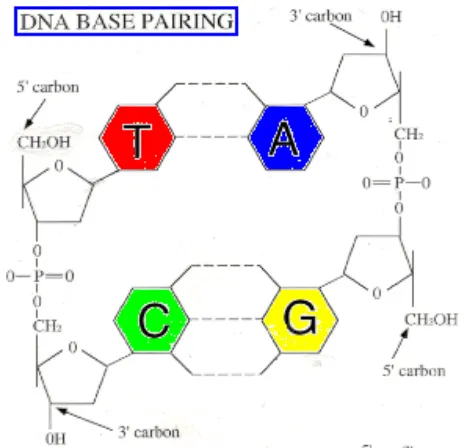
The two strands of DNA are connected at each base. Each base will only bond with one
other base, as follows: Adenine (A) will only bond with thymine (T), and guanine (G) will
only bond with cytosine (C). Suppose one strand of DNA looks like this:
A-A-C-T-G-A-T-A-G-G-T-C-T-A-G
The DNA strand bound to it will look like this:
T-T-G-A-C-T-A-T-C-C-A-G-A-T-C
Together, the section of DNA would be represented like this:
T-T-G-A-C-T-A-T-C-C-A-G-A-T-C
A-A-C-T-G-A-T-A-G-G-T-C-T-A-G
DNA strands are read in a particular direction, from the top (called the 5' or "five prime"
end) to the bottom (called the 3' or "three prime" end). In a double helix, the strands go
opposite ways:
5' T-T-G-A-C-T-A-T-C-C-A-G-A-T-C 3'
3' A-A-C-T-G-A-T-A-G-G-T-C-T-A-G 5'
The chemical structure of DNA is as follows:
What is DNA fingerprinting?
The chemical structure of everyone's DNA is the same. The only difference between
people (or any animal) is the order of the base pairs. There are so many millions of base
pairs in each person's DNA that every person has a different sequence.
Using these sequences, every person could be identified solely by the sequence of their
base pairs. However, because there are so many millions of base pairs, the task would
be very time-consuming. Instead, scientists are able to use a shorter method, because
of repeating patterns in DNA.
These patterns do not, however, give an individual "fingerprint," but they are able to
determine whether two DNA samples are from the same person, related people, or non
related people. Scientists use a small number of sequences of DNA that are known to
vary among individuals a great deal, and analyze those to get a certain probability of a
match.
How is DNA fingerprinting done
Southern Blot
The Southern Blot is one way to analyze the genetic patterns which appear in a person's
DNA. Performing a Southern Blot involves:
- Isolating the DNA in question from the rest of the cellular material in the nucleus. This
can be done either chemically, by using a detergent to wash the extra material from the
DNA,or mechanically, by applying a large amount of pressure in order to "squeeze out"
the DNA.
- Cutting the DNA into several pieces of different sizes. This is done using one or more
- Sorting the DNA pieces by size. The process by which the size separation, "size
fractionation," is done is called gel electrophoresis. The DNA is poured into a gel, such
as agarose, and an electrical charge is applied to the gel, with the positive charge at the
bottom and the negative charge at the top. Because DNA has a slightly negative charge,
the pieces of DNA will be attracted towards the bottom of the gel; the smaller pieces,
however, will be able to move more quickly and thus further towards the bottom than the
larger pieces. The different-sized pieces of DNA will therefore be separated by size, with
the smaller pieces towards the bottom and the larger pieces towards the top.
- Denaturing the DNA, so that all of the DNA is rendered single-stranded. This can be
done either by heating or chemically treating the DNA in the gel.
- Blotting the DNA. The gel with the size-fractionated DNA is applied to a sheet of
nitrocellulose paper, and then baked to permanently attach the DNA to the sheet. The
Southern Blot is now ready to be analyzed.
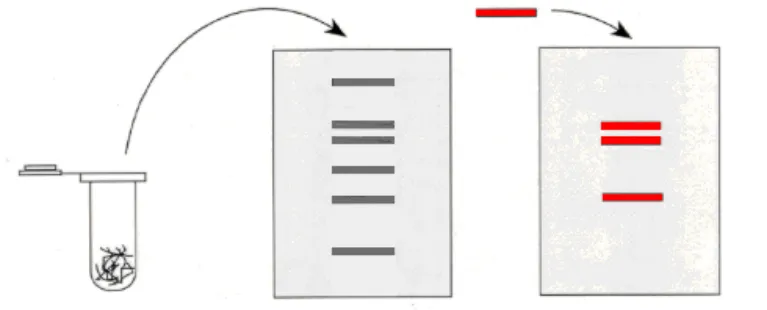
In order to analyze a Southern Blot, a radioactive genetic probe is used in a hybridization
reaction with the DNA in question (see next topics for more information) . If an X-ray is
taken of the Southern Blot after a radioactive probe has been allowed to bond with the
denatured DNA on the paper, only the areas where the radioactive probe binds [red] will
show up on the film. This allows researchers to identify, in a particular person's DNA, the
occurrence and frequency of the particular genetic pattern contained in the probe.
Making a radioactive probe
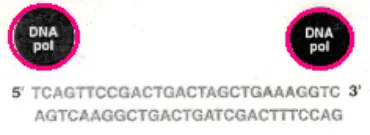
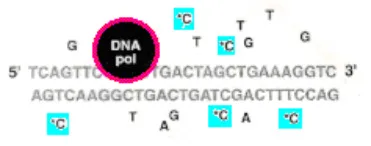
1. Obtain some DNA polymerase [pink]. Put the DNA to be made radioactive
(radiolabeled) into a tube.
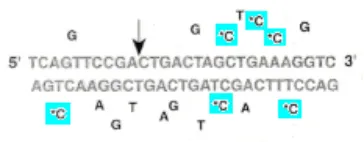
- Introduce nicks, or horizontal breaks along a strand, into the DNA you want to
radiolabel. At the same time, add individual nucleotides to the nicked DNA, one of which,
*C [light blue], is radioactive.
- Add the DNA polymerase [pink] to the tube with the nicked DNA and the individual
nucleotides. The DNA polymerase will become immediately attracted to the nicks in the
DNA and attempt to repair the DNA, starting from the 5' end and moving toward the 3'
end.
- The DNA polymerase [pink] begins repairing the nicked DNA. It destroys all the
existing bonds in front of it and places the new nucleotides, gathered from the individual
nucleotides mixed in the tube, behind it. Whenever a G base is read in the lower strand,
a radioactive *C [light blue] base is placed in the new strand. In this fashion, the nicked
strand, as it is repaired by the DNA polymerase, is made radioactive by the inclusion of
radioactive *C bases.
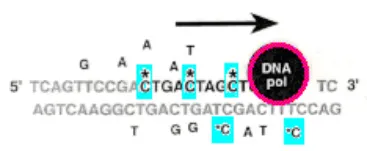 5. The nicked DNA is then heated, splitting the two strands of DNA apart. This creates
single-stranded radioactive and non-radioactive pieces. The radioactive DNA, now called
a probe [light blue], is ready for use.
Creating a hybridization reaction
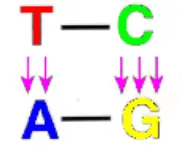
- Hybridization is the coming together, or binding, of two genetic sequences. The
binding occurs because of the hydrogen bonds [pink] between base pairs. Between a A
base and a T base, there are two hydrogen bonds; between a C base and a G base,
there are three hydrogen bonds.
- When making use of hybridization in the laboratory, DNA must first be denatured,
usually by using heat or chemicals. Denaturing is a process by which the hydrogen
bonds of the original double-stranded DNA are broken, leaving a single strand of DNA
whose bases are available for hydrogen bonding.
- Once the DNA has been denatured, a single-stranded radioactive probe [light blue]
can be used to see if the denatured DNA contains a sequence similar to that on the
probe. The denatured DNA is put into a plastic bag along with the probe and some
saline liquid; the bag is then shaken to allow sloshing. If the probe finds a fit, it will bind
to the DNA.
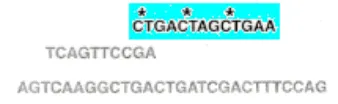
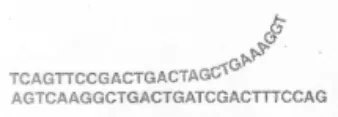
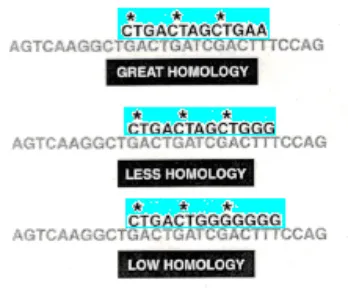
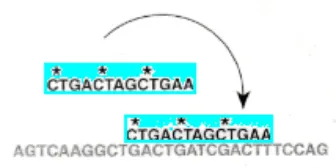 4. The fit of the probe to the DNA does not have to be exact. Sequences of varying
homology can stick to the DNA even if the fit is poor; the poorer the fit, the fewer the
hydrogen bonds between the probe [light blue] and the denatured DNA. The ability of
low-homology probes to still bind to DNA can be manipulated through varying the
temperature of the hybridization reaction environment, or by varying the amount of salt in
the sloshing mixture.
VNTRs
Every strand of DNA has pieces that contain genetic information which informs an
organism's development (exons) and pieces that, apparently, supply no relevant genetic
information at all (introns). Although the introns may seem useless, it has been found
that they contain repeated sequences of base pairs. These sequences, called Variable
Number Tandem Repeats (VNTRs), can contain anywhere from twenty to one hundred
base pairs.
Every human being has some VNTRs. To determine if a person has a particular VNTR,
a Southern Blot is performed, and then the Southern Blot is probed, through a
hybridization reaction, with a radioactive version of the VNTR in question. The pattern
which results from this process is what is often referred to as a DNA fingerprint.
A given person's VNTRs come from the genetic information donated by his or her
parents; he or she could have VNTRs inherited from his or her mother or father, or a
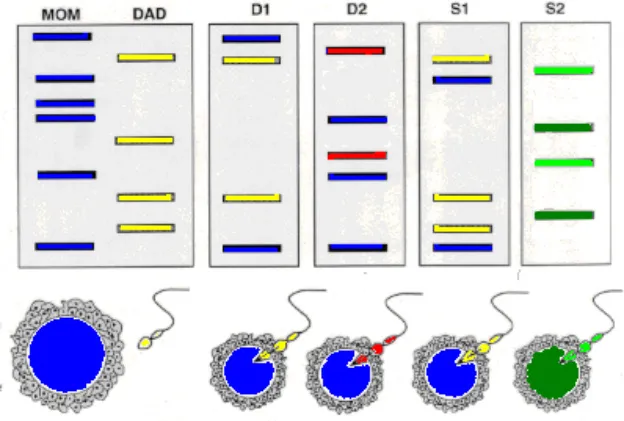
combination, but never a VNTR either of his or her parents do not have. Shown below
are the VNTR patterns for Mrs. Nguyen [blue], Mr. Nguyen [yellow], and their four
children: D1 (the Nguyens' biological daughter), D2 (Mr. Nguyen's step-daughter, child of
Mrs. Nguyen and her former husband [red]), S1 (the Nguyens' biological son), and S2
 (the Nguyens' adopted son, not biologically related [his parents are light and dark
green]).
Because VNTR patterns are inherited genetically, a given person's VNTR pattern is
more or less unique. The more VNTR probes used to analyze a person's VNTR pattern,
the more distinctive and individualized that pattern, or DNA fingerprint, will be.
Problems with DNA fingerprinting
Like nearly everything else in the scientific world, nothing about DNA fingerprinting is
100% assured. The term DNA fingerprint is, in one sense, a misnomer: it implies that,
like a fingerprint, the VNTR pattern for a given person is utterly and completely unique to
that person. Actually, all that a VNTR pattern can do is present a probability that the
person in question is indeed the person to whom the VNTR pattern (of the child, the
criminal evidence, or whatever else) belongs. Given, that probability might be 1 in 20
billion, which would indicate that the person can be reasonably matched with the DNA
fingerprint; then again, that probability might only be 1 in 20, leaving a large amount of
doubt regarding the specific identity of the VNTR pattern's owner.
Generating a high probability
The probability of a DNA fingerprint belonging to a specific person needs to be
reasonably high--especially in criminal cases, where the association helps establish a
suspect's guilt or innocence. Using certain rare VNTRs or combinations of VNTRs to
create the VNTR pattern increases the probability that the two DNA samples do indeed
 match (as opposed to look alike, but not actually come from the same person) or
correlate (in the case of parents and children).
Problems with determining probability
A. Population genetics
VNTRs, because they are results of genetic inheritance, are not distributed evenly
across all of human population. A given VNTR cannot, therefore, have a stable
probability of occurrence; it will vary depending on an individual's genetic background.
The difference in probabilities is particularly visible across racial lines. Some VNTRs that
occur very frequently among Hispanics will occur very rarely among Caucasians or
African-Americans. Currently, not enough is known about the VNTR frequency
distributions among ethnic groups to determine accurate probabilities for individuals
within those groups; the heterogeneous genetic composition of interracial individuals,
who are growing in number, presents an entirely new set of questions. Further
experimentation in this area, known as population genetics, has been surrounded with
and hindered by controversy, because the idea of identifying people through genetic
anomalies along racial lines comes alarmingly close to the eugenics and ethnic
purification movements of the recent past, and, some argue, could provide a scientific
basis for racial discrimination.
B. Technical difficulties
Errors in the hybridization and probing process must also be figured into the probability,
and often the idea of error is simply not acceptable. Most people will agree that an
innocent person should not be sent to jail, a guilty person allowed to walk free, or a
biological mother denied her legal right to custody of her children, simply because a lab
technician did not conduct an experiment accurately. When the DNA sample available is
minuscule, this is an important consideration, because there is not much room for error,
especially if the analysis of the DNA sample involves amplification of the sample
(creating a much larger sample of genetically identical DNA from what little material is
available), because if the wrong DNA is amplified (i.e. a skin cell from the lab technician)
the consequences can be profoundly detrimental. Until recently, the standards for
determining DNA fingerprinting matches, and for laboratory security and accuracy which
would minimize error, were neither stringent nor universally codified, causing a great
deal of public outcry.
Summary Cheat Sheet
Quick Recall Points
- Define key terms in one line and revise their use in plant biotechnology.
- Memorize major steps, methods, and applications covered in this lesson.
- Practice exam-style distinctions between related concepts and techniques.
Exam Traps
- Do not confuse similar terms without checking context and biological level.
- Revise process order carefully; sequence-based questions are common.
- Link each method with its most likely application question.
References
1 source • [1]
References
Standard BSc Agriculture Plant Biotechnology notes
BookLesson Doubts
Ask questions, get expert answers