🐮 Care and Management of Newborn Calves
Learn the immediate care, colostrum feeding, housing, hygiene, and heifer management practices required for healthy calf rearing.
The first few minutes after birth strongly affect the survival, immunity, and later productivity of a calf. Good newborn care reduces losses immediately and also improves the future performance of the animal as a milch cow or breeding stock.
Immediate Care After Birth
The calf should be attended as soon as it is born.
The original notes emphasize the following steps:
- Remove mucus from the nose and mouth.
- Check whether the calf has started breathing.
- If breathing is delayed, stimulate respiration by pressing and relaxing the chest wall.
- If needed, hold the calf with the head downward briefly to help clear passages.
- Dry the body if the dam does not lick the calf or if the weather is cold.
These steps are basic but critical because delayed breathing and chilling can quickly weaken the calf.
Navel Cord Care and Early Protection
After breathing is established, the navel cord should be checked and disinfected.
The source notes mention that the cord should be:
- tied about 2.5 cm away from the body
- cut below the ligature
- treated with tincture of iodine
- disinfected again for 2 to 3 days
The navel cord is a major entry point for infection in newborn calves, so its care should never be skipped.
Colostrum Feeding
Colostrum is the first milk secreted after calving. It is rich in antibodies, protein, vitamins, and minerals.
The original lecture stresses that colostrum should be fed within 15 minutes of birth.
Suggested quantities from the notes:
- calf: about 1/10 of body weight
- buffalo calf: about 1/15 of body weight
Why colostrum is essential:
- gives passive immunity
- supplies concentrated nutrients
- helps expel the first faecal matter
- improves survival during the early life stage
If meconium is not passed, the notes mention a mild warm-water enema.
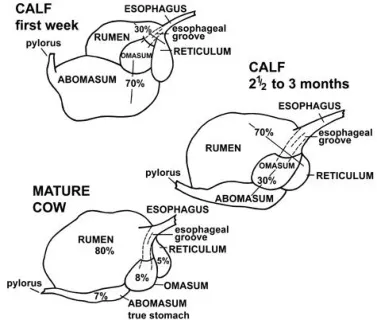
Weaning and Milk Feeding
If weaning is done at birth, enough colostrum must still be given for the first 3 to 4 days. If weaning is delayed slightly, later milk feeding should continue according to the rearing schedule.
Important feeding precautions from the source:
- keep all milk-feeding utensils clean
- use hygienic nipple pails or buckets
- train the calf patiently if open-bucket feeding is used
- avoid very cold milk
- do not overfeed
Poor feeding hygiene is a common cause of digestive problems in calves.
Housing and Sanitary Management
Calves may be reared indoors, outdoors, or partly both, depending on farm conditions. The original notes particularly caution against parasite exposure and climatic stress in humid tropical conditions.
Good housing practice includes:
- keeping calves in individual pens for the first 3 to 4 weeks
- maintaining dry, clean, and comfortable pens
- protecting calves from overcrowding
- preventing cross-suckling and cross-licking
- cleaning the mouth after milk feeding when required
This reduces infection, digestive disturbance, and parasite load.
Identification and Growth Monitoring
Good calf rearing requires record keeping.
Methods of identification mentioned in the lesson:
- ear tattooing
- metal ear tags or buttons
- neck strap or chain with number plate
The notes also mention regular body-weight recording. A well-fed crossbred calf may gain about 400 g per day or 2.5 to 3 kg per week.
Other early operations include:
- removal of supernumerary teats
- disbudding or dehorning at an early age
These should be done hygienically and carefully.
Care and Management of Heifers
The lesson also includes heifer care because proper management after calfhood determines the age at first breeding and age at first calving.
Important points preserved from the source:
- heifers may be reared indoors or outdoors
- they must be protected from heat, rain, biting flies, and parasitic infestation
- breeding should depend on both age and body weight
- crossbred heifers may show heat early but should not be bred before sufficient growth
- ideal age at first calving is around 25 to 28 months
Feeding guidelines mentioned in the source
| Class | Feeding suggestion |
|---|---|
| 3 months to 1 year | 1 kg concentrate |
| Above 1 year | 2 kg concentrate |
| Pregnant heifer | 3-3.5 kg concentrate |
| Leguminous green fodder | 10 kg |
| Non-leguminous green fodder | 25 kg |
| Dry fodder | 3 kg |
The source also mentions vaccination examples such as Brucella Strain 19, Foot and Mouth Disease, Haemorrhagic Septicaemia, Anthrax, and Black Quarter.
Summary Cheat Sheet
| Topic | Key Point |
|---|---|
| First care | Clear mucus and establish breathing |
| Navel care | Tie, cut, and disinfect to prevent infection |
| Colostrum | Feed immediately for immunity and early nourishment |
| Housing | Clean, dry, separate calf pens reduce disease risk |
| Monitoring | Identification and growth records are essential |
| Heifer rearing | Proper feeding and delayed breeding improve future performance |
Lesson Doubts
Ask questions, get expert answers