🛡️ Plant Defense Mechanisms
Pre-existing and induced structural and biochemical defense mechanisms operating in plants.
Plant defense mechanisms include pre-existing barriers and induced responses that limit pathogen entry, colonization, and damage. This lesson summarizes structural and biochemical defense strategies important for exams.
AND POSTINFECTION)
Introduction
Adjustment is probably, one of the most important virtue of a system that ensures it
survival, be it host or parasite. On planet earth, the green plants (autotrophs) constitute the only
biological system capable of converting solar energy (electro-magnetic radiations) into chemical
energy. Plants as a biological system resist this exploitation, at all levels and by all means.The co
evolution, forced by co-existence with pathogen, has led to development of defence mechanism
in plants.
Thus, resistance against any 'deleterious act' has become a natural and universal response of
plant system. The resistance against parasites/pathogen is the heritable trait of plants by virtue of
which they resist attack by parasites/pathogens or their activities. The defence mechanism(s) has
ensured the survival of plants in spite of living amongst some of the potentiality devastating
pathogens in addition to abiotic stresses. Plants have also developed ability to resist/tolerate
various abiotic stresses.
Pathogenesis and Host Response
Analysis of most of the host parasite relationships reveals that on the pattern of
pathogenesis, the plants on their part, do exhibit defence mechanisms (structural and cnemical)
as soon as challenged by the pathogen. The moment pathogen propagules come in contact with
host surface. the plants due to hereditary characters have several naturally occuring physical and
chemical barriers (preexisting) resisting penetration, and if at all the penetration occurs, the host
reacts by different means resulting in formation of physical and chemical barriers. These two
conditions are discussed in picture below:
Pathogens Host Reaction
Pre-penetration and Penetration
Invasion Colonization
Diseases (Symptoms)
Defense Mechanisms: Pre-existing or Passive
A Pre-existing Structural Defenses
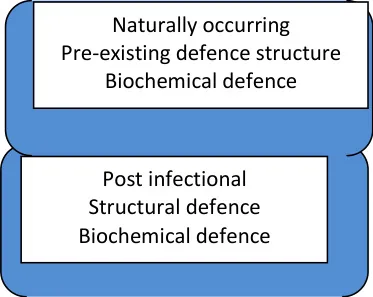
The first line of defence in plants is present in its surface. Several characters of the plants
surface function as barriers to penetration which pathogen must breach to enter the host. The
pathogens enter the plant host by penetrating the epidermis along with cuticle and cuticular wax
and number of natural openings existing before the onset of the pathogenesis can obstruct
penetration.
If the pathogen succeeds in penetration; it encounters pre-existing internal structural
barriers. The external and internal structural barriers existing before pathogen attack are also
called Pre-existing defence structures or passive/static or anit-infection structures.
Wax and cuticle
The cuticle covers the epidermal cells of plants and consists of pectin layer, a cutinized
layer and a wax layer. Cutin is composed of fatty acids. Waxes are mixture of long chain
aliphatic compounds which prevent the retention of water on plant surface essential for spore
germination. A negative charge usually develops on leaf surfaces due to fatty acids. This
condition repels air-bone spore / propogules. Only few pathogens are known to dissolve cutin
enzymatically. Examples: Monilinia fructicola penetrates cuticle of cherry leaves but not of
Gingko biloba leaves; the latter contains abundant cutin than the former. F. solani f sp . Pisi
produces the enzyme cutinase production by specific antibodies and inhibitors.
Epidermal layer
Epidermis is the first layer of living host cells that comes in contact with attacking
microbes. The toughness of epidermis is due to the polymers of cellulose, hemicelluloses, lignin
mineral substances, polymerized organic compounds, suberin etc. Potato tubers resistant to
Pythium debaryanum contain higher fibre. Silicon accumulation in epidemal walls provides
resistance against fungal attack. Suberization of epidermis confers protection against plant
Xanthomonas axonopodis pv. Citri because of broad cuticulat lips covering the stomata. A
functional defence mechanism has been observed in some varities (cv-Hope) in which stomato
open late in the day when moisture on leaf surface has dried and the infection tunes have become
non fuctional.
Hydathodes are natural openings on the edges of leaves and serve to excrete excess
water from the interior. They are easy entry pints of bacterial pathogens such as X.capestris pv.
capestis (black rot of cabbage), Similar to hydathodes are the nectarthodes in inflorescence of
many plants. They secrete sugary nectar and this serves as barrier to those organisms that cannot
tolerate this condition and thus, can enter through nectarines. Leaf hairs on leaves and on
nectarines also resist entry of pathogens. High hairlines of leaves and pods in chickpea is
resistant character against Ascpchyta rabei . Groundnut varieties showing resistance to
Cercospora leaf spots have thick epidemis-cum cuticle and compact paslisade layer, few and
smaller stomata and high frequency or trochomes on the abaxial surface of leaf.
Lenticles are opening in outer walls involved in gaseous exchange. They are weak
points in defence unless the cork cells within them are suberized. After suberizatoin and
periderm formation, lenticels are more resistant to invasion by pathogens.
Pre-existing biochemical defence
Plants liberate different chemicals, which interfere with activities of the pathogen and
pathogenesis, thereby preventing or reduce infection. These chemicals and the biochemical
conditions that develop may act either directly through toxic or lytic effect on the invader or
indirectly through stimulating antagonistic plant surface microflora. The compounds pre-existing
in plants as constitutive antibiotics and those, which are formed in response to wounds as
wounds antibiotics .
Release of anti-microbial compounds
Plants while growing and developing release gases as well as organic substances, from
leaves and roots (leaf and root exudates), containing sugars, amino acid, organic acids, enzymes,
glycoside etc. These materials have profound effect on the nature of surrounding environment,
particularly the phyllosphere, rhiizosphere microflora and fauna. Although these substances are
ideal nutrients for microbes and help in germination and growth of several saprophytes and
parasites number of inhibitory substances is also present in these exudates. Theses inhibitory
substances directly affect the microorganism, or encourage certain groups to dominate the
environment and function as antagonists of the pathogen.
Inhibitors present in the plant cells
In many host-parasite interactions, pre-existing toxic substances in the cells form the
basis of resistance. In resistant variety these substances life in abundance while in susceptible
variety they may be less or completely absent. Several phenollic compounds, tannins and some
fatty acid like compounds such as dienes pre-exisitg in high concentrations in cells have been
implicated for the resistance or young tissues to parasitic fungi such as Botrytis. Many such
compounds are potent inhibitors of many hydrolytic enzymes. Several other types of preformed
compounds such as saponins (glycosylaled steroidal or triterpenoid compound) tomatine in
tomato and avenacin in oats, have antifungal membranolytic activity. The fungal pathogens
which lack enzymes (saponinases) that breakdown the saponins are prevented from infecting the
host. Several preformed plant proteins have been reported to act as inhibitors of pathogen
proteinases or of hydrolytic enzymes. Similarly lactins (proteins that bind to certain sugars)
cause lyses and growth inhibition of many fungi. Plants surface cells also contain variable
amounts of hydrolytic enzyymes such as glucanases and chitinases, which may cause breakdown
of pathogen cell wall components.
Lack of essential factors
Recognition factors
The first step in infection process is the cell-to-cell communication between host and
pathogens. Plants of species or varieties may not be infected by pathogen if their surface cells
lack specific recognition factors. If the pathogen does not recognize the plant as one of its hosts it
may not adhere to the host surface or it may not produce infection substances such as enzymes,
or structures (appresoria, haustoria). These recognition molecules are of various types of
oligosaccharides and polysaccharides and glycoproteins.
Host receptors and sites for toxins
In many host parasite interactions the pathogen produces host specific toxins, which are
responsible for symptoms and disease development. The molecules of toxin are supposed to
attach to specific sensitive sites or receptors in the cell. Only the plants that have such sensitive
sites become diseased
Essential nutrients and growth factors
The fact that many facultative saprophytes and most of the obligate parasites are host
specific and sometimes are so specialized that they can grow and reproduce only on certain
varieties of those species suggests that for these pathogens the essential nutrients and growth
factors are available only in these hosts. Absence of these nutrients and stimulus make the other
varieties and species unsuitable hosts.
Defence mechanism: Induced or active
Plants have to face the wide variety of pathogens (enemies) standing at a place. Thus a
strategically designed pre-existing (structural and biochemical) defence mechanism in plants
exists. The real value of this system has not been critically examined. It appears that these pre
existing defence mechanisms help plants in warding-off most of microbes as nonpathogens. But
it does not seems t be sufficient.
The induced/active defence mechanism in plants may operate at different levels
- Biochemical defence

- Defence at cellular level

- Defences at tissue level
The activation or induction of defence mechanism may be both specific and non-specific type.
Several structural changes are known to be induced by a range of biotic or abiotic elicitors.
These dynamic defence mechanisms prevent further colonization or spread of pathogen. Active
defence in plants involves cellular defences that rely upon preformed surveillance systems are
encoded by resistance genes. The receptor-proteins are strategically located in cell membrane to
detect the pathogen or factor translocated by pathogens. The ability of plant to mount an active
defence response is again under genomic control.
Disease occurs when
-
Pre-exisiting defence mechanism are not enough to check the entry of pathogen
-
A pathogen avoids timely eliciting active defence system in plant tissue or habits active
defence response by secreting metabolic toxins.
Induced structural defence
Induced histological defence
Even after the establishment of infection in plant cells, the host defence system tries to
create barriers for further colonization of tissues. This may be at various levels.
Lignifications
Lignified cell wall provide effective barrier to hyphal penetration. They also act as
impermeable barrier for free movement of nutrient causing starvation of pathogen.
Following are examples.
Radish: Peronospora parasitica, Alternaria japonica
Potato: Phytophtora infestans
Wheat: Septoria nodorum
Cucumber: Cladosporium cucumerium, Colletorichum lagenarium
Carrot: Botrytis cineria
Suberization
In several plants the infected cells are surrounded by suberized cells. Thus, isolating
them from healthy tissue. Corky layer formation is a part of natural healing system of plants. eg.
common scab of potato and rot of sweet potato are good examples.
Abscission layers
It is a gap between host cell layers and devices for dropping –off older leaves and mature
fruits. Plant may use this for defence mechanism also. I.e. To drop-off infected or invaded plant
tissue or parts, along with pathogen. Shot holes in leaves of fruit trees is a common feature
Tyloses
The tyloses are formed by protrusion of xylem parachymatous cell walls, through pits,
into xylem vessels. The size and number of tyloses physically block the vessel. The tyloses are
inductively formed much ahead of infection, thus blocking the spread of pathogen. It suggests
biochemical elicitors and movement of tyloses inducing facto (TIF) up the stem. eg. Sweet
potato: Fusarium oxysporum f. sp. Batatas.
Gum deposition
The gums and vascular gels quickly accumulate and fill the intercellular spacis or within
the cell surroundings the infection thread and haustoria, which may starve or die.
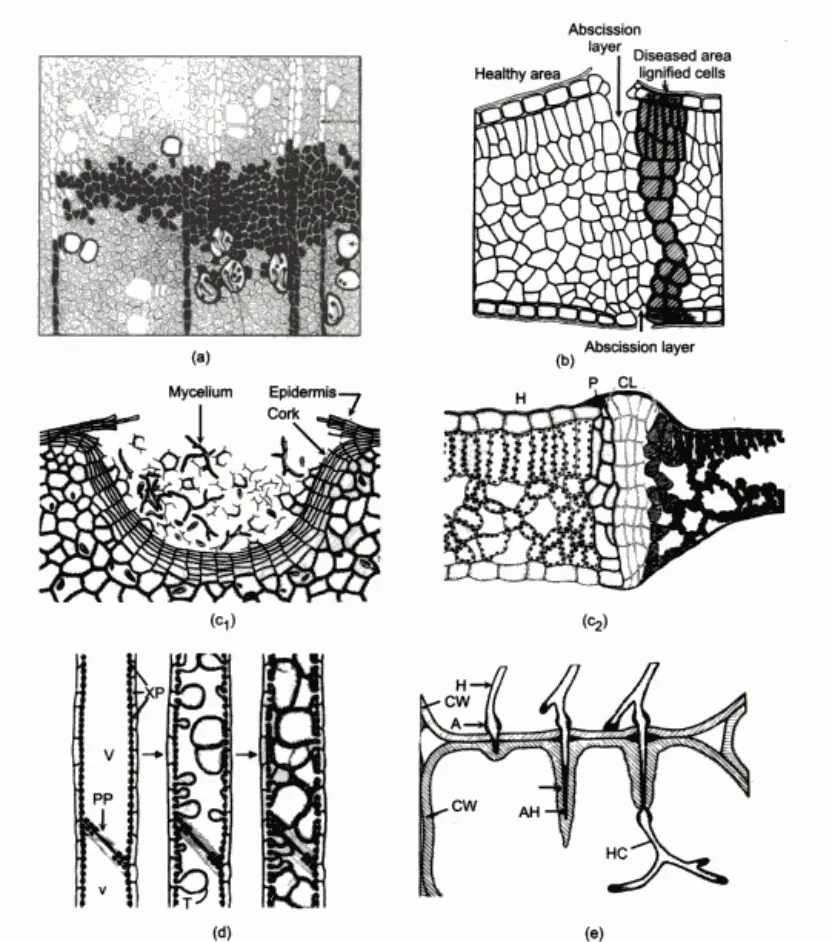
Mechanism of host resistance
a. Lignification b. Abscission layer formation. C1 & C2 Cork layer formation, d. Tyloses
formation and e. Sheathing of infection threads
Induced cellular defence
The cellular defence structures, ie. Changes in cell walls, have only a limited role in
defence. Following types are commonly observed.
-
Carhohydrate apposition (synthesis of secondary wall and papillae formation)
-
Callose deposition (hyphal sheathing just outside plasma lemma around the haustorium
which delays contact of pathogen (Phytophythora infestans) with host cells.
-
Structural proteins
-
Induced cytoplasmic defence that present last line of host defence and may effective
against slow growing pathogens, weak parasites or some symbiotic relationship.
Induced biochemical changes
The induced biochemical changes in host plants are the last line of host defence. This
may condition a plant or plant tissue from susceptible to resistant to immune status as per their
genetic potential. The role of bio chemical factor in host defence is based on the following four
attributes:
- The substance is associated with protection against disease at the site where protection
occurs.
-
The substance can be isolated from the host showing protection against the disease.
-
Introduction of isolated substance to the appropriate susceptible host confers protection.
-
The nature of protection so induced resembles that of the natural agents of a resistant
plant.
Toxic substances produced
Rapid production/suitable modifications and/or/ accumulation of chemicals toxic to
pathogen upto effective concentrations is an important component of overall active defence
strategy of plants. Slow production or accumulation or low levels of similar chemicals have
reported in susceptible host plants also.
Role of phenolic compounds
The phenolic compounds, viz., chlorogenic acid caffeic acid and ixidation products of
floretin, hydroquinone hydroxyquionones and phytoalexins are main toxi chemical produced to
inhibit pathogen or its activities. Some of these are performed toxic chemicals while others may
be de novo synthesized or modified to more toxic forms. The enzymes involved in chemical
pathways are present in host cell (pre-existing).
Role of phytoalexins
Most common response of plants to stress, biotic (phytoalexins/insects) or abiotic
(wounding), is the production and accumulation of substrates that can inhibit the growth and
activities of the biotic factors or may help in healing process. Muller and Borger proposed the
concept of phytoalexins in their study on hypersensitive reaction of potato to avirulent
P.infestans strains. Phytoalexins are antibiotics produced in plant pathogens interactions or as
result reposnse to injury or other psychological simulation.
Role of new protein synthesized
Post-infectional changes in host cells involve production and modification of large
number of proteins (structural and enzymatic), which have important role in defence
mechanism. The enzymes are required for various synthetic pathways (normal or modified) for
production of resistance related substances. In addition, phenol-oxidizing enzymes have vital
role. The influence of these changes may be confined to infection site or nearby cells.
Increased synthesis and activity of phenyl ammonia lyase (PAL) has been reported in several
bacterial and vital pathogens in resistant reaction. PAL plays key role in syntheses of phenols,
phytoalexins and lignin. The effectiveness of resistance depends on speed and amount of
synthesized products and their movements to neighboring healthy tissues to create defensive
barriers.
Inactivation of enzymes and toxins
The role played by chemical weapons (toxin and enzymes) of pathogens during
pathogenesis is well established. The necrotrophs and hemihiotrophs employ more of these
substances fro causing those tissue damage as compared to speacialized obligate parasites. The
defence strategy of resistant plants, through activity of phenols, tannins and protein as enzymes
inhibitors, the phenolics are not anti-fungal but make pathogen ineffective by neutralizing their
enzymes. In immature grape fruits catechol-tannin is known to inhibit enzymes produced by
Botrytis cinerea.
Toxins are known to be involved in pathogenesis to various edtents
(pathotoxins/vivotoxins). The resistance to toxins, in host, will be resistance to pathogens. This
can be achieved by detoxification or lack of receptor sites for these toxins
Role of altered biosynethetic pathway
The pose inflectional metabolism of host tissue is altered (stress physiology) to cope with
the advancing activities of pathogen. New enzymes (proteins) are produced in an effort to
synthesize defence related substances. Most of these compounds are formed through Shikmic
acid pathway and modified acetate pathway. Respiration in diseased tissue is invariably
increased; a part of glycolysis is replaced by pentose pathway, which yields four carbon
compounds are formed through Shikmic acid pathway and modified acetate pathway.
Respiration in diseased tissue is invariably increased; a part of glycolysis is replaced by pentose
pathway, which yields four carbon compounds. It is possible that in early stages of infection the
gene regulation of host cell is influenced and some specific genes.
Active defense to pathogens
Induction of host resistance, structural or biochemical seems to be universal I plants.
Active defense responses have been reported against all classes of pathogens (fungi, bacteria,
viruses and nematodes). Active defense response may lead to incompatible host-pathogen
interaction
Induced biochemical defense reactions
- On entry of the pathogen, a temporary increase in cellular metabolic activities occurs in the
host. Due to stress caused by increased metabolic activity cells die rapidly showing
hypersensitive reaction. Rapid death of cells in correlated with increased degree of resistance in
most diseased systems.
- When the infected tissue are reaching the nectotic stage, metabolism of neighboring tissues is
also increased and phenolics and other compounds are accumulated. In this process, the
synthesized compounds move from healthy to diseased tissues.
- The reactions expressed by hypersensitivity form common phenols, phytoalexins, and other
abnormal substances. The oxidized products of phenolics may detoxify the toxins or inactivate
other weapons of the pathogen.
- When spread of the pathogen is checked, the neighboring healthy tissues with accelerated
metabolic activities try to isolate the damaged parts by forming new tissues and eliminate the
disease/pathogen.
Host defence, pre-existing or induced, is a multi-component strategy where several factors work
together to fashion the final outcome. Figure below represents a case where more than on
factors are responsible to condition resistance in immature grapes berries against Botrytis
cinerea.
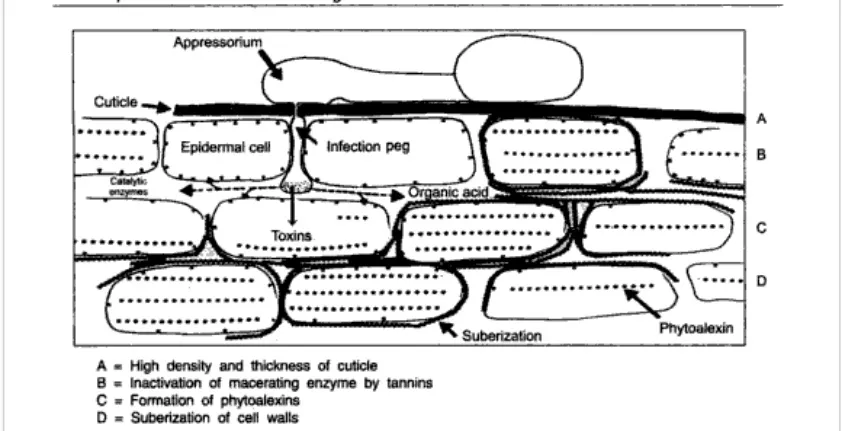
Multi component defense mechanism in young grapevine berries against Botrytis cincerea
Systemic acquired resistance
Induced resistance (cross protection) in plants is a phenomenon of significance, which
has not been properly exploited for plant disease management, probably because of our poor
understanding. Induced resistance,, localized or systemic, may be specific. The signal molecule,
that propagates the resistance to distant places are vital in systemic induced resistance. The
resistance is induced in manner comparable to immunization in mammals but the mechanism
differs.
The resistance may be induced due to any of the following:
Accumulation of PR proteins
Activation of lignin synthesis
Enhanced peroxidase actitivity
Suitable changes in plant metabolism
Principle of induced resistance
Induced resistance is a phenomena where a lead treated with certain chemicals or
inoculated with pathogen’s avirulent strain produce a signal compounds that is transported
systemically throughout the plant and activities its defence mechanism (making the entire plant
resistant to subsequent infection) without its own physical presence at the site. The picture
below explains a hypothetical mode to explain induction of SAR.
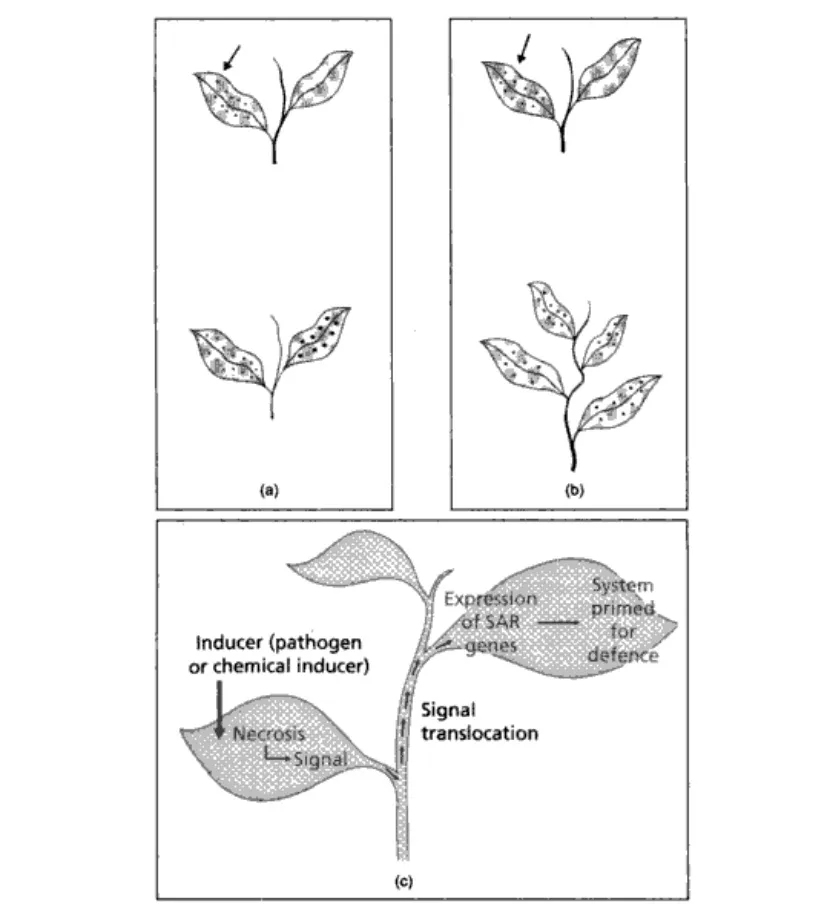
Representation of acquired resistance a) Local b) Systemic c) SAR
Summary Cheat Sheet
- Key points recap goes here.
References
1 source • [1]
References
Add source
Lesson Doubts
Ask questions, get expert answers