📈 Plant Disease Epidemiology
Disease spread patterns and the interaction of host, pathogen, environment, and time.
Plant disease epidemiology explains how host, pathogen, environment, and time interact to determine outbreak intensity and spread. This lesson focuses on endemic, epidemic, and pandemic patterns used in plant pathology problem solving.
environment and time factor
Edpidemiology or epiphytology is the study of the outbreak of disease, its course,
intensity, cause and effects and the various factors governing it. Based on the occurrence and
geographical distribution they are classified as follows:
Endemic or Enphytotic
When a disease is more or less constantly occurring year after year in a moderate to
severe form in a country or locality then it is called as endemic disease. eg: wart disease of
potato (Synchytrium endobioticum) is endemic in Darjeeling, citrus canker (Xanthomonas
axonopodis pv citri)in Asia and sorghum rust (Puccinia purpurea).
Epidemic or Epiphytotic
It is a sudden outbreak of a disease periodically over a widespread area in a devastatingly
severe form causing severe losses or complete destruction. This is constantly present in a locality
but it assumes severe form only on occasions. This is because of the occurrence of favorable
environment responsiblefor the rapid development of disease. eg: wheat stem rust (Puccinia
graminis tritici) and powdery mildew (Erysiphe graminis vor tritici), late blight of potato
(phytophthora infestans), red rot of sugar cane( Colletotrichum falcatum), downy mildew of
grapevine( Plasmophora viticola) and rice blast (Pyricularia oryzae).
Certain disease are endemic in one area and become epidemic in another area. Eg:
Citrus canker is endemic in Asia but epidemic in the introduced place, Florida (U.S.A).The
downy mildew of corn is a endemic disease in India but became epidemic in the Philippines.
Pandemic
When an epidemic disease spreads over continents or subcontinents and involves mass
mortality it is considered as pandemic. The outbreak of black stem rust of wheat in India during
1947 is best example for a pandemic disease.
Sporadic
Diseases which occur at irregular intervals over limited areas or locations are called
sporadic. They occur relatively in few instances. Eg: Fusarium wilt of cotton (Fusarium
oxysporum f sp. vasiinfectum) grain smut of sorghum (Sporisorium sorghi ) and loose smut of
wheat (Ustilago nuda).
An epidemic may cause widespread and mass destruction of crop in a short time or may
persist for long periods depending upon the three following factors responsible for the disease:
-
Host
-
Pathogen and
-
Environment
Environment flow chart
PATHOGEN ENVIRONMENT
Pathogen
A course of epidemic in nature differs with the nature of the host, the pathogen and the
environment. In arecanut the Koleroga fungus, Phytophthora arecae become destructive during
monsoon period (July-Sep) and wanes away with rising temperatures and dry conditions. The
above disease once again become destructive during rainy season. This type of epidemic is
known as seasonal epidemic or annual epidemic. Outbreak of Phytophthora wilt of betelvine
occurs during rainy season in South India. In temperate zone peach leaf curl and apple scab
follow the similar course.
Epidemics caused as a result of introduction of new pathogens in the locality hither to
free from them, appear in two phases viz., destructive phase and innocent phase (due to biologic
equilibrium reached between new comer pathogen and the original inhabitant). The well known
epidemics of late blight of potato in Europe and blast disease of rice in South East Asia, powdery
mildew and downy mildew of grapevine in Europe, leaf rust of coffee in Sri Lanka and
anthracnose of grapevine in India are examples of this category. In the above diseases the
pathogens after taking heavy toll of the crops have settled down.


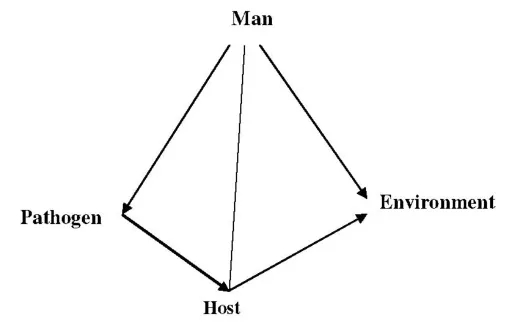
Factors governing epidemic or essential conditions for an epidemic
A disease is sometimes sporadic and assumes epidemic proportions under special
circumstances. The essential conditions for an epiphytotic or the factors governing epidemics can
be grouped under the three heads.
-
Nature of host
-
Nature of the pathogen and
-
Environment
An epidemic can only result from the cumulative effects of all the three factors
mentioned above, acting simultaneously. Few pathogens are capable of assuming epiphytotic
conditions while others are sporadic. The former group consists of late blight of potato, blast of
rice, downy mildew diseases and rust diseases.
| Host | Pathogen | Environment |
|---|---|---|
| Susceptibility of the host |
Introduction of a new pathogen |
Temperature |
| Aggregation and distribution of susceptible hosts |
Presence of aggressive strain of the pathogen |
Moisture and humidity |
| Introduction of new hosts |
High birth rate of the pathogen |
Rainfall |
| Introduction of | Low death rate of the pathogen | Light and |
| new collateral or alternate pathogen host |
Col2 | shade |
|---|---|---|
| Easy and rapid dispersal Wind of the pathogen Adaptability of the pathogen |
Wind |
A. Host Factors
Susceptibility of the host
Plants have ability to combat disease which manifests itself as susceptibility or resistance.
Plants are predisposed to the attack depending on their nature, environment and stage of growth.
Presence of susceptible varieties in an area may act as one of the causes of epidemic. For
example, late maturing varieties of groundnut are more susceptible to early leaf spot ( Cercospora
arachidicola ) and late leaf spot (Phaeoisariopsis) than the early maturing varieties. Similarly
late maturing varieties of wheat are susceptible to loose smut (Ustilago nuda tritici) than the
early maturing varieties. Early sown sugarcane varieties of sugarcane are more susceptible to leaf
rust in Deccan canals in Bombay area than the late sown varieties.
Wheat plant becomes susceptible to black rust (Puccinia graminis tritici) at the boot
stage but is resistant when young. Susceptibility of rice plants to blast disease (Pyricularia
oryzae) increases with application of heavy doses of nitrogenous fertilizers. Cottons plants are
susceptible to Fusarium wilt ( F.oxysporum f.sp. vasinfectum) at soil temperatures of 26 to 28°C,
brinjal to Verticillium wilt Verticillium dahliae at 20°C. But crop plants are resistant to these
soil-borne diseases at relatively lower or higher temperatures. Under the above conditions, the
pathogen multiplies faster, cause infection and effectively uses its propagules for quick
secondary spread causing epidemic.
Aggregation and distribution of susceptible hosts
Abundance of susceptible hosts in an area is one of the major causes of the spread of
epidemics. Continuous cultivation of susceptible variety or varieties in an area, that too in a large
contiguous area help in the build up of inoculum and improve the chances of epidemics. Under
the above conditions the pathogen increases the rate of multiplication of its propagules and
repeats the disease cycles in a short span. Wheat cultivation area in the U.S.A and Canada and
rice cultivation area in East Asian countries are exposed to a greater danger of epidemics by
wheat black rust and rice blast respectively.
Destructive epidemic of early and late leaf spots of groundnut in Bombay area (Gujarat
and Maharashtra States) during 1912-1913 was mainly the result of cultivation of local varieties
in a larger area. Panama wilt ( Fusarium oxysporum f.sp. v asinfectum ) susceptible table variety,
‘Son’ in banana was responsible for the destructive epidemic in parts of Bombay area (Gujarat
and Maharashtra) during 1936 – 1940 Countrywide cultivation of red rot ( Colletotrichum
falcatum ) susceptible sugarcane varieties (local varieties like Pundya, Khajuria etc.,) practically
made their cultivation impossible in Bombay area.
Introduction of new host (s)
Disease proneness in the host is induced by environment and other factors. The host is
liable to vigorous attack and successful infection by the pathogen. A resistant or moderately
resistant variety may become susceptible or highly susceptible. A susceptible variety may
become highly susceptible when conditions favouring proneness are existing and cause severe
damage. Under the above conditions the pathogen multiplies faster, cause infection and produces
more propagules for secondary spread. Introduction of an exotic cotton variety (C4 (Cambodia)
caused outbreak of bacterial blight ( Xanthomonas axonopodis pv . malvacearum) and grey
mildew (Septoacylindrium gossypii) in local variety, Deviraj, grown in Maharashtra area in
India.
Introduction of new collateral or alternate hosts
Alternate hosts are those plants on which the heteroecious pathogens pass part of their
life cycles. Similarly, collateral hosts are some wild plants in which the pathogen survives when
primary host is not available. Both alternate and collateral hosts are important in building up the
primary inoculum to the next crop. They determine the course and intensity of an epidemic.
Grass hosts (collateral hosts) of Sclerospora sacchari, S. philippinensis ( downy
mildews), Pyricularia oryzae ( rice blast), Ustilago scitaminea (sugarcane smut) may produce
abundant inoculum which aid in building up of epidemics. Outbreak of heteroecious blister rust
of pine (Cronartium ribicola ) in Europe and the U.S.A happened due to import or introduction
of Pinus strobus from the USA.
B. Pathogenic Factors
Introduction of new pathogen
Some pathogens, epidemic in certain area, may become quite aggressive and outbreak as
epidemic when introduced to new area. For example late blight of potato caused by
Phytophthora infestans was epidemic in South America. This disease became epidemic when the
infected tubers were introduced in Europe (in 1843-45). Fire blight ( Erwinia amylovora in North
America is endemic. Fire blight spread to Pacific coast fruit-growing areas of the U.S.A in 1884
and subsequently it reached Canada. It reached New Zealand in 1919 and it appeared in England
in 1957. The mode of introduction had been through fruit boxes. Coffee rust ( Hemileia vastatrix)
is indigenous in Ethiopia, where Coffea arabica is native. The disease spread to Sri Lanka in
1869, India in 1870, Sumatra in 1876, Java in 1878 and the Philippines in 1889. It also spread
from Kenya to the Congo by 1918 and reached the Cameroons. From 1950 onwards, it spread to
the reminder of West Africa.
The mode of long distance transport of H . vastatrix is wind. Spores have been trapped at
up to 1000 m above sea level up to 150 m from infected sites. Dutch elm diseases (Ceratocystis
ulmi ) first reported in 1919 in Holland, spread throughout Europe and reached Great Britain in
- It was introduced to the eastern United States on elm logs imported from Europe.
Presence of aggressive strain of the pathogen
All the strains of a pathogen are not aggressive. Only the aggressive strains are capable of
causing infectious diseases which spread as epidemic. They are characterised by rapid cycle of
infection and causing successful infection in new hosts. Rapid cycle of infection is essential for
successful infection and it happens only by aggressive strain of the pathogen. e.g., Puccinia
graminis tritici (wheat black rust) in India, stripe rust, bunt and loose smut of wheat in the
U.S.A. and Europe. The possibility of outbreak of epidemics increases with the number of
physiologic forms or pathogenic strains of the pathogen present in a locality.
High birth rate of the pathogen
Pathogen with high reproductive capacity and capable of rapid dissemination over wide
areas mostly cause epidemics. The fungal members causing powdery mildews, downy mildews,
rusts, blasts, blights etc., produce enormous amount of spores. These spores are easily dispersed
by using water or insects and cause infections to new plants. The high degree of fecundity and
the enormous amounts of inoculum produced by some common plant pathogens are given in
table.
Fecundity rates of plant pathogens
| Sl. No |
Pathogen | Extent of fecundity |
|---|---|---|
| Wheat stem rust_(Puccinia graminis_ tritici) |
Twenty five trillion uredospores in one hectare of wheat crops. |
|
| 2 | Wheat stem rust_(Puccinia graminis_ tritici ) |
64,000 million aeciospores from aecial cups in a single barberry bush |
| 3 | Cedar rust of apple | Two billion teliospores in a single gall. |
| 4. | A corn plant infected with downy mildew |
225 million sporangia in one night |
| 5. | A. grapevine infected by downy mildew |
32,000 sporangia per sq.cm |
| 6. | Bunt of wheat | 6 to 12 million smut spores in a single kernel |
| 7. | Smut of corn | 125,000 billion smut spores in one hectare |
| 8. | Chestnut blight | 150,000,000 spores in a single spore horn |
| 9. | Fomes applanatus | 5,460 billion spores in a single fruiting body |
Low death rate
Epiphytotics may also be caused by low death rate diseases. These diseases are caused by
agents of systemic nature which are protected by plant tissues. As they are protected by plant
tissues the chances of high mortality is reduced to the minimum. In these diseases the chief
source for accumulation of inoculum for epiphytotics is the diseased plant organ used for
vegetative propagation (corms, setts, tubers, etc,). Here the buildup of epidemics is
comparatively low compared to high birth rate diseases. When a particular area is planted and
covered with diseased planting material the chances of occurrence of epiphytotics are very high.
e.g., virus and phytoplasma diseases in crops propagated through vegetative plant parts.
Easy and rapid dispersal of the pathogen
The ability of the pathogen to cause epidemic depends both on the high birth rate and
dispersal. The propagules of the pathogen produced should be dispersed for development of an
epidemic. It may happen by external agencies like wind, water, insects, mites and nematodes.
Fungal spores / conidia are minute and light and resistant to adverse conditions. Fungal spores
are mostly disseminated by wind. Bacteria are mostly disseminated by water or insects. Virus
and phytoplasma diseases are mostly transmitted by insects, mites or nematodes. Epidemics are
determined by the velocity of wind, direction of wind, moisture, relative humidity, temperature,
presence and number of vectors and their rate of reproduction.
Adaptability of the pathogen
Pathogens have the capacity to adapt to adverse conditions. Fungi produce different types
of spores like oospores, ascospores and smut spores (chlamydospores) which help in tiding over
adverse conditions. Bacteria survive in diseased plant parts. Viruses and phytoplasmas live in
collateral hosts or insect vectors in the absence of the suitable crop hosts.
C. Environmental Factors
The environmental conditions such as temperature, relative humidity, rainfall, duration
and intensity of light, etc. play very important role in causing epidemics. These are actually the
deciding factors and influence almost all the stages of disease cycle. Favourable environmental
conditions are needed for sporulation, liberation of spores, dissemination of pathogen,
germination, infection and establishment of pathogen in the host.
For example, persistent optimum temperature and moisture are needed for spore
germination and entry of germ tube in the host. Similarly optimum temperature, moisture, light
and specific nutrition is required for the development of the disease and sporulation of pathogen.
Compound interest diseases and simple interest diseases The terms compound interest and
simple interest are for explaining rate of increase of pathogen. These terms were introduced by
Van der Plank in 1963 in the book ‘ Plant Diseases-Epidemics and Control’. Based on the mode
of multiplication of pathogen, the diseases are classified of two types:
-
Simple interest diseases
-
Compound interest diseases
Simple interest diseases
In simple interest diseases the increase is mathematically analogous to simple interest in
money. There is only one generation of the pathogen in the life of the crop. The primary
inoculum is seed-borne or soil-borne. The secondary infection rarely occurs during the crop
season. That is, the pathogens do not spread from plant to plant in one growing season. Simple
interest diseases are caused by seed-or soil-borne smuts, like loose smut of wheat, covered smut
of barley and soil borne fungi which attack roots, like wilt (Fusarium oxysporum) and root rot
(Rhizoctonia spp.) diseases.
Most of the smuts infect the seedlings, grow along with the growth of the plant and
produce spores in the inflorescence on maturity of the crop. There is no secondary spread from
the smutted heads. These smut diseases are mostly systemic in nature. They do not produce
propagules external to the host during the active season of the crop. Dispersal of propagules of
these fungi is restricted by existing climatic and biotic conditions.
Compound interest diseases
In compound interest diseases the rate of increase is mathematically analogous to
compound interest in money. The pathogen produces enormous amount of spores at a very rapid
rate. These spores are disseminated rapidly by wind and infect the other plants. Both the
inoculation and sporulation period are short so that the pathogen spreads from plant to plant
during the same growing season. New crop of spores is produced, disseminated and the cycle is
repeated fast. Thus more generations of the pathogen are produced in the life of a crop. e.g., late
blight of potato, powdery mildews and rust diseases. If we consider wheat stem rust caused by
Puccinia graminis tritici as an example, the fungus produces uredospores in very large numbers
(50,000 to 4,00,000 uredospores per uredosorus).
These spores are spread by wind and infect other plants. Each of the freshly infected
wheat plant produces uredopustules within 5 to 7 days at 24°C. Thus within a week of
appearance of the first pustule in the crop several thousand new pustules are formed which could
repeat the process within a week. If the climatic conditions of about 24°C temperature and
relative humidity remain for only few weeks, the entire crop is severely affected by the disease.
Course of epidemic
The course of epidemic follows two distinct phases viz.,
i. Progressively destructive phase and
ii. the decline phase
i. Progressively destructive phase
Some epidemics develop slowly (tardive) while others develop rapidly. Slow epidemics
(or epiphytotics) usually occur among population caused by systemic pathogens. The pathogen
multiplies slowly following the characters of simple interest disease. They belong to low death
rate category and have less incubation period and sporulation period. However, the rapid
epiphytotics are greatly influenced by environmental factors.
ii. Decline phase
During early stage, an epidemic spreads vigorously causing diseases in new hosts. After
development of a saturation stage it shows a decline by itself. No epidemics may be due to non
availability of suscepts non-availability of susceptible stages of the crop, unfavourable weather
conditions and reduction in aggressiveness of the pathogens. Generally the hosts are prone to the
disease at a specific developing stage. Once this stage is crossed in a plant it’s proneness to
infections is reduced or completely lost. Under the conditions the epidemic declines. The decline
in the epidemic may also be due to unfavourable weather conditions for disease development. As
a result future spread of the disease will be checked and the epidemic will decline. Wheat crop in
Northern India usually gets the attack of rusts in January to March.
Epidemics develop during these months. Although the plant remains prone to attack
afterwards also, further development of the disease is checked because of rise in temperature
which is favourable for the pathogen. Due to the above mentioned and other causes, the
aggressiveness of the pathogen may be reduced. When all susceptible individuals are destroyed
by the pathogen, it may try to parasitize the remaining resistant individuals of the same species.
In these adverse conditions, the pathogen may lose its power of successful infection, its
reproduction may slow down and the pathogen becomes less aggressive.
Slow and rapid epiphytotics
The form of epidemic is decided by the nature of the pathogen, host and the weather.
Epidemic may develop slowly and is called ‘ tardive’. Epidemic which develops rapidly is called
‘explosive’. In between these intermediate forms of epidemic may occur.
i. Slow epiphytotics
Slow epiphytotics occur among perennial (tree) populations. Infected host survives for
several years before dying. Most of the characters of a simple interest disease are found in slow
epiphytotics. The causal agent is mostly systemic. The pathogen multiplies slowly. Their
movement from plant to plant is much slower. They are low death rate pathogen. In slow
epiphytotics, crop sanitation is the best method. e.g., Swollen shoot of cocoa.
This disease spreads very slowly from tree to tree and still less from one garden to
another garden. For instance, the incidence of 31 % swollen shoot increased to 75 % over a
period of 2.5 years. As stated by Van der Plank (1959) the rate of multiplication of a systemic
disease of trees is about ten fold a year whereas it is 10,000 fold in respect of herbaceous plants
and it is of higher
rates for local lesion pathogens e.g., late blight of potato, wheat stem rust, etc.,
ii. Rapid epiphytotics
Rapid epiphytotics occur among annual crops. It is caused by non-systemic pathogens
with high birth rate. Several generations of the pathogen is produced within a short time. Rapid
epiphytotics are largely governed by environmental factors compared to slow epiphytotics.
Disease increase is rapid and the disease rises to a beak in short time and then show sharp decline
when the weather turns unfavourable or when the host becomes resistant due to maturity or due
to restricted dispersal of propagules of pathogen. e.g.,apple scab. This type of epiphytotic is
controlled by protective spraying or dusting with chemicals.
Summary Cheat Sheet
- Key points recap goes here.
References
1 source • [1]
References
Add source
Lesson Doubts
Ask questions, get expert answers